Build a Better Mousetrap Competition | |
FDOT Unveils New Diverging Diamond Interchange at I-4 and C.R. 532 | |
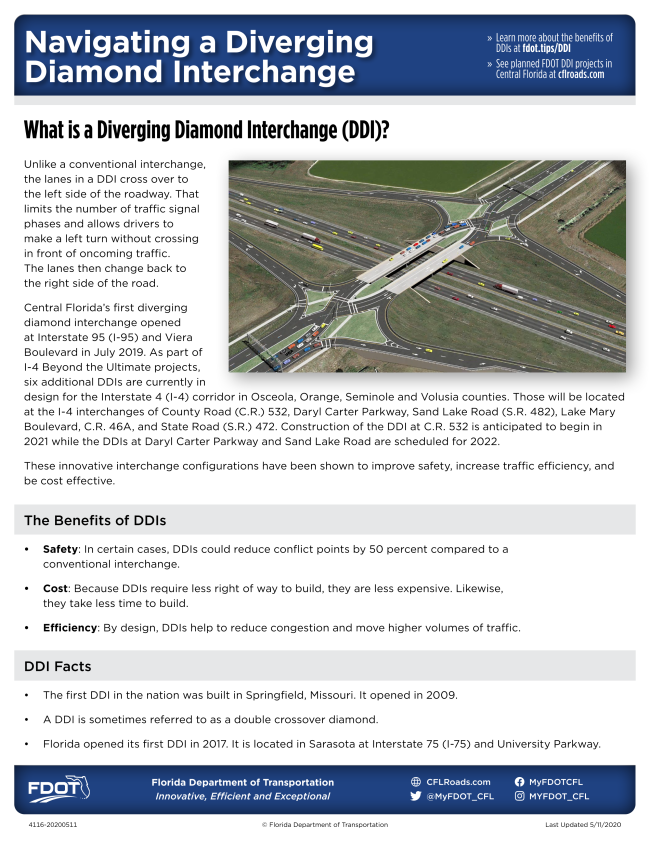
A Diverging Diamond Interchange (DDI), sometimes known as a double crossover diamond, is an innovative interchange configuration with many safety benefits. DDIs reduce conflict points — places where traffic either merges or intersects —from 18 to eight and reduce the severity of crashes when compared to a conventional interchange.
| |
A new DDI has recently opened at I-4 and County Road (C.R.) 532 in Osceola County and, while it brings with it all the safety benefits of a traditional DDI, additional technology features are being added to make the interchange even safer. These include:
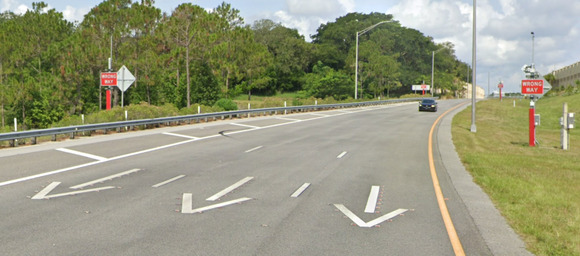
- Wrong Way Vehicle Detection System (WWVDS) – This technology produces an alarm when a vehicle is detected traveling in the wrong direction (see above photo). The detection system monitors all lanes, including shoulders.
- Closed-Circuit Television (CCTV) cameras – A series of cameras will provide constant video coverage of the intersection. These maneuverable cameras will provide traffic administrators with real-time video to identify incidents and ensure traffic is flowing smoothly.
- Advanced technology signalization with pedestrian and vehicle detection systems.
| |
FDOT is also implementing other safety features to enhance visibility and reduce confusion for drivers both approaching and already within the intersection.
- Thermoplastic pavement markings with glass beads to increase visibility.
- Wrong way arrows with reflective pavement markers (RPMs).
- Americans with Disabilities Act (ADA) compliant ramps with detectable warning surfaces.
- Streetlights.
- Guardrails.
- High-visibility crosswalks.
- Wrong-way signage.
- Signalized pedestrian crossings.
To further reduce severity of crashes within the interchange and allow motorists more time to smoothly navigate through the horizontal layout of the interchange, the speed limit was lowered from 35 mph to 25 mph. For more information on DDIs, visit i4beyond.com/DDI.
| |
FHWA EDC-7 Virtual Summit Recap | |
Every Day Counts (EDC) is a state-based model that identifies and rapidly deploys proven, yet underutilized innovations to improve safety for all users, shorten the project delivery process, create an equitable transportation system, and build sustainable and resilient infrastructure.
The summit is an integral component of the EDC model, bringing together transportation leaders and front-line professionals responsible for the development and delivery of highway projects. The EDC-7 summit was conducted virtually and included 2000 attendees from State DOTs, local agencies, federal land management agencies, tribes and industry to encourage creative thinking and celebrate a shared vision for new opportunities.
EDC is Innovation for a Nation on the Move. In this cycle, the seven initiatives feature strategies to improve safety for all users, build sustainable infrastructure for the future, and grow an inclusive workforce. The presentations, fact sheets, videos, virtual booths, and pdfs of homegrown innovations developed by the National State Transportation Innovation Council (STIC) Network are available on-demand to all registered participants through February 2024.
Learn More
| |
National Center for Rural Road Safety: Call for Presenters & Speakers | |
The National Center for Rural Road Safety is excited to announce that the 2023 National Summit on Rural Road Safety will be held September 12-14, 2023 in Oklahoma City, OK. The Summit will be in partnership with the National Association of Development Organization’s (NADO) National Regional Transportation Conference (NRTC). The theme is “Resources for Rurals: Equipping you to save lives” and they are currently seeking ideas for presentation topics and speakers.
The goal of the Rural Road Safety Summit is to provide rural transportation practitioners proven resources and noteworthy practices to make their roads safer. Suggested topics must support this purpose.
If you would like to present at the Summit, please submit your ideas no later than March 17, 2023.
Learn More
| |
Local Programs Training Resources Page | |
FDOT administers several grant funding programs for subrecipients more commonly known as “local agencies”. Local agencies have jurisdiction over a transportation facility and include but are limited to a municipality, county, expressway, or transportation authority, special district, or regional governmental unit. The Florida LTAP Local Programs page has information on recorded and upcoming trainings.
| |
This webinar is provided at no cost and will award a certificate of training listing Professional Development Hours (PDHs) or a certificate of completion verifying your attendance. | |
|
What is ACES?
-
Automated vehicles are self-driving or driverless vehicles that operate with little or no human intervention.
-
Connected vehicles are equipped with technology that allows them to communicate with other vehicles, infrastructure, other road users, and devices, enabling real-time data sharing and coordinated decision-making.
-
Electric vehicles are powered by electricity stored in batteries, rather than gasoline or diesel fuel, resulting in reduced emissions and improved environmental sustainability.
-
Shared vehicles are vehicles that are owned, maintained, and used by multiple users, rather than being owned by a single individual or organization. This can include car-sharing services, ride-sharing services, and other forms of shared mobility.
This webinar series is provided at no cost and will award a certificate of training listing Professional Development Hours (PDHs) or a certificate of completion verifying your attendance.
| |
National Work Zone Awareness Week | |
April 17 through April 21, 2023
A work zone, which can last from a few days to several years, involves workers, vehicles, trucks, and equipment that can necessitate lane closures, detours, and moving equipment. While work zone fatalities make up approximately three percent of overall fatalities and two percent of serious injuries, the safe and efficient flow of traffic through work zones is an ongoing priority for Florida’s transportation and traffic safety partners.
Learn the latest safety and mobility design concepts related to temporary traffic control (TTC) plans for work zones and identify the latest FDOT standards by watching the Advanced Work Zone Management and Design 4-part webinar series brought to you by FDOT through the Florida LTAP Center.
Learn More
| |
APWA Florida Chapter Public Works Expo | |
April 17 through April 21, 2023
The Florida Public Works Expo attracts hundreds of Public Works professionals from the State of Florida and the Southeast. Join the APWA Florida Chapter in Jacksonville and take time to network with your peers, boost your motivation, and gain powerful new tools for success!
You will also have the opportunity to attend a variety of technical sessions designed to sharpen your skills, maximize production and keep you on the cutting edge of emerging technologies and products.
This expo is not being hosted by the Florida LTAP Center. For details, please contact the event coordinator directly.
Learn More
| |
National Bike to School Day 2023 | |
May 3, 2023
The 26th annual National Bike & Roll to School Day is scheduled for May 3, 2023 but communities are welcome to celebrate any day in May that best fits their schedules.
Whether addressing the need to make routes to school safer for active trips or encouraging children to be more active, these events can be powerful tools to inspire lasting change. Of course, they are also fun!
The FDOT Safe Routes to School (SRTS) program provides opportunities for schools and communities to work together to help improve the safety of families walking and biking to school. Learn the steps for initiating a Walk & Bike to School Day, the planning involved, how to coordinate with schools and local partners, and the steps for carrying out an event in your community by watching the How to Plan a Walk and Bike to School Day webinar brought to you by FDOT through the Florida LTAP Center.
Learn More
| |
Low or No Emission and Grants for Buses and Bus Facilities Competitive Programs FY2023 Notice of Funding Opportunity | |
Now through April 13, 2023
The purpose of the Low-No Program is to support the transition of the nation’s transit fleet to the lowest polluting and most energy efficient transit vehicles. The Low-No Program provides funding to state and local governmental authorities for the purchase or lease of zero-emission and low-emission transit buses, including acquisition, construction, and leasing of required supporting facilities.
The purpose of the Buses and Bus Facilities Competitive Program is to assist in the financing of buses and bus facilities capital projects, including replacing, rehabilitating, purchasing or leasing buses or related equipment, and rehabilitating, purchasing, constructing or leasing bus-related facilities.
Learn More
| |
Florida Department of Economic Opportunity Announces More Than $247 Million in Funding for Broadband Infrastructure Expansion | |
Now through April 14, 2023
The program prioritizes unserved and underserved Florida communities in addition to communities with internet service speeds below symmetrical download and upload speeds of 100Mbps.
Eligible sub-recipients, including municipalities, county governments, non-profits, or private entities (such as Internet Service Providers), co-operatives, and electric utilities can find resources to prepare an application at www.FloridaJobs.org/Broadband.
Learn More
| |
|
Florida Local Technical Assistance Program (LTAP) Center
Center for Urban Transportation Research
University of South Florida
4202 East Fowler Ave., CUT100
Tampa, FL 33620-5375 USA
T: (813) 974-4450
FloridaLTAP@usf.edu
www.FloridaLTAP.org
| | | | |