|
|
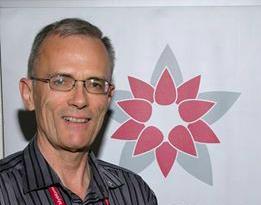
Spotlight on David McMullen
|
|
Patient, strong advocate, volunteer, and Support Group leader
|
|
Editor’s Note
: In celebration of our 15
th
Anniversary, the Spotlight section of Myeloma Matters has changed slightly. This year, our Spotlight Stars have been asked to share their stories alongside their relationship and involvement with Myeloma Canada. We hope you enjoy meeting our 2020 Spotlight Stars and that the new format provides you with information you didn’t know before. To all of you who have shared your stories in the past, and to hose of you who continue to do so today, we are indebted...you are an inspiration.
|
|
David, how did Myeloma Canada come into your life?
|
|
|
|
I was diagnosed with myeloma in January 2012, eight years ago. Like many patients, I had symptoms long before that. I was so fortunate that my family doctor recognized these symptoms as myeloma and gave me an urgent referral to the Cancer Centre in Hamilton. The hematology nurse there handed me the Myeloma Canada Patient Handbook. I took it home, studied it and saw that there were two support groups not far away, in Toronto and London (Ontario). Within three weeks I met both groups.
|
|
Later that year, I joined the Toronto group’s Steering Committee. The next year, after one of the Toronto group Co-chairs sadly passed away, I was asked to take the role. In 2014, I was asked to be the first Chair of the newly created Myeloma Canada Patient Advisory Council (PAC), a role in which I remained until the end of 2016. The PAC provides advice to the Board of Directors for Myeloma Canada and provides assistance to Myeloma Canada in many other ways.
|
|
How would you say myeloma has, or is, impacting your life?
Before my diagnosis, I experienced increasingly debilitating symptoms. I had three compression fractures, kidney damage, significant eye damage, anemia and frequent infections. Treatment including a stem cell transplant was very effective in curtailing the myeloma and these symptoms. Three years later, I relapsed and had a second stem cell transplant. I am now in a good second remission. So, has the disease impacted my life from a physical point of view? Yes, but not as much as it has for many other patients. I’ve been very fortunate. I generally feel well, and remain very hopeful about my future.
Another way myeloma has impacted my life is that I devote a fair bit of volunteer time to various myeloma-related activities, which has been very meaningful for me.
|
|
You’ve mentioned that Myeloma Canada has helped you through your myeloma journey. Can you share a bit more?
Myeloma Canada is a tremendous source of information and education, the best from a Canadian perspective. Myeloma Canada provides tremendous value through online and printed publications and information programs conducted throughout Canada. These include the annual National Conference, numerous Information Session meetings across the country, Meet and Greet events, webinars, excellent printed material, and an excellent website. The material they produce, such as the Patient Handbook, is excellent and a perfect source of information for newly diagnosed. There’s nothing better for the Canadian audience.
|
|
You’ve been involved with the Canadian myeloma community for many years now. How do you contribute to advancing the cause of those affected by myeloma?
On an individual basis, I hope that providing support and sharing my experiences with patients and caregivers helps them. At the same time, just being someone who listens is important. Patients and caregivers want to speak with other patients. I share the experiences in my journey with many individuals. I offer questions that they may choose to ask their doctors.
|
|
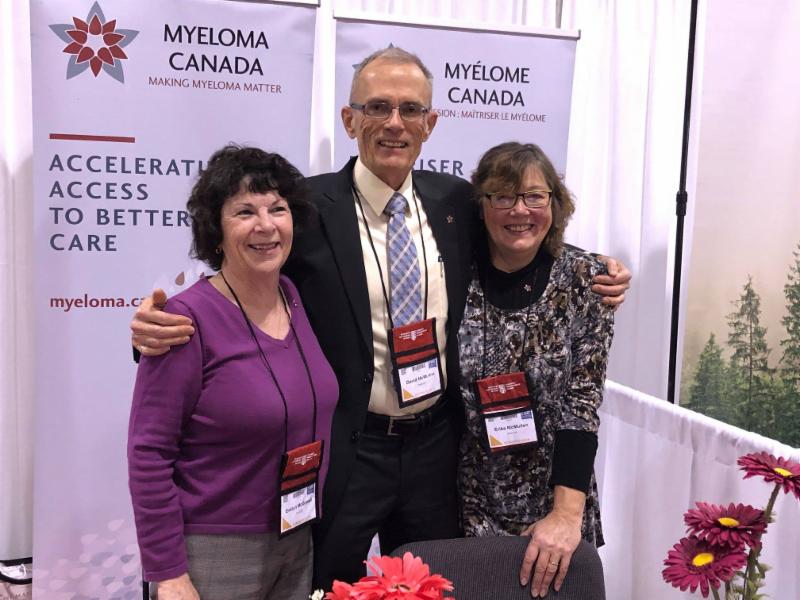
Family Medicine Forum 2018.
From left to right : Ev McDowell, David & Erika McMullen
|
|
I have been involved with five support groups. I’ve been a proud member of the groups in London and Halton-Peel for many years. We now have great new groups in Waterloo Region and Hamilton. I’m also directly involved with Myeloma Canada in numerous ways. In 2015, Aldo (Del Col, Co-founder of Myeloma Canada), recommended that I become a Patient Representative in the Canadian Cancer Trials Group, a national organization that conducts clinical trials for cancer, which I did. I’ve also been involved in some Myeloma Canada Research Network (MCRN) initiatives. I recently became a member of the CADTH (Canadian Agency for Drug and Technologies in Health) Patient and Community Advisory Committee.
|
|
Why do you feel Myeloma Canada is the best medium through which to advocate for those affected by myeloma?
On a broader scale, Myeloma Canada has the knowledge, the capabilities that as individuals we do not. Aldo was a great advocate. Martine is a great advocate; we are blessed to have her. She is so knowledgeable about drug treatment access. Through her previous career, she knows so many key people on a personal level and knows which doors to knock on. That’s a huge strength for Myeloma Canada.
|
|
What are some other things that Myeloma Canada does well that you’d like to share?
They provide support to patient and caregivers through a very extensive network of support groups across Canada. These have been most helpful for me. Myeloma Canada and the support groups have enabled me to meet countless other patients and caregivers; many are amazing people, and many have become friends.
Myeloma Canada has certainly also helped us by advocating for better treatments. Without Myeloma Canada, we would not have access to as many of the treatments we have now. Also, we have much improved research and access to clinical trials, and this encourages medical talent to come to Canada, or to stay here instead of going elsewhere, so we have the best of care.
Myeloma Canada also has strong awareness programs for the general public and the medical community to make them more aware of myeloma and its possible symptoms. Being aware of the symptoms can lead to an earlier myeloma diagnosis before major health damage occurs, which is so important.
All of these are invaluable.
|
|
If you had one wish for patients and their loves ones, what would it be?
We often talk about a cure. Until recently, that was a concept for the future. Now, there are some researchers who say we already do achieve a type of cure for some patients for whom myeloma has become more of a chronic disease. My wish would be for patients to live long and strong lives with better prospects in the future. Slowly we’re getting there, but there still is a ways to go. The last 20 or 30 years have seen a great deal of progress for myeloma patients. 30 years ago, if you had myeloma your prognosis was really quite grim; now it’s so much better.
|
|
Is there anything else you’d like to add?
In my view, the caregivers, like my dear wife Erika, are the real heroines and heroes. Patients often get the recognition and attention, but caregivers play a hugely important role and are often overlooked.
Thank you for your time and insights David, and all you do alongside Myeloma Canada.
Thank you!
|
|
|
Editor’s Note:
You can download the
Multiple Myeloma Patient Handbook
here
or for a free printed version, please call Myeloma Canada at 1-888-798-5771, or email us at
contact@myeloma.ca
.
For a full list of educational publications and videos, please visit
www.myeloma.ca
, “Resources”.
|
|
Follow us on social media for the most up-to-date information and resources:
|
|
|
|
|
|
|