|
--On September 27, Governor Gavin Newsom signed AB846 into law, which will limit rent increases for tenants in low-income housing tax credit (LIHTC) developments across California. The California Tax Credit Allocation Committee (CTCAC) has until June 30, 2025, to create regulations specifying how this limitation will be implemented.
--This new law builds on the existing CTCAC rules from April 3, which capped rent increases for developments receiving tax credits after that date or those planning to transfer ownership within the next five years. AB846 broadens this to include all LIHTC developments, regardless of when they received tax credits.
--CTCAC has not yet provided specific guidance on how or when this expanded rent limitation will be enforced, but it is expected that they will apply their current rent increase guidelines to all LIHTC properties.
How are the Limits Calculated?
The maximum increase in rent in a 12-month period for a LIHTC household in California is now the lesser of:
- 5% plus the percentage increase in cost of living, or
- 10% of the lowest rental rate charged for that household during the previous 12 months.
What does this mean for owners of LIHTC properties in California?
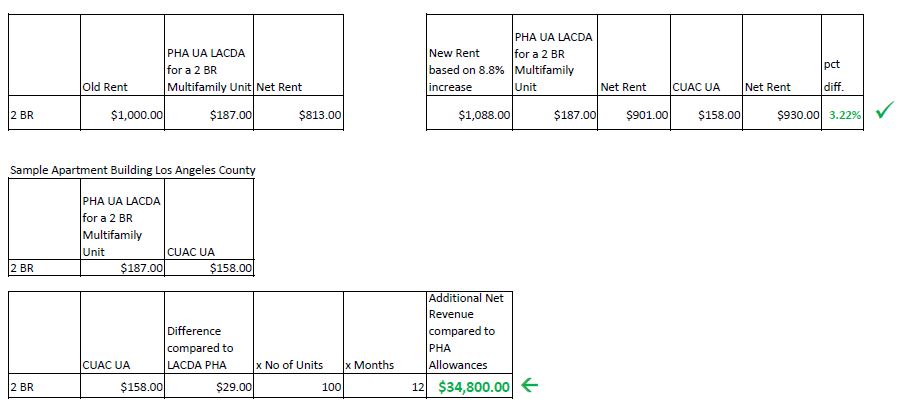
--Certainly this is not welcome news to owners of LIHTC assets in California. The 5% plus the percentage increase in cost of living will likely be the scenario that applies for the foreseeable future and is obviously more negatively impactful to owners than HUD’s 10% cap that was enacted last year. With that said, there could be recourse for owners in the form of the utility allowances at their respective properties. The sample scenario below illustrates this point. This is a LIHTC property in Los Angeles County. Under the new regulations, the max increase for Los Angeles this year would be 8.8%. If you had a tenant living in a two-bedroom home paying $1,000, you would be able to increase their rent to $1,088 (as long as the $1,088 is less than the LIHTC limit). In this hypothetical scenario, let’s assume this property has 100 units and has been using the LACDA Public Housing Authorities’ allowances. For simplicity’s sake let’s assume residents only pay for electricity. LACDA’s current utility allowance for a 2 Bedroom Apartment is $187. Many developers and management companies use this allowance not knowing that California allows other methodologies namely the IRS § 1.42-10 Utility allowances (E) Energy consumption model by using CUAC software to estimate how much tenants will pay for utilities. It's designed to be more accurate than the utility allowance schedules used by public housing authorities. In the scenario below, the new allowance using this tool for a 2 bedroom unit will be $158. You can see that the net rent percent increase will be 3.22% and below the 8.8% cap. That difference still equates to an additional $34,800 in rent the property can charge which is obviously not an insignificant amount.
|