Weekly Digest Number 32 - August 9th, 2022 |
|
Welcome to the RWU Rail & Labor News! This news bulletin is produced and emailed out each Tuesday morning. We hope you find each week's news and information useful. If so, please share with co-workers, friends, and colleagues. If you like, you can sign them up to get all the news from RWU HERE. Or forward them the link. Note: If you read over this news bulletin each week, you will be sure to never miss the important news of what is going on in the railroad world from a worker's perspective!
|
|
(Editor's Note: This might well be the first time in decades that the U.S. government is considering some minimal intervention to clip the rail industry's wings. Things have reached a point where politicians of all persuasions are more inclined to act.) |
|
Freight-Rail Shipping Law Proposed to Resolve Service Problems |
|
Members of U.S. House of Representatives transportation and agriculture subcommittees yesterday introduced the "Freight Rail Shipping Fair Market Act" that would reauthorize the Surface Transportation Board to regulate freight-rail service.
The bill was introduced to help address the inconsistent and unreliable freight-rail service that shippers and labor unions have reported this year to the STB, lawmakers said in a press release.
Specifically, the bill would:
• strengthen the STB's authority to address rail-service emergencies;
• require rail contracts to include service delivery standards and remedies, while leaving details to be privately negotiated between parties;
• provide the STB with clear direction to resolve common carrier-obligation complaints;
• create financial incentives for railroads and their customers to efficiently move rail cars;
• support freight railroad efforts to identify where freight is located on their systems while in transit; and
• adequately fund the STB to allow for quicker dispute resolution when petitioned.
The bill was introduced by U.S. Rep. Donald Payne Jr. (D-N.J.), chair of the Subcommittee on Railroads, Pipelines and Hazardous Materials; U.S. Rep. Peter DeFazio (D-Ore.), chair of the Committee on Transportation and Infrastructure; U.S. Rep. David Scott (D-Ga.), chair of the Committee on Agriculture; and U.S. Rep. Jim Costa (D-Calif.), chair of the Committee on Livestock and Foreign Agriculture.
"The freight rail companies have focused on profits instead of performance and it has led to delays and problems in how we transport commodities to farms, factories and stores across the country," said Payne, adding that the legislation would give the STB "the power to prohibit rail rate increases during a rail emergency and resolve rail emergencies when they occur."
|
|
(Editor's Note: This is by far the most comprehensive report to members since bargaining began in 2019. But the report that railroad workers now want to hear most is what the union leadership is doing to prepare for a strike, and ways that the rank & file should be getting ready for such an event. On this subject, the officials continue to be mute.) |
|
BLET, SMART-TD Presidents Update Members following PEB 250 |
|
Brothers and Sisters of our unions:
Presidential Emergency Board (“PEB” or “the Board”) 250 conducted hearings in Washington, D.C. this past week, concluding on July 28th. We both were honored to represent our unions and, by extension, the memberships of the dozen strong United Rail Unions as we presented and testified in support of our unified case to the PEB. We are sharing this joint message to ensure that our members are up to date on all of the bargaining round issues.
For the first time in history, the 12 United Rail Unions, representing 115,000 members in every craft in the industry, presented a unified case on wages, healthcare, sick leave and holidays to the Board. Also for the first time in history, BLET and SMART-TD Presidents made joint presentations on our unions’ proposals to eliminate carrier-imposed attendance policies, provide for voluntary rest days for road crews, and to increase away-from-home terminal meal allowances. In addition, BLET Director of Benefits Dan Cook, who also serves as the Cooperating Railway Labor Organizations’ Administrator, testified in support of the United Rail Unions’ unified Health and Welfare proposal and SMART-TD VP Brent Leonard testified in opposition to the crew consist issues that the carriers attempted to improperly raise in this proceeding.
|
|
(Editor's Note: This is a great development for rail labor. After endless hearings earlier this year - hearings where rail labor, shippers, and Class One carriers all agreed that a lack of workers was at the root cause of the crisis - the STB Chair has boldly stated the obvious: that there is not a "labor shortage" but rather a good jobs shortage. Pay these people what they are worth and you can end the staffing crisis!) |
|
STB Chairman Says Higher Pay Would Help Solve Railroad Crew Shortages
“There is a price that will get you enough workers. I don’t know what that price is. But everything has a price,” Martin J. Oberman says
|
|
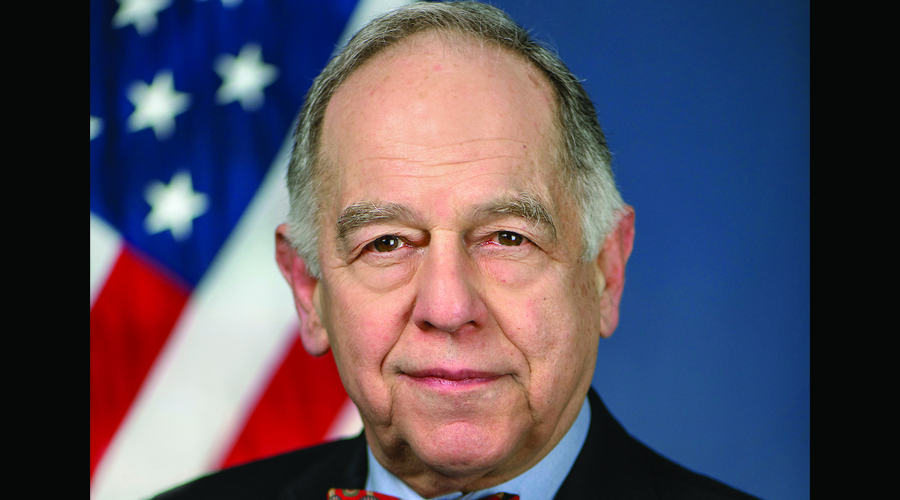
Surface Transportation Board Chairman Martin J. Oberman says railroad service is suffering for one simple reason: The big four U.S. Class I systems aren’t paying enough to retain and recruit train crews.
BNSF Railway, CSX Transportation, Norfolk Southern, and Union Pacific are experiencing ongoing crew shortages that since last year have caused widespread congestion and significant delays.
The railroads say the crew shortage is largely due to factors that are out of their control. Crews furloughed at the onset of the pandemic didn’t return to the railroad at the same rates as they typically had, and attrition rose due to the Great Resignation that accompanied the pandemic and has affected all businesses. Meanwhile, the historically tight labor market has made it difficult to hire conductors, an outdoor job with an unpredictable schedule and a significant amount of time spent away from home.
Surface Transportation Board Chairman Martin J. Oberman speaks during a hearing on reciprocal switching.
Oberman says he’s told each railroad CEO that “there is a price that will get you enough workers. I don’t know what that price is. But everything has a price.”
The railroads and the unions that represent most of their employees have been unable to reach a new contract after three years of fruitless negotiations. The two sides remain far apart, with railroads offering a 17% raise and the unions seeking a 31% increase. The contract dispute is now before a Presidential Emergency Board, which will make recommendations for a settlement.
In an interview last week, Oberman declined to comment on the negotiations process or the Presidential Emergency Board. But he says it’s clear that higher pay would help the railroads attract enough new workers to restore service to normal levels.
“If you need another 400 crews to move those trains that are sitting out there, pay whatever price you need to get them,” Oberman says. “Don’t come in and tell me it’s hard to hire. And it’s not like they can’t afford it. They’re paying out billions and billions every year in stock buybacks. You could use some of that to get the workforce you need.”
|
|
Tell President Biden: Railroad Workers Deserve Fair Pay and Time Off |
|
Given the record profits of the railroad industry, railroad worker unions are asking for a wage increase for workers, to maintain their current healthcare plan with a slight increase to vision and autism services, a national sick leave policy with 15 paid sick days per year, and an end to dangerous one-man shifts.
Workers currently get no sick leave and are on-call 7 days per week, year round. This is an opportunity for President Biden to uplift workers’ demands in the face of a greedy industry that is asking more and more of its workers without appropriate compensation.
Watch More Perfect Union’s exclusive reporting, then send a message to the president to help deliver historic wage increases and time off for thousands of railroad workers.
|
|
ATDA Members Overwhelmingly Vote To Strike |
|
The American Train Dispatchers Association (ATDA) members covered under the National Agreement were issued ballots to vote for or against a strike if a settlement was not reached under the provisions defined in the Railway Labor Act. Over 99% of our voting members cast their ballot in favor of a strike.
ATDA says in a statement that over 99% of those voting have approved a strike, citing “their frustration in waiting over three years without a raise and the railroads’ refusal to bargain in good faith, especially in light of their astronomical profits …” The most recent offer from railroads, the union claims, “would shift huge healthcare costs on our employees along with [providing] inadequate General Wage Increases that would be insufficient to combat the high inflation period that has caused financial hardship on each of our members.”
|
|
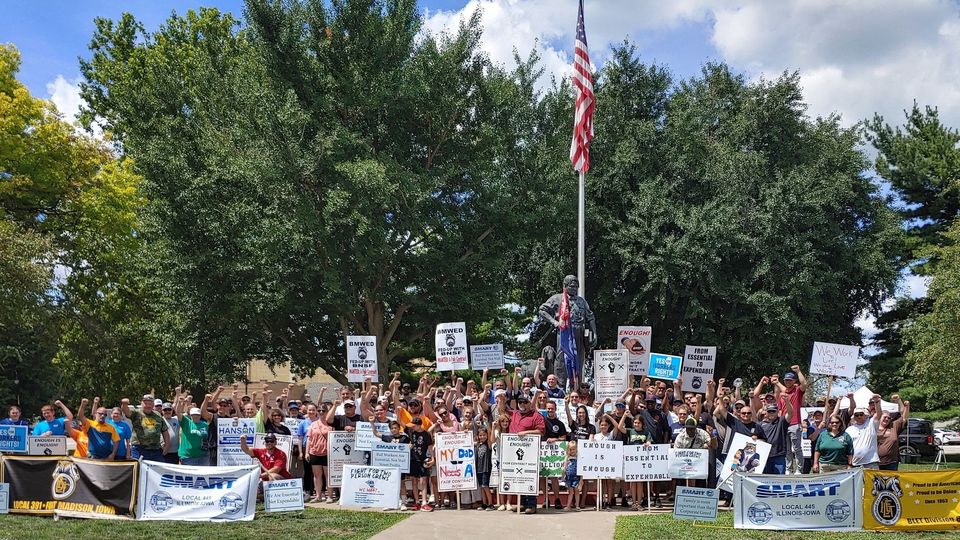
(Editor's Note: It is great to see workers conducting rallies at towns across the country. Perhaps the unions can call on ALL railroad union locals to get together and organize similar rallies at hundreds of terminals across the U.S. Maybe on the same day. Maybe on Labor Day?!!!) |
|
'We're Just Looking for a Fair Contract': Union Freight Workers Rally in Galesburg |
|
As frustration continues over long negotiations, workers, union representatives and supporters demand better working conditions. |
|
Another Homemade Video about the Rail Industry |
|
While you were being told to hide in your homes in 2020 ... 794 healthy firms received stealth bailouts by the Feds. The railroads were no different. The CARES Act allocated $25 billion to the SMCCF Program. It gave money to the Big Four as follows: UP Railroad binds $100 million taxpayer money; BNSF Railtoad binds, 106 million in taxpayer dollars; NS $52.5 million; CSX 85 million. The end result: Higher stock prices. More cheap money for stock buybacks. And yet they refuse to negotiate a raise to keep up with the inflation they helped to create. |
|
(Editor's Note: This fight continues to drag on. Ultimately, it is a fight about PSR, long trains, stock buybacks, and short-term profiteering. The Class Ones put all of these things above the needs and desires of passengers, shippers and the public.) |
|
Amtrak to STB: Gulf Coast Service Won’t 'Unreasonably' Impair Freight Service |
|
Amtrak late last week filed with the Surface Transportation Board a supplemental brief and evidence in the railroad’s quest to relaunch passenger-rail service along the Gulf Coast.
The STB on May 12 asked Amtrak to provide additional information about its proposal to begin serving the Gulf Coast between New Orleans and Mobile, Alabama, an area that has been without Amtrak service since Hurricane Katrina struck the region in 2005. CSX and Norfolk Southern Railway, which own the tracks on which Amtrak trains would operate, oppose Amtrak’s proposal unless the intercity passenger railroad makes significant infrastructure investments.
Amtrak has asked the STB to require CSX and NS to allow passenger trains to operate on the line. Alabama Port Authority officials also have said Amtrak’s return to the Gulf Coast would have a negative economic impact on Port of Mobile operations.
In its latest filing with the STB, Amtrak says that its additional evidence confirms that the Gulf Coast service does not "unreasonably impair" CSX's and NS's freight transportation and that the Class Is' infrastructure demands are unsupported. Their and the port’s predictions about what would happen if Amtrak offers two round-trip trains are "greatly exaggerated."
Amtrak also claims that Gulf Coast service can be restored without the level of capital investment that CSX, NS and the port are seeking, and that any impact from Amtrak service can be mitigated with routine operational changes and cooperative service planning.
To read Amtrak’s filing in its entirety, click here.
|
|
(Editor's Note: After coming to the brink of a systemwide strike last month, the carrier and union have agreed to a contract that the members could vote for.) |
|
Union Ratifies Three-Year Agreement with VIA Rail |
|
MONTREAL — Members of Canada’s Unifor union have ratified the contracts from last month’s tentative agreement between the union and VIA Rail Canada covering some 2,400 VIA worker. The union represents on-board personnel, maintenance workers, and those in VIA’s customer center and administrative offices.
The new agreements will be retroactive to Jan. 1, 2022, and run through Dec. 31, 2024. They include raises of 5.5% in 2022, 3.5% in 2023, and 2.5% in 2024.
“This round of bargaining presented a unique set of challenges; nonetheless, we were determined to make gains in wages and benefits and deal with matters of importance to our members,” Zoltan Czippel, president of Unifor Local 100, said in a press release.
The union says the agreement also includes enhanced benefits and improved contract language; VIA says it includes revisions to work rules and closer collaboration on issues of diversity and inclusion.
“We are delighted with the ratification of these mutually beneficial agreements which will provide stability for the next three years, as well as increased flexibility to actively pursue the recovery of our services and advance VIA Rail’s impo
|
|
"What If Rail Workers Struck?" A Talk with RWU Organizer Ron Kaminkow
In this segment of the "One Big Podcast", the hosts Jason and Deric - members of the Ypsilanti Industrial Workers of the World (IWW) - pose questions to RWU Organizer Ron Kaminkow about the state of rail labor, the prospects for a strike, what is happening with rail labor in the UK, how other workers and unions can get involved in supporting railroaders, and more.
|
|
Webinar: The Chicago Access Program
Aug 12, 2022 12:00 PM Central Time
|
|
Join us for a discussion about the Chicago Access Program, a group of high-impact projects that will increase capacity and improve reliability for trains entering and exiting Chicago. Amtrak is taking the lead on this program that will improve Chicago Union Station, create more routes into the city and will open up a variety of new service options. They have already applied for a Mega Grant and partnered with stakeholders who will help fund this $850 million project.
We will break down the projects included in the Chicago Access Program, explain why it will impact train service far beyond Chicago, and how it sets the stage for additional improvements to our national rail network.
|
|
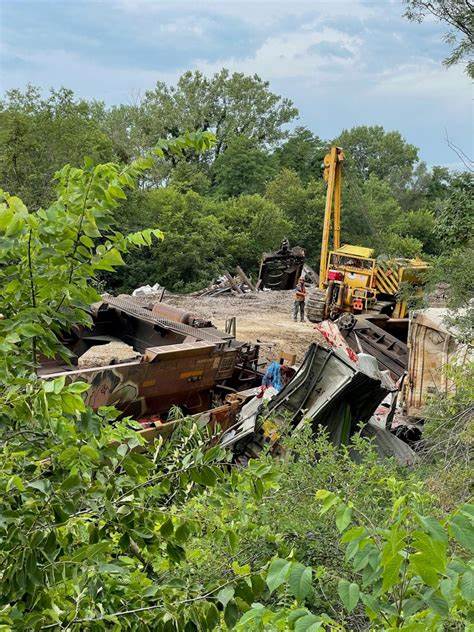
(Editor's Note: Just a few days after the rail labor rally in Galesburg - see article above - this major derailment tool place just east of where the rally was conducted.) |
|
BNSF Train Derails in East Galesburg, Illinois |
|
EAST GALESBURG, Ill. — Some 30 to 40 cars of an eastbound BNSF Railway train derailed Tuesday night, according to East Galesburg’s mayor, blocking both tracks on the Chillicothe Subdivision of the railroad’s Southern Transcon mainline.
The Galesburg Register-Mail reports the accident occurred about 9 p.m. Tuesday. Mayor Darrell Corbin said he was told no hazardous materials were involved. No injuries were reported. Photographs from the scene show damaged double-stack container cars were involved.
BNSF is investigating the cause, but Corbin said he was told a broken wheel might be involved. A BNSF advisory to shippers said the railroad did not yet have an estimate when tracks would be reopened.
|
|
(Editor's Note: The rail union leadership in the US could learn a little from this bloke. We are all pissed off here, just like in the UK. We are all disgusted, demoralized, degraded, and dejected, here just like there. The difference is that in the UK there is leadership and organization to fight back and win. In the immortal words of labor organizer and martyr Joe Hill, "Don't Waste Time in Mourning, Organize!") |
|
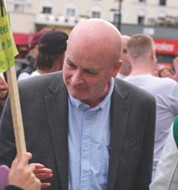
Mick Lynch: ‘It’s No Good Being Pissed Off – We Need Organisation |
|
INTERVIEW BY: Ronan Burtenshaw
An interview with Mick Lynch. Tribune sits down with the RMT's Mick Lynch to discuss the national rail strike, his viral television appearances – and how workers can come together to topple Britain's super-rich elite.
RB
A lot has happened since the rail strike kicked off in June, but I think it’s worth reminding people about why it started. Can you give us some background to the dispute?
MK
The background is Covid. As soon as Covid came around, the passenger numbers dropped because they asked people to stay at home. And they came to us, the government and the companies, saying the industry’s got to change. They wanted to use this as a once-in-a-generation opportunity to cut costs and get the working practice changes that they’ve been after for years. So that’s exactly what they’ve been pursuing.
It’s been delayed from summer 2020 because the train operating companies collapsed. Since that time, they’ve been working out emergency measures and passenger service contracts. The government has been stuffing their mouths full of gold, in effect, and saying:
We will take all the risk out of your business. You won’t have to put any capital at risk. Your returns will be lower but it’ll be guaranteed.
They’ve got this model now that the companies get a royalty, essentially, of all the costs of the business. Until they did that, the companies themselves — FirstGroup, Go-Ahead, Abellio, and so on — wouldn’t move against workers because they knew it would cause industrial action. That’s the background, it’s a generalised cost-cutting.
|
|
|
|
|
|
|