Rail & Labor News from RWU
| | Weekly Digest Number 34 - August 25, 2026 | | Welcome to the RWU Rail & Labor News! This news bulletin is produced and emailed out each Tuesday morning. We hope you find each week's news and information useful. If so, please share with co-workers, friends, and colleagues. If you like, you can sign them up to get all the news from RWU HERE. Or forward them the link. Got a hot tip? Please forward the article and a link to raillabornews@gmail.com. Note: If you read over this news bulletin each week, you will be sure to never miss the important news of what is going on in the railroad world from a worker's perspective! | | THIS WEEK'S RAIL AND LABOR NEWS | | Editor's Note: For nearly three months, 300 signal workers withheld their labor from CPKC, and when the company placed its terms before them, nearly nine in ten answered no. Yet they now return to work while others decide the conditions under which their labor will be sold. The railroad owns the property and commands the treasury, but not a wheel turns, a signal clears or a dollar is earned until working people put their hands to it. Capital has money, lawyers and time; the worker has only their labor and the strength of those willing to stand beside him. That is why solidarity has never been charity among workers; it is their defense against a power that has never surrendered anything willingly. | |
|
Trains Magazine / August 22nd
Alberta — Members of the International Brotherhood of Electrical Workers in Canada will return to work at CPKC on Monday, Aug. 24, after agreeing to binding arbitration to end the strike that began May 31.
CPKC announced the agreement on Friday, Aug. 21.
IBEW’s Canadian Signals and Communications Council No. 11 represents about 300 CPKC workers across Canada. Its members had rejected CPKC’s most recent offer just a week earlier [see “IBEW votes down offer …,” Trains.com, Aug. 16, 2026].
The union had said at the beginning of the strike that the railroad had “failed to meaningfully address the issues affecting recruitment, retention, compensation, and work-life balance” for its members. The railroad responded by saying the IBEW had made “unreasonable, unrealistic demands far beyond the wage and benefit increases received by our other railroaders.”
| |
| Editor's Note: Once again, Virginia appears to be leading the nation in the advancement of passenger rail. Hopefully the state will blaze a trail for others wishing to revive passenger train networks. | |
Railway Age / August 18th
The Federal Railroad Administration (FRA) is providing grant funding thought the National Railroad Partnership Program (NRPP) for station upgrades and equipment acquisition that will support Virginia passenger rail service.
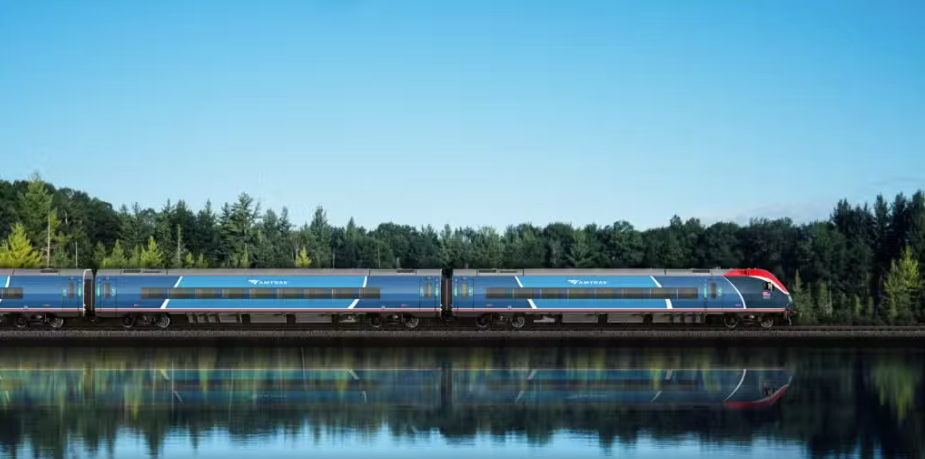
The Virginia Passenger Rail Authority (VPRA) on Aug. 17 reported that the NRPP grants will benefit the Staunton Station, as well as enable Amtrak to purchase more Airo trainsets from Siemens.
The historic Staunton station, built in the 19th century, will receive up to $15,566,400 for repairs and upgrades to its platform and canopy. The goal of the project, VPRA said, is to return the platform area to a state of good repair, as well as make improvements to meet ADA design standards. Planned repairs include rehabilitation of the platform and a new canopy to replace the existing structure. The investment will benefit riders who use the station to travel on Amtrak’s Cardinal service between New York City and Chicago.
| | Editor's Note: While the railroad ridge in question may in fact be safe - for now - thousands of bridges just like it, quilt more than a hundred years ago, will all need to be rebuilt or replaced in the coming decades. Expect the privately held rail industry - which largely self-regulates - to push these massive expenditures off into the future as far as possible, suffer a number of catastrophic failures, then come begging hat in hand for government money to replace these aging structures. | | CBS Pittsburgh / August 17th |
| Editor's Note: Great to see Amtrak get funding to eliminate dangerous rail crossings and re-equip its fleet of regional trains and locomotives from coast to coast. Next up: re-equipping the worn-out long distance fleet. Our hope is that the new equipment will not just enable Amtrak to continue running its existing routes, but to add new routes and additional frequencies. The demand is there! | |
Progressive Railroading / August 17th
The Federal Railroad Administration (FRA) on Aug. 14 announced $5.3 billion in federal grant funding to purchase new Amtrak trainsets, overhaul Amtrak locomotives and improve grade crossings throughout the country.
The grants are awarded through the FRA's National Railroad Partnership Program (NRPP). About $2 billion of the total grant package comprises funds previously awarded to the California High-Speed Rail Authority. The FRA terminated $4 billion in grant funding for the high-speed rail project in July 2025.
Amtrak will receive $2.05 billion to acquire 43 new trainsets made in the United States to replace its aging fleet and another $140 million to overhaul 41 locomotives currently serving Amtrak's Midwest and Pacific Routes, FRA officials said in a press release.
| | Editor's Note: Maryland has become the fourteenth state to require two-person freight crews, overriding its governor to do it. The railroad corporations have spent generations discovering that every worker can be called unnecessary when removing that worker adds another dollar to the ledger. They will call two-person crews obsolete, inefficient and burdensome, because capital has always found elegant words for eliminating labor. But no railroad was built, maintained or moved by a balance sheet, and no community endangered by a derailment has ever been rescued by one. Maryland has drawn its line.. progress in railroading will not be measured by how many workers can be removed from the cab. | |
|
Trains Magazine / August 10th
Maryland has joined the list of states requiring two-person crews for freight trains after the legislature last week overrode a veto by Gov. Wes Moore.
The action in Maryland follows signing of a similar bill by Rhode Island Gov. Dan McKee in late July. Fourteen states now have two-person crew laws.
Maryland’s HB 862 was one of two vetoes overridden by legislators during a two-day special session that concluded Aug. 4. The override passed by a 99-30 margin in the House and 33-11 in the Senate, the news site Maryland Matters reports.
The FRA adopted a two-person crew law in 2024, but efforts to repeal it have twice been introduced in the U.S. House of Representatives [see “Missouri Congressman again seeks …,” Trains.com, Sept. 8, 2025]. Supporters of the bill characterized it as a backstop against a change to the federal regulation.
| |
| Editor's Note: Union Pacific collected $91.1 million more in fuel surcharges than it spent on fuel in the second quarter, and the excess flowed straight into profit. Workers are told there is never enough money for crews, never enough room in the budget, never enough justification to preserve a job, yet somehow there is always room for another dollar to be taken from the public and carried upward. This is the old arrangement in its modern form.. labor creates the wealth, customers supply the revenue, and those at the top claim the surplus as though they alone produced it. A corporation that demands sacrifice from everyone beneath it while practicing none itself has forfeited the right to lecture anyone about efficiency. The problem is not that the railroad lacks money; it is who the railroad believes that money belongs to. | |
|
Reuters via AOL / August 18th
U.S. railroad Union Pacific collected $91.1 million more in fuel surcharges than it paid for fuel during the second quarter, far outpacing rivals, according to a company filing with the Surface Transportation Board and first reported by Reuters.
Those excess surcharges boosted Union Pacific's profit, underlining criticism from some shippers that surcharges meant to recoup rising petroleum costs due to the U.S. and Israeli war on Iran are sometimes excessive.
Railroads are the only U.S. transportation companies that report both fuel costs and fuel surcharge revenue to regulators, offering rare insight into how surcharges can improve company profits.
| |
| Editor's Note: The machinery of consolidation is moving again, and once more working people are expected to stand quietly while men in boardrooms decide the fate of thousands who will never be invited into them. Union Pacific and Norfolk Southern call their $85 billion union progress, but workers have learned what that word means when spoken by concentrated capital.. fewer hands doing more work so that greater wealth may flow into fewer hands. They will speak of efficiency, competition and public benefit, because exploitation has always preferred respectable language. But these railroads were built, maintained and moved by generations of workers, and their livelihoods are not corporate waste to be trimmed from a balance sheet. If this nation’s railroads exist only to enrich those who own them, then the public has surrendered far more than a railroad merger. | |
|
Trains Magazine / August 18th
The Surface Transportation Board today adopted a schedule for review of the Union Pacific-Norfolk Southern revised merger filing, removing a hold it placed on the proceeding in May.
But the board’s decision did not address the merits of the application or any of the comments filed since UP and NS submitted their 412-page supplemental filing on July 27.
The review schedule would push a final decision on the $85 billion deal well into the second half of 2027.
“In this decision, the Board removes the proceedings from abeyance, adopts a procedural schedule, directs Applicants to resubmit certain workpapers with unfiltered data, rules on a pending procedural request, and advises that the Board will address other outstanding motions at a future date,” the decision said.
| |
| Editor's Note: In "solving " their "profit problem," the Class Ones created their "growth problem." Closing hump yards, ripping out double track, cuts to crew staffing, maintenance and inspection, rotten customer service, unreliable delivery times, and literally driving traffic off the rails and onto the highways are part and parcel of the carriers "solution" to their profit problem. Unless and until the rail industry can free itself from the short-term profit-driven mandate of Wall Street hedge funds and financiers, the growth problem will not be solved. It is time for Public Ownership of the Railroads. | |
Trains Magazine / August 11th
Why would a shipper want to use rail? It should be pretty simple: lower cost per ton-mile, fuel efficiency, more volume per carload, etc. Although the benefits are there, railroads have not participated proportionally in economic growth over the last decade. Instead of growing their way into profitability, they shrank.
For decades, the rail industry focused on solving a profitability problem. By most financial measures, it succeeded. Operating ratios improved, networks became leaner, and railroads finally earned their cost of capital. But many of the strategies that improved profitability also constrained growth, creating consequences not easily reversed.
From 2013 through end-of-year 2024, the U.S. economy grew over 30% in real terms. Real GDP rose from approximately $17.8 trillion in 2013 to approximately $23.9 trillion by the end of 2024. Over that same time period, total rail traffic declined by 8%. In 2013, U.S. rail traffic was approximately 27.4 million units (~14.6 million carloads + ~12.8 million intermodal); by 2024, that total had fallen to 25.18 million units (~11.34 million carloads + 13.84 million intermodal units).
| | Editor's Note: As Amtrak's fleet of aging equipment continues to be replaced, the carrier will continue to attract new and return riders, as speeds, frequencies and comfort increase, and breakdowns, sold-out trains and delays decrease. Despite political opposition in Washington, look for Amtrak to succeed in the coming years, accompanied by job growth in train and engine service, on-board staffing and in other crafts. | |
Grist / August 19th
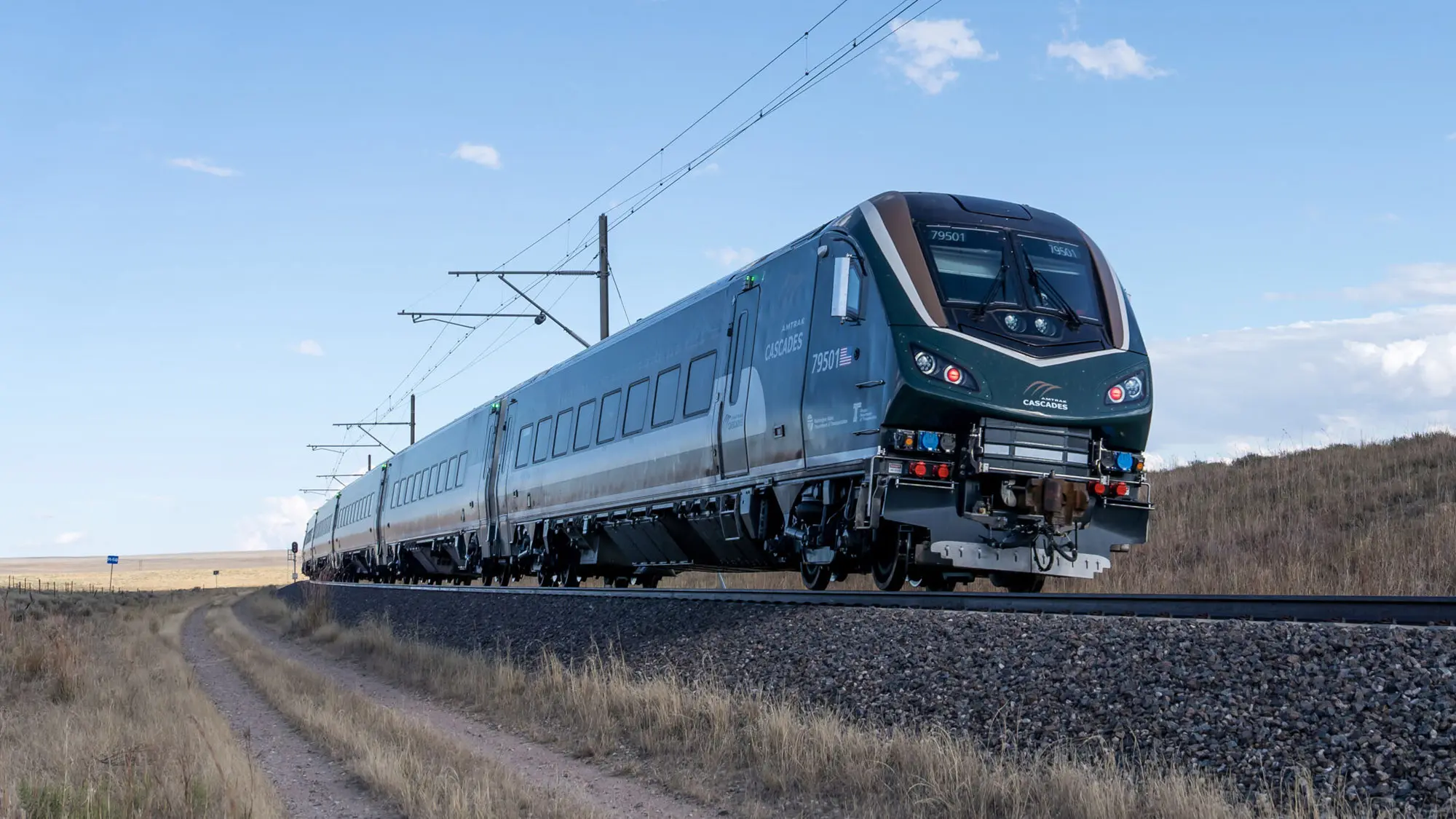
On Charlie Hamilton’s regular Amtrak rides from Seattle to Portland, Oregon, and Vancouver, British Columbia, he passes some of the country’s most spectacular vistas: the Puget Sound coast and the Skagit Valley. On clear days, he can even see Mount Rainier. But perhaps the most beautiful sight is not the natural wonders of the Pacific Northwest. It’s the cars and trucks inching along the highway.
“It’s nice to be able to be going along there and going faster than what people on Interstate 5 are doing. We kind of like that bit,” said Hamilton, who leads the train advocacy organization All Aboard Washington.
Indeed, riding the train in the Pacific Northwest can take about as long as driving. The trip between Seattle and Portland takes about 3 hours and 30 minutes by either mode, even though the train makes six stops along the way.
| | Editor's Note: It took 20 years for this service to be restored following the washout due to the hurricane. Why? Largely because the Class One railroads stonewalled at every turn, claiming that it would cost as much as $1.2 billion to enable passenger operations! Thanks to an STB that was adamant about this service returning, last year we finally witnessed the initial runs of the Mardi Gras trains. And as predicted, the pent up demand was there, the trains - like most all new train services these days - is a resounding success, surpassing all expectations in ridership. | |
Progressive Railroading / August 19th
Amtrak's Mardi Gras service marked its first anniversary of service on Aug. 18 with strong ridership numbers; the twice-daily service between New Orleans and Mobile, Alabama, logged 150,000 customer trips in its first year, Amtrak officials reported in a press release.
When the route opened in 2025, it was the first time in 20 years that Amtrak had been able to serve that area of the Gulf Coast.
“This route has exceeded every expectation for ridership and revenue,” said Amtrak Executive Vice President Jennifer Mitchell. “The trains are consistently at the top of all services in customer satisfaction scores, due to great work by Amtrak train, engine, on-board and maintenance teams.”
| | Editor's Note: Norfolk Southern, the EPA and the powers that be continue to downplay the effects of the disastrous train wreck in February 2023 in the small eastern Ohio town of East Palestine, despite scientific finding to the contrary. | |
CBS News / August 20th
More than three years later, we're beginning to learn about the health impacts of the Norfolk Southern train derailment in East Palestine, Ohio, with studies confirming people were in fact exposed to those toxic chemicals released into the air, water, and soil.
Misti Allison lived a mile away from the site when it happened in February 2023, and she still lives in the area. Already, she said people are feeling the long-term effects.
"We know that there are some people that are getting sick, and it's very scary," Allison said. "People in the community just want to know if their families are safe in the long term."
| | Editor's Note: Great to see the majority of rail labor come out in opposition to the proposed merger, but tragic that we could not all speak with one voice. Sadly, that is the nature of the antiquated and outdated system of craft unionism that we are saddled with. At least this time the two Teamster affiliates - BLET and BMWED - have stopped waring with one another after a decades' long feud. This time SMART is fractured, with the Transportation Division in favor and the Mechanical Division opposed. It is time we stopped fighting the powerful carriers with one hand tied behind our backs and form a single and powerful railroad workers union! Here is the RWU flyer about coordinated bargaining of all rail unions. | |
Trains Magazine / August 19th
A coalition of rail unions has told the Surface Transportation Board that they support motions asking the board to summarily deny or reject the Union Pacific-Norfolk Southern merger application.
BNSF Railway, CSX, and a group of five shippers’ organizations filed those motions earlier this month, arguing that UP and NS had not made the prima facie, or first-look, argument that the merger was in the public interest [see “Railroads, shipper organizations ask …,” Trains.com, Aug. 7, 2026].
In their filing today (Aug. 19), the unions said they “will not belabor the record with duplication of citations, authorities, and arguments set forth ably and in detail by the Movants.” But they specifically took aim at the requirements that an application must show that the merger is in the public interest; that it will enhance rail competition; that it must address the potential downstream effects, such as further mergers; and that it must include a detailed Service Assurance Plan to address possible disruptions during the period when operations are being unified.
| | NEWS FROM AROUND THE LABOR MOVEMENT | | Each week, RWU includes a few articles about advances and developments in the larger labor movement that are of interest to railroad workers. Got an artcile to submit for possible inclusion next week? Email it along to raillabornews@gmail.com. Thank you! | | Editor's Note: Central Labor Councils have great potential to build union power across a specific geographical area. All to often they simply function as "feel good" organizations, engage in charity work, and adjuncts to the Democratic Party. At their best, they unite area labor and community organizations, take the lead on progressive causes, elect working class people to office, engage in strike support, are at the forefront of mass demonstrations and take the leadership in a community's fight for justice. | |
Convergence / August 13th
I’d been to Music City Center in Nashville before, but this day was different. I sat with colleagues and ran into other people I knew from the progressive movement, but we had not convened to discuss organizing strategies or hear from a candidate. We were there to mourn the loss of a grand force in not only Nashville, but all of Southern labor: Vonda McDaniel.
McDaniel’s presence loomed large all throughout the center’s 2.1 million square feet, literally and figuratively. Photos of her adorned the monitors across the building, and she had served as vice-chair of the Music City Center board, ensuring that organized labor had a seat at the table of Nashville’s largest convention center. Charles Starks, president of Music City Center, called it “the house that Vonda built.”
Hundreds of people had gathered from across the country on July 8 to pay their respects to McDaniel, who at the time of her death was transitioning from her role as president of the Nashville and Middle Tennessee Central Labor Council (CLC) to co-executive director of the prestigious Highlander Center.
| | Editor's Note: While RWU refrains from candidate endorsements, and has called for an end to the corporate controlled two-party monopoly in the U.S., it is worth commenting upon a political movement that appears to be sweeping the country. Working people in both political parties are revolting against a political establishment that is ties to big business, Wall Street, and the rich. Working class people - regardless of what political party they tend to favor - can relate to this movement for good union jobs, better wages, affordable healthcare, access to education, taxing the wealthy and all the rest. Are we witnessing the beginning of the move towards a genuine workers party, free of elitist domination?! | |
Common Dreams / August 19th
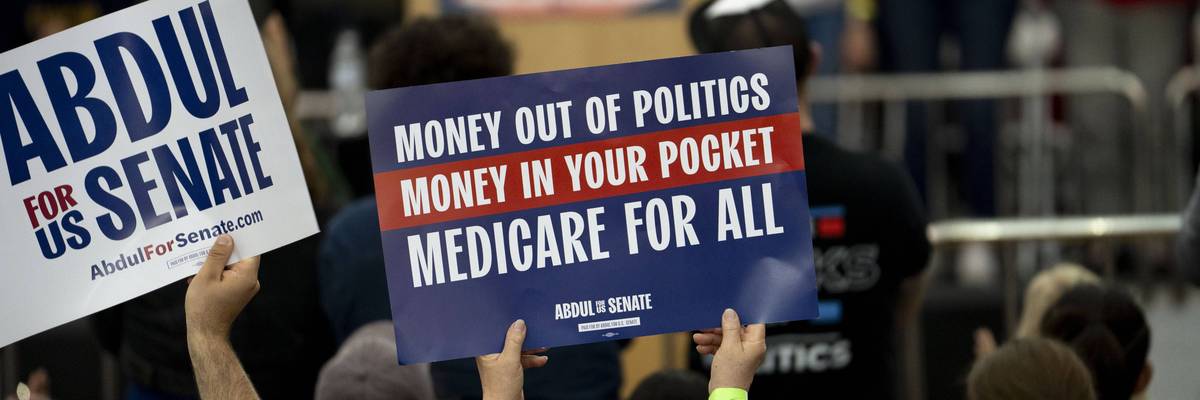
The media pundits have written article after article desperately trying to understand why progressive candidates, despite being heavily outspent, keep defeating establishment Democrats in primaries around the country. Well, the answer is not complicated.
Whether it is a corrupt campaign finance system, unprecedented income and wealth inequality, a broken and wildly expensive healthcare system, the enormous threats posed by AI or an immoral and destructive foreign policy, progressives are talking about the real issues facing working families. And they are providing real solutions. Establishment Democrats are not.
Poll after poll shows the same thing. The American people know that the current economic system is rigged. The very rich get richer, while working families struggle. Today, while 60% of Americans live paycheck to paycheck, the billionaire class has never ever had it so good.
| | Editor's Note: Railroad workers are often disenchanted with their union officials at the Local, General Committee, and National Division levels. One answer is to run for office, individually or with a slate. This workshop can help you. And RWU has issued a flyer that can be of assistance as well in helping you to formulate a principled program of action. | | |
Labor Notes / Event on September 15th
One of the most important tools in the rank-and-file toolbox for transforming the labor movement is running for local union office.
Internal elections are one of the ways that members can present a new way forward for the union, by putting the direction of the union in the hands of the membership—even if it means challenging existing leaders to do so. But running for union office—and winning, or losing and still building lasting networks in our locals—is not just about getting your name on a ballot. It takes mapping out your local, building support across worksites, listening to members’ issues, and building a team that can successfully lead the union.
NEW: Check out the new book from Labor Notes, Running for Local Union Office. Bulk discounts available when you buy for your whole slate or campaign team (5 copies or more). We also have a new running for office resources page.
When: Tuesday, September 15
Time: 8 p.m. to 9:30 p.m. Eastern (5 p.m. to 6:30 p.m. Pacific).
Where: This is an online workshop and will be held via Zoom.
Registration fee: $10—no one will be turned away for lack of funds. Reach out if you need the registration fee waived.
| | WEEKLY DERAILMENT DEPARTMENT | | Each Tuesday in this news bulletin, RWU does our best to present a picture of what has been happening over the course of the previous week in terms of derailments in North America, and investigation determinations of previous accidents. NOTE: This list is by no means comprehensive. Smaller and less consequential mishaps are generally not reported here. If the wreck results in injury or fatality, or is especially damaging/extreme, a full article will appear as a feature in the dozen or so rail articles above. Know of a train wreck? Please feel free to forward a link to raillabornews@gmail.com for possible inclusion next week. Thanks! |
| | | |