In This Issue
Research Spotlight: CPCE Takes Part in 11th Annual Global Health Conference
CPCE In the News:
Preventing Hemorrhage in Severely Injured Children
CPCE In the News:
Mayor Kenney Proposes Vaping Legislation to Protect Minors
Upcoming Events
Recent Publications
|
|
CPCE faculty and staff made a strong showing at this year’s
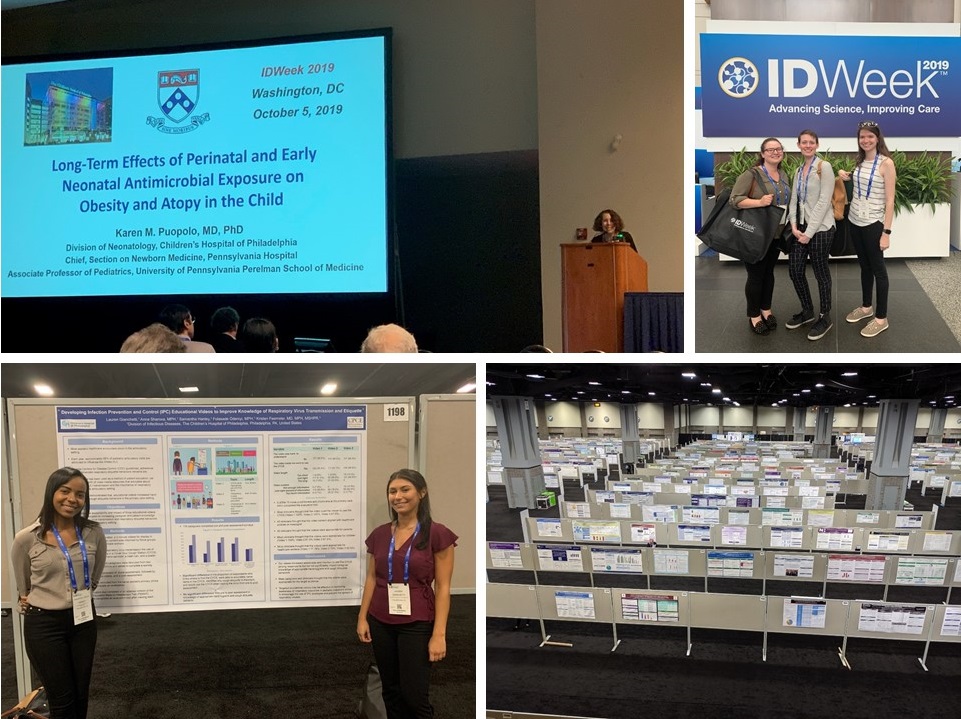
IDWeek, the annual joint meeting of the Infectious Diseases Society of America (IDSA), Society for Healthcare Epidemiology of America (SHEA), the HIV Medical Association (HIVMA), and the Pediatric Infectious Diseases Society (PIDS). This year’s conference, held October 2-6 in Washington, DC, brought together over 8500 Infectious Diseases (ID) and ID adjacent healthcare professionals from all over the world to highlight research that is “Advancing Science, Improving Care.” Session topics ranged widely, from antibiotic stewardship to genomics in biomedicine to the impact of climate change on outbreaks.
|
CPCE team members presented fifteen posters and participated in ten sessions during pre-meeting and conference days. Highlights include:
- Kevin J. Downes, MD spoke Thursday morning on procalcitonin as a marker for sepsis. To learn more about this session, you can listen to Dr. Downes expand upon this topic in this podcast.
- Julie Szymczak, PhD led Thursday morning’s “Behavioral Approaches to Antibiotic Stewardship” symposium panel with Penn Medicine’s chief of Infectious Diseases, Ebbing Lautenbach, MD, MPH, MSCE. This session highlighted research concerning the human factors in effective antibiotic usage programs.
- Pediatric IDEAS research staff members Lauren Gianchetti, Anna Sharova, MPH, and Samantha Hanley, working with Kristen Feemster MD, MPH, MSHP, presented their poster “Developing Infection Prevention and Control (IPC) Educational Videos to Improve Knowledge of Respiratory Virus Transmission and Etiquette,” which showed an increase of caregiver intention to use and awareness of appropriate hand hygiene and cough etiquette.
- Karen Puopolo, MD, PhD attending her first IDWeek, presented “Long-Term Effects of Prenatal/Perinatal/Early Neonatal Antimicrobial Exposure on Obesity, Atopy and Autoimmunity in the Child” at the Saturday afternoon symposium “Impact of Early Life Microbiome Disruptions in the Child.”
Next year, IDWeek will take place in Philadelphia, October 21-25, 2020.
|
|
Preventing Hemorrhage in Severely Injured Children
CPCE Core Faculty member
Sage Myers, MD, MSCE is leading CHOP's participation in a multi-site pilot feasibility study of a medication to treat uncontrolled bleeding in children following traumatic injury. Tranexamic acid (TXA) is used routinely in adults with traumatic injury, and it is approved for use in children in some circumstances such as to treat bleeding disorders; however, there is insufficient evidence to support TXA use in children with traumatic injuries. The
Traumatic Injury Clinical Trial Evaluating Tranexamic Acid in Children (TIC-TOC) study aims to change that. The study will enroll 40 participants across four sites including CHOP, and will lay the groundwork for a larger study that will enroll patients from hospitals across the U.S. and abroad. Dr. Myers discussed some of the challenges and opportunities surrounding this work with Cornerstone, the CHOP Research Institute's blog.
|
|
Mayor Kenney Proposes Vaping Legislation to Protect Minors
CPCE and PolicyLab Core Faculty member
Brian Jenssen, MD, MSHP continues to raise awareness and use evidence to help guide action with regard to teens and e-cigarettes. Philadelphia Magazine reported that Mayor Jim Kenney proposed a citywide education campaign to warn young people about the dangers of vaping, as well as a bill that would ban the sale of high nicotine concentrate flavored e-cigarettes in stores that admit minors. Amid more aggressive proposals in other states to ban e-cigarette sales completely, Dr. Jenssen called the Mayor's proposal an appropriate first step. “We do know there’s evidence that trying to restrict marketing, sales, flavor, and access to teens makes a dent,” Dr. Jenssen commented.
|
|
Upcoming Events
Challenging Dogma - Mechanisms and Implications of Nondifferential but Dependent Misclassification
Date: TODAY, October 25, 2019
Time: 12:00 - 1:00 PM
Location: Roberts Center for Pediatric Research, 2nd Floor, 2-160
The CPCE and PolicyLab Speaker Series welcomes Kelly D. Getz, PhD, Assistant Professor of Epidemiology, Department of Biostatistics, Epidemiology & Informatics, University of Pennsylvania Perelman School of Medicine. RSVP to
CPCE@email.chop.edu.
AAP National Conference & Exhibition
Dates: October 25-29, 2019
Location: New Orleans, LA
The annual conference of the American Academy of Pediatrics kicks off today in New Orleans. The full conference schedule is available
here, or view our
summary of CPCE and CHOP speakers.
Novel methods from behavioral economics and their application to the Habit Formation Trial
Date: October 29, 2019
Time: 12:00 - 1:00 pm
Location: Roberts Center for Pediatric Research, 2nd floor, 2-180
Sponsored by the CHOP Clinical Trials Research Affinity Group (RAG) and presented by Iwan Barankay, PhD, Associate Professor of Management, Wharton School, and Mary Putt, PhD, ScD, Professor of Biostatistics, Hospital of the University of Pennsylvania. Learn more
here.
Piecing Together the Data on Vaping: What is the Current State?
Date: October 30, 2019
Time: 12:00 - 1:30 PM
Location: Biomedical Research Building, Gaulton Auditorium, 421 Curie Blvd.
The Penn Public Health Seminar Series will host Frank Leone, MD, MS, from Penn Medicine, Catherine Maclean, PhD, from Temple University, and Cheryl Bettigole, MD, from the Philadelphia Department of Public Health. Learn more and register
here.
Impact of Unmeasured Confounding in Observational Studies
Date: November 1, 2019
Time: 12:00 - 1:00 PM
Location: Roberts Center for Pediatric Research, 2nd floor, 2-160
The CPCE / PolicyLab Seminar Series welcomes Yun Li, PhD. Dr. Li is Associate Professor of Biostatistics in the Department of Biostatistics, Epidemiology, & Informatics at Penn and in Pediatrics at CHOP. Dr. Li conducts distinguished methodological research in causal inference, unmeasured confounding, missing data, mediation, Bayesian analyses and survey methods. She joined CHOP and Penn in 2019 and will be particularly active within the
Pediatric IDEAS research group. To learn more or to register, e-mail
CPCE@email.chop.edu.
American Public Health Association Annual Meeting & Expo
Dates: November 2-6, 2019
Location: Pennsylvania Convention Center, 1101 Arch St. Philadelphia
APHA's Annual Meeting and Expo is the largest and most influential annual gathering of public health professionals. Learn more about the meeting
here or view the summary schedule of CPCE and PolicyLab speakers
here.
PolicyLab Morning Speaker Series featuring Gregory Tasian, MD, MSc, MSCE
Date: November 14, 2019
Time: 9:00 - 10:00 AM
Location: Roberts Center for Pediatric Research, 1st floor, 1-120A
PolicyLab's Morning Speaker Series every Thursday at 9am allows the CHOP community to learn from colleagues and partners in related fields of work. To learn more, contact
Lindsay Capozzi.
American Heart Association Scientific Sessions
Dates: November 16-18, 2019
Location: Pennsylvania Convention Center, 1101 Arch St. Philadelphia
The scope and quality of the scientific programming make Scientific Sessions the premier cardiovascular research and instructional meeting in the world. General information is available
here, or view our
summary of CPCE speakers.
|
Recent Publications
Adherence to immunosuppressive medications is important for preventing transplant rejection. Deviation from daily routine, including weekend vs. weekdays, may hinder adherence.
Sandra Amaral, MD, MHS and colleagues leveraged data from the Teen Adherence in Kidney Transplant Effectiveness of Intervention Trial (TAKE-IT) to assess adherence by day of the week. The TAKE-IT study had
previously shown improved adherence to immunosuppressive medications by young adult kidney transplant recipients, via text message, e-mail, and/or visual cue reminders, combined with coaching to review adherence data at three month intervals. However, they found poorer adherence on weekends than weekdays in both the three-month run-in period and the 12-month intervention period. The authors recommend that patients and families be encouraged to develop strategies to maintain adherence when routines are disrupted.
Outpatient providers often do not receive after-visit summaries (AVS) given to patients by acute care providers, indicating a potential missed opportunity for care coordination between clinicians. A team of researchers, including
Naveen Muthu, MD and
Jeremy Michel, MD, MHS, created a 17-item heuristic evaluation instrument for assessing usability of medical documents and tested it with eight experts and four simulated AVS. This process identified problems such as unnecessary information, poor organization, and inconsistent formatting with the AVS that made it difficult for patients, caregivers, and clinicians to use the documents. These results may inform adaptations to electronic health record systems to generate more useful and useable documents.
Risk-adjusted adverse event (AE) rates have been used to measure quality of pediatric and congenital cardiac catheterization laboratories.
Michael O’Byrne, MD, MSCE and
Andrew Glatz MD, MSCE and colleagues sought to compare AE rates vs. failure to rescue (FTR), a quality measure which has been used in other clinical settings. Using data from the Improving Adult and Congenital Treatment (IMPACT) Registry, they found that hospitals with higher annual volume of catheterization performed better when measured by FTR. Further, hospital rankings based on FTR and AEs were not significantly correlated, leading them to conclude that FTR is a complementary quality measure of catheterization labs and should be included in further research.
A team of CHOP researchers, including
Robert Grundmeier, MD, sought to determine if time to antibiotic administration is associated with mortality and in-hospital outcomes in a neonatal intensive care unit (NICU) population. They found that longer time to antibiotic administration was associated with increased risk of mortality at 14 days and at 30 days. They identified no significant associations with ventilator-free days or NICU length of stay. The authors recommend further study define optimal timing of antimicrobial administration in high-risk NICU populations.
|
|
About CPCE
We are a pediatric research center dedicated to discovering and sharing knowledge about best practices in pediatric care by facilitating, organizing and centralizing the performance of clinical effectiveness research -- research aimed at understanding the best ways to prevent, diagnose and treat diseases in children. CPCE’s multidisciplinary team conducts research on a diverse range of clinical effectiveness topics.
CPCE E-News is edited by
Holly Burnside. Please feel free to contact us with questions or feedback.
|
|
|
|
|
|
|