Is Your Emergency Department PEDReady?
|
The 2020 National Pediatric Readiness Assessment will launch June 1, 2020! Download a PDF of the assessment
here
to familiarize yourself with survey questions in advance
. Let's all help Florida get PEDReady!
The Florida EMSC Program Manager needs contact information (email & phone number) to send your ED survey. Please email
Lorrianna.JeanJacques@flhealth.gov
with your ED designee name and contact information.
|
|
Encourage others to sign up for the PEDReady weekly newsbrief, the PE
2
ARL, by sharing this link:
http://bit.ly/flpearl
|
|
Focus: Croup (laryngotracheobronchitis)
|
|
1. Reminder: EMSC Advisory Committee Applications
|
|
The Florida Department of Health manages the EMS for Children (EMSC) Advisory Committee, which makes specific recommendations to the State Surgeon General on reducing child and youth mortality and morbidity caused by severe illness or trauma.
Applications are being accepted for the following vacancies on the committee:
- Physician with pediatric experience
- Family representative
- EMT/paramedic
- Emergency physician
- Nurse with emergency pediatric experience
- EMS education manager
The committee meets quarterly in-person and mid-quarter via conference calls. Appointed committee members are expected to attend a minimum of six meetings per calendar year.
Applications are due December 9, 2019.
Please include a copy of your resume or CV with your submission.
|
|
2. Croup (
laryngotracheobronchitis
)
|
|
Scenario:
You are called to transport a 2-year-old from a community ED with severe respiratory distress and possible asthma. There is a 2-day history of fever to 101°F, past medical history of mild reactive airway disease and RSV a year ago. The ED has given 3 albuterol and ipratropium nebulizer treatments and oral steroids. The CXR is normal. There is no IV in place. The patient is still working hard to breath and retracting despite these interventions.
On arrival, you see a toddler with “noisy” breathing, crying, coughing and retracting. A nebulizer is being held to his face administered with wall oxygen.
Weight and color zone: Yellow 14 kg, HR: 125, RR: 50, BP: 95/65, Oxygen saturation: 96%
|
|
 |
Initial Impression:
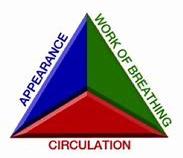
Sick or not sick? Don’t forget the pediatric assessment triangle!
This child is 1-800-SICK and has stridor at rest!
|
|
|
|
Additional History:
negative for prematurity, previous intubation, or congenital airway conditions
Differential Diagnosis of Stridor:
Viral croup, spasmodic croup (recurrent croup, afebrile), retropharyngeal abscess, airway foreign body, subglottic stenosis, angioedema, tracheomalacia, laryngeal fracture, laryngomalacia, laryngeal web or other anatomical abnormalities, vocal cord paralysis, gastroesophageal reflux (especially for recurrent croup), bacterial tracheitis, peritonsillar abscess, epiglottitis, etc.
Key Croup Points:
- Accounts for 15% of annual U.S. clinic and ED visits with a pediatric respiratory tract infection.
- Name derived from Anglo-Saxon word, kropan, and old Scottish word, roup, meaning to cry out in a hoarse voice.
- Most common etiology for hoarseness, cough, and onset of acute stridor in febrile children.
- Primarily a disease of infants and toddlers, with peak age incidence 6 months to 36 months; 5-6 cases per 100 toddlers.
- ≤ 5% of children diagnosed with croup require hospitalization
- Begins with nonspecific respiratory symptoms (rhinorrhea, sore throat, cough). Fever is generally low grade. Within 1-2 days, characteristic signs of hoarseness, seal like barking cough, and inspiratory stridor develop, often suddenly, with variable degrees of respiratory distress.
- Symptoms often worse at night, with most ED visits occurring between 10 pm and 4 am.
- Symptoms typically resolve within 3-7 days, but can last up to 2 weeks.
- The most common viral etiologies are parainfluenza (80%) but also caused by RSV, adenovirus and other viruses that may cause wheezing in addition to stridor.
- A secondary bacterial infection may result in pneumonia or bacterial tracheitis.
- Narrowing of the larynx and trachea below the level of the glottis causes the characteristic audible inspiratory stridor
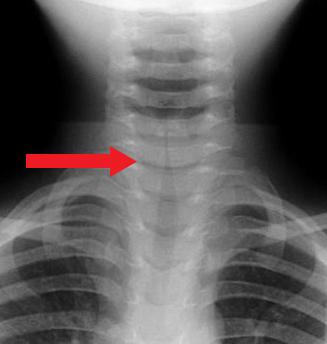
- X-ray not required for diagnosis but usually shows the classic “steeple sign”
|
|
Home Management of Croup (mild stridor or barky cough):
- Treat fever with an antipyretic such as acetaminophen or ibuprofen.
- Encourage oral intake including popsicles.
- Avoid smoking in the home; smoke can worsen cough.
- Allow position of comfort and keep child's head elevated if tolerated.
- At bedtime, parent/caregiver should stay in close proximity to the child in case there is increasing respiratory distress.
EMS and ED Management:
Follow local protocols
- Do you start an IV? Only if child is in severe distress. Goal is to keep child calm.
- Humidified oxygen therapy based on exam, pulse oximetry and level of distress
- Corticosteroids- oral (preferred in mild croup) or IM steroids, or IV in severe cases
- Dexamethasone: 0.3-0.6 mg/kg (range 0.15 -0.6 mg/kg), MAX 16 mg; can give IV solution orally
- Other steroids can be used if dexamethasone not readily available
- Epinephrine if patient has stridor at rest, moderate to severe work of breathing or hypoxemia
- Racemic epinephrine (vaponephrine): 0.25-0.5 ml mixed with 3 ml saline given as a nebulizer treatment is commonly administered.
- Many EMS agencies and smaller EDs do not stock racemic epinephrine. That’s ok! Everyone usually has regular 1:1000 epinephrine on hand. Both forms of epinephrine are effective in the treatment of croup.
|
|
|
“Regular” epinephrine, the type we are most familiar with, is also called L-epinephrine because it is the levorotatory version of epinephrine. Racemic epinephrine contains both L-epinephrine, AND D-epinephrine. The “D” stands for dextrorotatory. To learn more, review this post on
Ditch Doc EM
.
General Dosing:
L
- Epinephrine:
1:1000- 2.5 ml (2.5 mg) if < 10 kg; 5 ml if > 10 Kg
-Or 0.5 ml/kg/dose with MAX of 5 ml
R
-Epinephrine:
0.25 ml if < 10 kg; 0.5 ml if >10 kg, mixed with 3 ml NS
-Or 0.05 ml/kg/dose, MAX 0.5 ml
|
|
|
|
- Children who receive nebulized epinephrine in the ED or field should be observed for approximately 3 hours before discharge home. Those requiring more than one epinephrine neb or those with continued stridor or distress at rest are admitted or transferred.
Key Scenario Take Home Points:
It can be hard to distinguish sounds in “noisy” breathing and both wheezing (lower airway) and stridor (upper airway) can occur together. Always ask about past history!
Clinical Pathways, Protocol Examples and Resources:
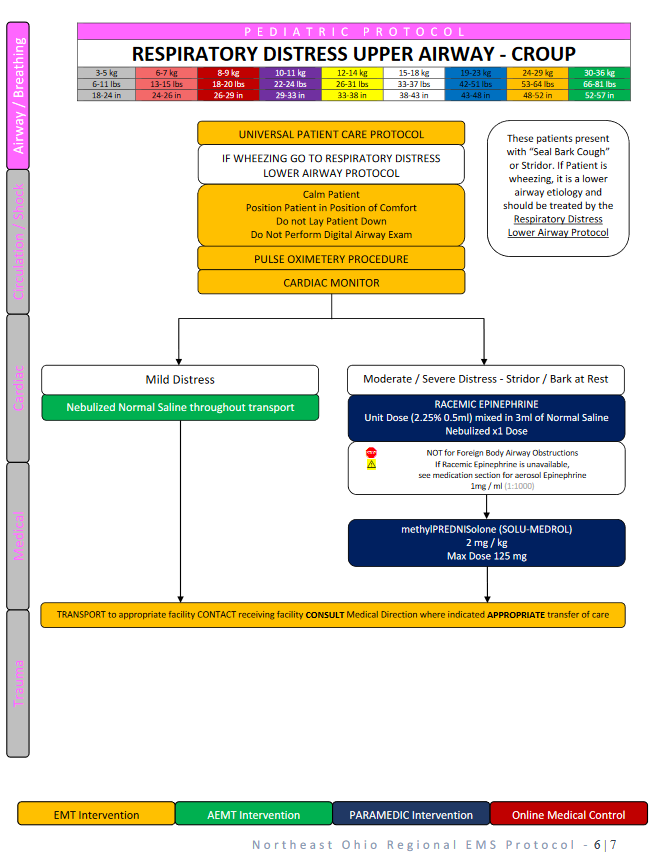
-see pages 137-140
-great examples of EMS protocols (see photo below). To find croup: navigate to Table of Contents on p. 9-10. Click on Section 7; croup begins on 6-7.
|
|
|
Are you planning pediatric emergency educational courses for 2020? Please share the information and dates with FL PEDReady by emailing
pedready@jax.ufl.edu
. Course information will be added to our website and weekly newsletters.
|
|
|
|
Free Webinar: Drugs of Abuse During Pregnancy & Lactation
1.0 CE | Expires January 2, 2020
Hosted by: EMLRC
Substance abuse among pregnant women in the U.S. is increasing. Emergency care providers must be able to recognize and manage the immediate consequences of substance abuse in a pregnant patient. Dr. Sara Baker will review pregnancy complications associated with drugs of abuse, impacts on maternal wellbeing and fetal development, and appropriate treatment options during pregnancy and the postpartum period.
|
|
|
Thanks for being a Pediatric Champion!
|
|
The Florida PEDReady Program
|
|
|
|
|
|
|
|