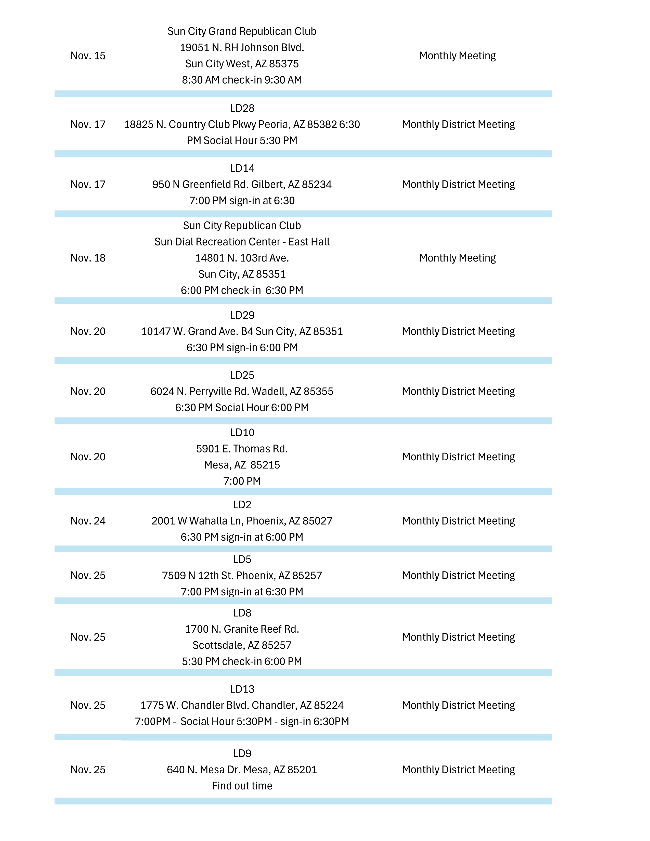
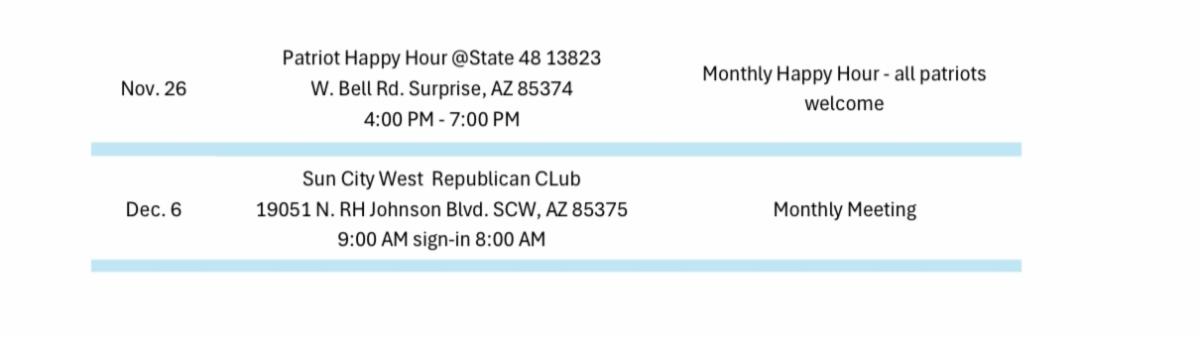
November 3, 2025


Democrats Hold the American People Hostage—Again


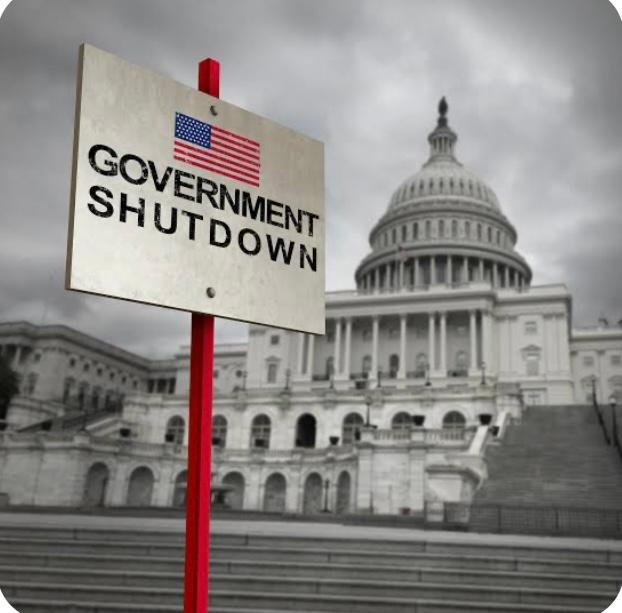
Here we go again. The Democrats are holding the American public hostage—this time, using the threat of withholding SNAP benefits from low-income families just in time for Thanksgiving.


With the government shutdown that began on October 1st, millions of Americans are now caught in the crossfire of yet another political standoff in Washington. The timing couldn’t be worse. As families across the nation prepare to gather around the dinner table, the federal government’s inaction may leave many without the means to put food on that very table.


It’s almost ironic. The Democrats have supported similar Republican-proposed Continuing Resolutions (CRs) in the past—temporary funding measures that keep the government running while negotiations continue. But now, with President Trump back in the White House, Chuck Schumer under pressure, and the holidays approaching, Democrats appear determined to play hardball.


Let’s be honest: this isn’t about principles. It’s about power. Democrats are gambling with the well-being of hardworking Americans to gain political leverage.


Even Senator John Fetterman, a Democrat, has broken ranks and sided with Republicans on this issue—proof that common sense can still exist across party lines. For that, we should be grateful. Unfortunately, too many of his colleagues are taking the opposite approach. As one Democrat reportedly said, “We can use the pain of the American people as leverage.”That statement says it all.


As Rush Limbaugh often reminded us, sometimes a government shutdown isn’t the worst thing—at least then they can’t waste our money. But this one feels different. When the most vulnerable Americans—families who depend on food assistance, veterans awaiting benefits, and small businesses waiting on federal contracts—are being used as pawns in a power game, it’s not just politics. It’s cruelty.


Thankfully the Republicans will not compromise. The Democrats are demanding the following:


  • Reversing Republican-enacted healthcare cuts: The bill sought to reverse funding cuts to Medicaid and other health care programs made by Republicans in the "One Big Beautiful Bill Act" passed in July 2025. Democrats claimed these cuts would have removed health coverage from millions of Americans and "decimated" Medicaid.
  • Expanded eligibility for legal immigrants: The proposal aimed to make Medicaid, the Children's Health Insurance Program (CHIP), and ACA coverage available to legal immigrants who were previously eligible for these programs but had lost coverage due to a rule change by the Trump administration.
  • Pre-existing work requirements: It would repeal work requirements for able-bodied, working-age adults on taxpayer-funded health programs.
  • Rural health care funding: The proposal aimed to reverse $50 billion in cuts to rural health care funding that would have negatively impacted hospitals and clinics in vulnerable communities. 


The message is clear: the Democrat leadership in Washington cares more about political victories than about the American people.


Keep in mind in the Senate it will take 60 votes to reopen the government. There are only 53 Republicans. We need at least 7 Democrats to cross party lines. Right now we can only count on Fetterman. This is one reason it is important to build relationships with leaders across the isle.


This Thanksgiving, as we gather with family and friends, let’s remember who stood up for the people—and who used them as bargaining chips.

🚫 Stop the BNSF Intermodal Hub — Your Voice Matters November 5th!


On Wednesday, November 5th at 9:30 AM, the Maricopa County Board of Supervisors will hear BNSF Railway’s proposed change to the Comprehensive Plan — one of three critical phases the Board will review as part of BNSF’s massive Intermodal Hub proposal in Wittmann.


This specific agenda item seeks to reclassify 839 acres of land to match the same designation as the 4,321 acres BNSF already owns in the area. While this is just one step in a multi-phase process, it’s a crucial opportunity for citizens to make their opposition known. Every step counts — and a strong showing of public resistance could influence the Board’s final decisions on both zoning changes and height variances, which are still to come.


Although this vote is not the final decision, it sends a clear message to our elected officials. We are asking the Board of Supervisors to vote NO — even on this portion of the plan. If you can attend we need your help.


Make a plan to carpool with your friends and neighbors. It is critical we pack the room with citizens that oppose BNSF building in Wittmann.


📍 Meeting Details

Date: Wednesday, November 5, 2025

Time: Meeting begins at 9:30 AM (arrive early)

Location: 301 W. Jefferson Street, Phoenix, AZ

Parking: Be sure to allow plenty of time to park and walk to the BOS building — parking downtown can be tricky.

Free Parking lot: 501 W. Jefferson St, Phoenix, AZ


Traffic Alert: A Veterans Day parade will be taking place that morning, so please plan accordingly.


🗣️ Make Your Voice Seen and Heard

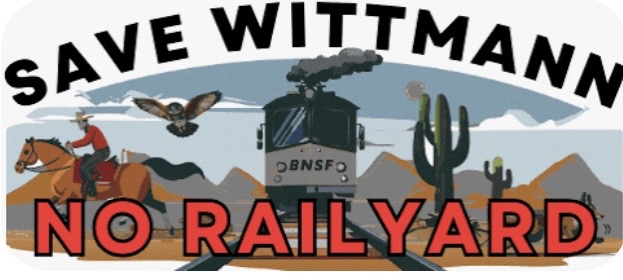
Not everyone will have the opportunity to speak during the meeting, but your presence matters. Upon arrival, please find me to pick up a “NO BNSF” sticker to wear during the meeting. A room full of citizens displaying clear opposition will send a powerful message to the Supervisors.


We will continue collecting petition signatures to send to both the Board of Supervisors and the Planning and Zoning Commission until all three votes have been held.


Together, we can protect our community from the harmful impacts of this industrial project — including increased traffic, pollution, and safety risks along school and residential corridors.


Let’s stand united for the future of Wittmann and the West Valley.


See you November 5th — let’s make our voices count!


The agenda item should read similar to this:


BNSF INTERMODAL CPA


Case #: CPA2024006 Supervisor District: 4


Applicant and Owner: Susan Demmitt, Gammage & Burnham, PLC / BNSF


Request: Major Comprehensive Plan Amendment (CPA) to change the land use designation in the White Tank Grand Avenue Area Plan from Single-Family Rural to Mixed Use Employment. CPA case approval is by Resolution.


Site Location: Generally located north of US-60 between 211th Ave. and 235th Ave. in the Wittmann area


Commission Recommendation: On 11/7/24, the Commission voted 6-0 to adopt a motion recommending the Board of Supervisors approve CPA2024006 (C-44-26-023-X-00)

Have You Dropped Off Your Ballot?


If you haven’t mailed your ballot yet, it’s too late to rely on the mail — you must drop it off at an official ballot drop box by Tuesday to ensure it’s counted. Every vote makes a difference, and your voice matters in shaping the future of our community. To find a secure drop box location near you, click the link below and make sure your ballot is safely delivered before Election Day, November 4th.

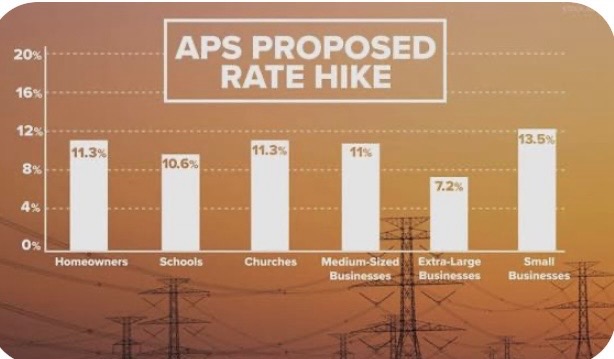
APS Wants a Rate Increase Again


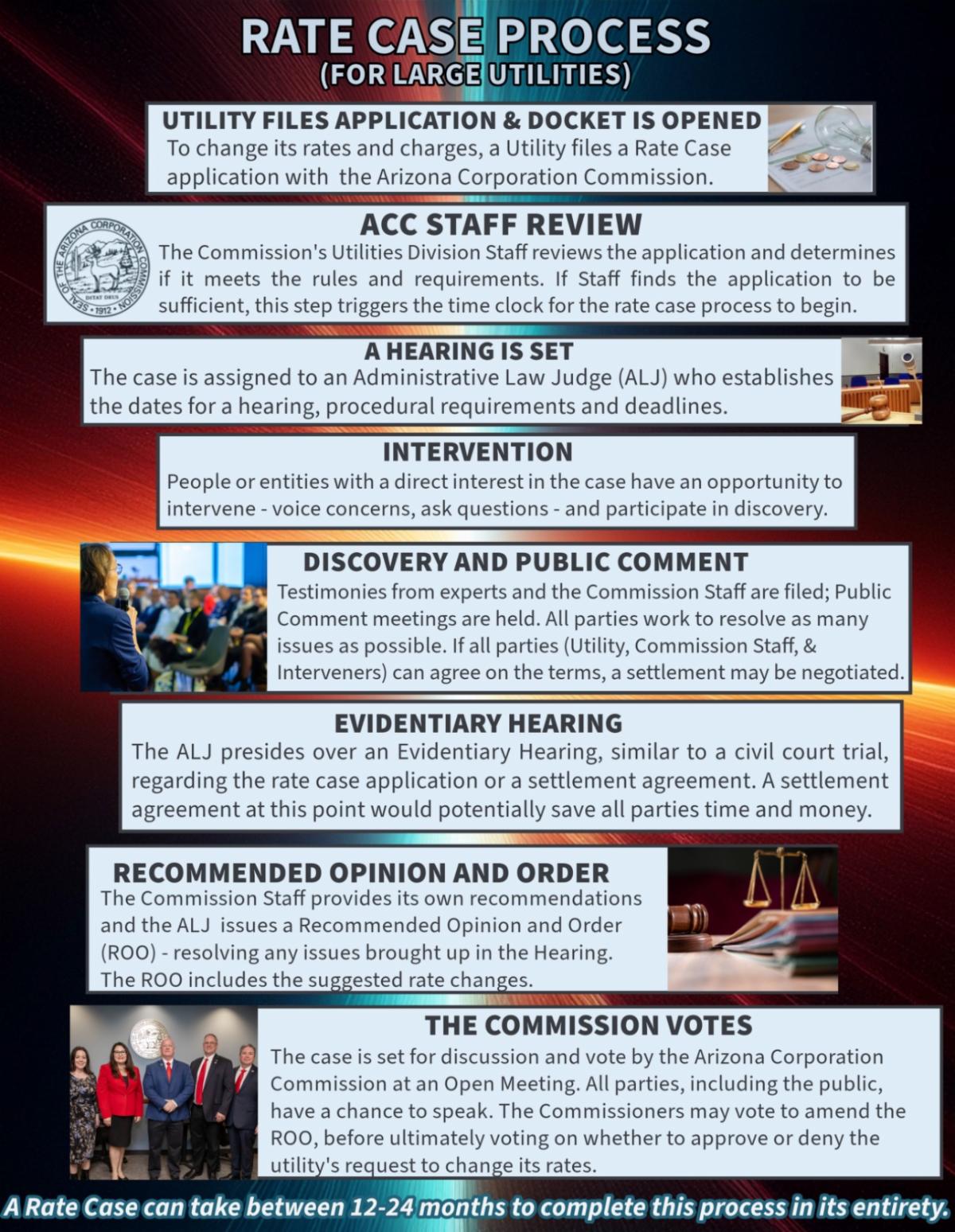
There has been a lot of talk lately about APS filing for yet another rate increase, and many Arizonans are understandably frustrated. Each time rates go up, families and businesses feel the impact — and with no alternative electric provider to switch to, it can seem like there’s no choice but to just pay more. Some people believe the Arizona Corporation Commission (ACC) simply rubber stamps every increase, but that’s not the case. The process is lengthy and detailed, often taking one to two years from start to finish. Each step involves audits, hearings, and opportunities for public input to ensure that any approved rate changes are fair, justified, and in the public interest. Details of each step are outlined below.


Understanding the Process at the Arizona Corporation Commission

When an electric utility in Arizona wants to raise rates, it can’t just flip a switch. The process is deliberate, transparent, and heavily regulated by the Arizona Corporation Commission (ACC) — the elected five-member body responsible for balancing the needs of consumers with the financial stability of utilities that provide essential services.


Step 1: Filing the Application

A rate increase begins when a utility files a rate case with the Arizona Corporation Commission. This is a detailed legal and financial document that explains why the utility believes a rate hike is necessary. The company must provide extensive data on:


  • Operating costs (fuel, labor, infrastructure maintenance)
  • Investments in new equipment or technology
  • Revenue requirements to ensure reliability and safety
  • Return on investment (ROI) for shareholders


This filing can run thousands of pages, and it’s publicly available on the ACC’s website so that citizens, organizations, and local governments can review it.


Step 2: Review by Commission Staff

After the filing, the ACC’s professional staff and consultants conduct a comprehensive audit. They analyze the utility’s books, verify expenditures, and determine if proposed costs and profit margins are justified.


The staff then issues a Staff Report, recommending approval, modification, or denial of the proposed rate increase.


Step 3: Intervention and Public Input

The process is open to the public. Any interested party — including individuals, consumer groups, or municipalities — can apply to intervene in the case. Intervenors have the right to submit evidence, call witnesses, and cross-examine utility experts.


In addition, the Commission holds public comment sessions across affected service areas so residents can voice support or opposition. Written comments are also accepted online and become part of the record.


Step 4: Hearings Before an Administrative Law Judge

An Administrative Law Judge (ALJ) oversees formal hearings that resemble court trials.

During these proceedings:


  • The utility presents its case.
  • Commission staff and intervenors present counterarguments.
  • Expert witnesses provide testimony on costs, reliability, and service impacts.


After considering all evidence, the ALJ prepares a Recommended Opinion and Order (ROO) summarizing findings and proposing how much, if any, of the rate increase should be approved.


Step 5: Decision by the Commissioners

The five elected Commissioners review the ALJ’s recommendations and vote in an open meeting. They may adopt, modify, or reject the recommendation entirely.


Once approved, the decision sets new rates, typically including stipulations about how the utility must invest in infrastructure, renewable energy, or customer service improvements.


Step 6: Implementation and Oversight

The utility must notify customers of the new rates and effective date. The ACC continues to monitor compliance, ensuring funds are used as promised.

Future audits and reviews may occur before another rate case is considered.


Why It Matters

This process protects consumers from unfair rate hikes while allowing utilities to maintain and modernize Arizona’s electric grid.


Transparency is key — any citizen can participate or follow along at www.azcc.gov.


Informational Meeting for Project Baccara


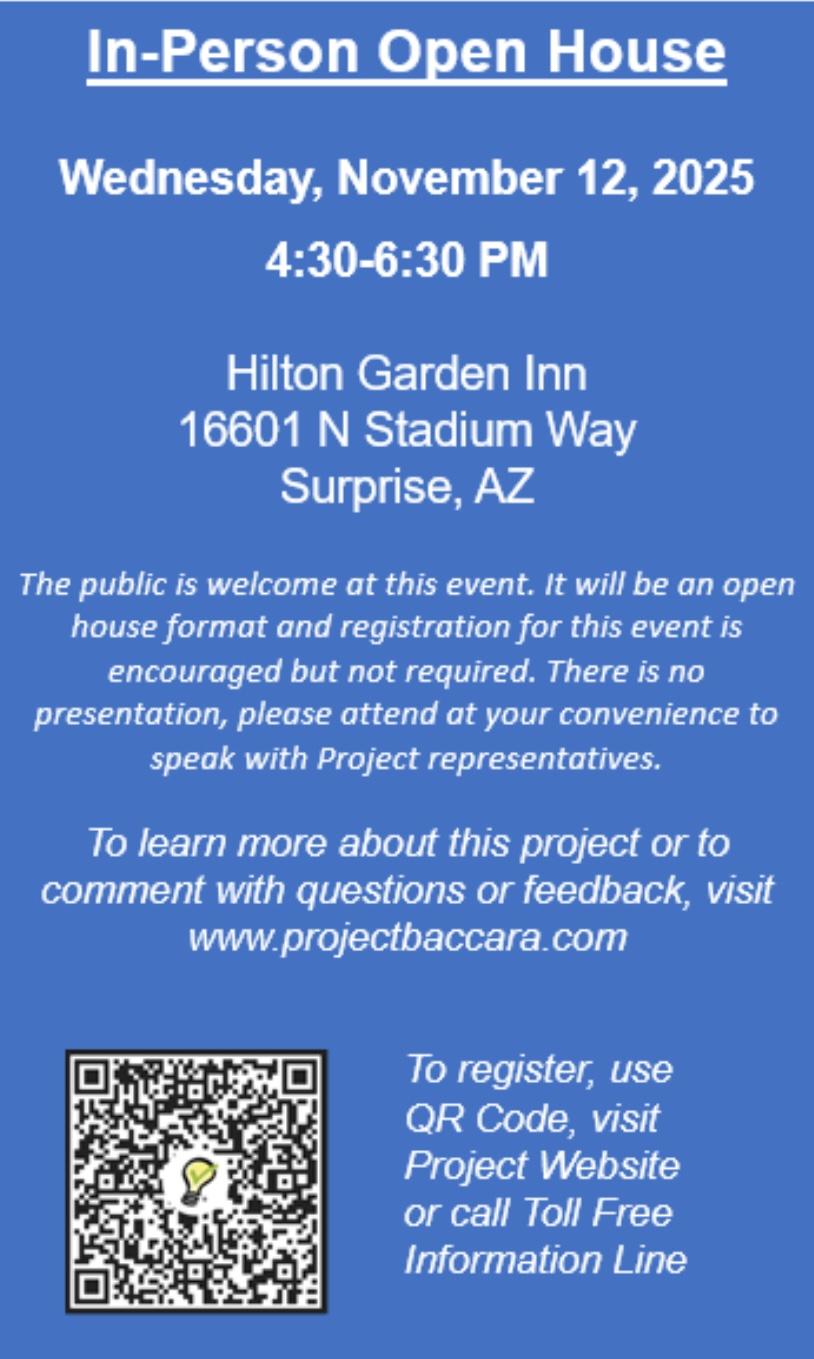
Project Baccara is a proposed large-scale data center planned for construction on a county island within the City of Surprise. The location of this project is particularly concerning because it sits directly beneath the Luke Air Force Base flight path, raising questions about safety, noise, and long-term land-use compatibility. Before Project Baccara can move forward, it must receive approvals from both the Maricopa County Board of Supervisors and the Arizona Corporation Commission (ACC). To help inform residents and gather feedback, informational meetings are being held so the public can learn more about the project’s potential impacts — including traffic, infrastructure demands, and environmental considerations — before any final decisions are made. Community input will play an important role in determining whether this project aligns with the surrounding area and the long-term goals for growth and safety in the West Valley.


A MESSAGE FROM OUR STATE PARTY CHAIR, GINA SWOBODA

SAVE THE DATE: AZGOP Mandatory Meeting


Dear Members of the State Committee,


I am excited to announce that our next mandatory meeting will be held on January 24, 2026 at the Findlay Toyota Center in Prescott Valley.


I think we can all agree that given the vital role that our rural counties have played in our party’s success - including winning Arizona for President Trump - it is long overdue for our party to hold a state committee meeting in rural Arizona.


Please see important dates on our AZGOP website here: 2026 Mandatory Meeting - AZGOP


More information, including hotel room blocks will be coming under separate cover.


I look forward to seeing you all in beautiful Yavapai County this coming January for this important mandatory meeting.


In liberty,

Gina Swoboda

Chairwoman


Patriot Happy Hours – Where Community and Conversation Come Together!


Looking for a place to relax, connect, and recharge with like-minded patriots? Patriot Happy Hours are the perfect opportunity to do just that! These monthly gatherings bring together neighbors, friends, and community members who share a love of country, common sense, and good company.


We meet at State 48 Brewery in Surprise from 4:00 to 7:00 PM. Normally, Patriot Happy Hours are held on the last Wednesday of every month, but due to the upcoming holidays, our next events will be:


  • Wednesday, November 19th
  • Wednesday, December 17th


After that, we’ll return to our regular schedule — the last Wednesday of every month.

Come enjoy great food, local brews, and even better conversation with people who care about our community and our country. Bring a friend (or three!) — you won’t want to miss it.

We look forward to seeing you there! 🇺🇸

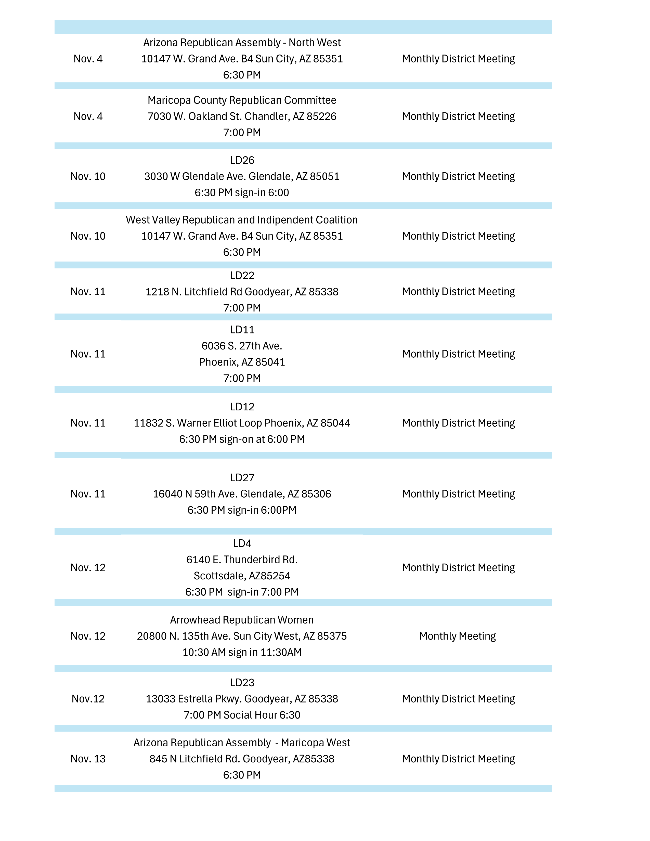
IF YOU WOULD LIKE YOUR MEETING ADDED TO THE CALENDAR PLEASE REPLY TO THIS EMAIL. IF YOUR TAKING DECEMBR OFF, PLEASE REPLY TO THIS EMAIL.


Thank you,

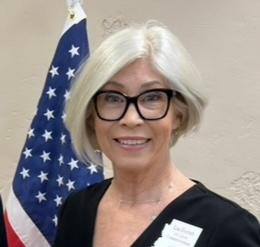
Lisa Everett

LD29 Chair


Follow me on:

X - @patriotnheels

Facebook - @patriotnheels

Instagram - @patriotnheels