E-Mail Newsletter
December 2021 Volume 6 Number 28
|
|
2021: Changes in DOI Leadership, a Win for Tribal Sovereignty, and More |
|
December 16, 2021: By Mark Vezzola, CILS Escondido Office Directing Attorney
As 2021 draws to a close, it is time to look back at the last twelve months. If you work in federal Indian law or care about Indian country, there are a number of developments to reflect on. Some changed the political and legal landscape, and a few were major news stories. Many were positive for those concerned about tribal sovereignty.
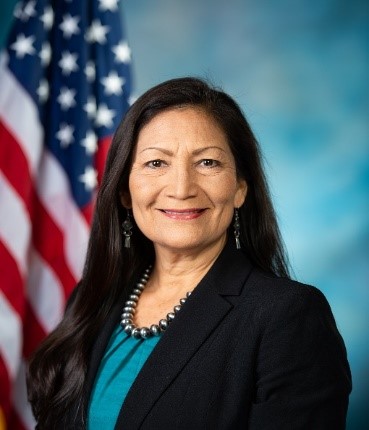
The U.S. Department of Interior (DOI) has a new leader who is already tackling often overlooked issues affecting Indian country. Deb Haaland, a former congresswoman from New Mexico and an enrolled member of Laguna Pueblo, became the first Native American Secretary of the Interior (which includes the Bureau of Indian Affairs) in March and the first-ever Native American Secretary in any presidential cabinet. Since taking office, Haaland has prioritized investigating murdered and missing indigenous women and examining abuse claims in now-defunct federally-funded boarding schools.
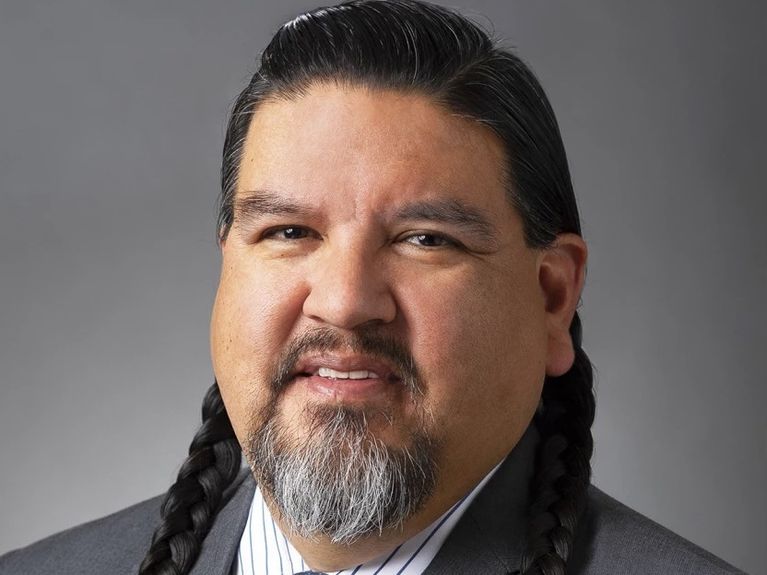
More recently but less publicized, Charles “Chuck” Sams III became the first Native American Director of the National Park Service (also part of DOI) on November 19 with unanimous Senate support. Sams is an enrolled member of the Confederated Tribes of the Umatilla Indian Reservation with connections to the Cayuse, Walla Walla, Yankton Sioux, and Cocopah people. Sams previously served in the U.S. Navy as an intelligence specialist with experience in natural resource and conservation management. President Biden’s appointments are significant, considering Native Americans now hold two high offices in a federal agency once synonymous with assimilation.
|
|
|
CILS Receives Holiday Donation from the Sycuan Band of the Kumeyaay Nation |
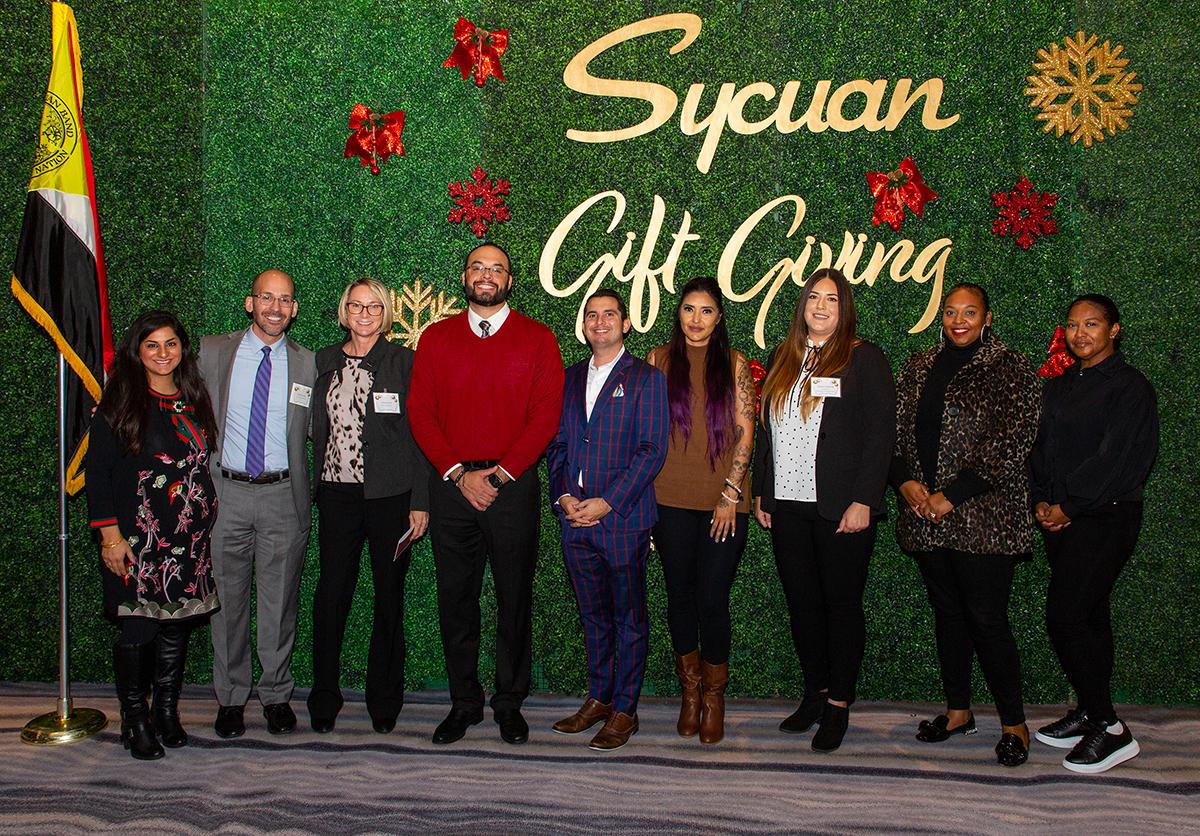
Pictured from left to right: Sycuan's Paralegal Lauren Ghosh, CILS Escondido Office Directing Attorney Mark Vezzola, CILS Director of Marketing and Development Nicole Scott, Sycuan's Council members Chairman Cody Martinez, Vice Chairman Joshua Muse, Council Member Alanna Sandoval, Council Member Brianna Sandoval, Treasurer LaShunna Davidson, and Secretary Pilar Pettiford. Missing from the photo is Council Member Xusha Brown, Sr. |
December 9, 2021: By Nicole Scott, Director of Marketing and Development
CILS' Escondido Office Directing Attorney Mark Vezzola and Director of Marketing and Development Nicole Scott attended Sycan's annual Holiday Gift Giving Ceremony at Sycuan's Heritage Events Center.
Tribal Council Members and top leaders in Sycuan's Management Team had the opportunity to present a special holiday gift to a charity of their choice. Mark Radoff, General Counsel to the Sycuan Band of the Kumeyaay Nation, selected CILS to receive his gift of $3,750.
"We are incredibly grateful to Sycuan Tribal Council for their support and generosity. CILS is embarking on many exciting changes while building upon the legacy of being the oldest non-profit Federal Indian Law Firm in California. Without this type of support, we would not have been able to make historical strides on behalf of Tribes and continue to do good work today," said Heather Hostler, Executive Director. "The Sycuan Band of the Kumeyaay Nation demonstrates great leadership and partnership, and we want to express our appreciation for all they do."
"CILS appreciates the continued financial support from the Sycuan Band of the Kumeyaay Nation. With the Tribe's funding, we can reach more and provide greater services to low-income Native Americans and CA tribes," said Dorothy Alther, Legal Director. "Thank you, Sycuan Band of the Kumeyaay Nation."
You can help too. Your support makes justice possible. Help our mission protect and advance Indian rights, foster Indian self-determination, and facilitate tribal nation-building.
|
|
Historical Perspective: CILS’ Protection of Tribal Court Sovereignty |
|
December 3, 2021: By Debra Avenmarg, CILS Eureka Office Staff Attorney
Over the years, CILS has played an important role in defending Tribal Court jurisdiction and sovereignty. One particular case that illustrates the importance of protecting Tribal Court orders from intrusion by state courts is the case of In re M.M. (2007) 154 Cal.App.4th 897.
In re M.M.: Background
In re M.M. involved a tribal child who was a dependent of the Humboldt County Superior Court in a child welfare case. After paternity testing revealed who the biological father was, the Karuk Tribe determined that the child was eligible for enrollment and intervened in the matter. The Karuk Tribe then filed a motion to transfer the case to Karuk Tribal Court. A contested hearing was held on the transfer request and various other issues. Ultimately, the Humboldt Superior Court granted the motion and transferred the case to Karuk Tribal Court. Before closing the case, the Humboldt Court set a hearing two weeks out to verify that the Karuk Tribal Court had accepted the case and completed the transfer. At this next hearing, it was verified that the file had been delivered to the Karuk Tribal Court, and the Tribal Court accepted the case within six days of ordering the transfer. The Humboldt Superior Court then closed its case.
Under California law, typically, parties have 60 days after the date of an order to file a “Notice of Appeal” to seek appellate court review of a court’s decision that they do not agree with. In the case of In re M.M., the attorney for the child did not agree with the transfer to Tribal Court and filed a “Notice of Appeal” 19 days after the order was made, which was within the usual time frame for appeal.
|
|
|
|
CILS’ New and Legacy Litigation
- CILS successfully defeated three University of California professors’ legal challenge to block the repatriation of ancient Kumeyaay human remains. Tim White et. al v. University of California et. al and Kumeyaay Cultural Repatriation Committee (KCRC), (2016).
- CILS protected tribes from BIA intervention into internal political matters. Coyote Valley Band of Pomo Indians v. U.S. 54 IBIA 320 (2012).
|
|
The holiday formerly known as Columbus Day is now celebrated as Indigenous People’s Day. The day acknowledges North America’s Indigenous people’s struggle for rights, recognition, and reparations since 1492.
|
|
Tribal Elections 101 – Consider the Following When Updating Tribal Election Laws and Regulations
|
|
November 22, 2021: By Denise Bareilles, CILS Eureka Office Directing Attorney
I have had the pleasure of working closely with several Tribes in administering tribal elections. It is an interesting area of tribal law that constantly presents new issues for tribal self-governance. Consider the information below when updating Tribal Election laws and regulations.
Does the Tribe’s Constitutional Framework Still Meet the Needs of Tribal Elections?
Most tribal Constitutions set forth the basic framework for tribal elections. The Constitution will generally have a specific section explaining the following:
- The governing body (committee, Board, or other administrative agency) responsible for administering elections
- Qualifications for running as a candidate and respective nomination procedures
- Voter registration process
- When elections will be held
- Process for enacting or amending the tribal election law
- Process for challenging election results
The Constitution is a living document that should continuously serve its intended purpose. Do the election provisions in the Constitution continue to reflect the needs on how to administer tribal elections effectively? If not, update the Constitution to avoid disputes that challenge election procedures as unconstitutional.
Here is an example of this issue presenting itself in tribal elections. The Tribe’s Constitution stated that the voting membership must elect all members of an Election Board. Over time, it became common practice (and well known in the community) that the board made emergency appointments to fill empty Board seats. These emergency appointments were necessary to avoid canceling elections due to the lack of a Board quorum to carry out election administrative actions. This emergency appointment procedure was not expressly provided for in the Constitution, and a lawsuit was eventually filed challenging the practice in the Tribal Court. The emergency appointment procedure was ultimately held unconstitutional.
|
|
Restoring the Voting Rights Act: Protecting the Native American and Alaska Native Vote |
|
September 8, 2021: By Sheila Quinlan, CILS Escondido office Staff Attorney
Early November is election season nationwide. While blatant, state-sanctioned barriers to voting for Native Americans ended more than 50 years ago, many barriers—whether intentional or accidental—still hamper access to voting for many native communities. In some places, ill-intentioned state legislatures take advantage of structural deficiencies in Indian country to suppress the native vote. Poor roads, remote residences, and lack of access to reliable transportation, for example, can make it challenging for voters on reservations to make it to far-flung polling places off reservations to cast their ballots. State mandates that require identification with residential addresses pose barriers to many reservation residents who may not have physical addresses.
Recently, Senator Ben Lujan, a Democrat from New Mexico, introduced the Native American Voter Protection Act that would seek to promote and protect the Native American vote. Some key features of the proposed legislation include requiring that states offer on-reservation early voting, registration, and polling places along with drop boxes for ballots and that they accept tribal identification cards as a valid form of voter identification. The proposed legislation also bans states from placing a cap on the number of ballots collected on Indian tribal lands, allowing organizations to help deliver ballots for tribal members on reservations who may live far from polling places and lack mailboxes at their homes.
|
|
|
|
Honoring Indigenous Peoples’ Day on Capradio |
CILS Executive Director, Heather Hostler, was invited by Capitol Public Radio Insight host, Vicki Gonzalez, to participate on her show honoring Indigenous Peoples’ Day. She was joined by other indigenous changemakers in and around Sacramento, and they discussed Federal Indian Law, challenges with the federal recognition process, the history of two-spirit members within tribal and indigenous communities, and much more.
|
|
|
This Child is Happy and Thriving in his Forever Home |
|
We are sharing a happy story with you.
After nine months of zealous advocacy and watching a tribal child shuffled between three different non-ICWA compliant placements despite the availability of a tribal home, CILS successfully argued for a transfer to tribal jurisdiction in Los Angeles County Superior County.
By mid-September, the tribe found the little guy a forever home with a tribal member relative who provides for his day-to-day needs while maintaining his cultural and family connections.
Because of your generosity, together, we can change lives!
Thank you for being a part of the CILS Community.
|
|
CILS held an Intake Outreach at the Sacramento Native American Health Clinic (SNAHC) on October 28, 2021. Starting January 2022, we will have an Intake Outreach at SNAHC on the last Thursday of every month. |
|
Tribal Customary Adoption Prevails
In September 2021, Directing Attorney Mark Vezzola prevailed following a three-hour trial in tribal court, arguing that Tribal Customary Adoption was in the sibling group's best interest. Mark, who represented a tribal social services department, argued that the children, all under the age of 10 and showed signs of significant trauma related to parents' drug use, were thriving in the prospective adoptive parents' care. Further placement could interrupt the children's progress and cause further psychological and physical setbacks. Tribal Customary Adoption under the tribe's law will provide the children with permanency with permitting continuing contact with their biological parents and grandparents.
Probate Assistance for Personal Representative
The Eureka CILS office recently assisted an elderly tribal member in understanding her responsibilities as the personal representative (PR) named in the Will of her recently deceased brother. The tribal member was overwhelmed by all of her duties because many decedent tribal members own assets subject to federal and state probate laws at the time of their death. CILS provided limited counsel and advice and explained the process of delivering the necessary information to the Bureau of Indian Affairs (BIA) and the State Superior Court to open probate formally. CILS explained her role as the PR for both estates and the option of declining that role to the Successor PR named in the Will. The elderly client was very grateful for CILS' assistance and felt confident in making decisions on behalf of the estate.
Survivor Benefits for Widow
After three years of fighting with SSA, the Bishop office successfully obtained survivor benefits for an elderly Native American married to a deceased husband, a tribal member. The issue was establishing that our client and her husband were married under their tribe's customs and traditions. CILS provided a letter from the Tribal Chairwoman confirming the marriage under tribal custom and submitted anthropology writings on the marriage practices of the Shoshone Paiute. A hearing brief was submitted, and on the day of the hearing, the ALJ contacted the Bishop's office attorney and informed her that the Judge was ruling in our client's favor based on the brief and there was no need for a hearing.
|
|
Tribal Stimulus Money Exemption
California-based member of an Oklahoma tribe applied for a COVID-related stimulus payment from her Tribe (funded under the CARES Act appropriation to tribal governments). Her eligibility for the stimulus payment was based on her primary income is Supplementary Security Income (SSI) benefits. After receiving the stimulus from her Tribe, the Social Security Administration (SSA) deducted a significant amount of money from our client’s SSI benefits, determining that her Tribal stimulus money was not exempt from being considered as income.
This posed a circular problem. After all, she was only eligible for the Tribal stimulus because she received SSI benefits, and yet her SSI benefits would have been reduced because she received the Tribal stimulus. COVID-related stimulus money given to low-income individuals by the federal government was exempt from the income calculation. Still, initially, the same type of stimulus given out by a Tribe to low-income members was not exempt.
The Sacramento office challenged SSA’s reduction of our client’s benefits, arguing that Tribal stimulus money for COVID-related purposes should receive the same exemption status as the COVID-related stimulus money given out to low-income individuals by the federal government. We succeeded in getting our client’s SSI benefits restored. Further, the SSA conceded that, in general, Tribal stimulus monies provided to low-income individuals for COVID-related purposes are exempt from income calculation for SSI benefits.
Unsealing Birth Records Leads to Tribal Enrollment
Escondido Intake Advocate Summer Morales worked with an individual client for over a year to successfully unseal his birth records allowing him to enroll in an Oklahoma tribe. The client, who was adopted under state law as a small child over forty years ago, knew very little about his biological family until he discovered some biological relatives on Ancestry.com. Summer prepared a petition to unseal our client’s birth records citing various sections of the Indian Child Welfare Act (ICWA) and California Family and Probate Codes, as well as a proposed order which a California superior court judge later signed. The order will be submitted to the California Office of Vital Statistics, which will release the client’s original birth certificate unlocking valuable information necessary to connect with his biological family and enroll in his tribe.
|
|
SUPPORT COMES IN MANY WAYS.
We encourage you to think about CILS while you are shopping on Amazon. Give us a big smile because you are making a difference for California Indians that need low cost or free legal services. With your donation through Amazon we can continue to provide legal services to California Indians.
|
|
California Indian Legal Services
|
|
|
|
|
|
|
|