Happy June, Adolescent Network!
Network Member Spotlight
This month we are delighted to learn more about Adolescent Network Member
|
|
Describe your current position and your research interests.
I’m a Research Associate at the Steve Hicks School of Social Work at the University of Texas at Austin, funded on a K01 grant through NIMHD. My primary research interest is in the overlap of various dimensions and milestones of queer identity that people experience differently with stressors that lead to tobacco use. I’m also interested in tobacco use specifically by trans and gender expansive people. As a group that was largely absent in the literature surrounding LGBTQA+ tobacco disparities, it’s great to finally see researchers start to disentangle the distinct but overlapping constructs of sexuality and gender identity.
What excites you the most about your current research?
When data from multiple projects reflect my own lived experience and that of so many other queer people, it’s both exciting and validating. My favorite part of the research is the enthusiasm and understanding other queer people have in connection to my work. It’s also exciting to feel so much acceptance and welcome for these ideas in the larger tobacco research field. I’m finally to a point where I’m actively collaborating with some of my heroes – and it really feels like anything is possible. And last but not least, I’m excited to enter the job market this fall for a tenure track position!
How or why did you first get involved or interested in adolescent nicotine and tobacco research?
I began my graduate work under the mentorship of Dr. Alex Loukas as a trainee in the Texas TCORS 1.0. I quickly became interested in the tobacco use landscape and was amazed to see my own experiences as a young person with tobacco and minority stress reflected in the science. Dr. Loukas allowed me to include expanded SOGI (sexual orientation and gender identity) items on our survey questionnaire, which allowed me to start exploring the “why” behind disparities in tobacco/nicotine product use exhibited by these Texas adolescents and young adults. It also gave me a start in expanding the range of identities included in sexual and gender (SGM) tobacco research.
Could you tell us a little bit about the SRNT pre-conference workshop and one important or interesting insight you had from it?
This year’s pre-conference workshop felt even more timely and electric than in the past, considering the current political tumult. We offered practical advice for conducting adolescent SGM-focused work while underscoring the importance of community-engaged and intersectional perspectives. Our speakers were leaders in SGM tobacco research who provided historical context to LGBTQA+ tobacco use disparities, led group brainstorming activities in user-centered design considerations for intervention development, and explained best practices and limitations for SGM-specific data management and analysis. Unfortunately, I think the current political climate will continue to exacerbate tobacco use disparities for SGM and other marginalized social groups. However, offerings like this pre-conference workshop leave me confident that SRNT and its members are committed to doing the rigorous work required to reduce tobacco-related morbidity and mortality for SGM and other social groups.
What do you do in your spare time (what are your hobbies?)?
My favorite activities usually involve my wife, our two young children, and our rescue dog. We like to hike, ride bikes, and do home-improvement projects. I’m usually daydreaming about ways to be outside and play with camping gear or master a manual on my bmx (it’s like a wheelie without pedaling). I’ve also got my eye on a trail running endurance race series in the fall!
|
|
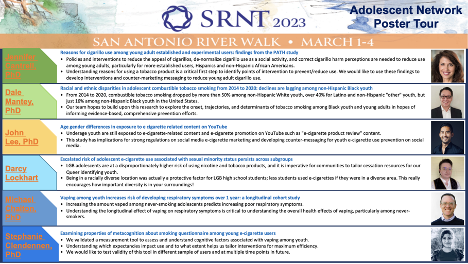
SRNT 2023
The Adolescent Network Poster Tour featured the exciting work of six members:
|
|
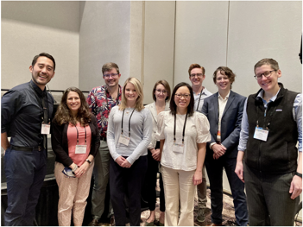
The Adolescent Network pre-conference workshop, “Refining tobacco use research among sexual and gender minority (SGM) youth and young adults” was a hit! We discussed health disparities, the etiology of tobacco use among SGM youth and young adults, and shared methodological considerations in SGM youth and young adults tobacco research. We distributed resources and facilitated a mock intervention development session of SGM user-centered tobacco prevention/treatment design. Thank you to our presenters and attendees: these smiles say it all!
|
|
ADOLESCENT NETWORK UPDATES
Member meeting: We held our annual member’s meeting in March. The network leadership provided an overview of the Adolescent Network and associated subcommittees, we made a call for volunteers/members and held breakout sessions, in which we generated ideas for potential activities for 2023-2024. We encourage you to review the slides and to contact Jenny Cornacchione Ross & Sarah Kowitt with questions or feedback.
The Adolescent Network Advisory and Subcommittees are growing! The Communications Subcommittee welcomes Dr. MeLisa Creamer as co-chair and Brenda Dimaya, MPH as a member. The Annual Meeting subcommittee welcomes Olatokunbo Osibogun, MBBS, MPH, PHD as our new Operations Coordinator.
Check out these publications authored by our Adolescent Network peers:
Compton, W. M., Flannagan, K. S., Silveira, M. L., Creamer, M. R., Kimmel, H. L., Kanel, M., ... & Volkow, N. D. (2023). Tobacco, Alcohol, Cannabis, and Other Drug Use in the US Before and During the Early Phase of the COVID-19 Pandemic. JAMA network open, 6(1), e2254566-e2254566.
Pasch, K. E., Thomas, J. E., North, C., Marti, C. N., & Loukas, A. (2023). Exposure to Tobacco Retail Outlet Tobacco Marketing and Initiation of Cigarette and E-Cigarette Use: Depressive Symptoms as a Moderator. Drug and Alcohol Dependence, 109935.
Strong, D., Glasser, A., Leas, E., Pierce, J., Abrams, D., Hwyrna, M., ... & Niaura, R. (2023). Indicators of tobacco dependence among youth: Findings from Wave 1 (2013-2014) of the Population Assessment of Tobacco and Health (PATH) Study. Nicotine and Tobacco Research, ntad072.
Sutfin, E. L., Lazard, A. J., Wagoner, K. G., King, J. L., Cornacchione Ross, J., Wiseman, K. D., ... & Reboussin, B. A. (2023). Point-of-Sale health communication campaigns for cigarillos and waterpipe tobacco: effects and lessons learned from two cluster randomized trials. Health Communication, 38(6), 1201-1212.
Wackowski, O. A., Bover Manderski, M. T., Gratale, S. K., Weiger, C. V., & O’Connor, R. J. (2023). Perceptions about Levels of Harmful Chemicals in E‐cigarettes Relative to Cigarettes, and Associations with Relative E‐cigarette Harm Perceptions, E‐cigarette Use and Interest. Addiction.
Catch up with Adolescent Network Co-Chair Dr. John Lee, who has been very busy!
|
|
Dr. Lee will serve as Co-Chair of the SRNT Health Equity Network LGBTQ+ workgroup. He will facilitate tobacco research related to LGBTQ youth and young adults. Please feel free to reach out to Dr. Lee with webinar ideas or collaborative research activities (e.g., writing commentaries).
Dr. Lee received a Yale TCORS pilot grant, titled “Lesbian, Gay, Bisexual, Transgender, and Queer (LGBTQ)-targeted tobacco marketing: Evaluating frequency of exposure and relationships with tobacco use, susceptibility, and risk perceptions among LGBTQ young adults.” Dr. Lee will assess tobacco marketing exposure in LGBTQ-related venues (e.g., gay/lesbian bars, pride festivals), and examine how exposure is related to tobacco use behaviors and susceptibility among LGBTQ young adults.
Check out some of the other exciting work Dr. Lee has been up to:
Lee, J., & Parker, M. A. The association between vaping and driving under the influence of cannabis among US young adults: Results from 2020 National Survey on Drug Use and Health (NSDUH). American Journal of Preventive Medicine, S0749-3797(23)00159-9. doi: 10.1016/j.amepre.2023.03.017
Lee, J., Krishnan-Sarin, S., & Kong, G. Social Media Use and Subsequent E-cigarette Susceptibility and Initiation Among US Youth: Results From the Population Assessment of Tobacco and Health (PATH) Study Waves 4 (2016-2018) and 5 (2018-2019). Preventing Chronic Disease. (Accepted)
Lee, J., Krishnan-Sarin, S., & Kong, G. Social media use and vaping cannabis initiation among US adolescents. Drug and Alcohol Dependence. (Accepted)
Lee, J. (May, 2023). E‑Cigarette Marketing on Social Media: A Scoping Review. FDA Center for Tobacco Products, CASEL Journal Club Discussion. Role: Presenter and Discussant.
Lee, J. (June, 2023; Appointed). Identifying E-Cigarette Content on TikTok: Using Bert Topic Modeling Approach. 2023 CPDD Annual meeting. Role: Presenter at the Oral Communication, titled “E-Cigarettes: That's Not a Thumb Drive, Mom!”
|
|
Follow the Adolescent Network on twitter @adolescentSRNT |
|
Society for Research on Nicotine & Tobacco | Website
|
|
|
|
|
|
|