Rail Workers Weekly News Digest
Number 36, November 26th, 2019
|
|
Below is a series of articles compiled over the previous week.
They are of interest to railroad workers.
_____________________________________________
|
|
Article 1
Striking CN workers say they want more rest between shifts — not a pay raise
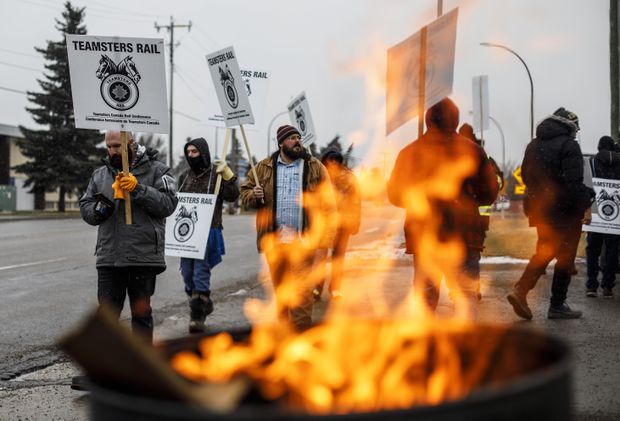
CALGARY—If Daniel Walter wasn’t walking a picket line in Calgary, he might be at home with his wife. Or unexpectedly rushing to a job.
The life of a railroad worker is one of incredible uncertainty, according to three Calgary-based conductors
on strike
. All said they work on a constant “on-call” basis. Within two hours of receiving a call from their supervisor, they need to be at their assigned train — no matter the time of day or night.
“It’s very sporadic,” Walter said, during a break from picketing, trudging across a set of tracks leading to the city’s CN Sarcee depot on a snowy Tuesday morning. “You’ll go from thinking you’re working 12 hours from now to, all of a sudden, get called right away when you’re just getting ready to go to bed.”
Around 3,000 conductors, yard workers and other railway workers with CN went on strike as of 12:01 a.m. on Tuesday. The Teamsters Canada Rail Conference (TCRC), the union representing the strikers, isn’t too concerned about pay rates, but listed safety as a big issue. They cited certain practices performed by CN, such as requiring conductors to use remote controls to shuttle trains between lots while hanging onto the outside of the locomotive.
But one of their biggest concerns is fatigue — and it isn’t confined to one particular company. According to an annual watchlist from the Transportation Safety Board, an independent investigator charged with improving safety practices, sleep-related fatigue issues have been a contributing factor in 31 railway incidents since the early 1990s.
|
|
Article 2
Fatigue on the Rails - A Trainman's Nightmare
Chuck, a locomotive engineer, says he hasn’t had a good night’s sleep in more than 20 years. Chuck isn’t his real name, and the 20 years is probably an exaggeration. But his fatigue is very real. I can hear it in his voice. He’s tired, angry, impatient, and very anxious to talk about his chronic fatigue — something he blames on the unpredictable schedules of his work. And the hazard he says this represents to the Canadian public.
And sometime in the next few hours, he’ll be boarding the locomotive of a freight train and putting in a shift. The money is good — engineers can earn as much $170,000 a year, according to his employer — but the condition of the operators can evoke dread.
Chuck says he’s always tired, operating on autopilot. (He insists on staying anonymous. Otherwise, he says he’d be fired).“A typical day cycle or night cycle for me is … get up, check the lineup, see where my placement on the board is, where the trains line up, and then go on about my day.”
In 2014, the Teamsters surveyed their membership on the question of worker fatigue. The results are sobering. Just under 80 per cent of the respondents were “on call.” The rest were on scheduled shifts.
Here are some of the findings:
- Only 13 per cent said they were getting enough sleep on working days.
- 42 per cent said they work a mix of different shifts.
- Almost all of them said they had no scheduled days off.
- 42 per cent said they had put in 16-hour days three or more times in the past month.
- Nearly three-quarters admitted that, at one time or another, they drifted off to sleep while working.
|
|
Article 3
Two Amtrak Workers Killed Days Apart in Two Separate Incidents
In the space of two days, two Amtrak workers were been killed in two separate incidents, one in Chicago and one in New York. On Tuesday 11/12/19, Brother Martin Rivera - 42 years old - was killed at about 7:15 a.m. near the service and inspection building in Amtrak's mechanical facility south of Union Station. Less than 36 hours later, Brother Juan J. Diaz - age 65 - a member of BMWED Local lodge #3068 was struck and killed by a train on Dock Bridge in New York. This is unacceptable!
|
|
This double tragedy comes days after Amtrak CEO Richard Anderson had touted Amtrak's safety record. On November 8th, the company issued an
Annual Report
in which it crowed about its recent achievements, including a supposed betterment in its "safety culture." In the face of what has unfolded this past week, one has to question the company's commitment to safety.
Amtrak CEO Richard Anderson spent his life as a CEO in the airline and Insurance industries, at Northwest, Delta, and United Health Care. Shortly after assuming the helm at Amtrak, he began a dramatic series of cost-cutting measures which included an expedited elimination of 500 middle level managerial positions. It was in this context of draconian cuts that Amtrak experienced two of its worst fatal incidents in recent memory. Amtrak management has gone on to shut down a major reservation call center, contract out jobs, shutter train stations, remove ticket clerks and baggage agents, eliminate amenities such as dining services from trains, reduce police and security, and threaten to remove some routes altogether! He has earned the wrath of workers across all crafts, and has alienated passengers and rail advocacy groups, mayors, governors and congressmen across the nation. Combined with last week's safety failures, perhaps it is time for him to go!
|
|
Article 4
Is Canada the light at the end of the PSR intermodal tunnel?
Those who have been watching the precipitous decline in United States domestic intermodal activity thus far this year have been able to take some comfort in the superior performance of the Canadian railroads. Intermodal growth north of the border supports the scenario that once the Precision Scheduled Railroading (PSR) transition is completed, the stage is set for intermodal gains. But a closer review calls this assumption into question.
PSR advocates take the position that the current losses represent “the pain before the gain.” Once the difficult and potentially disruptive transition to PSR is completed and the intermodal networks are “right sized” and streamlined, then superior operational performance will prove attractive enough to shippers to once again prompt highway-to-rail conversion and support intermodal growth. The performance of the Canadian railroads is the poster child for this scenario.
Based on these figures, Canada is clearly currently out-performing the US, notching a year-to-date gain of 1.2 percent through the end of October, versus a year-over-year US deficit of 4.5 percent YTD. Mexico lies between these extremes with a YTD loss of 2.7 percent.
But if we take a closer look at where the growth is actually being generated, the picture is quite a bit less encouraging. Intermodal Association of North America (IANA) ETSO data lets us segment the intermodal volume into movements of international ISO containers and domestic equipment (containers and trailers). It also allows us to segment the market geographically in a much more precise manner.
|
|
Article 5
NOTE:
Each month, the Poolson-Oden Law Firm publishes an article in their newsletter from RWU. See the most recent newsletter
Here
. The RWU article is on Page 2. In return, RWU features an article they submit in the RWU Weekly Summary.
I’m Covered Under Workers’ Comp, Right? Wrong!
The Federal Employers’ Liability Act and its Protection
Most railroad workers are under the impression they are covered under workers' compensation and their wages will automatically be paid following an on-duty injury. This is wrong! The realization that the railroad is not required to pay your wages can be surprising and scary. However, railroaders will be relieved to know that the federal injury law that protects railroad workers provides more protection and more compensation than fixed and arbitrary workers’ compensation systems.
The injury law that protects railroad workers is the Federal Employers’ Liability Act, or FELA for short. This body of laws was enacted by Congress in 1908 and still protects railroad workers today, over 100 years later. At the time FELA was enacted and the railroads were being built across the country, Congress noticed that the country's progress in transportation was being built on the backs of these railroad workers, who were being seriously maimed and injured without complete compensation for themselves or their families.
In fact, the average life expectancy for a switchman working in 1893 was just 7 years. The odds of a railroad brakeman dying on the job in 1888 were nearly four to one. During that time, when injuries and deaths of railroad workers occurred on the job, these workers and their families were not entitled to any form of compensation.
|
|
Article 6
New Report Condemns Lack of Time Off Work
(Editor's note: This brilliant expose speaks directly to the experience of North American railroaders, who have witnessed their industry reap record profits, while they have been forced to work longer and harder. Most T&E workers for example in the U.S. work under a vacation agreement that is more than half a century out of date, enjoy no sick time pay at all, and are increasing denied the right to mark-off under threat of discipline. "Quits" have largely become a thing of the past, and the 10- or even 12-hour day is becoming ever more common).
"The Leisure Agenda"
Americans worked a collective 270 billion hours in 2017, 1,739 hours for every worker.
1
These numbers mark an extraordinary burden of labor in our country: millions of people are spending far too much of their waking lives ensnared in needlessly excessive hours of work.
Too many Americans have no vacation days, or very few, or they are not paid enough to enjoy them properly. Too many Americans work hundreds of hours of unpaid overtime, or are forced to choose between parenthood and employment. Too many Americans are spending their twilight years in front of a cash register because they can’t afford a real retirement.
But it doesn’t have to be this way. With some simple and easy reforms, the United States could greatly increase the leisure time enjoyed by its workers. America has long since solved the hard, labor-intensive problems of economic production. This is a very rich country; we can afford to make sensible and morally urgent changes to our labor system.
|
|
Article 7
RWU Members Included in Iowa Conference on the Climate Crisis
SOLVING THE CLIMATE CRISIS
RWU members Ross Grooters and Jeff Kurtz are both rail workers and RWU members in the state of Iowa. Both were on hand for the big conference that took place earlier in November focusing on the climate crisis. Jeff is retired after 38 years as a locomotive engineer for BNSF and was head of the BLET Iowa State Legislative Board for many years. He now serves as an elected official in the Iowa State House. Ross currently works for UP, is an active BLET member, and serves on the local city council. He is one of three RWU Co-Chairs.
Railroad Workers United hopes to make rail a centerpiece to any "Green New Deal" type of legislation that is enacted, and to ensure that a transition to a "Green" economy is one that does not place the burden unduly upon industrial workers like miners and railroaders. As fossil fuels shipments decline, we support a robust rail system in this country, one that is expanding, not contracting, one that can provide tens of thousands of new good union jobs in every state, moving freight and people off the nations highways and onto the railroad.
Bernie Sanders, Alexandria Ocacio-Cortez, Naomi Klein and more presented on stage in Des Moines at this Climate Crisis Summit. Brother Ross Grooters - RWU Co-Chair - took the stage with six other Iowa citizens for a panel discussion on labor and environmental issues.
|
|
Article 8
Union, Management Resume Negotiations amid Korea Rail Strike
The labor union and management of Korea Railroad Corporation (KORAIL) are holding negotiations on Sunday as the unionized railway workers continued their general strike for the fifth consecutive day.
The two sides resumed negotiations on Saturday night at the proposal of the union but failed to narrow differences. The negotiations will continue on Sunday as the nation is set to host the ASEAN-South Korea summit in Busan on Monday and Tuesday.
Meanwhile, disruptions in train services will likely continue on Sunday. KORAIL plans to operate 68 percent of KTX bullet trains on Sunday, operating just 223 trains compared to 327 for usual Sundays.
Slower Saemaeul and Mugunghwa lines will be operating at 59 percent and 62-point-five percent of normal levels, respectively. Cargo services will be running at 31 percent of the general operative level.
|
|
|
|
|
|
|