REMINDER: YOUR SUBMISSIONS ARE ENCOURAGED | | |
1. I'm starting this week by giving a big Welcome Home to the two stranded ISS astronauts, Suni Williams & Butch Wilmore, who splashed down in the Gulf of Mexico on Tuesday.
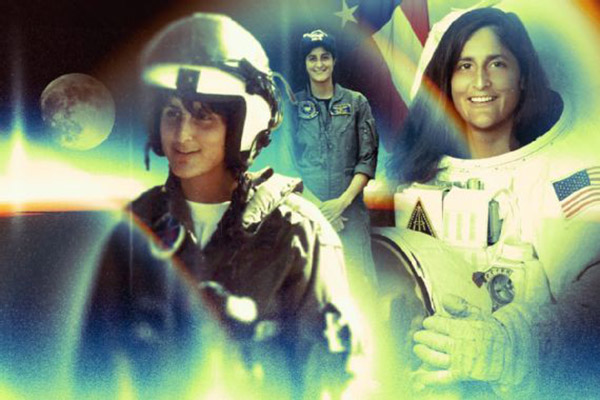
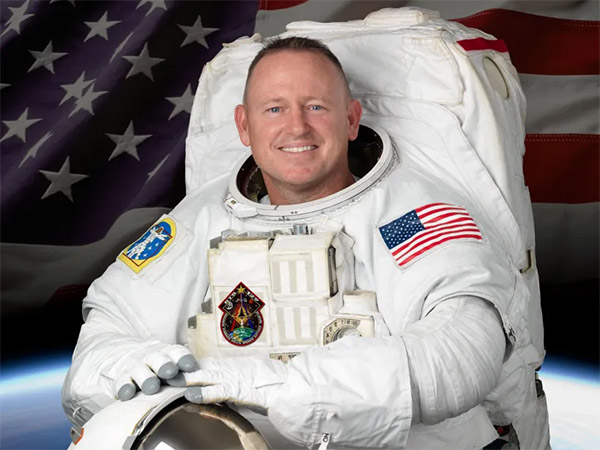
2. In the Flock Spotlight, I'm including bios on Suni & Butch.
3. Next, in Performing Arts, I'm featuring Bob Dylan.
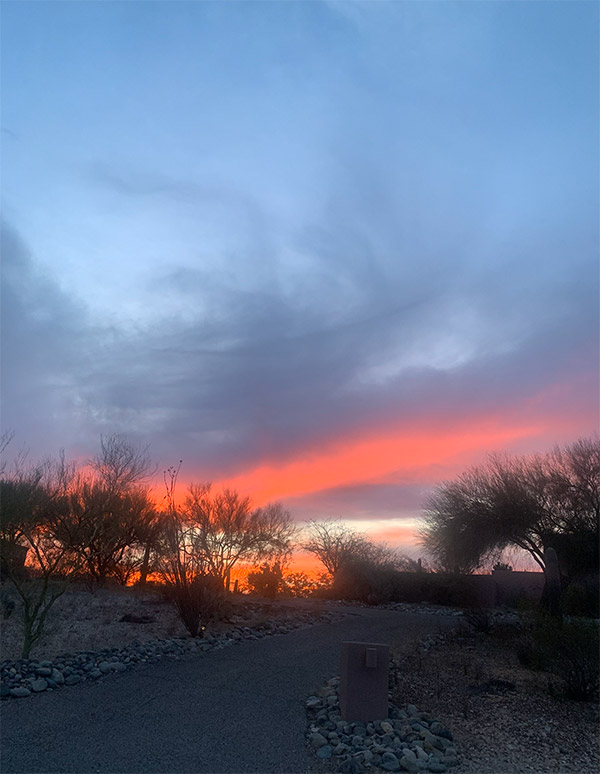
4. I'm always happy to receive and share a Reader Submission; this week, I have a colorful sunset photo from Bindu Shroff, a dear friend, and Flock reader, Bindu Shroff.
5. In Around Town, the annual Fourth Avenue Spring Street Fair is this weekend. The street Fair is one of Tucson's favorite community celebrations, and the weather should be beautiful.
6. March Madness is here. The Wildcats are coming in as a fourth seed this year, and their prospects look good. Bear Down Wildcats!
7. Wellness this week is a yawn, but it's something that all vertebrates do, and it's both healthy and contagious.
8. In the Pet's Corner, Cita Scott's cat, Oliver, takes a break from his busy cat schedule to check in.
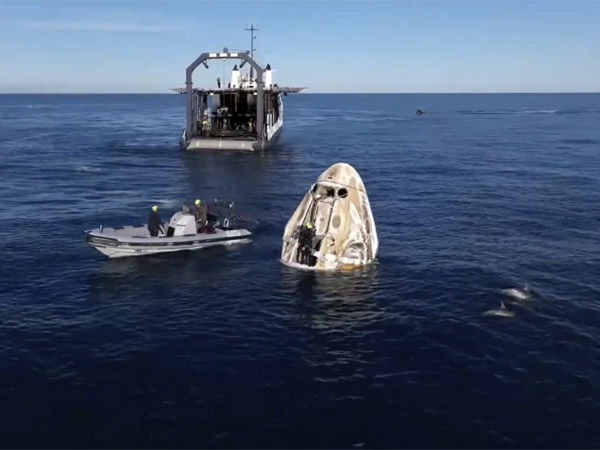
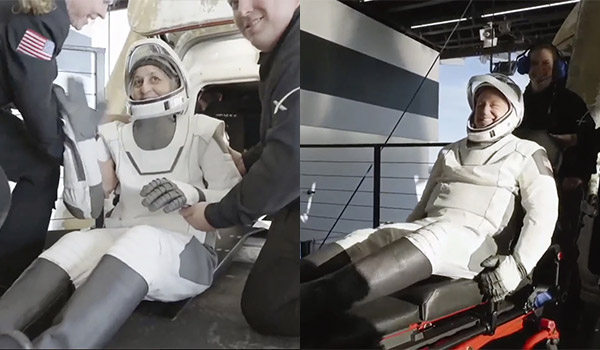
| | Now, to this week's Flock. | | 1. ISS Update: Welcome Home Butch & Suni! | | Last August, I started following the plight of NASA astronauts Butch Wilmore and Suni Williams, who were stuck on the International Space Station after technical issues with the Starliner capsule indefinitely extended their planned eight-day mission. The existing ISS team incorporated them into the mission. This past Tuesday, they returned to Earth aboard a Space X Dragon capsule with fellow ISS crew members Nicholas Hague and Aleksandr Gorbunov to be greeted in the Gulf of Mexico by a pod of curious dolphins. | | NASA astronauts Butch Wilmore and Suni Williams return to Earth after 9 months stuck in space | | |
It all started with a flawed Boeing test flight last spring.
…The two expected to be gone just a week or so after launching on Boeing’s new Starliner crew capsule on June 5. So many problems cropped up on the way to the space station that NASA eventually sent Starliner back empty and transferred the test pilots to SpaceX, pushing their homecoming into February. Then SpaceX capsule issues added another month’s delay.
Wilmore and Williams ended up spending 286 days in space — 278 days longer than anticipated when they launched. They circled Earth 4,576 times and traveled 121 million miles (195 million kilometers) by the time of splashdown.
…Dolphins circled the capsule as divers readied it for hoisting onto the recovery ship. Once safely on board, the side hatch was opened and the astronauts were helped out, one by one. Williams was next-to-last out, followed by Wilmore who gave two gloved thumbs-up.
| | Health impacts of 9 months in space as 2 NASA astronauts return home after extended stay on ISS | | Extended time in space can bring changes to human physiology and psychology. | | From: ABC News, By: Mary Kekatos, March 18, 2025 | | |
…Experts have said that spending a prolonged period in space -- especially many months -- can come with many changes to human physiology and psychology.
Changes due to microgravity
One of the biggest changes comes from spending time in microgravity, which allows astronauts to float inside a spacecraft or outside during spacewalks.
During this period, there is a decrease of muscle mass -- due to decreased use and lack of stimulus through exercise equipment — and bone loss, according to NASA.
Without Earth's gravity, bones that support the body's weight can lose 1% to 1.5% of mineral density on average per month in space, the federal health agency says.
Additionally, without eating a proper diet and getting proper exercise, astronauts lose muscle mass faster in microgravity than they would on Earth.
Space radiation
Space radiation is different from radiation experienced on Earth. It's made up of three kinds of radiation: particles trapped in Earth's magnetic field, particles from solar flares and galactic cosmic rays NASA said.
Earth is surrounded by a system of magnetic fields, called the magnetosphere, that protects people from harmful space radiation. However, the higher a person is in altitude, the higher the dose of radiation they are exposed to.
Due to prolonged exposure, astronauts can be at significant risk for radiation sickness and have a higher lifetime risk of cancer, central nervous system effects and degenerative diseases, according to NASA.
| |
2. Flock Spotlight: Suni Williams & Butch Wilmore
| | Sunita Williams family: All about her parents and husband Michael | | |
Sunita Williams' Family:
Sunita Williams' father, Deepak Pandya, hails from Jhulasan, Gujarat. After completing his Intermediate Science (I.S.) in 1953 at Gujarat University, he earned his M.D. in 1957. He then moved to the United States, where he completed his internship and residency in Medicine in Cleveland, Ohio. In 1964, Pandya joined the Department of Anatomy at Case Western Reserve University as a postdoctoral fellow and went on to work at various hospitals and research centres across the country.
Pandya met Slovenian-American Ursuline Bonnie Zalokar when he arrived in the U.S. in 1957, and the two married shortly after.
Sunita Williams' Husband:
Sunita Williams is married to Michael J. Williams, a federal marshal in Texas. Both of them had backgrounds in flying helicopters before embarking on their respective careers. The couple has been married for 20 years and has no children.
Some facts about Suni Williams:
• Suni Williams is the second female NASA astronaut of Indian-American ancestry to fly into space after Kalpana Chawla, who perished when the space shuttle Columbia disintegrated upon reentry in 2003.
• Suni graduated from the U.S. Naval Academy with the rank of ensign in 1987 before reporting for aviator training at the Naval Aviation Training Command.
• In 1995, she completed an M.S. in engineering management at the Florida Institute of Technology.
• She has logged over 608 days in space in her three missions to the International Space Station as a flight engineer on the space shuttle Discovery, a Soyuz capsule, the Boeing Starliner, and the Space X Dragon.
• She has a total of 62 hours and 6 minutes of space-walk time, the NASA record for a female astronaut.
| | NASA Astronaut Barry “Butch” E. Wilmore | | |
Barry E. Wilmore (Captain, U.S. Navy, Ret.) is a veteran of three spaceflights and has accumulated a total of 464 days in space. Wilmore launched to the International Space Station aboard a Russian Soyuz in Sept. 2014 as a member of Expedition 41. He served as a Flight Engineer until November when he assumed command of the station upon arrival of the Expedition 42 crew. He returned to Earth in March 2015. During this mission, he logged 167 days in space and performed four spacewalks totaling 25 hours, 36 minutes. In 2009, Wilmore served as a pilot aboard space shuttle Atlantis for STS-129, traveling 4.5 million miles in 171 orbits. Most recently, NASA astronauts Butch Wilmore and Suni Williams launched aboard Boeing’s Starliner spacecraft on June 5, 2024, for its first crewed flight, arriving at the space station on June 6. Following the agency’s decision to return Starliner uncrewed, the duo became Expedition 71/72 crewmembers and returned home in March 2025 aboard the SpaceX Dragon spacecraft with NASA astronaut Nick Hague and Roscosmos cosmonaut Aleksandr Gorbunov on NASA’s SpaceX Crew-9 mission.
Wilmore is married to the former Miss Deanna Newport of Helenwood, Tennessee, and they have two daughters, Daryn and Logan. Wilmore was raised in Mt. Juliet, Tennessee where his parents Eugene and Faye Wilmore still reside. His brother Jack and family reside in Franklin, Tennessee.
Some Facts about Butch Wilmore:
• Butch has a Master of Science in Aviation Systems from the University of Tennessee.
• Butch was a team captain on the Tennessee Tech University football team.
• He was the 2018 recipient of the NCAA's highest honor: the Theodore Roosevelt Award, given to an individual who exemplifies the ideals of college sports.
• He accumulated over 8,000 flight hours and 666 carrier landings and completed 21 combat missions during Operation Desert Storm as a navy pilot.
| | 3. Performing Arts: Timeless Bob Dylan | | The popularity of A Complete Unknown, the Academy Award-nominated biopic about Bob Dylan's early musical career and his mentorship under folk singer Pete Seeger, got me googling. I found this essay from Forward on the timeless relevance of Bob Dylan's lyrics. I'm including a trailer for the film and a performance of North Country Blues by a 22-year-old Bob Dylan at the 1963 Newport Folk Festival. | | In 1964, when he was just 23, Bob Dylan wrote the prophetic anthem that encapsulates Trump’s America | | Decrying a world characterized by materialism, violence and blind conformity, Dylan echoed the warnings of King Solomon | | From: Forward, By: Seth Rogovoy, March 9, 2025 | | |
With well over 600 songs in Dylan’s catalog, it is never difficult to find lines or verses that speak to whatever defines the moment. Take 1967’s “Too Much of Nothing,” in which Dylan sings, “Too much of nothing can make a man abuse a king / He can walk the streets and boast like most / But he wouldn’t know a thing.” Those lines echo through the decades, as do the following: “Too much of nothing can turn a man into a liar — when there’s too much of nothing it just makes a fella mean.” Remind you of anyone?
Around the same time, Dylan wrote in another song, “I pity the poor immigrant who wishes he would’ve stayed home.” Note that this was in an era when immigration was not anywhere near the heated topic of political conversation that it is today. “I pity the poor immigrant whose strength is spent in vain / Whose heaven is like Ironsides / Whose tears are like rain,” Dylan continued, borrowing imagery from the Book of Leviticus, chapter 26. On that same album, Dylan sang in “All Along the Watchtower” — which borrows its central imagery from the Book of Isaiah, chapter 21 — “‘There must be some way out of here,’ said the joker to the thief / ‘There’s too much confusion, I can’t get no relief’,” expressing a sentiment many of us feel these days after perusing the news.
One continues to find such resonant phrases in Dylan’s writing throughout the 1970s and beyond. “Socialism, hypnotism, patriotism, materialism / Fools making laws for the breaking of jaws / And the sound of the keys as they clink / But there’s no time to think,” Dylan sang in “No Time to Think” on his 1978 album, Street Legal. In “Pay in Blood,” a hard-rocking number from the 2012 album, Tempest, Dylan sings, “Our nation must be saved and freed / You been accused of murder, how do you plead?”
| | A Complete Unknown | Official Trailer | | Bob Dylan | North Country Blues (Newport Folk Festival 1963) | | 4. Reader Submission: A Colorful Sunset | | |
The colors in this beautiful sunset photo submitted by my long-time friend and Flock reader, Bindu Shroff, remind me of some of the images from the post on Holi, the Festival of Colors, with which I opened the first March Flock. Thank you, Bindu, for sending this beautiful sunset to the Flock.
If you would like to submit photos, poems, stories, or your thoughts with the Flock, please use the "Share Stories & Photos " button below.
| |
5. Around Town: Fourth Ave. Street Fair
| | The annual Fourth Avenue Spring Street Fair is being held this weekend just north of Tucson's Downtown, along Fourth Ave.The Street Fair brings the whole town out and is a great way to enjoy the weekend and Tucson's mild spring weather. | | 56th Annual Fourth Avenue Spring Street Fair | | |
The Fourth Avenue Street Fair, held bi-annually in the historic district of Tucson, AZ, is recognized as one of the premier community celebrations in the Southwest, it is a Top 100 event both nationally and internationally.
We invite you to participate in this Tucson tradition, which attracts more than 350,000 visitors. This family-friendly event promotes original, hand-made art, with 350+ artists from around the world.
The Fair offers something for everyone including live entertainment, buskers, 40+ food vendors, beer, and our local 4th Avenue Merchants.
Admission is free of charge to the public.
| |
6. University of Arizona: March Madness
| | The annual NCAA Men's March Madness basketball tournament has begun. The University of Arizona is ranked 21st nationally and is the 4th seed in the East Region this year. I'm rooting for the Wildcats and coach Tommy Lloyd this year; Bear Down! | | Arizona To Make 39th NCAA Tournament Appearance | | |
The bracket for the 2025 NCAA Men's Basketball Championship was unveiled on Sunday and for the 39th time, the Arizona Men's basketball team will be a participant. Head coach Tommy Lloyd and the Wildcats were joined by hundreds of fans at Union Public House in Tucson to watch the Selection Show live.
The Wildcats were selected as the No. 4 seed in the East Region and will play their first game on Friday, March 21 against No. 13 seed Akron at Climate Pledge Arena in Seattle, Washington.
This is the fourth time in four years under head coach Tommy Lloyd that the Wildcats have advanced to the NCAA Tournament. Each year, Arizona has been a top four seed in its region.
The Wildcats have played in the NCAA Tournament in Seattle twice before. In 1988, as a No. 1 seed on the way to the first Final Four in program history, Arizona defeated No. 5 seed Iowa, 99-79, in the regional semifinal and then took down No. 2 seed North Carolina, 70-52.
Then in 1991, Arizona was a No. 2 seed and lost to No. 3 seed Seton Hall, 81-77, in the regional semifinal.
| |
7. Wellness: Why Do We Yawn?
| | We all yawn. Almost all vertebrates, including birds, reptiles, amphibians, and mammals, yawn, except for some marine mammals like whales and dolphins. So, why do we yawn? | | From: WebMD, By: Frances Gatta, March 15, 2024 | | |
What Is Yawning?
Yawning is a common reflex in which you open your jaw wide, take a deep breath, and then quickly breathe out. It lasts about 4-7 seconds and often happens when you're waking up or falling asleep.
Yawning begins in the womb as early as the 11th week of pregnancy and continues for a lifetime. When you yawn, a wetting agent known as a surfactant coats the tiny air sacs (alveoli) in your lungs, which helps keep them open.
Although no one knows exactly why we yawn, new studies suggest that yawning may not always be a sign you’re tired or bored, as most people believe.
Interestingly, many people feel more relaxed after yawning.
Why do we yawn?
Yawning may be contagious or spontaneous. Contagious yawning happens when you see, hear, feel, or think about someone yawning. On the other hand, spontaneous yawning occurs without any obvious trigger.
According to a popular theory, a yawn can help cool the brain when it’s warming up. Researchers think this cooling happens for two reasons:
• Yawning opens up the muscles in your skull and jaw to increase blood flow to the brain
• Yawning causes you to breathe in deeply, which increases blood flow in the veins in your brain and allows cooler air in.
| | |
Why is yawning contagious?
Contagious yawning starts in early childhood. You might yawn after seeing, hearing, or thinking about someone else yawn. In fact, seeing your pet or animals such as fish, birds, and apes yawn may also make you yawn.
Contagious yawning is believed to have evolved as a way to stay alert and in sync in a group. It may also be a way of telling other people that you feel the same way (maybe bored) about a situation or experience.
Research suggests that contagious yawning may be linked to empathy, which is feeling and understanding someone else’s experience, and people who yawn after seeing others yawn show higher empathy. You’re also likely to yawn when someone you’re close to or care for yawns.
| | 8. Pet's Corner: Oliver Checks In | | |
photo: Cita Scott
Oliver doing cat things: relaxing by the flowers.
| | |
credit: NASA, ESA,STSci, and hubble Space Telescope
The Lagoon Nebula
| | These Flock regulars are always here for you: | | Don't Be Shy: Share Your Stories! | | I'm looking forward to sharing more of your personal stories - oral, written, or otherwise, as we enter our third year. I'd so love to present them to The Flock, hit a mailbox below to share your story. | | Subscriptions & Idea Submissions
Reminder: Your submissions are always welcomed. | | |
Feel free to forward this email to a friend. If this was forwarded to you and you would like to receive your very own Flock Newsletter, you can sign up here. If you have any questions or suggestions for future Flock resources, don't hesitate to contact me.
Your fan and friend,
Beth
| | | The information and materials contained or referenced in this newsletter are for informational purposes only and not intended to be a substitute for professional medical advice, diagnosis, or treatment. Always consult a physician or other qualified medical professional with any questions you may have regarding a medical condition or treatment and before beginning a new health care regimen. Do not disregard professional medical advice or delay seeking medical advice or care based on anything contained in this newsletter. | | | | |