| | |
POLICY & ADVOCACY UPDATE
Issue #75, 9 July 2026
| | | |
- From the AA CEO James Goodwin
- Visa fee increases
-
Debit card costs survey - due tomorrow
- Shifting accommodation and regional patterns in international holiday nights
- Capital city hotel performance for June
| |
| |
From the AA CEO
As we close another financial year and enter a new one, it is worth reflecting on how quickly market conditions can change. Only a few months ago, there was considerable uncertainty about the outlook for Australia's accommodation sector. Pleasingly, the end of the financial year has shown a level of resilience across our capital city markets that exceeded expectations, demonstrating the enduring strength of domestic and international demand.
| | | |
|
The picture, however, is not consistent across the country. Many regional destinations continue to face more challenging conditions, particularly those that rely heavily on a strong winter season. Markets such as the Northern Territory are experiencing softer trading conditions, reminding us that recovery and growth remain uneven across Australia. And some more snowfall would help boost those relying on the ski season in New South Wales and Victoria these school holidays.
Our focus turns to the mounting cost pressures facing operators. Increases in wages, energy, insurance and other operating expenses continue to place significant pressure on margins, even where occupancy and demand remain solid. If you haven’t completed the survey about debit card transactions, please do so below. Important we continue to work together for better outcomes.
James Goodwin
Chief Executive Officer
| | | | |
Visa Fee Increases
In a surprise announcement last week, the Government increased fees on a range of visa categories by approximately 25% as at 1 July 2026. These changes were not signalled in the Federal budget or at anytime before the announcement. Although this is not unusual, as the government does not want to create a rush on visa applications before fee increases, it is still disappointing as it will impact both business costs and tourism visitation. The increases will also impact Australia's attractiveness for working holiday makers and students. The main fee increases which will impact the hotel sector include:
- Employer nomination scheme (permanent skilled) from $4,910 to $6,135.
- Skills in Demand Temporary skilled visas from $3,210 to $4,015
- Working holiday maker visa from $670 to $840.
- Student visa from $2,000 to $2,500
- Graduate visa from $4,600 to $5,750
- Visitor visa up from $200 to $250.
With migration such a hot political issue at the moment, it is likely that the government would consider it a low risk to increase visa fees and would not be too concerned about a reduction in migration numbers while at the same time pocketing the extra revenue. Of course, from our industry perspective, this would be a shortsighted view as the potential for economic cost may outweigh the benefit.
| |
Debit Card Costs Survey
In less than four months, on 1 October 2026, the RBA is banning surcharging on all card and mobile transactions. AHA and AA are working on getting the best deal for members from EFTPOS, Visa, Mastercard and payment service providers – but we need your data now to do so. Pulling together is our only chance of securing a good deal after October 1 – when you will no longer be able to pass on costs to customers. Please complete this very brief survey by tomorrow Friday, 10 July. The link to the survey is here.
| | |
Shifting accommodation and regional patterns in international holiday nights
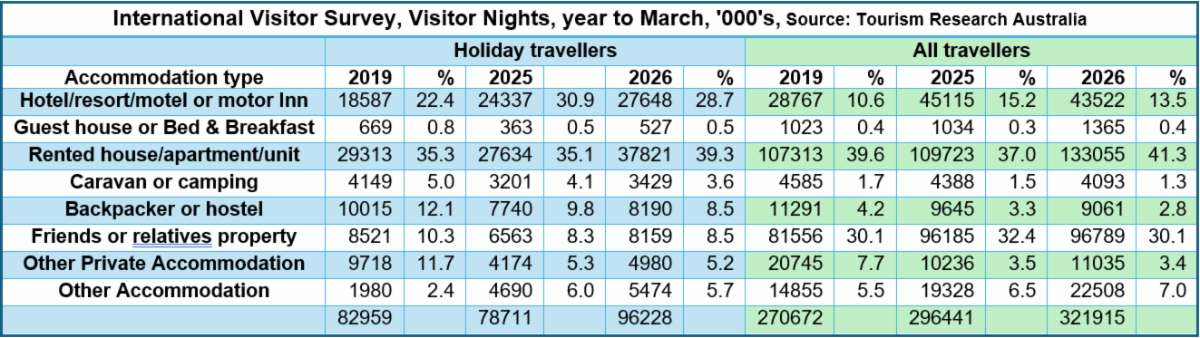
Last month, Tourism Research Australia released the International Visitor Survey (IVS) accommodation data for the year to March 2026. The overall IVS holiday nights figures (capital cities, Gold Coast, and the regions) highlight a mixed but increasingly competitive picture for the hotel sector. While overall international holiday visitor nights have continued to grow strongly since 2019, reaching a record 96.2 million in 2026, hotels have lost some ground in the most recent year, with their share easing from 30.9% in 2025 to 28.7% in 2026, as can be seen in the table below. This reflects ongoing pressure from the continued expansion of rented houses and apartments, which reinforces the challenges hotels face with short term rentals. Over the longer term, traditional and lower-cost segments such as backpacker/hostels, caravan and camping, and friends and relatives have also seen sustained declines in relative share, underscoring a gradual but persistent shift in how international visitors are choosing to stay in Australia.
The data also enabled AA to do a deep dive on regional dispersal of international travellers indicating that the share of international holiday visitor nights spent in the regions has declined in the last ten years from 31% in 2016 to 28.2% in 2026. The hotel share of international regional holiday visitor nights has increased in the last ten years from 20.1% to 23.9%. This increase has not matched the more significant rise in the use by international holidaymakers of regional rented houses/units (AirBnb etc), where the share has risen from 24.5% ten years ago to 35.2% in 2026. For the full analysis of regional dispersal of international holiday visitor nights, see here.
| | |
Capital city hotel performance for June
Preliminary capital city CoStar data for the month of June 2026 continues to illustrate mixed results for the Australian hotel market, with relative strength in Sydney, Melbourne, Canberra, and Hobart, while Brisbane, Perth, and Darwin experienced more negative outcomes. For June 2026 compared to June 2025:
- Sydney saw a 1.1% rise in occupancy to 74.2%, and ADR was up 2.6% to $243.81.
- Melbourne's occupancy was up 2% to 66.4% and ADR rose 0.4% to $195.91.
- Brisbane occupancy fell by 4.5% to 72.4%, while ADR fell 3.1% to $230.15.
- Adelaide occupancy rose by 0.2% to 69.2% and ADR rose 5% to $188.13.
- Perth occupancy fell 4.6% to 73.9% and ADR fell 2.3% to $227.60.
- Hobart occupancy up by 4.2% to 71.2% and ADR up 5% to $214.08.
- Darwin occupancy fell 11.4% to 68.2% but ADR rose 4.5% to $256.33.
- ACT and Canberra occupancy was up 5.5% to 71.2% and ADR stayed consistent with a 0% change at $186.33.
- Gold Coast occupancy up 2% to 58.9% and ADR up 7.1% to $247.79.
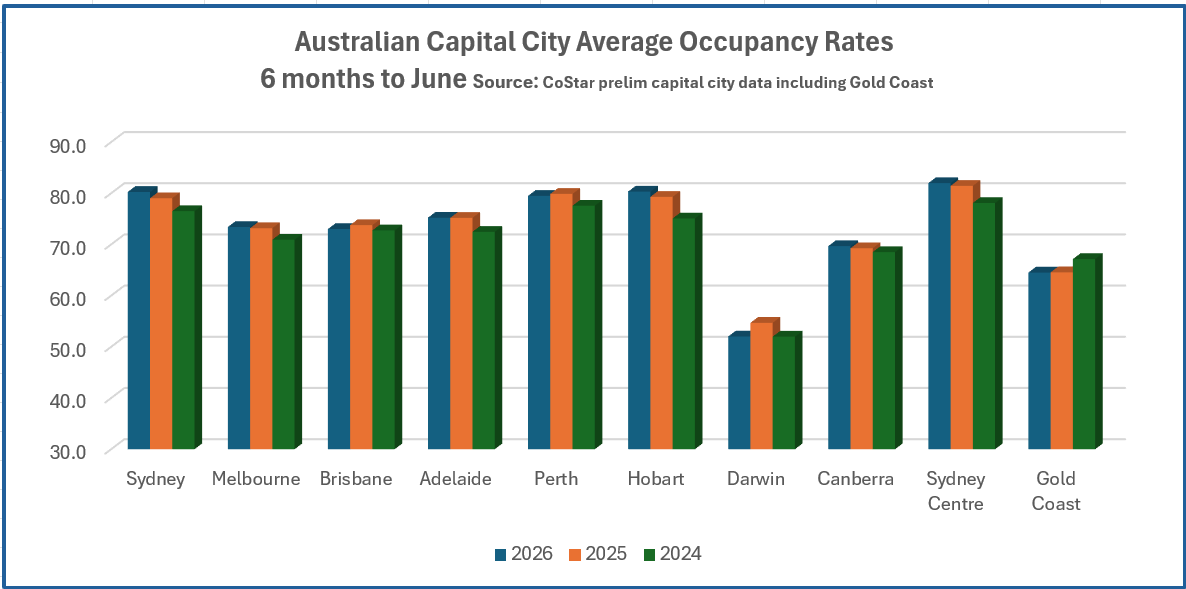
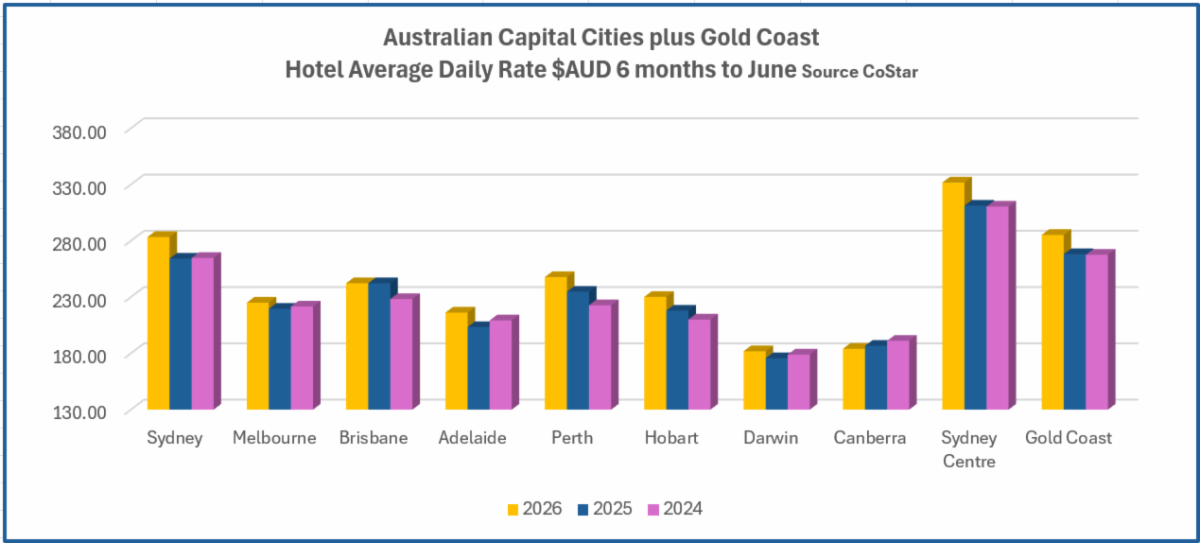
The graphs below derived from the CoStar data show the average occupancy rate and ADR experienced in the capital cities in the first six months for each of the last three years. Over the six months, four cities have recorded a decline in average occupancy compared to 2025: Darwin, Brisbane, Gold Coast, and Perth. Canberra is the only capital city to see a fall in average room rate, continuing a downward trend over the last two years. Sydney has recorded the strongest increase in ADR, up 7.3% to $283.36 averaged over the six months, with Adelaide, Gold Coast, and Hobart also showing strong ADR performance.
| |
| | |
3 things for you to do today to support the industry's jobs and careers platform eeger.com.au:
- Register on eeger to build your employer profile
-
Follow eeger on LinkedIn to stay in touch
- List your job vacancies on the site that has been developed for industry by industry
| | | | |
Drop me an email at policy@accommodationaustralia.org or give me a call on 0418 277 919 if you have any national policy issue that you think AA should be following up. If you know an AA member who is not receiving this advocacy report but wants to, then encourage them to email me and we can add them to the distribution list. Back issues of the fortnightly advocacy updates can be found here.
Kind Regards
Jenny Lambert OAM
National Policy Director
Accommodation Australia
| | | | |