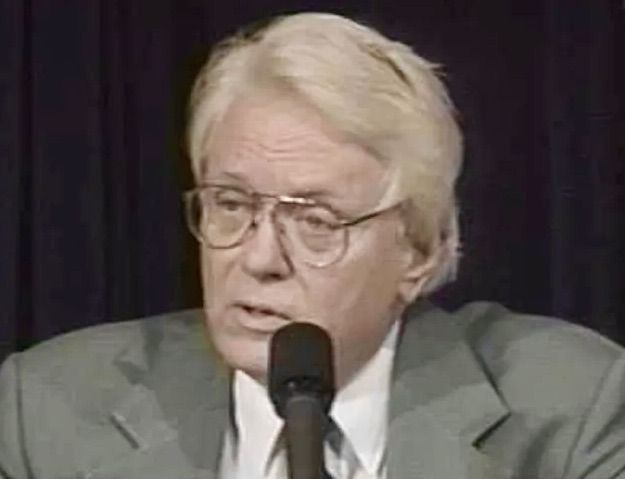
A newly established broadcast journalism scholarship supports diversity within the field while honoring longtime radio journalist Wes Vernon (pictured), a former National Press Club member.
The Wes Vernon Broadcast Scholarship will provide $5,000 annually to a student who demonstrates a commitment to a career in broadcast journalism. The award can be renewed up to three years for a total of $20,000 toward educational expenses.
“My father loved his years in news radio – every morning he was excited to see what the day would bring,” said Diane Powell, Mr. Vernon’s daughter. “I hope this scholarship will support the studies of others with the same enthusiasm for broadcasting.”
In creating the scholarship, Mr. Vernon’s family wished to remove barriers for students from backgrounds underrepresented in broadcast journalism.
Funded by the Robertson-Powell Foundation, the scholarship recipient will be selected annually by the National Press Club’s Scholarship Committee and will be administered by the National Press Club Journalism Institute. The inaugural scholarship will be awarded this year; applications are due June 1.
“We are honored to help the family of Wes Vernon recognize his incredible radio journalism career,” said National Press Club President Lisa Matthews.
A broadcaster herself, Matthews said, “When I first joined the news desk at the AP, there weren’t many other people there who looked like me. This scholarship will help ensure that more broadcast newsrooms start to look more like the communities they cover.”
While developing the scholarship criteria and its impact, the Powell family emphasized its desire for students of all ages and backgrounds to be considered. Preference will go to students entering or enrolled in a community college, although the award is open to any student — whether an incoming freshman or a mid-career professional changing careers — pursuing an education in broadcast journalism.
“This scholarship creates a wonderful legacy and a way to pass Wes Vernon’s good work on to the next generation of journalists,” said Angela Greiling Keane, president of the National Press Club Journalism Institute.
Wes Vernon retired from the airwaves in 1997, after nearly five decades on the air. After earning a job as a disc jockey at age 18 – and after a year of studying journalism at Utah State University – he considered his career launched.
Vernon worked at stations in Utah, Wyoming and Montana for more than a decade, tracking down local stories and developing a speciality in politics reporting. In 1968, Vernon became the chief of Bonneville International’s new Washington Bureau, serving as a one-person news bureau covering the local angle of national news for several markets in the US and filing as many as 15 to 20 stories a day.
By 1972, Vernon joined the CBS Radio Stations News Service as a Washington correspondent. In 1975, he added duties as host for the CBS program Crosstalk. He spent the next 25 years reporting on various national and regional news stories as well as Democratic and Republican conventions for seven CBS-owned and -operated stations in seven major markets.
“It’s so meaningful for my family to preserve his legacy in this way,” said Powell, whose father now suffers from Alzheimer’s disease. “We hope it will provide aid to students with his passion for broadcast news.”
The Wes Vernon Broadcast Scholarship joins a portfolio of student support that includes:
- Scholarship for Journalism Diversity Honoring Julie Schoo, a $5,000 award, which can be renewed up to three years, given to a high school senior interested in journalism.
- Feldman Fellowship for Graduate Studies in Journalism, a one-time stipend of $5,000 to help defray post-graduate tuition costs.
- Richard G. Zimmerman Journalism Scholarship, a one-time $5,000 award given annually to a high school senior who wishes to pursue a career in journalism.
For additional information on the Wes Vernon Broadcast Scholarship, email Beth Francesco.
To apply for the Wes Vernon Broadcast Scholarship, click here. Deadline is June 1, 2021. Contribute to the Wes Vernon Broadcast Scholarship here.