|
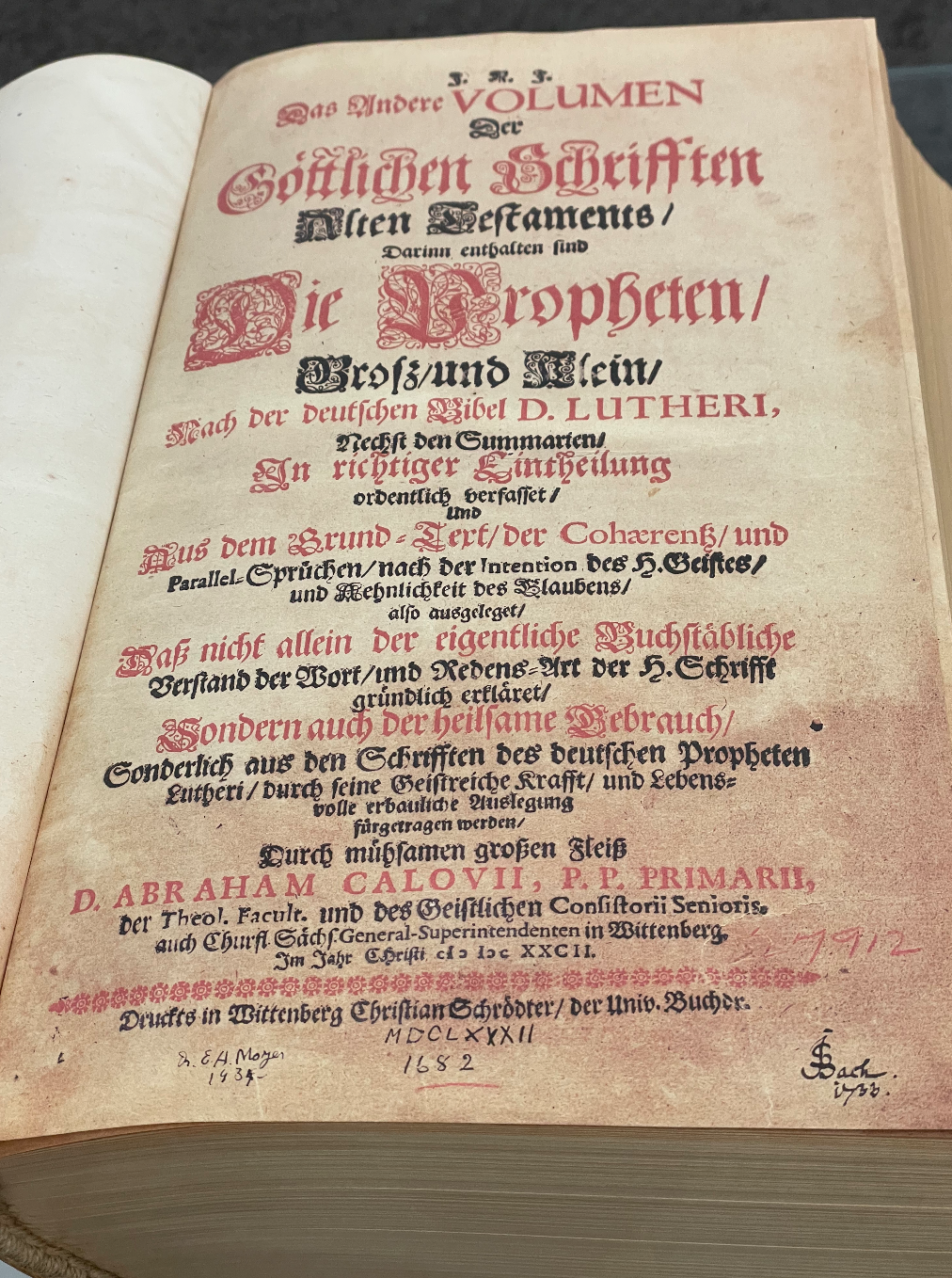
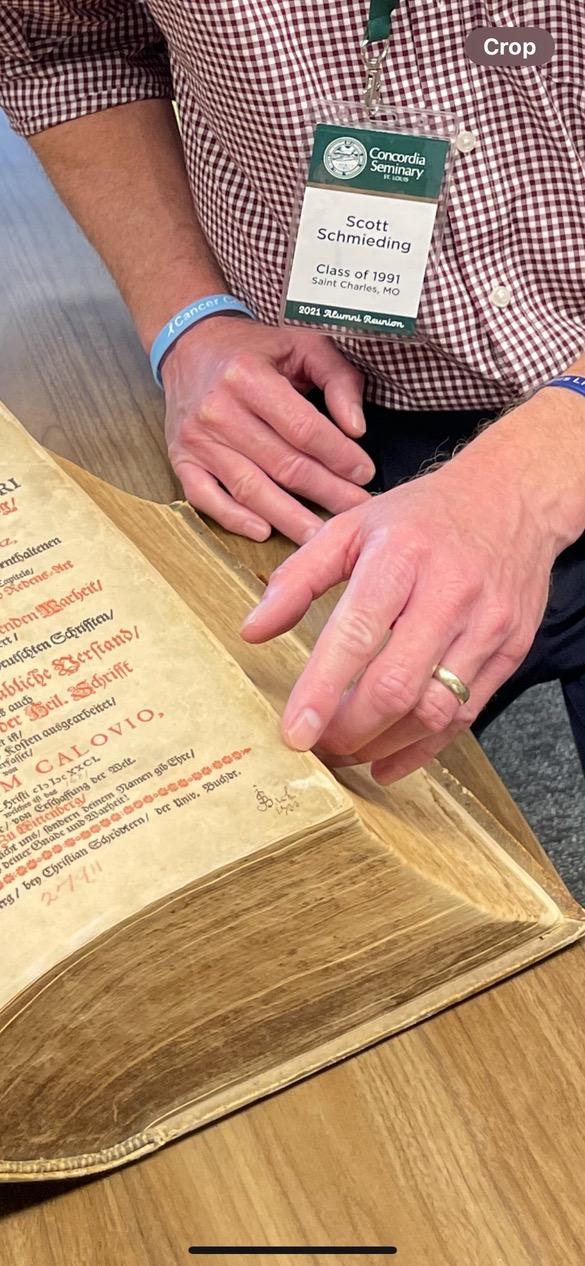
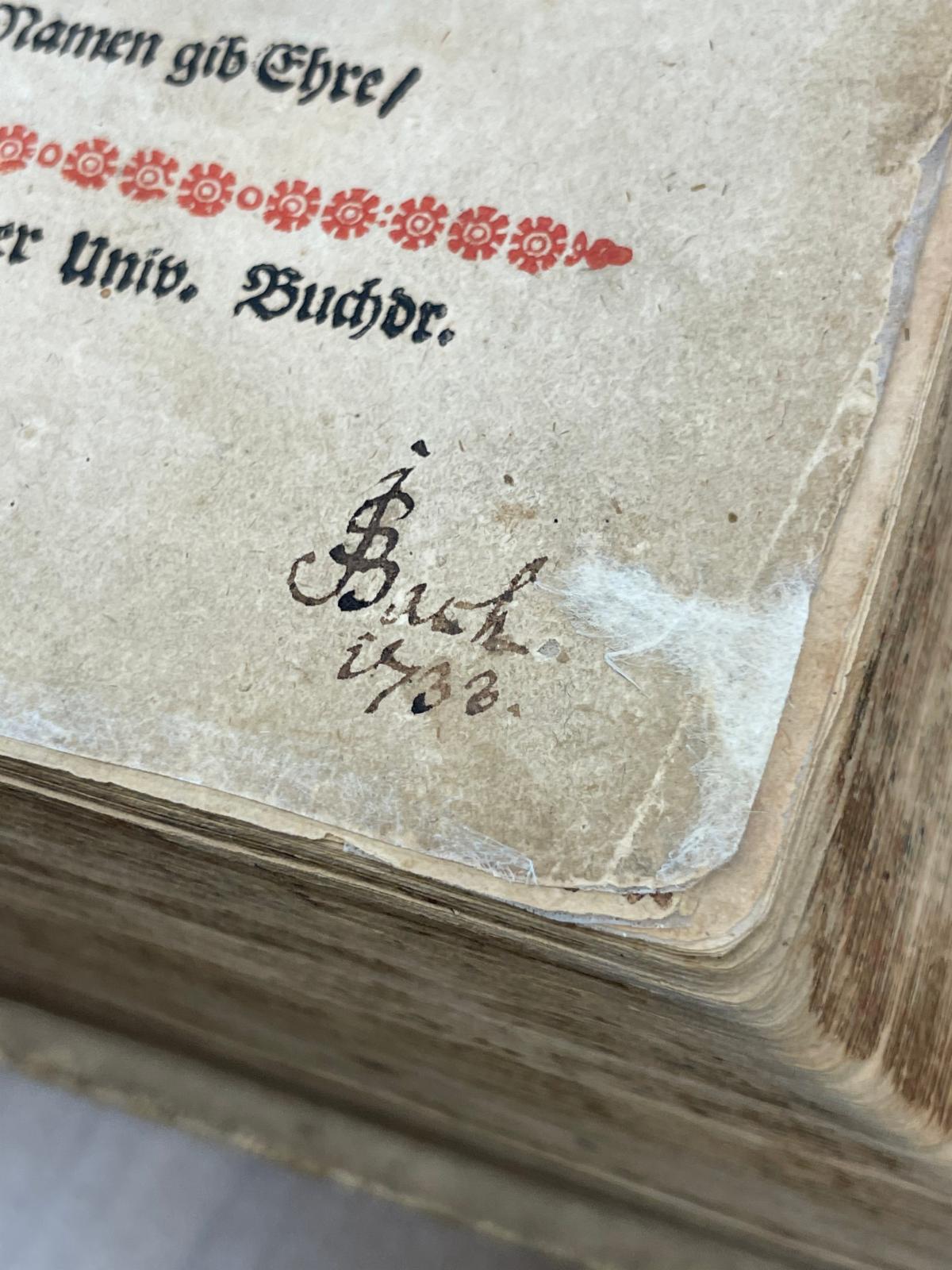
The above three pictures are of the actual German edition of Luther’s translation of Die Heilige Bibel (The Holy Bible) that was owned and used by J.S.Bach. Note Bach’s handwriting and how he artistically abbreviated his full name using his J.S.B. initials in the front of his Bibel in 1733!
It was inspiring and an honor to touch and see Bach’s Bible and handwritten comments! The so-called Calov Bach Bibel is a priceless part of the rare book collection at our LCMS Concordia Seminary in St. Louis. All of Bach’s other primary personal books are in safe keeping in his former home and studio (now a museum) in Eisenach, Germany.
In addition to the creative combination of his JSB initials for his signature, J.S. Bach also wrote the short Latin phrase Soli Deo Gloria--S.D.G--at the end of many of his sacred musical works. S.D.G is Bach’s personal and powerful brief Biblical witness which also reminds us to use all of our musical and artistic talents and gifts to give glory to our one true Triune God.
Saint Paul also emphasizes it is a faith and joy-filled blessing whenever Christians use God’s gift of music to express our thanks and praise to God. God inspired Paul to write in Colossians 3:
15 And let the peace of Christ rule in your hearts, to which indeed you were called in one body. And be thankful. 16 Let the word of Christ dwell in you richly, teaching and admonishing one another in all wisdom, singing psalms and hymns and spiritual songs, with thankfulness in your hearts to God. 17 And whatever you do, in word or deed, do everything in the name of the Lord Jesus, giving thanks to God the Father through him.
Martin Luther viewed music as a precious and powerful gift of God second only to theology and God’s Word itself. Luther wrote:
Music is an endowment and a gift of God, not a gift of men. It also drives away the devil and makes people cheerful; one forgets all anger, unchasteness, pride, and other vices. I place music next to theology and give it the highest praise. And we see how David and all saints put their pious thoughts into verse, rhyme, and songs, because music reigns in times of peace. (What Luther Says: p.980 #3091)
+ Martin Luther highly valued music and viewed it as a gift of God.
+ Luther made it a priority in his reform efforts to combine God’s message with music as another way of sharing the Truth of God’s Word and the Good News of Jesus.
+ Martin Luther often sang in his home with family and friends.
+ Luther composed over 30 hymns to help promote congregational singing during the Divine Service of worship.
+ Luther’s most famous hymn is: “A Mighty Fortress Is Our God” based on Psalm 46.
+ Lutherans are often referred to as: The Singing Church.
In 1541 Martin Luther presented a Bible to Wolf Heinz, the organist at Halle (Germany), and wrote the verse Psalm 149:1 in it, that says: “Praise the Lord! Sing to the Lord a new song, his praise in the assembly of the godly!” Luther also added these comments about using God’s gift of music and every instrument (old and new) to proclaim the saving love and Gospel miracles of God. Luther wrote:
A new miracle deserves a new song, thanksgiving, and preaching. The new miracle is that God through His Son has parted the real Red, Dead Sea and has redeemed us from the real Pharaoh, satan. This is singing a new song, that is, the holy Gospel, and thanking God for it. God help us to do so. Amen.
The stringed instruments of the following psalms are to help in the singing of this new song; and Wolf Heinz and all pious, Christian musicians should let their singing and playing to the praise of the Father of all grace sound forth with joy from their organs and whatever other beloved musical instruments there are (recently invented and given by God), of which neither David nor Solomon, neither Persia, Greece, nor Rome, knew anything. Amen. (What Luther Says: p.982 #3100)
Lutherans use all music in the service of the Gospel to thank and praise Jesus and the Triune Name of our Holy God. Lutherans chant ancient liturgies, sing beautiful Biblical Old and New Testament canticles (songs), cherish the incredible tunes and texts of traditional hymns, and also make a joyful noise to Jesus with new songs inspired by and in harmony with God’s creative Word!
Lord in Your mercy; Hear me as I pray and praise You using Psalm 98:
1 Oh sing to the Lord a new song,
for he has done marvelous things!
His right hand and his holy arm
have worked salvation for him.
2 The Lord has made known his salvation;
he has revealed his righteousness in the sight of the nations.
3 He has remembered his steadfast love and faithfulness
to the house of Israel.
All the ends of the earth have seen
the salvation of our God.
4 Make a joyful noise to the Lord, all the earth;
break forth into joyous song and sing praises!
5 Sing praises to the Lord with the lyre,
with the lyre and the sound of melody!
6 With trumpets and the sound of the horn
make a joyful noise before the King, the Lord!
Soli Deo Gloria! To God alone be the glory! Amen.
Source(s) of Quotes and Notes:
* What Luther Says. Compiled by Ewald M. Plass. Concordia Publishing House, St. Louis: 1959; Eighth printing 1986. It is an impressive collection of over 5,000 Luther quotes translated from the authoritative Weimar and St. Louis editions of Luther’s writings.
Unless otherwise noted, all scripture quotations used in this Faith Focus are from The Holy Bible, English Standard Version, copyright © 2001 by Crossway Bibles, a division of Good News Publishers. Used by permission. All rights reserved.
|