|
|
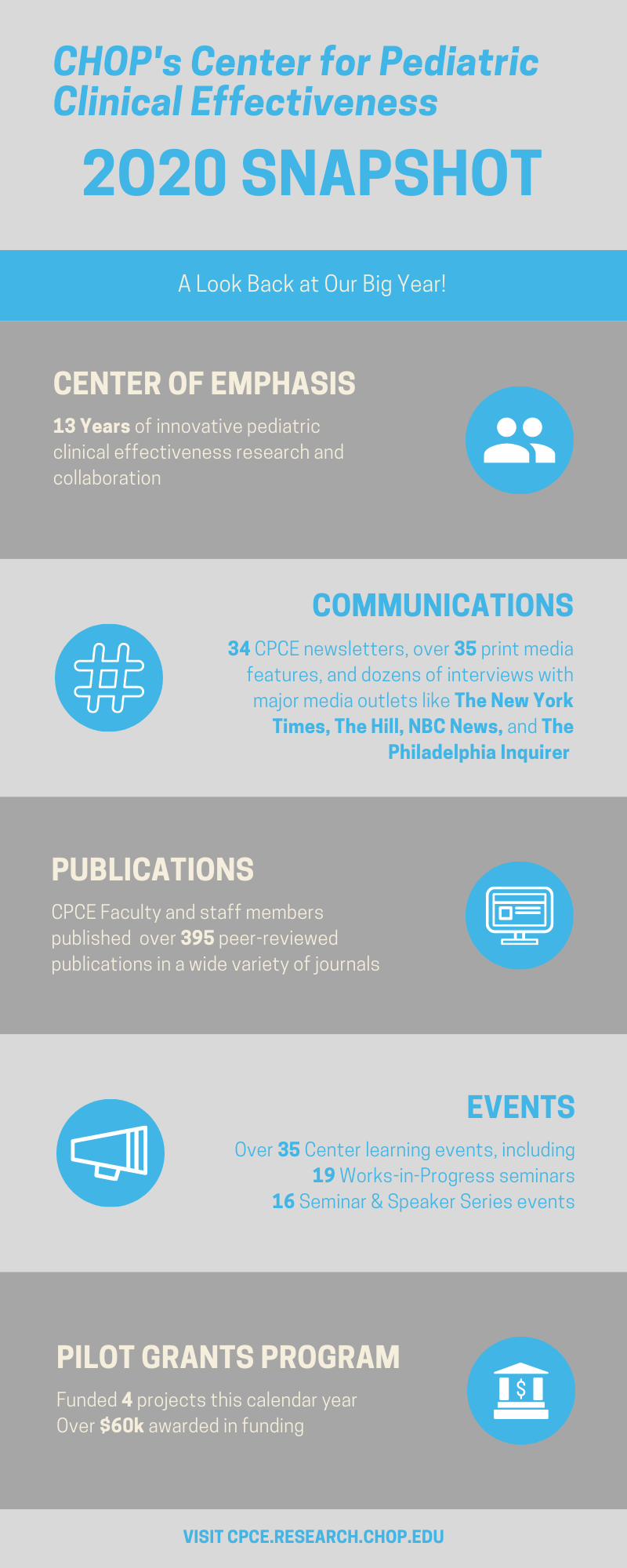
The year 2020 started out much like any other. Then on March 11 th, the World Health Organization declared COVID-19 a global pandemic, and CPCE along with everyone else quickly changed the way we work and interact with others. Clinically, CHOP and other healthcare systems saw a sharp decline in face-to-face visits, coinciding with an increase in the use of telemedicine. Sarah Wood, MD, MSHP, Nadia Dowshen, MD, MSHP and CHOP colleagues described early outcomes of the rapid scale-up of telehealth in adolescent medicine, and Dr. Dowshen discussed her experiences caring for youth living with HIV and transgender youth via telemedicine in a Philadelphia Inquirer opinion piece.
Aside from COVID-19, our team members continued to seek answers to pressing clinical effectiveness questions. Fran Balamuth, MD, PhD, Scott Weiss, MD, MSCE and CHOP colleagues developed and validated an algorithm, leveraging CHOP’s Arcus platform, to track the epidemiology of pediatric sepsis. Also this year, Drs. Balamuth and Weiss launched a pragmatic trial to compare the effectiveness and monitor safety of two types of fluids for sepsis treatment. |
|
Christopher Bonafide, MD, MSCE and colleagues found overuse of continuous pulse oximetry monitoring among infants hospitalized for bronchiolitis not requiring supplemental oxygen. Continuous pulse oximetry monitoring of these patients has not been shown to improve clinical outcomes, and may unnecessarily extend hospital stays and increase patient care costs, along with contributing to alarm fatigue among nurses and other front-line clinicians. This work, published in JAMA, was later named one of the Top 10 in the field of Pediatric Hospital Medicine for the 2019-2020 academic year.
A team including Brian Jenssen, MD, MSHP, Mary Kate Kelly, MPH, Chloe Hannan, MS, Alexander Fiks, MD, MSCE, and other CHOP and Penn colleagues identified messaging strategies that may help parents quit smoking. Parents preferred smoking cessation messages that emphasized the impacts of quitting on their child’s health, over the parent or family.
A study by Ariel Williamson, PhD and colleagues identified sleep problem patterns in children and found that sleep disturbances at any age are associated with diminished well-being by the time the children are 10 or 11 years old, underscoring the importance of screening for sleep problems.
This is only a sample of our work from the previous year. View more on our website or follow us on Twitter, and we look forward to sharing more with you in 2021. |
|
Upcoming Events
2021 Martin Luther King, Jr. Health Equity Symposium
Date: January 20, 2021
Time: 12:00 - 1:30 pm
The Penn Medicine Office of Inclusion and Diversity presents their annual symposium involving topics about health equity and disparities. Dorothy Roberts PhD, MPH, MA will present "The History and Future of Race, Health and Justice." Dr. Roberts is the 14th Penn Integrates Knowledge Professor and George A. Weiss University Professor of Law & Sociology at the University of Pennsylvania, with joint appointments in the Departments of Africana Studies and Sociology and the Law School, where she is the inaugural Raymond Pace and Sadie Tanner Mossell Alexander Professor of Civil Rights. She is also the founding director of the Penn Program on Race, Science, and Society. Learn more and register here.
The Science of Stakeholder Engagement in Research: Development and Validation of Evaluation Metrics
Date: January 20, 2021
Time: 2:00 - 3:00 pm
Join the Drexel University Dornsife School of Public Health for a virtual Population Health Spotlight Series on “Racism and Health: Evidence and Action.” Melody S. Goodman, PhD, MS will present. Dr. Goodman is the associate dean for research and associate professor of biostatistics in the School of Global Public Health at New York University. Goodman is a biostatistician and research methodologist with a large statistical toolbox. Her research interest is on identifying origins of health disparities and developing, as necessary, evidence-based primary prevention strategies to reduce these health disparities. Learn more and register here.
CPCE/PolicyLab Virtual Seminar Series*
Date: February 5, 2021
Time: 12:00 - 1:00 pm
Alexander Fiks, MD, MSCE and Jeffrey Gerber, MD, PhD, MSCE will present “Reduced antibiotic prescribing for children with respiratory illness.” This event is co-hosted with the CHOP Clinical Trials Research Affinity Group.
11th Annual Community-Driven Research Day (CDRD)
Date: February 11, 2021
Time: 10:00 am - 12:30 pm
The 2021 CDRD event will be held virtually with a theme of Resilience and Action to Improve Health. The new format will include live, 3-minute presentations from local CBOs and community groups about their organization and research questions of interest; as well as keynote speaker Barbara Israel, DrPh, of the University of Michigan's School of Public Health and the Detroit Community-Academic Urban Research Center. Learn more and register here.
13th Annual University of Pennsylvania Conference on Statistical Issues in Clinical Trials
Date: April 12, 2021
Time: 8:30 am - 4:30 pm
Continuing its longstanding collaboration with the Department of Biostatistics, Epidemiology and Informatics at the University of Pennsylvania, the ASA, NISS and SCT is delighted to announce the 13th Annual Conference on Statistical Issues in Clinical Trials: Cluster Randomized Trials (CRTs) - Challenges and Opportunities. Learn more and register here.
*For CPCE/PolicyLab Virtual Seminar Series: If you would like to participate in any of the virtual events and did not receive an Outlook invitation, please contact crosss2@email.chop.edu.
|
Recent Publications
This retrospective cohort study by Susan Coffin, MD, MPH, Andrew Steenhoff, MBBCh, DCH, Brian Fisher, DO, MSCE, and their colleagues aimed to define the epidemiology of and outcomes from infection in children with acute leukemia treated in a large public pediatric hospital in the Dominican Republic. Invasive infections were common and a prominent source of death in this cohort. Rates were highest in the first 60 days after diagnosis. Gastroenteritis/colitis, cellulitis, and pneumonia were most frequent, with bacteremia common early on. Multidrug resistant bacteria were prevalent among a small number of positive cultures. Age ≥ 10 years and distance from the hospital > 100 km were each protective against invasive infection in the first 180 days after diagnosis. Over one-third of patient deaths were related to infection.
Nadia Dowshen, MD, MSHP and her research team conducted in-depth, semistructured interviews to elicit the perspectives of survivors of child trafficking on addressing trafficking in the pediatric emergency department (ED) and, secondarily, to provide a survivor-derived framework to help pediatric emergency medicine (PEM) providers discuss trafficking with their patients. Interviews revealed that trafficking survivors feel that the pediatric ED can be a place where they can be asked about trafficking, and that when done in private, it is not harmful or retraumatizing. Fear is a major barrier to disclosure in the pediatric ED setting.
A team of researchers including Pamela Weiss, MD, MSCE describe characteristics of children with enthesitis-related arthritis (ERA) and juvenile psoriatic arthritis (JPsA) enrolled in the Childhood Arthritis and Rheumatology Research Alliance (CARRA) Registry. In this registry, there are over 900 children with ERA or JPsA. There was high biologic use in this population, especially in those with sacroiliitis. Further, there was equal sex representation in those with sacroiliitis. In children with sacroiliitis, the physician global, parent/patient global, and cJADAS 10 were all significantly worse at the first visit with clinically active sacroiliitis versus the first visit without active sacroiliitis.
This retrospective, matched cohort was run by Robert Grundmeier, MD, Molly Passarella and others to determine incidence and severity of acute kidney injury (AKI) within 7 days of sepsis evaluation and to assess AKI duration and the association between AKI and 30-day mortality. Among 203 episodes of late-onset sepsis, infants with late-onset sepsis had increased odds of AKI and greater AKI severity within 7 days of sepsis evaluation, compared with age-matched infants without sepsis. AKI was independently associated with increased 30-day mortality.
While fluoroquinolones are commonly used in adults, the use in children has been low. The objective of Jeffrey Gerber, MD, PhD, MSCE and colleagues was to describe the use of fluoroquinolones in children and assess the impact of 3 recent FDA warnings on fluoroquinolone use. From 2000 to 2018, they assessed claims for all outpatient prescription fills to measure the use of systemic fluoroquinolones and other broad-spectrum antibiotics in children less than 18 years old in the MarketScan Commercial Claims and Encounters database. Fluoroquinolone use was low compared with other common broad-spectrum antibiotics and declining trends over time were associated with FDA warnings, even though these warnings were not pediatric specific.
Pressure ulcers are a major problem for national healthcare systems since they frequently occur in hospitalized patients, negatively affecting patients' quality of life and extending duration of hospitalization. Theoklis Zaoutis, MD, MSCE and his colleagues ran a systematic search in PubMed, Scopus, and ProQuest databases of the available evidence regarding the incidence, prevalence, attributable length of stay and cost of hospital-acquired pressure ulcers in pediatric populations. The results of this meta-analysis indicate that hospital-acquired pressure ulcers occur frequently in pediatric populations with a great variation across different age groups. Moreover, although limited data are available, it seems that hospital-acquired pressure ulcers have significant economic implications for the healthcare systems since they prolong patients' hospitalization stay.
Continuous pulse oximetry monitoring (cSpO) in children with bronchiolitis does not improve clinical outcomes and has been associated with increased resource use and alarm fatigue. It is critical to understand the factors that contribute to cSpO overuse in order to reduce overuse and its associated harms. Christopher Bonafide, MD, MSCE and his research team ran this multicenter qualitative study took place in the context of the Eliminating Monitor Overuse (EMO) SpO study, a cross-sectional study to establish rates of cSpO in bronchiolitis. They identified barriers and facilitators to deimplementation of cSpO for stable patients with bronchiolitis across children's hospitals with high- and low-cSpO use.
A critical barrier to adoption of this recommendation is the lack of a standard definition of "near-fatality" in the context of suspected child maltreatment. Researchers including Joanne Wood, MD, MSHP sought to develop a consensus definition of near-fatal child maltreatment to be used in practice, policy, and research using a multidisciplinary expert panel of 23 individuals from across the United States. Experts defined near-fatal child maltreatment as life-threatening cardiopulmonary dysfunction directly attributable to suspected abuse or neglect as evidenced by (a) respiratory insufficiency/failure requiring intubation and mechanical ventilation, (b) respiratory insufficiency/failure requiring medications to reverse effects of toxic ingestion, or (c) cardiac arrhythmia with/without cardiopulmonary resuscitation (CPR).
Mary-Ellen Vajravelu, MD, MSHP and her colleagues ran a prospective observational cohort study to characterize gut microbiome profiles of infants with congenital hyperinsulinism (HI) who underwent near-total or partial pancreatectomy for hypoglycemia management, as compared with healthy controls. Seven subjects with ≥50% pancreatectomy and 6 with <50% pancreatectomy were included. α (within-sample) diversity was lowest among infants with ≥50% pancreatectomy. β (between-sample) diversity differed across groups. Bifidobacteria and Klebsiella species were least abundant among infants with ≥50% pancreatectomy but did not differ between infants with <50% pancreatectomy and historical controls.
Diagnostic and interventional catheterization procedures are an increasingly important part of the care of young patients with cardiac disease. Michael O’Byrne, MD, MSCE, Andrew C. Glatz, MD, MSCE and their team aimed to enumerate and categorize quality metrics relevant to the pediatric/congenital cardiac catheterization laboratory (PCCL). In the systematic review, 6 metrics were identified (from 9 publications), all focused on safety either as an outcome (adverse events [AEs], mortality, and failure to rescue along with radiation exposure) or as a structure (procedure volume or operator experience).
A research team including Fran Balamuth, MD, PhD conducted a secondary analysis of a cross-sectional study to describe the characteristics and outcomes of afebrile infants ≤60 days old with invasive bacterial infection (IBI). Of 440 infants with IBI, 78 (18%) were afebrile. Among afebrile infants, 62 (79%) had bacteremia without meningitis and 16 (20%) had bacterial meningitis (10 with concomitant bacteremia). Five infants (6%) died, all with bacteremia. The most common pathogens were (35%), (16%), and (16%). Sixty infants (77%) had an abnormal triage vital sign (temperature <36°C, heart rate ≥181 beats per minute, or respiratory rate ≥66 breaths per minute) or a physical examination abnormality (ill appearance, full or depressed fontanelle, increased work of breathing, or signs of focal infection).
Sabrina Gmuca, MC, MSCE, Maitry Sonagra, MPH, Pamela Weiss, MD, MSCE, Jeffrey Gerber, MD, PhD, MSCE, and their colleagues performed a cross-sectional cohort study to characterize suicidality among youth with juvenile fibromyalgia syndrome (JFMS) receiving treatment from pediatric rheumatologists at a tertiary care center in order to determine the prevalence of suicidality in JFMS and to explore risk factors for persistent suicidal ideation. Of the 31 subjects, more than one-quarter endorsed suicidality. Suicidality was prevalent among youth with JFMS and persistent despite concurrent receipt of mental health services. Higher patient-level resilience was independently associated with a reduced odds of suicidality.
In November 2020, the US Food and Drug Administration (FDA) provided Emergency Use Authorizations (EUA) for two novel virus-neutralizing monoclonal antibody therapies, bamlanivimab, and REGN-COV2 (casirivimab plus imdevimab), for the treatment of mild to moderate COVID-19 in adolescents and adults in specified high-risk groups. A panel of experts in pediatric infectious diseases, pediatric infectious diseases pharmacy, pediatric intensive care medicine, and pediatric hematology including Kevin Downes, MD and Kathleen Chiotos, MD, MSCE, was convened. A guidance statement was developed and refined based on review of the best available evidence and expert opinion. The panel suggests against routine administration of monoclonal antibody therapy (bamlanivimab, or casirivimab and imdevimab), for treatment of COVID-19 in children or adolescents, including those designated by the FDA as at high risk of progression to hospitalization or severe disease.
Observations among Israeli pediatric rheumatologists reveal that pediatric Juvenile Spondyloarthritis (JSpA) may present differently compared to patients from the United States (US). This retrospective, cross-sectional study by Pamela Weiss, MD, MSCE and her team is aimed to compare the demographic and clinical variables of Israeli and US JSpA patients upon presentation. Israeli children with JSpA presented almost exclusively with axial disease compared to US patients who were more likely to present with peripheral symptoms. HLA B27 prevalence was significantly lower in the Israeli cohort compared to the US cohort.
|
|
About CPCE
We are a pediatric research center dedicated to discovering and sharing knowledge about best practices in pediatric care by facilitating, organizing and centralizing the performance of clinical effectiveness research -- research aimed at understanding the best ways to prevent, diagnose and treat diseases in children. CPCE’s multidisciplinary team conducts research on a diverse range of clinical effectiveness topics.
CPCE E-News is edited by Holly Burnside. Please feel free to contact us with questions or feedback. |
|
|
|
|
|
|