|
In This Issue:
- Market Update: Rice Farmers Looking for Positive News
- Washington, D.C. Update: Federal Government Shutdown Continues
- Domestic News: Texas Rice Roundup Postponed
- International News: Bringing Rice to the Table: Free Community Cooking Classes in Fraijanes, Guatemala
- Accepting Applications for the Ray Stoesser Memorial Scholarship
- RMTC 2026: We Want to Hear from You
- Photo from Rice Country
| |
| Rice Farmers Looking for Positive News | | |
If you didn’t receive the special update from The Rice Advocate sent out on October 29th, you need to review it. It is one of the most concise, complete, and yes—depressing pieces on the state of the rice industry you’ll find. The footnotes you need to know are below:
America’s rice producers are under severe financial pressure as low prices, escalating input costs, and rising global competition converge to create one of the toughest market environments in decades. Current futures around $10.75 per cwt sit nearly 40% below breakeven levels of $15.50–$17.00, leaving many farmers unable to cover costs amid surging fertilizer and repair expenses. At the same time, U.S. exports have dropped nearly 19% year-over-year due to poor milling quality and increased competition from South America, while imports—especially aromatic rice from Thailand—now exceed domestic ending stocks. These trade imbalances are magnified by the heavy government support enjoyed by Asian producers, creating a global marketplace where U.S. farmers struggle to compete. The resulting oversupply, paired with declining export demand, has caused inventories to swell and prices to collapse even further.
Compounding these challenges is the outsized influence of speculative trading: large investment funds now hold nearly 70% of short positions in rice futures, driving prices down and threatening widespread farm bankruptcies. Policymakers are being urged to act decisively by expanding GSM-102 export credit guarantees to move surplus lower-quality rice into developing markets, imposing temporary tariffs or safeguards on key rice imports to restore fairness, and strengthening market oversight to deter excessive speculative pressure. Without coordinated steps to reduce supply, stabilize prices, and rebalance trade, U.S. rice production faces the risk of deep structural decline. However, with targeted export support, smart trade protections, and renewed domestic innovation—particularly in higher-value aromatic varieties—the industry can still recover competitiveness and preserve its long-term role in global food security.
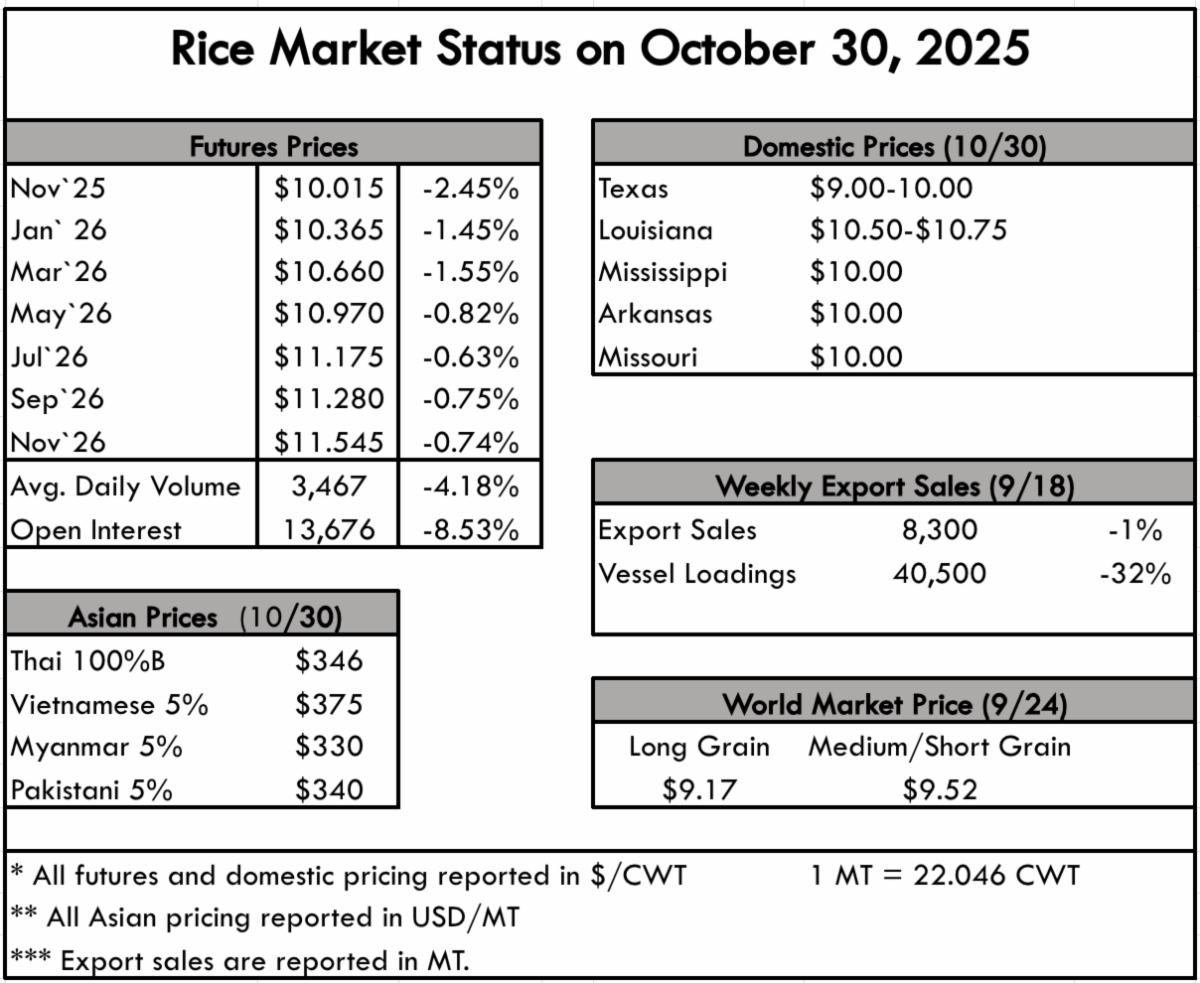
| | As regards to prices this week around the globe, Asia has remained stable in the last week, albeit at record low prices. Thailand sits at $335 pmt, Vietnam at $375 pmt, and India at $355 pmt. In the Western Hemisphere, challenges persist in pricing as well with the U.S. being the highest at $575 pmt. Uruguay and Brazil are both reporting in at $100 pmt less at $475 pmt. Argentina is resting just below $390 pmt. This is all for milled rice, of which most U.S. exports are going to Haiti, and waiting for an Iraq tender. Paddy prices have slumped to as low as $275 pmt. The upcoming November meeting of CONMASUR (Confederation of Mercosur Rice Industry) will produce important numbers to assess including updates of carryover stocks, production numbers, estimations for 2026, etc. The situation for farmers in Mercosur is very similar to the U.S. conditions and apparently, hopefully the market has reached is lowest price point. | | |
Federal government shutdown continues to persist
As of today, October 31, the federal government has been in a shutdown for a full month now with still very little public insight as to when Republicans and Democrats will come to a deal to reopen the government. The House of Representatives continues to be out of session (and has been since September 19) while the Senate has been in session every week since the beginning of October. Up to this point, the Senate has attempted to pass a clean continuing resolution (CR) to fund and reopen the government on the floor 13 different times and has come up short of the 60-vote majority needed every time.
More tension arises as today marks another date federal workers, such as Air Traffic Controllers and government agency and hill staff, will go without a paycheck. Starting tomorrow, November Supplemental Nutrition Assistance Program (SNAP) benefits will lapse for the 42 million Americans on SNAP, which places even more pressure on Congress to find a pathway out of the shutdown. As this shutdown persists into next week, it starts to rival the record for the longest government shutdown which currently stands at 35 days that occurred in December 2018 and rolled into January 2019. All in all, it is still uncertain how long it will take Congress to reach a timely compromise to reopen and fund the federal government.
Senate Finance holds hearing for USTR Chief Ag Negotiator nominee
On Wednesday, October 29, the Senate Committee on Finance held a nomination hearing for a string of various presidential nominees across different departments and agencies including for the Office of the U.S. Trade Representative (USTR) Chief Agricultural Negotiator, Dr. Julie Callahan. Republicans and Democrats differed in support for three of the candidates but were generally both in support of Dr. Julie Callahan’s nomination, especially due to her longstanding career experience working for USTR.
During the hearing, there was a lot of consternation from both sides regarding the recent Argentinian beef announcement from the White House to quadruple imports in an effort to decrease beef prices at home for American consumers. Other topics directed toward Callahan included addressing the current agricultural trade deficit, the Trump Administration’s trade policies and active trade negotiations, reciprocal tariffs, coffee imports, protecting the domestic lamb market, and China’s purchasing commitments and the impact on the soybean industry and other sectors of agriculture. Next steps in the confirmation process entail Senate Finance holding a full Committee vote to advance Dr. Callahan’s nomination to then face a vote before the full Senate. At this point in time, there is no indicator as to when those votes will be scheduled but will likely to be announced in the coming weeks. You can watch the full nomination hearing here.
Senate Ag holds another round of nomination hearings for USDA nominees
On Wednesday, October 29, the Senate Committee on Agriculture, Nutrition, and Forestry held a nomination hearing for three USDA nominees including Dr. Mindy Brashears to be Under Secretary of Agriculture for Food Safety, Ms. Yvette Herrell to be an Assistant Secretary of Agriculture, and Mr. John Walker to be Inspector General for the Department of Agriculture. Republicans and Democrats agreed on the importance of strong, science-based leadership and transparency within the U.S. Department of Agriculture (USDA). Republicans focused on the nominees’ qualifications, emphasizing food safety reforms, oversight of USDA programs, and support for agricultural stakeholders. Democrats concentrated on ensuring scientific integrity, employee retention, responsiveness to Congress, and safeguarding public health and worker safety. Other topics discussed included USDA reorganization, support for small and specialty crop producers, tribal relations, data privacy, and the need for bipartisan collaboration and communication within the agency. Now, the nominees await a Committee vote advancement before they can be voted on and confirmed by the full Senate. You can watch the full hearing here.
USTR initiates a Section 301 investigation into China’s Phase One implementation
Last Friday, October 24, United States Trade Representative (USTR) Ambassador Jamieson Greer announced the initiation of a Section 301 investigation into China’s implementation of the Economic and Trade Agreement (Phase One). This agreement focused on the areas of intellectual property (IP), technology transfer, agriculture, and financial services, and committed China to make substantial additional purchases of U.S. goods and services. This investigation will focus on violations through non-tariff barriers, market access issues, and purchases of U.S. goods and services. More information on the investigation can be found here and the docket for public comments can be found here and will open on October 29.
| | Texas Rice Roundup Postponed | |
Due to the current economic challenges facing not only the rice industry, but U.S. agriculture as a whole, the Texas Rice Council and the US Rice Producers Association have made the difficult decision to postpone the Texas Rice Roundup from January 31, 2026 to January 23, 2027.
We understand how difficult these times are for producers. Our hope is that by next year, market conditions will have improved, and prices will return to sustainable and profitable levels.
In the meantime, please know that the Texas Rice Council and USRPA remain fully committed to standing by you, working tirelessly both in the marketplace and in Washington D.C. to advocate for the future of Texas rice.
Our thoughts and prayers are with every producer, family, and community impacted by these hardships. We deeply admire your perseverance and pray that brighter, more prosperous days are ahead.
Tommy Turner
Texas Rice Council President
US Rice Producers Association Board Member
| | Bringing Rice to the Table: Free Community Cooking Classes in Fraijanes, Guatemala | | |
We’re excited to announce the start of free cooking classes for all residents of Fraijanes at the Fraijanes Municipality Training Center in Guatemala! Throughout the month of November, participants will learn creative and delicious ways to use rice, from everyday meals to traditional favorites, while discovering its nutritional and economic value.
These classes are made possible thanks to the support of the US Rice Producers Association and ARROZGUA, promoting education, community well-being, and a love for U.S. rice in every home.
“Connecting directly with housewives is essential because they are the heart of family decision-making and the main buyers of rice,” said Iris Figueroa, COO of the US Rice Producers Association and Director of Promotions for the Western Hemisphere. “By reaching them through these community classes, we not only share new and delicious ways to prepare U.S. rice, but also strengthen the bond between our farmers and the families who enjoy their harvest every day.”
| | Fifth Annual Ray Stoesser Memorial Scholarship | | |
Happy Halloween! Whether you’re brewing up something spooky in the kitchen or enjoying a cozy fall meal, remember, every great dish starts with great rice! Thanks @consumearrozusa for showcasing how versatile and fun U.S. rice can be.
Send us your Rice Country photos or videos on Facebook, Instagram, or via email!
| |
| | |  |
Food & Agriculture
Regulatory & Policy Roundup
| | | | | | Inter-Rice World Rice Market Report | | | |
January 21, 2026
Western Rice Belt Conference
More details to come
| |
February 5 - 6, 2026
29th Annual National Conservation Systems Cotton & Rice Conference
Jonesboro, AR
More Information
| |
February 19, 2026
Missouri Rice Council Annual Meeting
Gobler, MO
More Information
| |
|
May 26 - 28, 2026
Rice Market & Technology Convention
Cartagena, Colombia
More Information
| | |
USRPA does not discriminate in its programs on the basis of race, color, national origin, gender identity, sexual orientation, religion, age, disability, political beliefs, or marital/family status. Persons who require alternative means for communication of information (such as Braille, large print, sign language interpreter or translation) should contact USRPA at 713-974-7423. |
| | | |