Rail Workers Weekly News Digest
Number 29 - October 8, 2019
|
|
REMINDER: If you are a railroad worker and have not yet signed the Petition for Rail Union Unity, you can do that
HERE
|
|
Below is a series of articles compiled over the previous week.
They are of interest to railroad workers.
|
|
Article 1
RAILROADS FILE LAWSUIT TO CONFIRM NEGOTIATION RIGHTS ON STAFFING
(Editor's Note: Rail carriers have played their hand. They are going to come after the second crew member in this round of bargaining! It's time to organize!)
ARLINGTON, VA. (Oct. 3, 2019) – The National Railway Labor Conference’s largest members, including the major U.S. freight railroads, are asking a federal court to confirm that any dispute over their right to negotiate about train crew staffing in the upcoming national bargaining round must be resolved through arbitration.
The railroads filed a lawsuit today in U.S. District Court for the Northern District of Texas in Fort Worth opposing positions that have been taken by the International Association of Sheet Metal, Air, Rail and Transportation Workers, Transportation Division (SMART-TD). The union has maintained that decades-old labor agreements bar negotiations over crew staffing on freight rail trains. The freight railroads disagree and believe that collective bargaining is the proper forum to discuss the issue.
Proposals in the new bargaining round can first be exchanged on Nov. 1, and the industry is seeking to leverage new safety technology to redefine the role of conductors on certain trains. “The industry wants to work collaboratively with SMART-TD to shape a future, ground-based role of the conductor to best ensure we sustain a vibrant and competitive transportation system for our people, customers and the communities we serve,” said Brendan Branon, chairman of the National Railway Labor Conference and the National Carriers’ Conference Committee (NCCC), the bargaining representative for the major U.S. freight railroads.
|
|
Article 2
New Law Regarding Railroad Crossings To Take Effect
Effective October 1, Nevada law regarding a driver's responsibility at railroad crossings is changing. While current law requires drivers to yield to trains, a change will also require drivers to yield to on-track equipment.
“On-track equipment can include anything from a small, four-wheeled track inspection car up to a semitractor equipped to travel on rails towing rail cars,” says Matt Parker, Manager of Operating Practices – Northern Region for West Coast Railroaders Group. “Many in the public may not be aware of this equipment, or of their responsibility to yield to it at railroad crossings, but they should be. Just as with a train, a collision with a piece of this equipment poses the risk of serious injury or death, both to the equipment operators as well as vehicle occupants.”
“We've been able to update state statutes in 30 states so far to include 'the approach of on-track equipment' as a condition that a motorist would stop at a railroad grade crossing,“ says Charlie Hogue, Director of Government Affairs for the Brotherhood of Maintenance of Way Employes Division (BMWED). “But updating the state laws is just a first step. We have followed up with Operation Lifesaver and other railroad safety advocates to educate the public that there are other dangers associated with railroad grade crossings in addition to traditional trains if a motorist is unaware of their surroundings.”
Representing nearly 40,000 members who maintain the track and related structures of the nation's major railroads, many of whom operate on-track equipment as part of their daily duties, BMWED led the effort to effect this change to Nevada's motor vehicle laws.
|
|
Article 3
Indiana Rail Road, associations sue Illinois over train crew rule
In a
lawsuit
filed in Chicago federal court yesterday against the Illinois Commerce Commission, the railroad and associations argue that federal regulations preempt the crew-size law that
Illinois Gov. J. B. Pritzker signed
in August. The law is set to take effect Jan. 1, 2020.
Pritzker signed the law three months after the
Federal Railroad Administration
(FRA) determined that "no regulation of train-crew staffing is necessary or appropriate" for railroads to operate safely, according to the lawsuit.
"In recent decades, technological breakthroughs have allowed railroads to gradually decrease average crew sizes —from about five in the 1960s to just two today — while compiling an ever-improving record of safety," the court filing states. "Now, the nation's railroads are poised to deliver even safer and more efficient service."
The suit also notes that the FRA spent years considering crew-size evidence and found nothing to show that requiring minimum crew sizes would improve safety.
|
|
Article 4
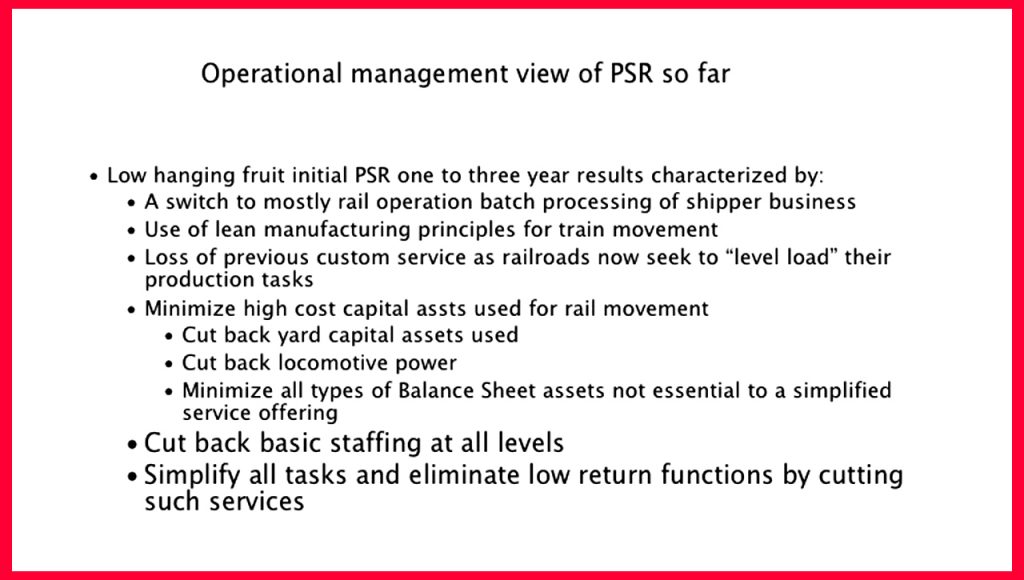
What PSR Is—And Isn’t
Out of a remote location in a corner of New England comes an interesting operations research view of what Precision Scheduled Railroading (PSR) is, and is not. Peter Swan, a Ph.D rail and logistics expert from the Penn State School of Business Administration, spoke Oct. 3 at the NEARS (Northeast Association of Rail Shippers) Fall 2019 Conference in Burlington, Vt.
Swan, who spent a decade working in the railroad industry, also taught at Penn State’s Smeal College of Business. He earned his Ph.D. in business administration at the University of Michigan Business School. He holds an MBA from the University of Tennessee and a bachelor’s degree from the University of Michigan. He has published in such journals as Journal of Business Logistics, Transportation Journal, Public Works Management & Policy, International Journal of Physical Distribution and Logistics Management, and Academy of Management Journal. His professional affiliations include the Transportation Research Board, Council of Supply Chain Management Professionals, American Society of Transportation and Logistics, and Penn State Center for Supply Chain Research.
So, in terms of directly taking on the task of demystifying so-called PSR as a freight business process, it’s no surprise that NEARS invited Swan to give a deep but understandable academic dissection of the strengths and weaknesses of the evolving versions of different PSR operational railway changes. NEARS is, after all, an educational organization among other things, and its leadership sought to have an independent review for members.
Following is my summation of Swan’s important technical conclusions, based upon the part of my freight railroad career that involved IT, operations research, logistics, marketing and finance. In a nutshell:
• PSR is not customer centric.
• PSR is not a volume growth strategy.
• PSR is focused on batched processing of train movements.
• PSR is not car asset utilization-focused; it is train movement-focused.
• PSR often ends up asking customers to change their rail use business process—regardless of the shipper’s customer inventory requirements.
|
|
Article 5
Hyundai and Kia file huge lawsuit against 4 biggest US railroads
Remember in
There Will Be Blood when Daniel Plainview got all salty at the idea of paying the railroads to ship his oil, so
he built a pipeline and killed a guy before he ever had to actually pay?
The suit specifically alleges that BNSF, CSX, Norfolk Southern and Union Pacific railroads tacked on a ton of fees for shipping services under the guise of "fuel recovery surcharges" that netted the companies billions of dollars in profits during the early-to-mid-aughts.
It's not clear exactly how much Hyundai and Kia paid to the railroads as a result of these fees, but we do know that the lawsuit is seeking triple damages, which, you know, is kind of intense. Hyundai and Kia filed the lawsuit near their US headquarters in Santa Ana, California. Hyundai owns just over a third of Kia, which is part of Hyundai Motor Group.
The suit is reliant on an independent study from way back in 2007 that found that the railroads' surcharges exceeded the actual cost of fuel by $6 billion. Despite racking our brains, we can't think of any other fees that seemed that unbelievably gougey -- even
airline baggage fees and
Ticketmaster surcharges.
|
|
Article 6
The Bomb Train Derailment That Sparked a Resistance in the Columbia River Gorge
The fossil fuel industry maintains a strong presence in the Pacific Northwest thanks to its international export activity. But ever since a dangerous rail accident in 2016, local residents have served as a fierce check on its growth
A cluster of pick-your-own cherry orchards beckons visitors to the town of Mosier, Oregon, each summer. The town is about 70 miles east of Portland in what’s known as the “dry side” of the Eastern Columbia Gorge. It’s a quiet life for Mosier’s 452 residents, whose hill homes sit between steep peaks climbing to nearby Mount Hood and the rail tracks lining the Columbia River. Quiet, that is, except when the freight trains barrel through.
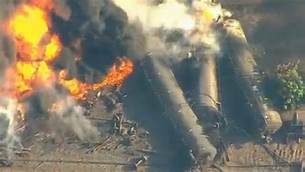
It’s June, and I’m in Mosier with the town’s mayor, Arlene Burns. Cherry season has just begun, but I’m here to visit the site where, three years ago, a 96-car Union Pacific train carrying highly volatile Bakken crude oil derailed, setting off a massive blaze.
Burns is a petite woman with blue eyes the color of the Columbia. Her voice is only slightly roughened by the late nights and speeches and negotiations concerning the threat that transporting crude oil by rail poses to her town.
At the site, Burns points out the Mosier Manor Mobile Home Community beyond the hill just above, which narrowly escaped the blaze. Maples, fir, and oaks once stood here next to the tracks. Now the strip is barren—a dry, rocky pit awaiting restoration by Union Pacific.
Charles Young was one of the first volunteer firefighters on the scene the afternoon of June 3, 2016. “I saw a big, black clouds of smoke rising, not a great sign,” he says, his Australian accent heavy with the gift of understatement. Young arrived to find
16 tankers splayed at angles
, like a toy train toppled by a child’s hand. Three cars were on fire, and one had torn the lid off a sanitary sewer, its oil now flowing directly into the wastewater channel.
|
|
Article 7
Solutionary Rail Means Deep Cuts to Greenhouse Gas Emissions
Finding solutions in the face of climate change is one of our fundamental motivations.
Transportation accounts for 30% of United States greenhouse gas emissions. If we electrify our transportation using renewables, we can cut this deeply – especially if electrifying the railroads is prioritized.
- Steel wheels rolling on steel rails require 1/3 the energy of rubber tires on pavement – trains are much more energy-efficient than trucks and cars, regardless of the fuel source.
- The railroad – freed from diesel – could be powered by renewable electricity via overhead power lines, with very low life-cycle greenhouse gas emissions.
- As a bonus, additional power lines can be installed above the ones powering locomotives, with the sole purpose of transmitting renewable electricity from the rural areas where it’s produced to towns and cities where it’s needed.
Electrify the trains: Electric cars and trucks will require resource-intensive battery manufacture and disposal. Electrifying the railroad, on the other hand, can take advantage of the fixed infrastructure of rail transport; like some bus lines in cities today, electric locomotives could receive electrical power by catenary wire accessed by a pantograph or an electrified third rail. An additional advantage of electric locomotives results from equipping them for regenerative braking – different from today’s diesel-powered trains equipped for dynamic braking, where energy is lost as heat. Electric locomotives with regenerative braking can return electrical power to the electrical grid, increasing the efficiency of rail transport.
|
|
Article 8
SPECIAL CLIMATE STRIKE EDITION #34, October 2019
Making a Living on a Living Planet
Welcome to:
Making a Living on a Living Planet: News of how working people are fighting for a planet that is sustainable—environmentally, economically, and socially. If you like what we are doing and want to connect,
please sign up for our newsletter
and for other information at
labor4sustainability.org
. You are welcome to repost anything in this newsletter to spread the word!
IN THIS ISSUE
- U.S. Unions Back the Climate Strike
- Amazon Workers Walk Out for Climate Strike
- What’s Next for the Climate Strikes?
- Labor Lawyers Say International Law May Protect Climate Strikes
- LNS and Environmental Groups Back Striking UAW Workers
- Who We Are: Featured Staff Intern Leo Blain
- More About Us: LNS - Making a Living on a Living Planet
|
|
|
|
|
|
|