|
HaKol
The Voice of the
Pelham Jewish Center
October, 2026/Tishrei-Cheshvan 5787
| | |
Leadership Messages
Rabbi Benjamin Resnick
Education Director
Ana Turkienicz
HaKol Editor
Barbara Saunders-Adams
| |  | |
Congregant News
& Donations
Congregants' Corner
Emily and Justin Pauley
Book Notes
Barbara Saunders-Adams
Food for Thought
Share a Simcha
Tributes & Donations
| | | |
Bereshit 11
Now all the earth was of one language and one set-of-words.
And it was when they migrated to the east that they found a valley in the land of Shin’ar and settled there.
They said, each one to his neighbor:
Come-now! Let us bake bricks and let us burn them well-burnt!
For them brick-stone was like building-stone, and raw-bitumen was for them like red-mortar.
And they said:
Come-now! Let us build ourselves a city and a tower, its top in the heavens,
and let us make ourselves a name,
lest we be scattered over the face of all the earth!
But YHWH came down to look over the city and the tower that the humans were building.
YHWH said:
Here, [they are] one people with one language for them all, and this is [merely] the first of their doings—
now there will be no barrier for them in all that they scheme to do!
Come-now! Let us go down and there let us baffle their language,
so that no one will understand the language of his neighbor.
So YHWH scattered them from there over the face of all the earth,
and they had to stop building the city.
Therefore its name was called Bavel/Babble,
for there YHWH baffled the language of all the earth-folk,
and from there, YHWH scattered them over the face of all the earth.
***
This past week, at the end of Parashat Noach, the Torah tells the story of the Tower of Babel. It is a sparse, cryptic narrative about the people of the world joining together under one banner. They speak a single language. They share a singular vision. And they try to build a magnificent tower reaching all the way to the heavens. And God, of course, frustrates their designs.
We’re not told how the people of the world managed to band together. In the chapter immediately preceding the story they are divided into small groups based on land, language, and lineage. And we are not told why God, apparently in keeping with the original plan for creation, chooses to divide them up again. And along with many of the stories in the Tanakh, the sparseness of the narrative excites the imagination. In contrast with the Greek fables, which offer clear, discrete moral lessons, the Tower of Babel, like all great Jewish stories, opens out onto broad and diverse vistas of meaning, and so it ascends to the highest heights, despite being cut down in medias res.
The central question of the story is why God (or the Israelites who wrote the story) found the tower so obnoxious. What, exactly, was the sin? The ancient midrash offers a variety of approaches to answering this question, whether focused on hubris or idolatry or the devaluation of human life (all of which are interconnected). Here I want to focus on just one aspect.
It seems to me that the central tension in the story revolves around the peoples’ desire for a profound and abiding unity, transcending tribe and culture. The tower is meant to serve as a physical instantiation of that shared oneness, “lest we be scattered throughout the entire world.” And the most important and all embracing manifestation of that oneness is found in the opening line of the story: “The entire world spoke one language with one set of words.” It is oneness of language that allows the people to strive together and it is precisely that unity that God destroys when he spoils the plan, scattering the people to their many tongues and ultimately giving us the English word “babble.”
Bereshit Rabbah, an important collection of ancient midrash, picks up on the importance of shared language and offers a striking reflection on the peoples’ monolingualism:
AND OF ONE SPEECH (AHADIM) means that they spoke sharp words (hadim), saying, 'Once in one thousand six hundred and fifty-six years the Firmament totters; therefore let us go and make supports for it, one in the north, one in the south, one in the west, while this spot will be its eastern support.’ Thus it is written, AND ALL THE EARTH WAS ONE LANGUAGE OF SHARP WORDS.
It does not rest with Him to choose the celestial spheres for Himself and assign the terrestrial world to us. Come, rather, and let us build a tower at the top of which we will set an idol holding a sword, that it may appear to wage war with Him.
This is a complicated midrash. In the first section, which is less about the dangers of monolingualism and more about our collective inability to properly identify and address our shared challenges, the midrash suggests that the impetus for building the tower was to ensure that the flood, which according to their calculation took place 1,656 years after creation, not happen again. It must be that the earth was built on a shaky foundation, but if we shore things up, so the logic goes, we can prevent a future cataclysm. Their error, of course, is that the world was not destroyed because of shoddy construction. It was destroyed because of their own moral failure. And so they try to solve the deep problem of the soul with the shallow tool of physical striving, a seemingly evergreen human impulse.
In the second section, the midrash follows up on this critique with a creative play on words, suggesting that the word “echad,” meaning one or oneness, is actually related to the word “chad” or “lechaded,” which means “to sharpen a knife.” And in the midrashic imagination the reason why they are sharpening the knife is to install it atop the tower, which is a declaration of war on God.
There are many places in Jewish literature (in the Tanakh, in the prophets, in the siddur) where we extol the value of oneness. Every time we say the Aleinu, which we do after almost every single service, we imagine that one day everyone will come to worship in the same place. But this midrash, and the whole story of the Tower of Babel, offers a striking counterpoint. According to the authors of Bereshit Rabbah–and according to the authors of the Tanakh–a world with one language and one culture and one purpose does not allow us to better worship God; it is, in fact, an affront to the very force of divinity that manifests itself, gorgeously, in our diversely plumed selves. And that explains, perhaps, the idea lurking behind the most famous midrash about the Tower of Babel, which says that when a person fell from the tower no one would care but what a brick fell people would weep. Because, after all, if we’re all essentially the same then we’re pretty much interchangeable and therefore expendable.
But that’s not the Jewish way. Over and against Paul, who said famously there is neither Jew nor Greek, slave nor free, male nor female, all are one in Jesus; unlike the streams of Islamic thought that advocate world conquest, we Jews insist that there is little corner of the world for us, just as there is a little corner of the world for all other nations. We insist that there is a distinction between Jew and Greek, not because one is better than the other, but because we Jews are a “nation that dwells apart.” And the reason why we dwell apart is our intuition, apparently manifest in God’s original plan, that only deep, abiding diversity can fully glorify the interconnected oneness of all that is.
Part of the background of all this, Bible scholars and ancient historians will suggest, is the Israelite critique, in the form of farce, of the global pretensions of the Assyrian empire, which built mighty ziggurats and sought to unite the world under their aegis. The story of Tower of Babel is a humorous send up of that ambition, penned by those who would buck imperial control and the ensuing march towards sameness. Those rebels were us, of course. And it’s something that would repeat again and again throughout our history. We are the resistance. We stand for the dignity and the sanctity and the irreducible importance of difference. And we need to keep it up, whether we’re resisting the onslaught of empires or the flat homogenizations of technology, whether grand towers or large language models, not so that everyone can become more like us, but to show others what it means to be more like themselves–proud and distinct and creative and immortal.
And so as the people ascended toward sharpened, sword-like oneness–oneness of language and vision and culture and purpose–God went down to meet us saying, “let us descend and mix up their languages,” scattering us to the winds, to our many nations and languages and mountains and valleys, not as a punishment but as a gift, saving us from making the fatal error of imaging that our being all alike in dignity and interconnected in destiny, means that our differences or reducible or unimportant. On the contrary our differences are of great importance. As Jews we know that it is not the insistence on difference that leads to bloodshed; it is the insistance on sameness. So it was in ancient Assyria and so it was in Rome and so it was in Spain and so it was in Germany and so it will be in the postmodern West and in the postmodern East, if we Jews do not stand in the breach.
Rabbi Benjamin Resnick
Ben
| | |
Education Director
Ana Turkienicz
| | |
The Picture Needs Your Piece
Reflections on Community, Responsibility, and Hope
During the High Holidays, I had the privilege of sharing a few thoughts with our PJC community about responsibility, belonging, and the unique contribution each of us brings to the world. As we settle into the rhythm of a new Jewish year, I would like to share those reflections here, with the hope that their message will continue to resonate throughout the year.
On Rosh Hashanah, we celebrated creation, chanting together:
Hayom harat olam: Today the world is born.
We imagined the possibility of beginning again. A new year. A new page. A world renewed.
Then came Yom Kippur, inviting us to turn our attention inward, to reflect on the year we had lived, the choices we had made, and the responsibilities we carry.
Not only to ask, What is wrong with the world? but also, What is my responsibility for the world?
And sometimes, faced with everything happening around us, we wonder: I am just one person. What difference can I possibly make?
The great Hasidic master Rabbi Simcha Bunim of Peshischa taught that every person should carry two notes, one in each pocket.
In one pocket:
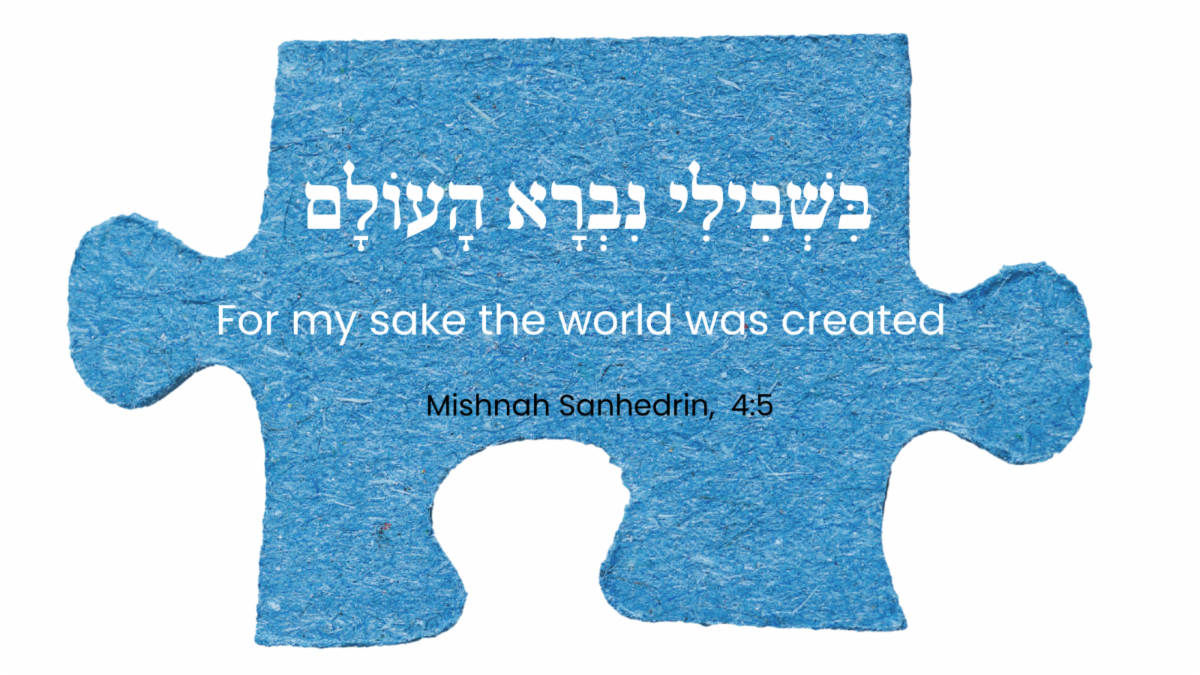
Bishvili nivra ha'olam: "For my sake the world was created." (Mishnah, Sanhedrin 4:5)
And in the other, Abraham's words:
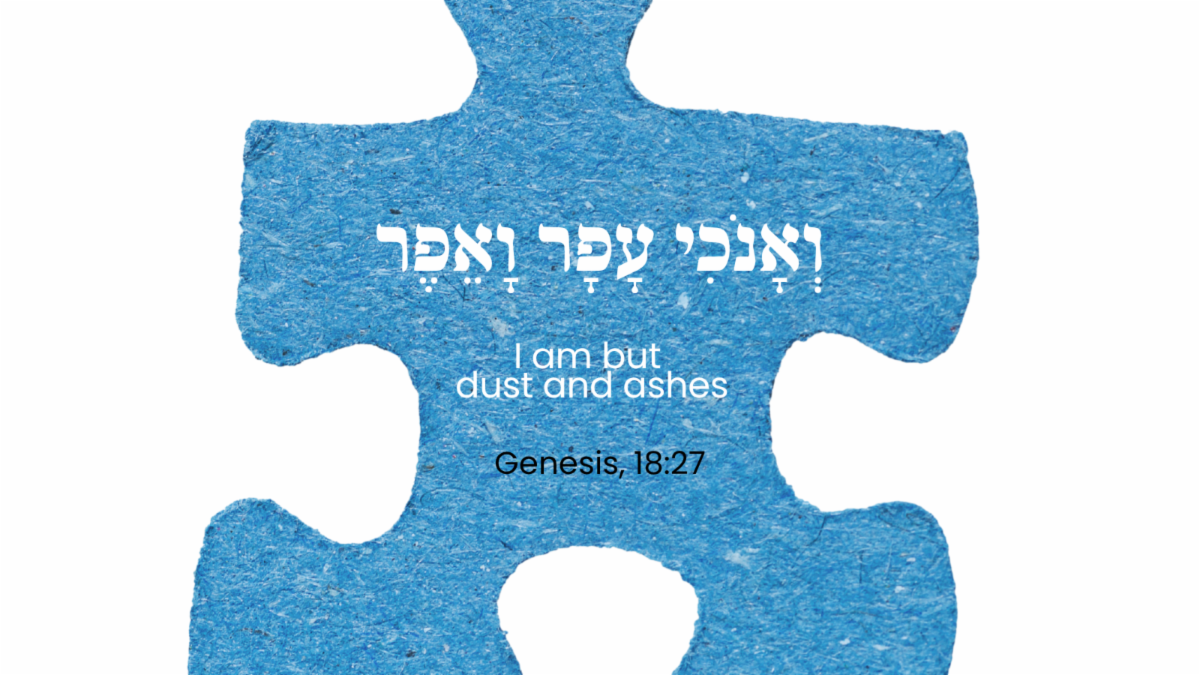
V'anochi afar va'efer: "I am but dust and ashes." (Genesis, 18:27)
We need both reminders.
The first tells us that we matter. Our presence, our choices, and our contributions make a difference. Each of us has something unique to offer that perhaps no one else can.
The second reminds us that we are not the center of the universe. We are part of something much larger, a story that began long before us and will, God willing, continue long after us.
At first, these two ideas seem contradictory. But I like to think of them as pieces of a puzzle.
Imagine holding a single puzzle piece. By itself, it seems almost insignificant, a small patch of blue, part of a face, a corner of the sky.
Now imagine completing the entire puzzle, only to discover that one piece is missing.
Where does your eye go?
Straight to that empty space.
Suddenly, that tiny piece matters enormously.
I am not the whole picture. But the picture needs my piece.
And isn't that exactly what community is about?
At The PJC, each of us brings something different. One person brings a tune to Shabbat services, another brings a child, a question, a story, a helping hand, or simply the decision to show up.
A vibrant Jewish community does not happen by itself. It is created through the choices we make, the relationships we nurture, and the time and energy we invest in one another.
We are not simply members of the community. We ARE the community.
Sometimes, however, the missing puzzle piece is not something we need to contribute to others. Sometimes it is a part of our own Jewish story that we have not yet had the opportunity to discover or claim.
This year, Andrea Rothberg is spearheading a new women's learning group at PJC for women who would like to embark on a journey toward becoming Bat Mitzvah: particularly women who chose Judaism as adults or who never had the opportunity to celebrate this milestone when they were younger.
This initiative is especially meaningful to me because eighteen years ago, right here at The PJC, I celebrated my own adult Bat Mitzvah. I know firsthand how powerful and transformative that experience can be, and I would be honored to help other women embark on that journey.
It is never too late to discover another piece of our Jewish identity.
And perhaps this is one of the most important lessons of teshuvah: our story is never finished.
If something is missing, we can seek it. If we have made a wrong choice, we can choose differently. If we have been standing at the edge of our community, we can step closer. And if we have been waiting for the right moment to begin, perhaps that moment is now.
This year, our PJC Learning Center theme is Tikvah: Hope.
I believe that tikvah and teshuvah are deeply connected.
Teshuvah reminds us that we can change. Tikvah reminds us that, because we can change, the future can change too.
But hope cannot remain just a beautiful idea. Hope calls us to action.
If we hope for a strong and welcoming PJC, we must participate in building it.
If we hope for meaningful Shabbat experiences, we must help create them.
If we hope for a vibrant Jewish future, we must invest ourselves in it.
If we hope for a meaningful relationship with Israel, we must continue to learn, connect, and engage.
And if we hope our children will choose Jewish community in the future, we must show them today what it means to belong to one.
As we enter the month of Cheshvan, a month without Jewish holidays, we have a wonderful opportunity to put these ideas into practice. After the intensity and inspiration of the High Holiday season, our challenge is to carry that inspiration into ordinary days; to turn prayer into action, reflection into participation, and hope into commitment.
Perhaps this is the perfect time to reach into our pockets and remember Rabbi Bunim's two notes:
Bishvili nivra ha'olam. The world was created for my sake.
V'anochi afar va'efer. I am but dust and ashes.
And to carry one more reminder in our hearts:
I am not the whole picture. But the picture needs my piece.
May this new year bring us the humility to recognize that none of us can do everything, and the courage to discover what each of us can do.
May we find our place in the larger picture; in our families, our PJC community, the Jewish people, our relationship with Israel, and the world around us.
And may we have the tikvah, the hope, and the courage of teshuvah to pick up our piece and help create the picture of the future we wish to see.
Chodesh Tov, and may we all have a year of hope, belonging, and meaningful action!
Ana
| | |
HaKol Editor
Barbara Saunders-Adams
| | |
Dear Friends,
Coming together on the High Holidays gives us the opportunity to rekindle relationships.
I greeted Richard Pine who I hadn't seen since Cheryl's shiva. I was hugged by Eleanor Dreyfus and Gloria Horowitz. I sat next to Melanie Stern and Zach Ehrenreich who told me about the joys of grandparenthood and invited Sam and I to a Shabbat dinner at their home. Andrea Rothberg regaled me with the purchase of an upstate home not too far from my own. Ana and Neco promised to visit me in New Paltz. I got a big smile from Liam Cepler. And, Andrea Prigot said we would get together for a concert. All it took was showing up.
Our intimate PJC community is open to forming friendships. Introduce yourself to the person next to you in the sanctuary. You may share much in common. I noted many new faces as I scanned the synagogue as well as familiar faces with new grandkids. Take advantage of the opportunity to create new friendships. It's worth the effort.
Barbara
| |
|
A LIFE STORY: HOW A CHANCE COLLEGE MEETING LED TO A COMMITMENT TO COMMUNITY SERVICE---AND EACH OTHER
It was 2003. Justin Pauley had developed a mentoring relationship with James Hammond, a computer science professor at Winthrop University in Rock Hill, South Carolina, and at the time Winthrop's Associate Vice President of Information Technology. Thanks to this connection, Justin and his fellow Association for Computing Machinery members were given weekend access to Tillman Hall to host their meetings, which largely involved playing video games.
Justin knew it was a privilege to have earned Hammond's trust and didn't take that lightly, so when he heard voices in the hall, he immediately investigated.
He encountered Emily Stevenson and two of her friends, who had found an unlocked door and decided to see if they could locate a chapter they heard was on one of the upper floors. Many hours of swapping jokes and getting to know one another that night set the stage for a future together, not just for Justin and Emily; but for many with whom they were connected.
Now married for 17 years with two children, ages eight and five, Emily and Justin Pauley continue to be intentional about how they engage professionally, within their community, and with their alma mater.
Justin, who earned a B.S. in computer science with a minor in mathematics, started his career at Wachovia as a software developer, but is now a partner and head of CLO Capital Markets at Brigade Capital Management. Emily, who landed a job in the finance department at Motivations, Inc. after graduating, now utilizes her business administration degree in her volunteer roles planning events for the Pelham Jewish Center, supporting her local La Leche League, and serving as the PTA treasurer at her kids' school.
With philanthropy as a cornerstone in their lives, the Pauleys also established an endowed scholarship and a restricted scholarship at Winthrop to honor their fond memories, as well as their belief in the strength of the CBT's computer science program.
"Tuition went from $5,000 a year to $10,000 while I was at Winthrop, and it just continues to increase. We wanted to do something to help, and it's so rewarding to receive thank-you letters from the students who benefit," said Emily.
Together, the Pauleys' experiences have taught them to make the most of every opportunity presented, and they hope that Winthrop's students and alumni will continue to do the same.
They conclude, "Keep evolving, especially with technology. Don't be afraid to put your hand up and ask questions, and get comfortable taking risks, too. If you're not failing at least sometimes, you're not learning, and that's what it takes to really soar."
Emily Pauley, the 2026 PJC Young Leadership Honoree and Woman of Valor, graduated from Winthrop in 2007 with a BS in Business Administration. The above essay is adapted from the Fall 2026 issue of Winthrop Magazine’s College of Business and Technology Alumni News.
| | | | |
The Jewish Policeman
Jonathan Dunsky
Little has been written about what happened inside the Displaced Person's Camps after the holocaust. The Jewish Policeman, the 9th book in the Adam Lapid series by Jonathan Dunsky, brings this period to life while providing another engrossing mystery revealing Lapid's hunger for revenge after his time in Auschwitz.
From its ironic opening line, “The street lay in ruins, and it filled my heart with joy”, Dunsky captures the mood of concentration camp survivors towards the defeated German people. Adam Lapid, the former Hungarian police detective and sole Auschwitz survivor in his family, maintains that those who survived the camps were compromised in both body and spirit. Those who survived were irreparably changed from who they had been before the war. Himself included.
The story is set in the actual Landsberg DP camp in Germany, one of the model Displaced Persons Camps under the watchful eye of Dr. Samuel Gringauz. It boasted a Jewish police force and a vibrant cultural life. How the story plays out as the survivors learn to govern themselves in preparation for the birth of the Jewish state is pure Dunsky genius.
Adam Lapid is cajoled into solving the first murder of a Jew by a Jew in the DP camp. To many, the question of how a Jew could murder another Jew after all they’d been through was outrageous and unthinkable. According to Dunsky, “it was a naïve notion, born of an idyllic view of how the Jewish people would rise from the ashes of their near extinction and build a society that would be a model for a tarnished world.”
Distrust of the Jewish police who were often brutal to prisoners in the concentration camps was common. Dunsky’s story is believable and troubling; literary and suspenseful. With unexpected twists and turns, The Jewish Policeman will keep you riveted.
P.S. Jonathan Dunsky agreed to join the PJC Book Group in December!
Barbara
| |
A Pity, We Were Such a Good Invention
by Yehuda Amichai
They amputated
your thighs off my hips.
As far as I'm concerned
They are all surgeons. All of them.
They dismantled us
Each from the other.
As far as I'm concerned
They are all engineers. All of them.
A pity. We were such a good
And loving invention.
An aeroplane made from a man and wife.
Wings and everything.
We hovered a little above the earth.
We even flew a little.
Translated by Assia Gutmann
| | | | |
"Share a Simcha" allows congregants to share their news with our PJC community. Please submit news about family members -- engagements, births, job updates, kid achievements, community acknowledgements and any other milestones -- to the HaKol Editor, Barbara Saunders-Adams.
Mazal Tov to our October Birthday Celebrants: David Katz, Marcelo Nacht, Callie Novick, Seth Goldman, Jacob Owen-Maachane, Seth Lieberman, Rena Ilkowitz, Saul Becker, Daniel Rubock, Mitchell Cepler, Greg Breskin, Andrea Prigot, Julia Glickman, Dylan Fleischer, Julia Martin, Max Lee, Daniel Cabin, Emma Almo, Sara Almo, Rachel Lief, Adam Gerber, Michael Dvorkin, Lynn Dvorkin, Zach Falberg, Jessica Morgan, Heather Schneider
Share a Simcha is a regular HaKol feature, so keep your news and updates coming!
| | |
Donations to the General Fund & Tributes
Adam & Magdalena Bukowski, in memory of Abbey Goldstein
Bob & Sandra Goldman, in honor of Desmond Bazeli’s Bar Mitzvah
Bob & Sandra Goldman, in memory of Abbey Goldstein
David & Jeanne Radvany, in memory of Abbey Goldstein
Jeb & Betsey Singer, in honor of Rhonda Singer’s 75th birthday
Joel & Beth Serebransky, in memory of Lee Cohen
Mark & Linda Levine, in memory of Carey Hochberg
Mark & Linda Levine, in memory of Lee Cohen
Michael Bowen & Judy Shampanier, in memory of Lee Cohen
Mitchell & Julie & Cepler
Neco & Ana Turkienicz, in memory of Lee Cohen
Donations to the Rabbi's Discretionary Fund
Marcelo & Jakeline Fischer
| | |
An Update From The Treasurer
As of June 30, Kesef, our third-party accounting firm, will no longer deposit checks on our behalf. Starting immediately, all checks should be sent to the PJC Office (451 Esplanade, Pelham, NY 10803).
Additionally, as we approach our fiscal year-end (June 30, 2026), please address any open balances. If you have any questions or concerns, I'm available to discuss them.
Key Takeaways:
-
Send all checks to the PJC. Kesef will deposit checks sent to Montvale until August.
- No more mailing checks to Kesef in Montvale, NJ.
- Best ways to pay: ACH (no fee) or a credit card directly on our website is the easiest and fastest way.
- Other ways to pay: You can also pay with investment securities or IRA distributions, which can help lower your taxes.
There are multiple ways to make donations:
Mail to: Pelham Jewish Center, 451 Esplanade, Pelham, NY, 10803
Log-in at https://thepjc.shulcloud.com/member or our new PJC member app on ShulCloud. You can set up automatic recurring payments. You can also access your account through the link in your monthly billing statement to pay online.
If you are interested in paying via appreciated securities or IRA distributions, please email Mitch Cepler.
It is the policy of the Pelham Jewish Center to make every effort to assist members experiencing financial challenges. Financial challenges should never be a barrier to being an active member of the PJC community. You can reach out to President, Adam Gerber, Treasurer, Mitchell Cepler or Rabbi Benjamin Resnick, to speak confidentially concerning your ability to pay PJC dues and Learning Center tuition.
| | | | |