| | |
POLICY & ADVOCACY UPDATE
Issue #59, 20 November 2025
| | | |
- National accommodation award winners announced
- Australia concedes to Turkey as the host of COP31
- AA Board meets on the Gold Coast
- Hotel performance in October 2025
- Overseas arrivals for September 2025
- Decline in post-secondary qualifications
| |
National accommodation award winners announced
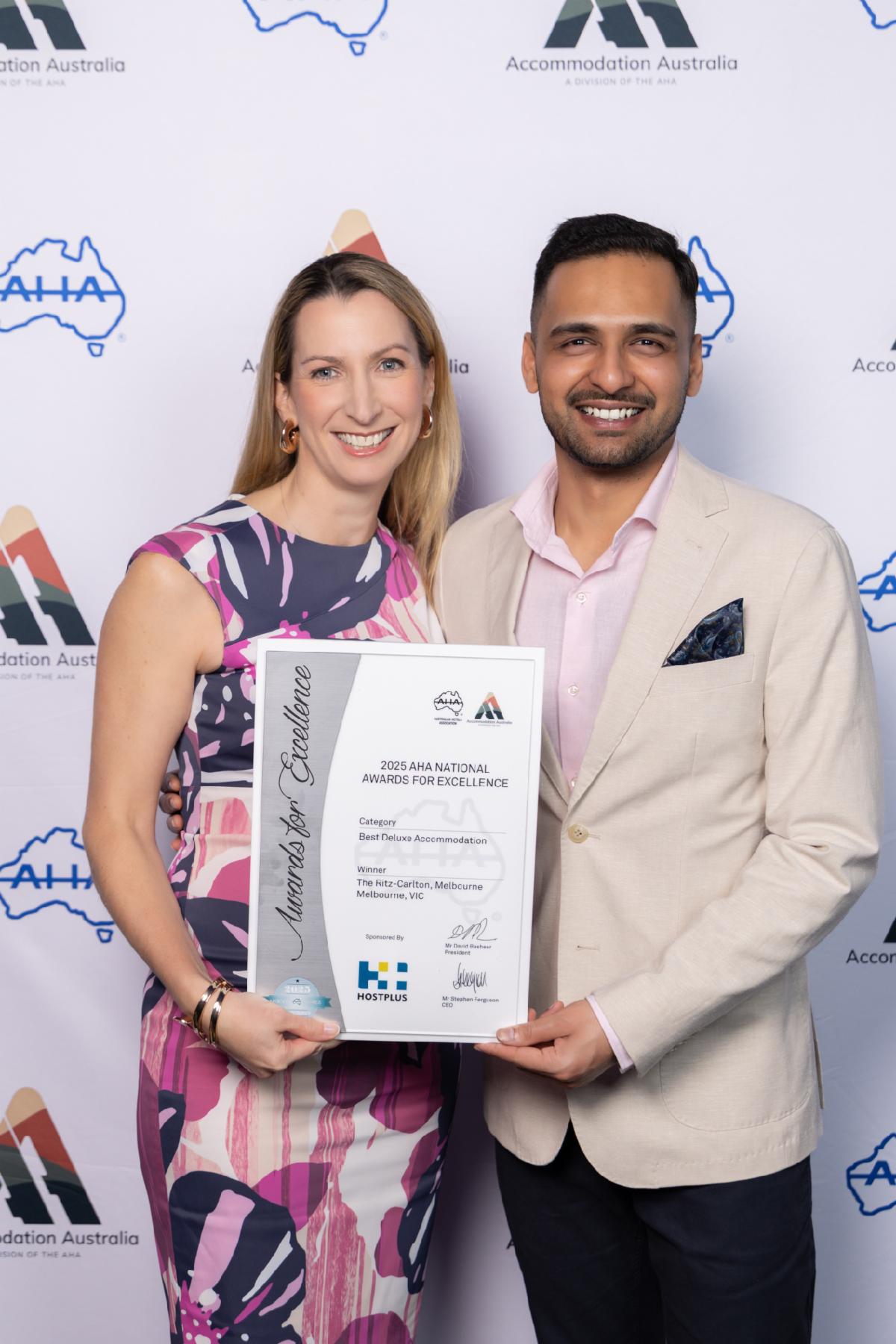
This week at a glittering AHA/AA ceremony on the Gold Coast, national accommodation and pub winners were announced with Ritz-Carlton in Melbourne the major accommodation winner, taking out the best deluxe and overall hotel of the year - accommodation division. Other major accommodation property winners include:
- Best mid-range - Parkroyal Parramatta, NSW
- Best superior - Oval Hotel, SA
- Best luxury - Saffire Freycinet, Tasmania
- Best lifestyle/resort - Michelton Hotel, Victoria
- Best suite/apartment - The Langham, Queensland
- Best Restaurant - (Deluxe): Oncore by Clare Smyth – Crown Towers Sydney, Barangaroo, New South Wales
- Best Restaurant - (Mid-Range - Superior): Yamagen – QT Gold Coast, Surfers Paradise, Queensland
The AHA inductee into the hall of fame was Paul O'Brian from Red rock Leisure. Other individual winners included:
- Rising star - Sade Vasquez, Sofitel Sydney, NSW
- Chef of the year - Pawan Dutta, the Royce, SA
- Commercial and Guest Experiences - Montana Daly, W Hotel, NSW
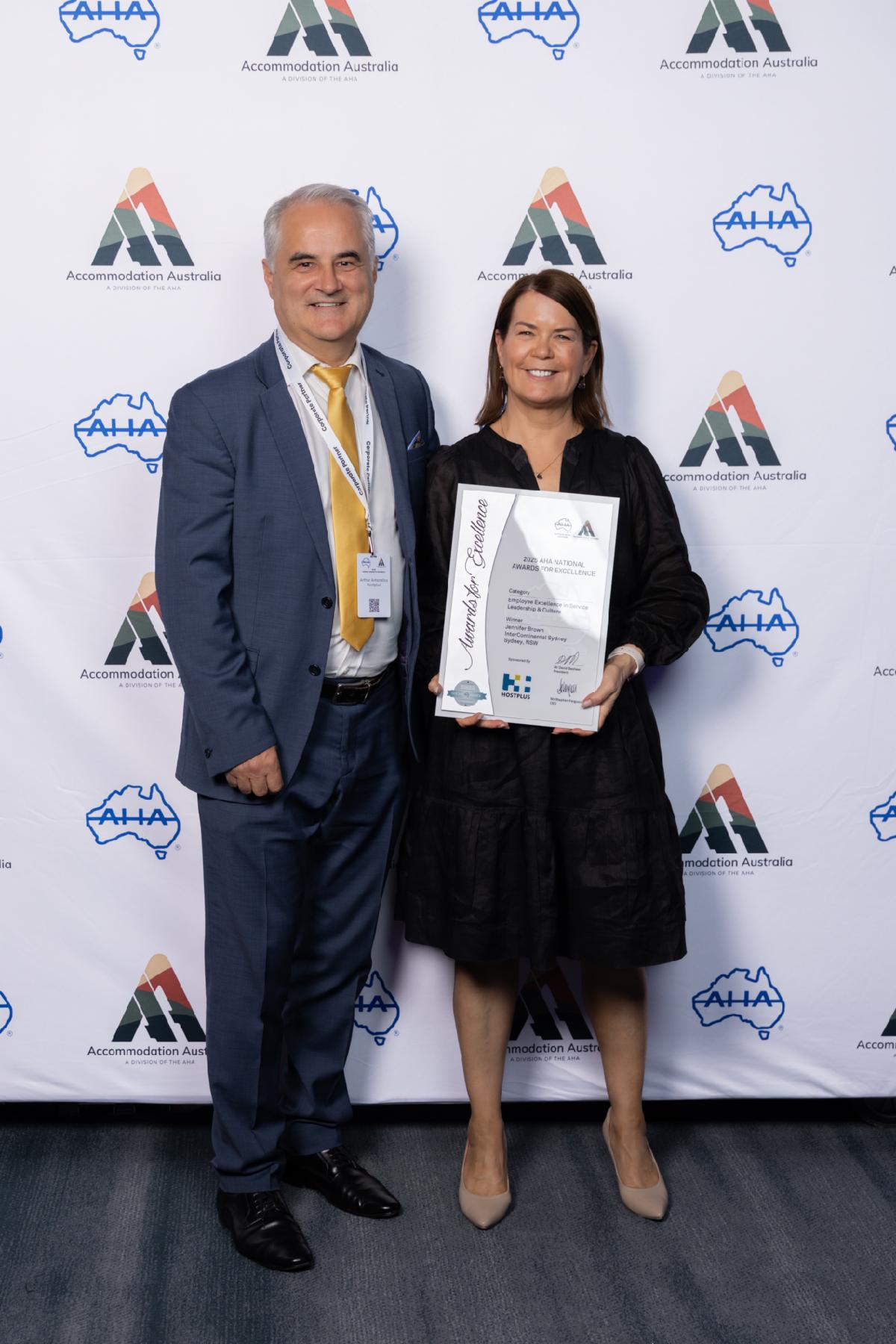
- Leadership and culture - Jennifer Brown, InterContinental Sydney, NSW
- Operations and support - Louise Nicdao - Batman's Hill on Collin, Victoria
- Front of House - Duncan Morrison, Sheraton Grand Sydney, NSW
For a full list of winners, click here.
| | | Winner of Best Deluxe Accommodation and overall Accommodation Award, Ritz-Carlton, Melbourne. | |  | Winner of Excellence in Service Leadership and Culture, Jennifer Brown from InterContinental Sydney with sponsor of the Award, Host Plus. | | | |
Australia concedes to Turkey as the host of COP31
In disappointing news for Adelaide and Australia generally, the world's most significant climate summit will be hosted by Turkey in 2026. The announcement today by Minister for Climate Change, Chris Bowen, was made from the COP30 Summit in Brazil. The frustrating process of choosing the host for the COP summits works on a consensus model, rather than a voting system. If it was unresolved, the conference would have automatically reverted to Bonn – the German city home to the UN Framework Convention on Climate Change Secretariat. In exchange for Australia's concession of host country, Turkey has agreed that Australia will lead next year's negotiations at the Summit. The Adelaide Convention Centre and hotels in the city have all been holding their breath, and their bookings, until the announcement, so the news will result in a scramble to fill beds and convention space in the time that was set aside for next year's event. According to the ABC, South Australian Premier Peter Malinauskas said he was "disappointed" but understood the prime minister's decision. "He has taken a position to try and navigate the frankly obscene process that exists internationally," he said. "We put our best foot forward and won the rights as a city and a state to host COP if it was won internationally, and internationally that was not able to be achieved." Now the outcome is known, AA SA is convening an industry meeting next week to develop a strategy to work with government to ensure a strong fourth quarter in 2026.
| |
AA Board meets on the Gold Coast
Membership and advocacy priorities were the two key items on the agenda when the AA Board met on Monday. The Board also signed off on the annual report for 2024-25, being the second full year since the amalgamation of the two previous accommodation bodies. The board was also joined by the CEO of the AHA Stephen Ferguson and President David Basheer who engaged on the key policy issues such as migration and an update on the political landscape. Other matters discussed included the updated Short Term Rental Accommodation policy, chef shortages and workforce issues, growing tourism demand including aviation access and Tourism Australia funding, and the proposal to make NABERs energy rating system compulsory for hotels greater than 100 rooms.
Pictured below (L-R) Andrew Cairns – Crown Hotels & Resorts, Paul Hutton – Hilton, Geoff York – Crystalbrook Collection, Shelley Verdouw – RACV Hobart, James Goodwin - AA CEO, David Basheer - AHA National President, David Mansfield – The Ascott Limited/Quest (AA Chair), Andrew Bullock – 1834 Hotels, Adrian Williams – Accor, Pacific, Emma Hynes – IHG Hotels & Resorts (Deputy Chair)
| | |
Hotel performance in October
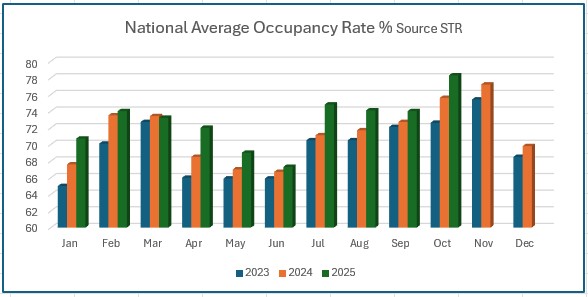
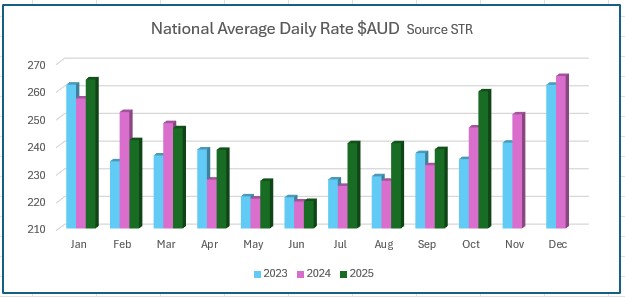
The latest STR accommodation data released for October 2025 continued the improving trend in both occupancy and average daily rate, with average occupancy in the month of October across Australia of 78.3% compared with 75.6% in 2024, and the Average Daily Rate up 5.9% to $259.54 compared with $245.15 in October 2024. Revenue per available room in October 2025 was $203.14, a significant rise of 9.6% from $185.27 in 2024. Occupancy rates for October 2025 saw the highest rises in ACT and Tasmania, followed by WA and SA, with ADR increases highest by far in WA (up 16.2%), followed by NSW and then ACT, with the NT the only one to experience a fall (down 1.6%). In the year to October 2025, Australia's average occupancy rate was 72.8% compared to 70.7% for the previous year, and the ADR average was up 2.9% to $242.01. All States and Territories have seen an increase in RevPAR in the year to date, with WA the highest up 9.6%. New Zealand for the third month in a row saw and increase in occupancy and also a rise in ADR in October 2025 with occupancy 68.9% this year compared to 64.5% last year, and ADR up by 3.7% to NZD221.84 compared to last year.
Preliminary capital city STR data for the month to November 15th shows that hotel performance remained relatively strong for most capital cities compared to the previous corresponding period last year with only Brisbane and Gold Coast experiencing a drop in occupancy. Sydney did particularly well in the first two weeks of November, with average occupancy across the whole city 90.7%, and 92.9% in the city centre. Sydney's ADR rose by 8.6% to $332.36 and RevPAR was up strongly by 15.1% to $301.54. Melbourne's occupancy rose 8.9% to 81.5%, and ADR up 6.3% to $255.42; Brisbane occupancy was down 5.3% to 76.4%, but ADR was again up by 5.1% to $260.90; Adelaide occupancy up by 3.0% to 83.2% and ADR up 3.4% to $239.11; Perth occupancy up 4.0% to 88.4% and ADR strongly up 14.5% to $271.94; Hobart occupancy up 9.0% to 87.6% and ADR strongly up 9.9% to $242.32; Darwin occupancy up 5.1% to 54.0% but ADR down 2.8% to $152.17; Canberra occupancy 4.4% to 76.0% and ADR up 1.0% to $194.35; and Gold Coast occupancy down 4.4% to 71.0% but ADR up 2.3% to $268.48.
The graphs below derived from the STR data show the monthly average performance of occupancy and ADR across Australia since January 2023
| |
| | |
3 things for you to do today to support the industry's jobs and careers platform eeger.com.au:
- Register on eeger to build your employer profile
-
Follow eeger on LinkedIn to stay in touch
- List your job vacancies on the site that has been developed for industry by industry
| | | | |
Overseas arrivals for September 2025
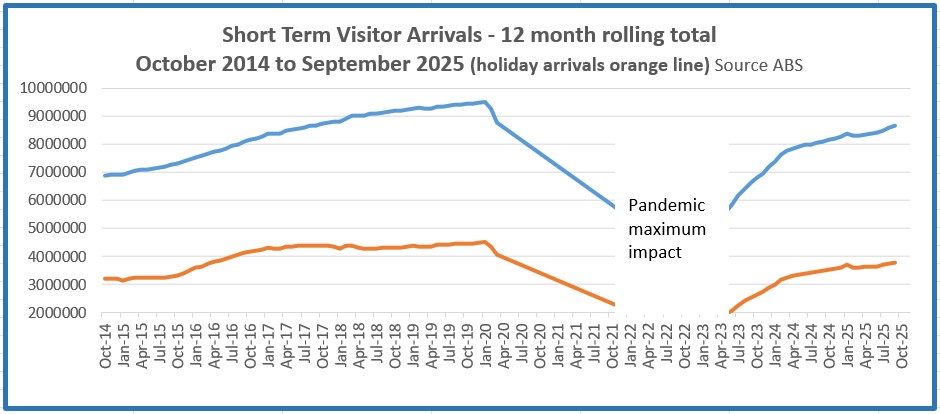
According to the ABS data released last week, there was a commendable increase of 10.4% in short-term visitor arrivals in September 2025 to 696,500 compared to the same month last year. For the first time since the pandemic, the monthly arrival number was above the pre-COVID level, 0.2% above the 694,960 short term visitors who arrived in Australia in September 2019. New Zealand was the largest source country in September 2025, accounting for 19.5% of all short-term visitor arrivals. compared to 15% for the previous month. NZ was followed by China (83,080) and then the UK coming in third with 46,900 visitors. It is particularly good news to note that holiday arrivals are improving on the back of TA's latest promotional campaign (Come and Say G'Day Chapter 2) with an increase in holiday arrivals - up 13.6% compared to September 2024 on the back of a 18.6% increase in August coinciding with the Lions tour. Of the top ten origin countries, New Zealand, the UK, Singapore, India South Korea, and Indonesia all had arrivals greater than September 2019.
The 12-month rolling total arrivals tell a more useful story, illustrating the recent improvement as well as the difference with pre-COVID visitors, particularly for holidaymakers. In the 12 months to September 2025, there were 8,646,960 arrivals up by 6.7% on the year to September 2024, with holiday arrivals at 3,794,030, up 8.3% on the previous year. Holiday arrivals historically peaked at 4.48 million in the year to December 2019. If holiday arrivals grow in the remaining 9 months of 2025/26 similar to the growth in the last three, then total year holiday arrivals will be over 4.8 million for the year to June 2026. The graph below shows rolling 12-month totals for total short-term arrivals and holiday arrivals.
| | |
Decline in post-secondary qualifications
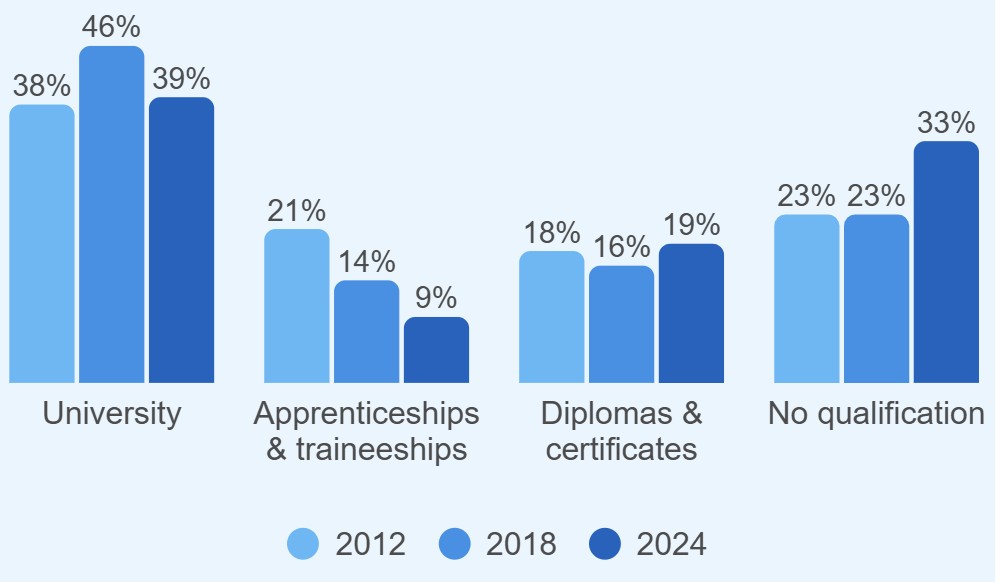
In our recent submission on Apprenticeships, we strongly argued that the government had shifted its skills priorities away from encouraging as many people as possible to receive a post-secondary qualification to "picking winners" amongst industries and occupations to the detriment of industries such as ours. This concern has again been demonstrated by the evidence, this time from the latest data released by the National Centre for Vocational Education Research (NCVER), where the Longitudinal Study of Australian Youth has shown a dramatic drop in people in their early twenties holding a post-secondary qualification, with apprenticeship and traineeship declines the biggest factor. As the graph below shows, 33% of 24 year olds in 2024 do not have any qualification compared with only 23% of 24 year olds in 2012 and 2018 (Source: NCVER LSAY).
| |
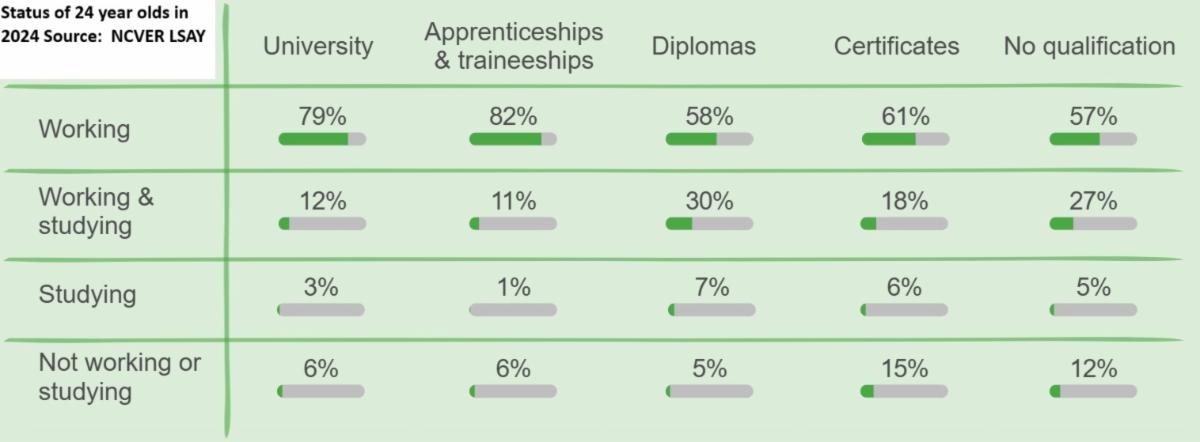
The dramatic decline in apprenticeship numbers has been led by a removal of incentives for traineeships in industries such as ours. This is particularly concerning when you look at the table below which shows that those that hold apprenticeship qualifications have a higher chance of being in work at 24 years of age than any other qualification category, and those with no qualification unsurprisingly at the lowest. The survey also showed that of those 24-year-olds who were working in 2024, only 54% were full time, a fall from 65% in 2012. In terms of job satisfaction, 88% of 24 year olds reported satisfaction with their work colleagues, 84% satisfaction with their work and 81% satisfaction with the opportunities to use their skills. Only 61% were satisfied with their promotional opportunities.
This further should serve as a wake-up call to the government, but at the moment there is no sign of a change in direction.
| |
Drop me an email at policy@accommodationaustralia.org or give me a call on 0418 277 919 if you have any national policy issue that you think AA should be following up. If you know an AA member who is not receiving this advocacy report but wants to, then encourage them to email me and we can add them to the distribution list. Back issues of the fortnightly advocacy updates can be found here.
Kind Regards
Jenny Lambert OAM
National Policy Director
Accommodation Australia
| | | | |