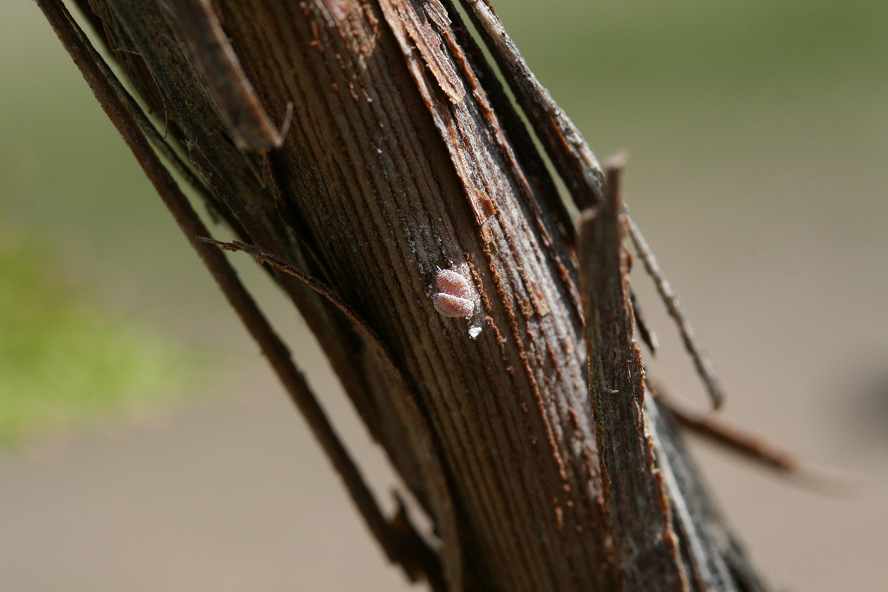
Grape mealybugs on a grapevine.* |
|
As it does every December 21, this month brought the shortest, darkest day of the year. With the Omicron variant circulating around this Winter Solstice, there’s a lot of uncertainty and anxiety out there. It’s been easy to focus on the darkness.
At NGRA’s End-of-Year Board Meeting, held via Zoom on November 18, 2021, we looked back at the year, to consider what goals we achieved and regroup on those we didn’t, to review our financial performance (and my job performance) for the year concluding, and to set a budget and plan for our future. Yes, there were some “low lights,” as Board Chair Russ Smithyman said, namely around growth of the organization.
We had hoped to grow our ranks by one new industry member and our first affiliate member. But the challenges that have buffeted the grape and wine industry—the pandemic, wildfires, low yields—have made philanthropic giving tough. Add to that the fact that research (the focus of our nonprofit) is a long game whose returns can be years away, maybe even beyond the scope of our lifetime. In these dark days, it can be difficult to see beyond the now. But if you’re passionate about advancing our industry, consider joining NGRA. Our research mission is all about translating our common challenges into issues science can solve. In this way, as our November Board meeting proceedings show, there is a lot of “light” to focus on! Read on for the highlights.
Our goal to get at least two NGRA-initiated research projects funded was met via these vital projects:
-
The Online Guide to Varieties of the U.S., a project initiated by our Extension and Outreach Research Theme Committee, led by co-PIs Matthew Fidelibus and Glenn McGourty (UCCE) – Received first-year funding from the American Vineyard Foundation
-
HiRes Vineyard Nutrition, which emerged from our Integrated Production Systems Theme Committee and is led by Markus Keller (WSU) – Received second-year funding from the USDA-NIFA Specialty Crop Research Initiative (SCRI)
And with planning meetings, proof of concept work and/or grant applications throughout the second half of 2021, our Research Theme Committees continued to work toward launching the projects that emerged from their most recent brainstorming and prioritization process, spanning soil health, fruit-quality sensing, broad-spectrum disease resistance and the state of viticulture and enology extension in America (a directory, survey and white paper).
We successfully met our goal to produce the ASEV-NGRA Precision Viticulture Symposium with our colleagues at the American Society of Enology and Viticulture—and there’s more to come. The conference proceedings—a day of presentations by 22 leading lights in precision viticulture theory and practice—were delivered virtually on June 21, 2021. An in-person, on-the-ground demo day is planned for Spring 2022, where innovations in precision viticulture will come to life. A conference grant from USDA-NIFA’s Agriculture and Food Research Initiative helped to make this event possible.
We’re on track to conduct our first strategic planning in a decade—a critical 2021 goal, set to ensure NGRA remains a strong, vibrant organization for years to come. We issued a request for proposals for strategic planning services in Fall 2021 and will soon select a service provider to support this activity, culminating in an in-person, all-Board-member strategic meeting in July 2022.
As the NGRA Board closed out the year, reviewing our past 12 months and planning the next, we recognize that our work, like science, is often slow. There is much we want to achieve, and we’re grateful for the wisdom, patience and steady engagement of our members in continuing to pursue our goals. Thank you to all who volunteer with and contribute to NGRA and our research mission. Truly, none of the light we bring to the industry is possible without you.
And as for that new member: maybe it’s you?
|
|
|
|
*About the photo
Thanks to Cornell's Stephen Hesler for this all-too-familiar image. He's one of the authors of the related Research Focus article on leafroll disease, below.
|
|
Weigh in on Federal Climate Change Research |
|
The U.S. Global Change Research Program (USGCRP) coordinates research across 13 federal agencies to understand the human-induced and natural processes that influence the total Earth system—the atmosphere, land, water, ecosystems and people. It's working on its research plan for the next 10 years and invites public comment. Got ideas on emerging, large-scale scientific questions related to global change and/or response, how science is or isn't being used to inform societal response to climate change, or knowledge gaps and obstacles to implementing scientific tools or knowledge? Weigh in by January 11, 2022.
|
|
New Research Leader at USDA-ARS Genetics Unit in Parlier |
|
As of December 5, 2021, Dr. Rodrigo Krugner is the new Research Leader of the USDA's Agricultural Research Service (ARS) Crop Diseases, Pests and Genetics Research Unit at the San Joaquin Valley Agricultural Sciences Center in Parlier, CA. Previously a Research Entomologist at the unit, Rodrigo is one of the foremost scientists on the bacterial pathogen, Xylella fastidiosa, and associated insect vectors, including the glassy-winged sharpshooter. |
|
New Research Staff at Oregon Wine Board |
|
Neil Ferguson recently joined the Oregon Wine Board (OWB) as the new Insights & Industry Relations Manager. He is responsible for managing and administering the OWB’s research program, including its viticulture and enology research investments and annual Winery and Vineyard Report, as well as sending the Grapevine newsletter along with other industry-related communications, toolkits and more. |
|
Oregon this month added its 22nd federally recognized American Viticultural Area (AVA). The Lower Long Tom AVA is the tenth nested AVA in the Willamette Valley and the first AVA in the southern Willamette Valley. It spans 25,000 acres, 12 wineries and 24 vineyards. The new AVA was granted approval by the Alcohol and Tobacco Tax and Trade Bureau (TTB) on November 10 and took effect on December 10, 2021. |
|
Cornell Summer Scholars to Boost DEI, Digital Ag Efforts |
|
Cornell AgriTech’s Summer Research Scholars Program offers undergraduates an opportunity to participate in cutting-edge research projects alongside faculty members at the Geneva, NY, campus. Over a nine-week period, student interns explore one of three areas: entomology, horticulture and plant pathology/plant microbe-biology. Now, with a grant of nearly $500,000 from the USDA's National Institute of Food and Agriculture (NIFA), the program is increasing the number of underrepresented student participants (and thereby improving diversity, equity and inclusion [DEI]) and boosting expertise in digital ag technology. The 2022 Summer Research Scholars Program runs June 1 through July 29. Participants receive housing and a stipend of $4,825. Applications are due February 4, 2022. Learn more.
|
|
USDA Offers Fellowships for Faculty at Hispanic-Serving Institutions
|
|
The USDA’s Office of Partnerships and Public Engagement (OPPE) is accepting applications for 2022 Hispanic-Serving Institutions (HSI) Fellows through the E. Kika De La Garza Fellowship Program. These fellowships introduce faculty and staff from HSIs to the vast array of USDA resources available to them. Of particular interest are the Science Fellowships offered for science faculty at HSIs to collaborate with leading scientists from either USDA-ARS or Natural Resources Conservation Service (NRCS). Fellows attend a one-week program (July 11-15, 2022) in Washington, D.C., and an additional week (July 18-22, 2022) at either a USDA-ARS research center or with the USDA NRCS Soil Science Lab in Lincoln, NE, depending on their field of interest. Learn more and apply by March 2, 2022.
|
|
UC ANR Seeks a Table Grape Advisor |
|
The University of California, Agriculture & Natural Resources (UC ANR) is seeking a UC Cooperative Extension (UCCE) Advisor for table grapes. Based in Tulare County, CA, the Table Grape Advisor will implement an extension education and applied research program to address high-priority production issues for table grapes and provide research-based technical and educational assistance to the California table grape industry. The advisor will work closely with the California Table Grape Commission Viticulture Research Committee to address critical issues facing table grapes such as vineyard cultural practices and their impact on fruit quality and yield, integrated pest and disease management, irrigation and fertilization management and efficiency, best practices to minimize environmental effects on table grape production, postharvest storage and handling, and automation and mechanization. Learn more and apply by January 17, 2022.
|
|
THE BEST WAY TO CURTAIL GRAPEVINE LEAFROLL DISEASE?
ROGUE AND REPLANT
By Stephen Hesler, Rosemary Cox and Greg Loeb, Cornell; and Marc Fuchs, Cornell AgriTech
|
|
Grapevine leafroll disease, which reduces yield and delays ripening of grapes, is one of the most important viral grapevine diseases worldwide. In Cabernet franc vineyards in New York’s Finger Lakes region, for example, it was shown to delay accumulation of juice soluble solids by about three weeks, and reduce yield by up to 25%. A study by Cornell economists estimated losses ranging from $10,100 to $16,200 per acre over the 25-year lifespan of a Cabernet franc vineyard in New York. The virus is introduced to vineyards in infected planting stock, but is spread to adjacent vines by insect vectors such as the grape mealybug (shown above).
Despite progress in understanding leafroll disease ecology, and modeling of disease spread in relation to bioeconomic factors for guiding management recommendations, the best strategy to mitigate the impacts of leafroll disease in New York vineyards has remained uncertain. And there still is no cure for leafroll in the vineyard. Once a vine is infected by one or several of the leafroll viruses, it will remain infected until it is removed or dies. However, leafroll disease can be managed by reducing the number of infected vines, and to some extent, by controlling vector populations.
To that end, in a five-year (2015 to 2021) large-scale field experiment, the ability of roguing and insecticides—either applied separately or in combination—was tested to reduce the virus inoculum and limit the spread of GLRaV-1 and GLRaV-3 in a commercial Finger Lakes Cabernet franc vineyard moderately infected by leafroll disease. To our knowledge, this is the first replicated large-scale field trial to demonstrate the effectiveness of roguing to reduce leafroll in a commercial vineyard in North America.
Insecticides applied from 2015 to 2021 effectively reduced grape mealybug populations to nearly zero. Notably, the mealybug population was already near zero within the first year of insecticide application. Remarkably, the grape mealybug population was 32- to 257-fold higher in untreated control vine panels compared with insecticide treated vine panels from 2016 to 2021. This multi-fold increase in mealybug populations was within the same range (13-221) for the vine panels to which “roguing only” was applied.
Roguing applied from 2016 to 2020 reduced virus incidence, as measured by the cumulative number of vines infected by GLRaV-1 and/or GLRaV-3, from 4.20% to nearly zero in the vineyard study site in 2020 and 2021. Similarly, roguing in combination with insecticides reduced virus incidence from 5.20% to nearly zero during the same period. In contrast, virus incidence increased from 5.20% to 15.6% from 2017 to 2021 in the control vine panels, and from 5.80% to 13.4% in the vine panels treated with insecticides during the same period.
The bottom line? Over five years, roguing alone and the combination of roguing and insecticide application reduced the percentage of leafroll-infected vines from 4% to 0.6%, while infection increased from 5.2% to 15.6% in untreated control plots. For the combined treatment, roguing was the dominant factor in reducing the virus inoculum, with insecticides contributing relatively little additional reduction.
It took five years (2016 to 2020) for roguing to achieve a drastic reduction in the number of infected vines. In addition, insecticides efficiently repressed the mealybug populations but did not contribute significantly to limiting new virus infections and virus spread unless applied in combination with roguing.
Although leafroll disease remains a concern to the grape and wine industries in New York and beyond, the response to leafroll disease is mixed, with producers often failing to fully consider long-term profit-maximizing options. Most vineyard managers and owners tolerate the disease without controlling it, despite its documented detrimental impacts on yield and fruit quality in vineyards. A few vineyard managers and owners opt for replanting entire vineyards or roguing diseased vines. This study illustrated that roguing is the cornerstone of a successful leafroll disease management program. (And critical to the success of roguing is the cleanliness of the replants.)
|
|
Sidebar
Management recommendations of leafroll disease in a vineyard with moderate disease prevalence (1-25%) in which virus spread is occurring
|
|
- Scout the vineyard late in the growing season over two or three years, and count the number of diseased vines in any given area of the vineyard. Then divide this number by the total number of vines inspected. This number corresponds to leafroll disease prevalence.
- An increase of infected vines over time is indicative of virus spread.
- If virus spread is occurring and disease prevalence is 25% or less, flag diseased vines and two vines on either side before or after grape picking.
- Remove flagged vines and replace them with clean vines without fallow.
- Select replant vines derived from scion and rootstock vine stocks that have been tested for viruses and shown to be clean.
- Consider removing the entire vineyard if disease prevalence is more than 25% and plant clean vines.
|
|
Remote Sensing Journal Seeks Submissions |
|
Three NASA Harvest scientists are guest-editing the forthcoming special issue of the journal Remote Sensing, titled " Recent Advances for Crop Mapping and Monitoring Using Remote Sensing Data." They’re accepting submissions that demonstrate recent advances in remote sensing applications in agriculture. They encourage research papers that use advanced remote sensing techniques and/or focus on advanced modeling approaches such as new methods in machine learning/artificial intelligence or their integration with physical models. Manuscripts are due by February 28, 2022. |
|
Funding Opportunities
Sharpen your pencils! These research funding programs have upcoming deadlines.
|
|
Arguably the most important competitive grant program for research for specialty crops, SCRI offers funding for three types of projects: 1) Standard Research and Extension Projects (SREPs) are funded for up to four years and up to $1,000,000 per year; 2) larger-scope, systems-oriented Coordinated Agricultural Projects (CAPs) are funded up to four years and up to $2,000,000 per year; and 3) Research and Extension Planning Projects are funded for one year at up to $50,000 to provide planning assistance in the development of quality SREP or CAP proposals. Matching funds have been waived per the current federal continuing resolution. As needed, NIFA will revise the pre-application and full application RFA based on any changes to statutory authority. The deadline for SCRI pre-applications is January 21, 2022.
The Unified Grant Management system for viticulture and enology research is now open and all programs are accepting proposals through January 31, 2022. They (and their focus areas for funding) include:
-
American Vineyard Foundation: Breeding, germplasm and evaluation; cultural practices; education and outreach; enology; grapevine pest and disease management
-
California Grape Rootstock Improvement Commission: Breeding new rootstock materials; cleanliness and sanitation; development of efficient production practices
-
California Grape Rootstock Research Foundation: Same as above
-
California Department of Food and Agriculture Pierce's Disease and Glassy-winged Sharpshooter Board: Education and outreach; glassy-winged sharpshooter/other Pierce's disease vectors; grapevine red blotch/other grapevine viruses; insect management/mealybugs/brown marmorated stink bug/spotted lanternfly; Pierce's disease
-
Oregon Wine Board: Wine quality, sustainable production, changing climate, foundational research
The NYWGF welcomes new proposals for research in viticulture, enology and business management for 2022. Apply by January 24, 2022.
The joint Organic Research Program sponsored by the Organic Center and Foundation for Food and Agriculture Research (FFAR) supports innovative research that will have the biggest impact on bringing organic into the future. For 2022, the research should focus on transforming how organic systems can contribute to climate change mitigation and resilience. Submit a pre-application by January 28, 2022.
The NCSFR request for applications (RFA) timeline is changing. Check for the RFA after January 3, 2022, and apply by January 28, 2022.
The California Department of Food and Agriculture (CDFA) Fertilizer Research and Education Program (FREP) is now accepting proposals for research that advances fertilization practices and minimizes environmental impacts of fertilizing materials. Apply by January 28, 2022.
The WSWC is soliciting research grant proposals for fiscal year 2023 (July 1, 2022 - June 30, 2023). Both short-term and intermediate research projects are funded through this competitive program. Apply by January 31, 2022.
|
|
December 20, 2021 | Lodi Winegrowers Blog
“Maintaining a favorable root zone ought to be the primary focus of soil management,” writes viticulturist Stan Grant. Vines need a soil environment conducive to roots’ extension and access to soil resources to support vine growth and development. Three soil attributes support root zone functions: tilth, water-holding capacity and fertility.
December 19, 2021 | Napa Valley Register
The Pierce’s Disease Research Symposium this month highlighted ongoing work on the disease and its vector, the glassy-winged sharpshooter (GWSS), funded by California’s PD/GWSS Board. The 15 talks over two days also covered research on other economically important grape pests and diseases, such as mealybugs, red blotch and leafroll, also funded by program grants.
December 18, 2021 | CleanTechnica
In 2021, in California's San Joaquin Valley, which is home to wine, raisin and table grapes, the areas around Bakersfield, Fresno and Merced experienced 27, 36 and 17 days with maximum temperatures equal to or above 104°F (40°C), respectively. From 1971 to 2000, an average year delivered about five days of such extreme heat.
December 16, 2021 | Wine Australia
In Australia, new auto steer tech for grape harvesters enables the machines to navigate curved rows. Traditionally, a harvester follows the A-B line, but development of an auto-correct system enables steering off the pendulum of the picking head, so it's not limited to straight rows. A LiDAR-based canopy sprayer is also being trialed there.
December 16, 2021 | Forbes
The winery at Monterey's Scheid Family Wines is powered by the energy generated by a 400-foot tall, 1.85-megawatt wind turbine. Heidi Scheid says, "In 2020, this turbine generated 3.7M kilowatt-hours, equivalent to a reduction in CO2 emissions of approximately 3,000 tons. In addition, each year it produces enough excess renewable energy to provide power for up to 125 homes in the local community."
December 14, 2021 | Decanter
In a modification of EU rules, member states can employ disease-resistant grape varieties in the production of wines with protected denominations of origin. While certainly a step in the right direction, lack of cooperation between Europe’s grape breeding programs and acceptance by appellation regulatory authorities remain obstacles to the adoption of resistant varieties.
December 13, 2021 | Morning Ag Clips
Oklahoma State University is starting the Grape Library of Viticulture Extension—or Grape LOVE—to evaluate and disseminate performance of grapevine cultivars in the state.
December 13, 2021 | The Brock News
Due to warmer temperatures, vineyards in Canada saw greater numbers of ladybeetles and higher incidence of methoxypyrazines in wines, which can come from both dense canopies and “ladybug taint,” when the insects are inadvertently crushed with grapes at harvest. In the journal, Biomolecules, the team explored management of the compounds…and insects. The full article can be found here: https://bit.ly/3dQVuQY.
December 9, 2021 | Pix
Wine writer Rachel Signer writes: "'Variety' is the noun, and 'varietal' is the adjective. So, Merlot is a grape variety, but a wine that's made from Merlot is a varietal wine. How did an adjective begin masquerading all around the wine industry as a noun? And should wine lovers worry about this slippage, and attempt to correct it?" Click to get her gracious conclusion!
December 2, 2021 | Penn State University
Growing cover crops under grapevines in vineyards can reduce erosion in wet regions, enhance soil health, reduce herbicide use and improve water quality, according to a team of Penn State researchers. But it can also grow a new crop of customers who are willing to pay more for sustainably grown wines.
December 2021 | OWRI Vine to Wine
Is there a way to normalize pressure bomb data collected across a broad range of environmental conditions, such as readings taken at various blocks over the course of a week? Alec Levin at Oregon State University’s Southern Oregon Research and
Extension Center says yes, with the vapor pressure deficit (and a bit of math).
November 30, 2021 | Napa Valley Register
From sensors and mapping for precision management to soil stimulants for regenerative farming, new technologies offer ways for grape growers to offset drought.
November 24, 2021 │ UCANR E-Journal of Entomology and Biologicals
Entomologists at UC Agriculture & Natural Resources overlaid county acreage and crop value reports over risk maps for spotted lanternfly to forecast what's at stake for California farmers if/when SLF lands in the state. For grape growers in the central San Joaquin Valley, the outlook isn't good.
November 23, 2021 | Good Fruit Grower
Where there’s wildfire, there’s not always smoke exposure. Using a network of sensors installed in vineyards around Washington’s Yakima Valley, WSU’s Tom Collins can estimate the thresholds at which smoke levels will compromise fruit quality. The smoke sensors and related modeling work will help understand how smoke moves in the landscape and assess risk to grapes and wine. Air quality monitors used to track the human health risk from smoke don’t accurately reflect the risk to grapes and wine, he notes.
November 23, 2021 | Financial Times
Climate change has forced all makers of fine wines to adapt. But growing techniques to cope with, say, heat, lead to other issues like mold. Wildfires, chronic drought, hail, frost and more are changing the game for winemakers (and as this article points out, investors).
November 18, 2021 | Fruit Growers News
WSU researchers recently confirmed the discovery of a parasitoid wasp, Ganaspis brasiliensis, in the US for the first time. It's an important biocontrol milestone for fighting spotted wing drosophila because it's "very host-specific," says entomologist Elizabeth Beers. "It really likes to attack spotted-wing drosophila larvae and generally doesn't bother other species."
October 28, 2021 | San Francisco Chronicle
Drought is changing the mix of crops grown in California—but not in the way you might think. Instead of planting crops that use less water, farmers are putting in plants that deliver more revenue per acre, like almonds, pistachios and walnuts. "Even in drought years, prices matter a lot," says UC ag economist Daniel Sumner.
December 2021 | Climate Viticulture Newsletter - University of Arizona Cooperative Extension
Across Arizona’s three AVAs, temperatures were cooler this grapegrowing season than in record-hot 2020, says University of Arizona climatologist Jeremy Weiss. But longer-term, growing season temperatures continue their regional warming trend.
November 2021 | OWRI Vine to Wine
Oregon State scientists examined aroma composition of wines produced from GRBV positive vines that had undergone two different leaf removal treatments in the 2018-2020 growing seasons. Results suggest that early leaf removal may lessen the effect of red blotch disease on grape anthocyanin content and improve aroma composition.
October 21, 2021 | The Scientist
This fascinating research in Arabidopsis is the first evidence of plants taking up RNA secreted by other plants into the environment. Nearby individuals take up the RNAs, which alter their gene expression patterns by binding to messenger RNAs and preventing certain genes from being translated into proteins (a process known as RNA interference). Why would a plant need to affect another plant's gene expression? Theories include warning of nearby stresses or competition for local resources.
April 21, 2021 | ASEV Catalyst
It's pruning season! In this ASEV Catalyst article, UC Agriculture & Natural Resources viticulture extension agents Matthew Fidelibus and Kaan Kurtural review best practices in consideration of vineyard design, as well as operation of machines for optimal productivity for the winegrape grower, not only for pruning but shoot-thinning, fruit-zone leaf removal, crop load management and mechanical harvest. How-to-videos are included, as well.
Find these stories and more, published daily, on NGRA's Facebook and Twitter feeds.
|
|
January 8-12, 2022
San Diego, CA
January 11, 2022
Eastern Viticulture and Enology Forum:
Virtual event
January 12, 2022
Easton, CA
January 18-19, 2022
Glendale, AZ
January 24, 2022
NGRA Annual Meeting of the Members and First-of-Year Board Meeting
Sacramento, CA
January 25-27, 2022
Sacramento, CA
January 26, 2022
Sacramento, CA
February 7-10, 2022
Kennewick, WA
February 8, 2022
Eastern Viticulture and Enology Forum:
Virtual event
February 8-10, 2022
Tulare, CA
February 15-17, 2022
Virtual event
February 17-19, 2022
Denton, TX
February 21-22, 2022
Dublin, OH
February 24-25, 2022
Virtual event
|
|
The monthly NGRA Update is provided as a service to the U.S. grape and wine industry.
|
|
|
|
|
|
|