This week we talked to Grants Manager Brian Schmitz about his role and the substantial impact grants have on our agency and the communities we serve. Federal, state and foundation grants have helped us create innovative new programs and partnerships, hire key personnel, and acquire life-saving equipment.
Grant funding reduces crime and makes neighborhoods safe. Grants can also increase agency transparency and accountability through audits and reporting. They allow us to do more without relying on taxpayer dollars. Schmitz says grants have also led our agency to establish new partnerships within our community, building trust. Partnerships are essential to embracing public safety as a shared responsibility.
As of this month, the Sheriff's Office has over 60 active grants worth more than $24 million and 20 pending grant applications worth nearly $8 million.
Specifically, grants have provided body-worn cameras for our deputies, computers, crime scene unit equipment, two eco-friendly transport buses, boats for patrolling the Houston Ship Channel, an airplane for aerial surveillance of the Houston Ship Channel, and more. Grants have also funded 85 positions agency-wide, jail re-entry programs, our Motorist Assistance Program, our Behavioral Health Division, anti-gang efforts, crime victim services, traffic enforcement, and employee training.
Collaborations with Local Universities
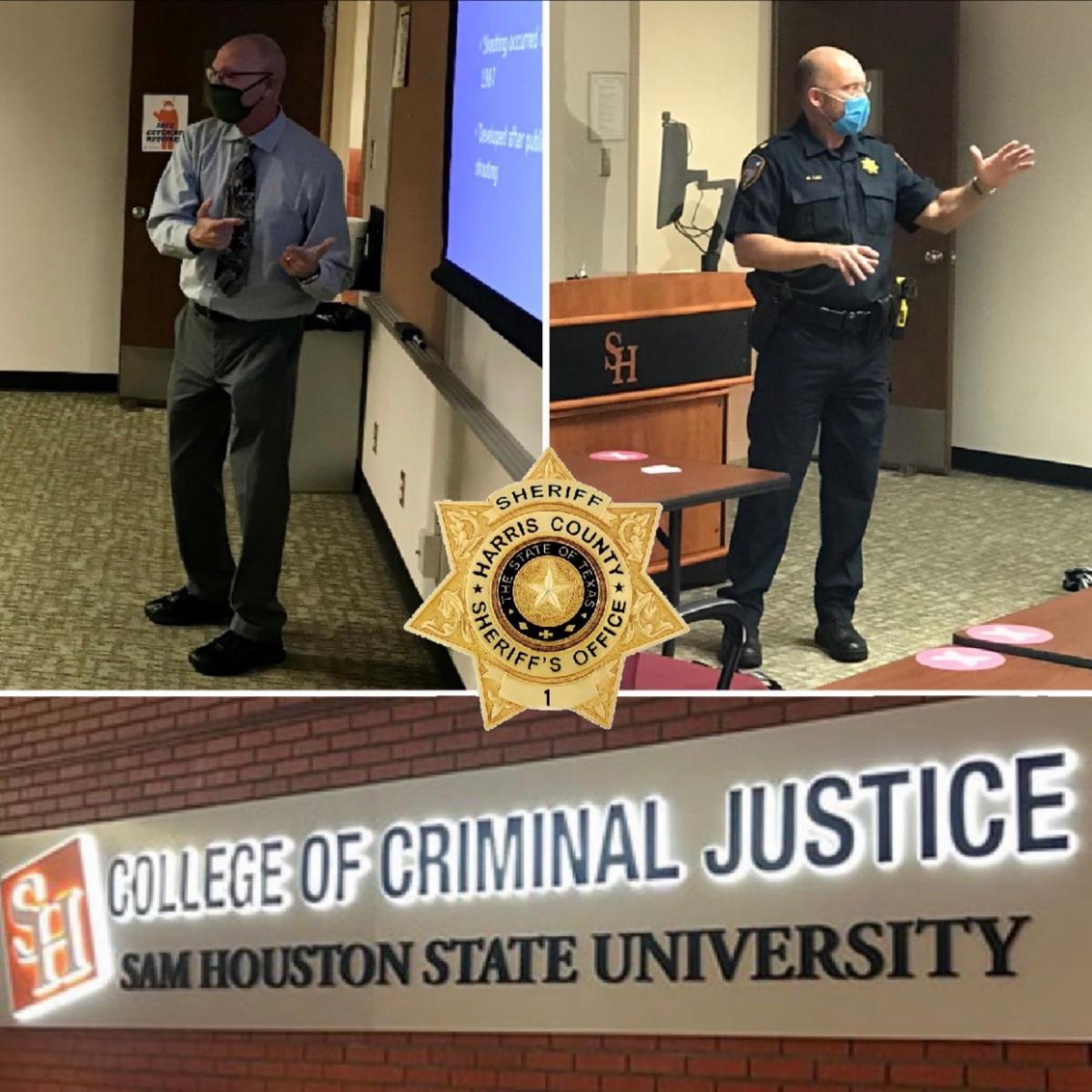
Through a grant awarded by Arnold Ventures, the University of Houston-Downtown (UHD) conducted an independent evaluation of our pioneering telehealth and behavioral health crisis program – Clinician and Officer Remote Evaluation (CORE). CORE uses technology to connect our deputies in the field with a clinician from The Harris Center via an iPad. UHD’s findings were instrumental in Harris County Commissioners Court’s decision to fund the program. CORE is now a model program for responding to persons experiencing a behavioral health crisis.
Rice University is conducting an independent evaluation of our Stars and Stripes Program, an initiative we launched to empower military veterans with resources and support while they’re incarcerated. Its success, including lower recidivism rates from its program participants, led to the creation of our Brothers in Arms Program.
We will be partnering with Texas Southern University to offer education and training on forensic science to local elementary and middle school students during future summer camps. The young scholars will learn how our investigators examine and analyze evidence from crime scenes that can assist in the investigation of crime or eliminate an innocent person from suspicion.
The Elements of Grant Proposals
Grant applications and the management of grant funding can become complex, but the process is very rewarding for Schmitz and his team of grant analysts. Schmitz says he most enjoys the diversity of assignments and the chance to work closely with various divisions and units within our agency.
The process of applying for grants can require months of effort with a significant investment of time, research, and knowledge. A grant proposal includes several sections, such as a project narrative that details a need and our proposed solution, a project budget, and letters of endorsement from community partners. Competing for grants gives us an opportunity to tell our agency’s story so that others can understand the vision for how important it is and be a part of it.
When asked about the significance of grants, Schmitz says at the heart of his team’s work is giving our agency the ability to try something new or innovative. Because most general fund money is already allocated, grants are instrumental in helping us launch pilot projects.
Brian joined the county’s budget office 14 years ago and has served in his current role as our grants manager for two years. He is a graduate of the University of Texas and Indiana University. Our agency has invested in four positions dedicated to specializing in grants.