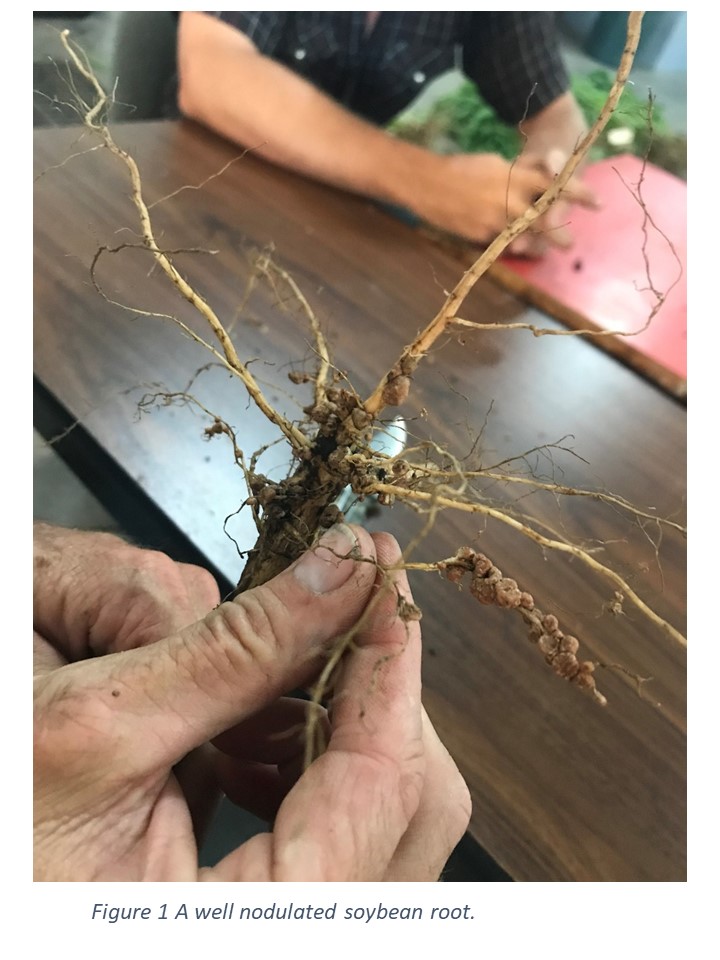
legume, which means they have the ability to form a symbiotic relationship with a specific type of bacteria that grow along the roots (rhizobacteria), allowing them to take N that is abundant in the atmosphere and utilize that N for growth.
On acres that have never had soybeans before, it is highly likely that this type of rhizobacteria Bradyrhizobium japonicum isn’t present in the soil. This species of bacteria will need to be applied with the seed during planting. It is important to remember when handling rhizobacteria inoculant that it is a living specimen of bacteria and it is usually stored with some type of food source to keep it alive in transport whether the inoculant is liquid, granular, or peat based. That living specimen needs to be treated with care and should not be set out to bake in the sun. It is also important to remember the soil conditions needed for this relationship to thrive. If there is already a high amount of N in the soil, the soybean plant isn’t going to spend energy to create this relationship and will instead use the N that is readily available.
Research conducted between the Dickinson and Hettinger REC’s from 2017-2018 showed no yield benefit of adding N at planting timing. When fertilizer costs were added, the fertilized treatments had a lower return than the inoculated treatments. Fertilizer research across 16 states in the 2019-2020 growing season, 46 site-years, including ND found that foliar fertilizer did not increase soybean yield and the profitability was reduced when using the products in the studies. The only time when N should be added is when there are N deficiency symptoms and no nodules are present on plants. There are two main possibilities that can cause lack of nodules and N deficiency.
The first, cause is something went wrong with the inoculant; it either wasn’t added or it was no longer living. A way to avoid this issue, especially on virgin soybean ground, is to double inoculate with two sources of inoculant at planting (i.e. liquid and granular inoculant). The second possibility could be a soil pH issue. We are continuing to see more and more acres test below pH 5.5 with surface stratified soil acidity in no-till systems. The rhizobacteria do not function well in this acidic environment. The best way to identify soil acidity is through site specific soil sampling. The acid areas can be remediated by lime applications.
Soybean stand is important to consider in the dryer environment of western North Dakota. The dryer environment relative to eastern North Dakota reduces yield potential. John Rickertsen’s research at the Hettinger REC indicates a population of 120,000 plants per acre is adequate as opposed to wetter environments suggesting 150,000+.
There is a wide range of maturity options in soybean but the best options for our region are on the early maturing end with 00.8 to the later maturing 0.3. When selecting a 00 variety, it’s recommended to increase seeding rate as there will be less branching due to an earlier maturity. Solid seeding versus planting rows of soybeans yield the same. However, drilled soybean will canopy quicker allowing for better weed suppression. Soybean yields are usually made in August, so even with a drought through most of the growing season, a late rain can bring decent yields.
When soybean was first introduced to the US in the 1700s it was actually as a forage crop. Soybean forage varieties can be a great option as an annual forage that also can fix some N for the next crop in the rotation. Whether producing soybean for forage or as grain be sure to utilize the NDSU Extension resources on fertility, pest management, and variety selection.
If you are looking to learn more about soybean production in our region take advantage of a free opportunity sponsored by the North Dakota Soybean Council on February 7th 2022 from 1-4 MST in Dickinson at Stark County Family and Ag Resource Campus Office, Dakota Room Door C, 2680 Empire Rd., Dickinson, ND.
The event will cover carbon markets, soil fertility, variety selection, crop protection, and weed management.
CEU’s are available for CCA’s.
For more information: