Volume 252 | October 28, 2025

Satellite-to-Phone Connectivity: Threat or Opportunity?

The wireless industry has been buzzing with recent announcements from SpaceX’s

Starlink, AST SpaceMobile, and other satellite providers promising direct-to-device

(D2D) connectivity—smartphones connecting directly to satellites without relying on

towers. For property owners with rooftop sites, tower leases, or ground leases, this

raises an important question:


Does satellite-to-phone service mean towers and rooftop sites are becoming

obsolete?


The answer is clear: No. Even though there have been great strides in direct to

device, the terrestrial infrastructure has its issues.


Why Satellites Won’t Replace Towers


1. Physics of Connectivity


  • Latency and Bandwidth Limits: Satellites in low-earth orbit (LEO) can reduce latency to 25–40 milliseconds, but that still can’t match the single-digit millisecond latency required for real-time applications like gaming, telemedicine, and autonomous vehicles.


  • Capacity Constraints: A satellite covers thousands of square miles, meaning limited bandwidth must be shared across all users in that footprint. Towers, on the other hand, can be densified to serve more users in high-demand areas.


2. Urban & Suburban Coverage Needs


  • Buildings, trees, bridges and terrain block satellite signals, especially in dense environments. That’s why urban and suburban areas will continue to rely on towers, rooftops, and small cells for consistent, high-capacity service.


  • According to GSMA Intelligence, over 80% of global mobile traffic is consumed in cities and suburbs—areas where satellites alone cannot provide reliable connectivity.


The Role of Satellites: Filling Gaps, Not Replacing Sites


Satellites are designed to complement terrestrial networks by covering:


  • Rural and remote areas where tower construction and utility infrastructure is cost-prohibitive.


  • Disaster recovery zones, providing temporary coverage when terrestrial sites are damaged.


  • Maritime, aviation, and agricultural operations, where traditional coverage is limited.


This “coverage extension” model is already being adopted. For example, T-Mobile and

SpaceX announced a partnership to use Starlink satellites for eliminating mobile

“dead zones.” The service is initially limited to text and messaging, with voice and data

expected later—but it still depends on integration with existing terrestrial carrier

networks.


Hybrid Models: The Future of Connectivity


What’s coming next is not an “either/or” world, but a hybrid model:


  • Carriers will use both terrestrial and satellite networks to ensure seamless nationwide coverage.


  • 3GPP’s Release 17 standard (2022) already incorporates “non-terrestrial networks” (NTNs) into the global 5G framework, meaning carriers are planning for satellite + tower coexistence at the standards level.


  • This integration will increase demand for terrestrial sites to handle the heavy lifting of data traffic in populated areas.


Why Landlords Win in This Model


For property owners, the rise of satellite-to-phone service can actually strengthen the

value of leases:


  • Greater Reliance on Consistency: As networks become more interconnected, carriers will prioritize ground-based reliability to complement satellite solutions.


  • Amendments and Upgrades: Hybrid networks may require new antennas or equipment at terrestrial sites—creating opportunities for lease amendments and improved terms.


  • Strategic Value of Location: Properties in high-demand corridors—suburban rooftops, urban towers, industrial land—remain irreplaceable, as satellites cannot match their local capacity.


Takeaway


Satellite connectivity isn’t a threat—it’s an enhancement to wireless networks that

reinforces the importance of towers, rooftops, and ground sites. For landlords, that

means your assets are not at risk of obsolescence. On the contrary, they’re becoming

more critical in a multi-layered connectivity ecosystem.


NAI Global Wireless helps property owners navigate these evolving technologies and

ensures they capture the full value of their leases.


Contact us today for a free site evaluation and see how your property fits into the

future of wireless.

AT&T reports Q3 results, eyes fiber and spectrum expansion

AT&T reported steady third-quarter results, underscoring the company’s progress in broadband and mobility while preparing for major infrastructure investments in fiber and spectrum to support its long-term network strategy.


For the quarter ending September 30, the carrier posted revenues of $30.7 billion and net income of $9.7 billion, up significantly from a loss a year ago due to a gain from the sale of its DIRECTV investment. Diluted EPS came in at $1.29, compared with a loss of $(0.03) in the year-ago period, while adjusted EPS held steady at $0.54.


Operating income reached $6.1 billion and adjusted operating income was $6.6 billion. Adjusted EBITDA came in at $11.9 billion. Free cash flow rose to $4.9 billion, up from $4.6 billion a year earlier, with capital expenditures totaling $4.9 billion..Read More Here

Crown Castle Lifts Revenue Outlook As 5G Rollout Gains Pace

What’s going on here?


Crown Castle has raised its full-year revenue forecast for the second time this year, as US telecom companies accelerate 5G upgrades and ramp up demand for tower space.


What does this mean?


Crown Castle rents out about 40,000 US cell towers to major players like AT&T, T-Mobile, and Verizon, locking in reliable, long-term rental income as wireless networks get a 5G boost. That steady demand for site leasing helped Crown Castle edge past revenue expectations last quarter, reporting $1.01 billion in site rental income and prompting management to lift its annual outlook to as much as $4.05 billion. Adjusted funds from operations fell to $1.12 a share—down from last year’s $1.20—highlighting sector-wide headwinds like higher costs and stiff competition. Still, analysts expect the outlook for Crown Castle and other telecom real estate investment trusts to improve as network buildouts slow and expenses steady through 2026, paving the way for payout growth and stability..Read More Here

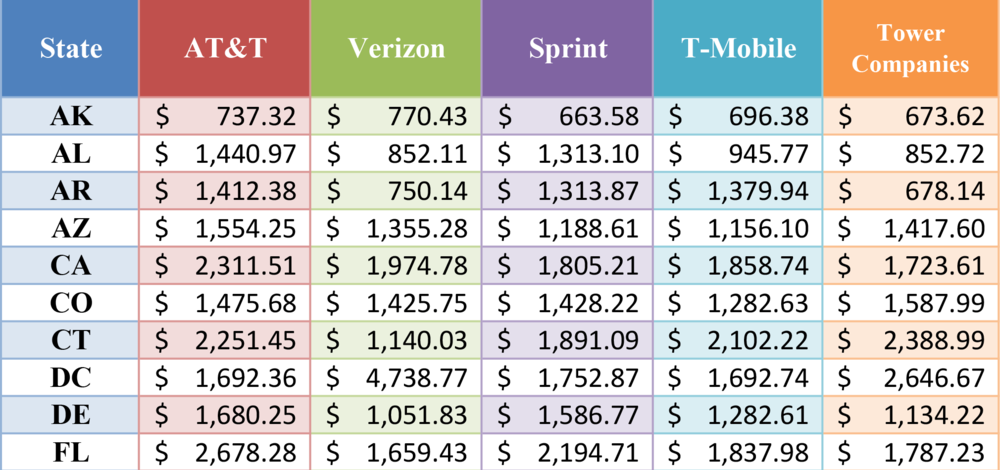
2025 Cell Lease Rate Report

We are pleased to offer a complimentary report that displays comparable lease data for the carriers in all 50 states. This report has been updated to reflect the 2024 rental rates.


PLEASE NOTE- If you do not receive the report within 5 mins, your server may be rejecting the message. Please email Amber directly if you do not receive the report.


DOWNLOAD HERE!

X Share This Email
LinkedIn Share This Email
 
ABOUT NAI GLOBAL WIRELESS

NAI Global Wireless is the only team of licensed real estate professionals dedicated to wireless real estate. We maintain strong working relationships with carriers, tower companies, and back haul providers. This allows you to be represented by brokers specializing in this asset class. Our mission is to share our knowledge and provide services to you to help make more profitable decisions in regard to your cell site(s).


NAI Global Wireless provides the following services:


  • Lease Negotiation
  • Compound Expansion
  • Litigation Avoidance
  • Site Valuation
  • Lease Purchase
  • Distributed Antenna Systems (DAS)
  • Small Cell Technology
  • Cell Site Relocation
  • 5G Technology
  • Billboards


At NAI Global Wireless, we maintain an unwavering commitment to representing only property owners. We do not, under any circumstance, represent wireless carriers, tower companies, or their affiliates. Our sole fiduciary duty is to advocate for the best interests of property owners, ensuring that our guidance, negotiations, and strategies remain free from outside influence or compromise. This exclusive alignment guarantees objectivity, transparency, and the highest standard of integrity in every engagement.


We are your cell lease experts. By working with our team you will be provided the highest level of service possible. Contact us today for a free evaluation of your lease and cell site.


David W. Moore

CEO/Principal

909-542-3325

dmoore@naiglobalwireless.com

CalBRE Lic # 00763044

Amber L. Brandhagen

COO/Principal

760-902-9592

abrandhagen@naiglobalwireless.com

CalBRE Lic #02006621

NV S.0196767