|
The right time to act is always now,
the most important person to focus on is the person you are with,
and the most important task is to do good to others.
~ the moral of Leo Tolstoy’s “The Three Questions”
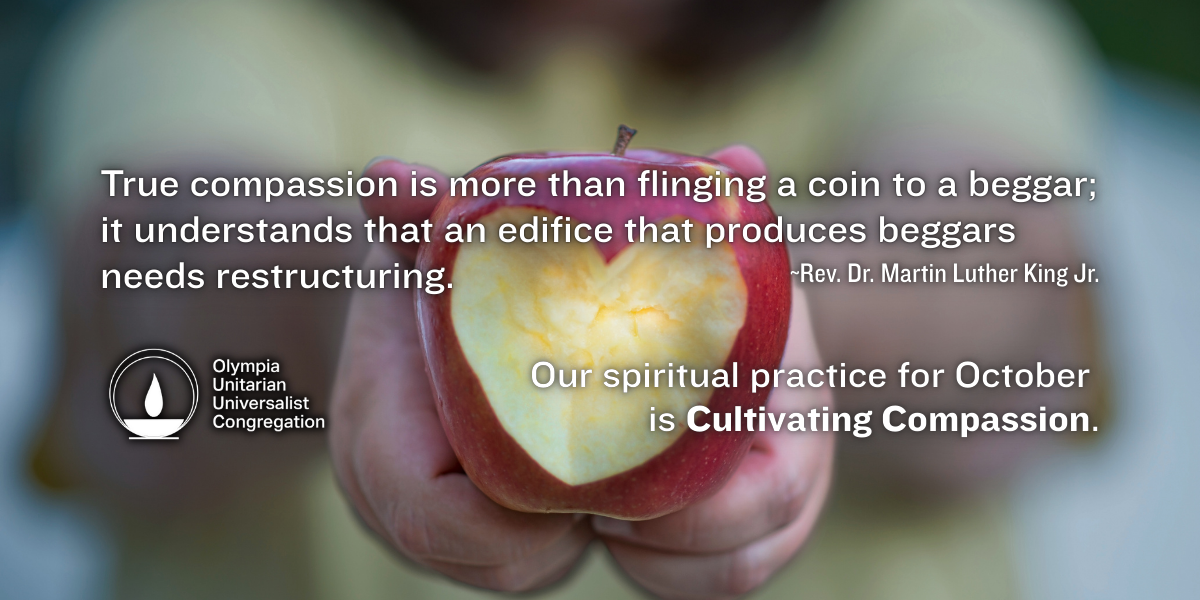
In the service this past Sunday, we celebrated the monthly spiritual practice of Cultivating Compassion. In the service, we offered a reading from Nadia Bolz-Weber, an ordained Lutheran pastor, author and founder of the House for All Sinners & Saints in Boulder, CO. In this reading, Bolz-Weber shares three questions for discernment, or how we can consider our actions:
- What’s mine to do and what’s not mine to do?
- What’s mine to say and what’s not mine to say?
- What’s mine to care about and what’s not mine to care about?
In our culture of urgency and never enough, it’s a radical idea to suggest that we can’t do everything and that we cannot care about everything. And yet we know we can’t. Self-compassion is important so we can open our hearts with compassion for others.
Keeping our heart open in these times can be a challenge when the news can feel overwhelming and so much is happening to hurt people and the planet. Yet we can feel hopeless and helpless in the face of what is before us.
In her book, The Lightmaker’s Manifesto: How to Work for Change Without Losing your Joy, author Karen Walrond suggests that there is no one way to change the world and that there are at least two ways to thrive as an activist. (You can read and hear an interview with her here.)
One is to broaden the definition of activism. She defines activism as “any time you are led by your values to do purposeful action in the hopes of making the world brighter for other people," which Walrond calls "lightmaking." Activism doesn't have to be big or flashy, or public. It just needs to be an action in alignment with your values that will help others. Each of us has the capacity to be activists in our everyday lives.
The second way to thrive as an activist, according to Walrond, is to do what we want to do instead of what we should do. Consider what you love to do, what brings you joy, what your gifts are, what you want to do, and do those things.
Walrond says the process of discernment about our activism is like building a campfire. First, we make a clearing by sorting through the noise of what we should do and listen to what we want to do.
Second, we gather tinder by considering our gifts and interests, naming what lights us up.
Third, we find our spark. What causes and beliefs light you up and cause you to want to take action? What are you passionate about?
And last, we tend the flame. We rest and look for joy, so we don’t burn out. We share the load with others as we do the work of justice together. Remember the words of 19th Century Unitarian minister Edward Everett Hale:
“I am only one, but I am one. I cannot do everything, but I can do something. And because I cannot do everything, I will not refuse to do the something that I can do.”
This is a unique time in history when things we never imagined are happening. It will take all of us to do what we can for the long haul, and it will take compassion for ourselves and each other. Be kind to yourself and to each other.
Blessings on your week,
Rev. Mary
|