|
EMC/FARC Warns US that its Militants are Ready to Fight Back in Case of US Operations in Colombia
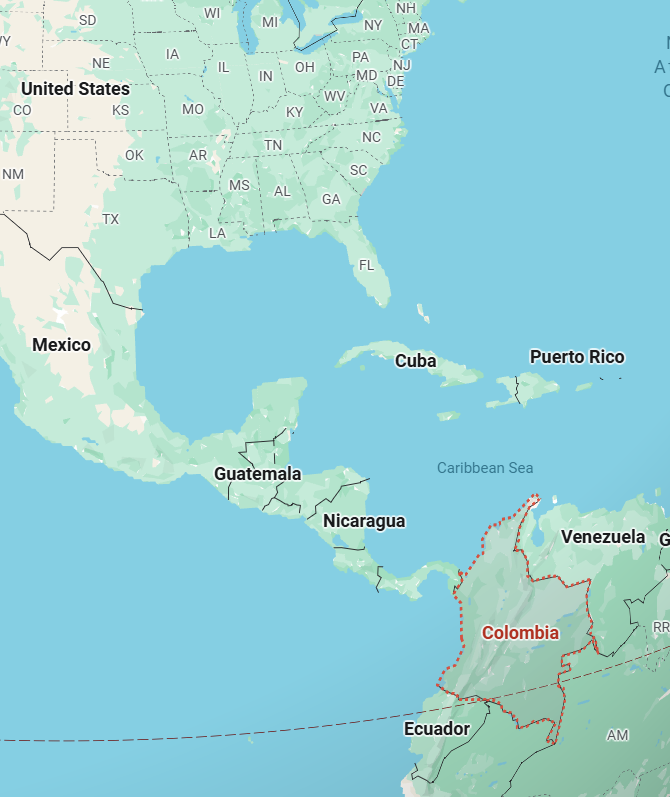
On 25 October 2025, representatives of the Central General Staff (Estado Mayor Central – EMC), the principal dissident faction of the Revolutionary Armed Forces of Colombia (FARC), issued a warning to U.S. President Donald Trump, declaring that the group would “respond with force” to any violation of Colombia’s sovereignty by American troops. The statement, circulated via text message to Colombian journalists, accused Washington of attempting to reassert military dominance in the region under the pretext of anti-narcotics operations.
The declaration followed recent comments by President Trump, who threatened direct U.S. military intervention in Colombia if President Gustavo Petro failed to intensify coca eradication efforts. Such rhetoric has drawn strong reactions across Colombia’s political and militant landscape, with armed groups framing it as an echo of Cold War–era U.S. involvement in Latin America. The EMC’s message sought to position itself as a defender of national sovereignty, appealing to anti-imperialist sentiment among leftist and rural communities that remain sympathetic to FARC’s original cause.
This is the first time in several years that FARC dissidents have directly addressed a U.S. president, reflecting both their growing political assertiveness and their attempt to regain relevance amid Colombia’s fractured security environment. The statement also highlights rising anti-American hostility among militant actors across Latin America, particularly as U.S. security cooperation discussions resurface in the wake of escalating cartel violence and cocaine production.
The timing of the EMC’s warning is notable. It came just two weeks after militants of Los Lobos, an Ecuadorian criminal organization, detonated an improvised explosive device (IED) outside a shopping mall in Guayaquil, in protest against rumors that Ecuador might allow the U.S. military base in Manta (Manabí Province) to be reactivated. The proximity of these two events suggests a broader regional backlash against perceived U.S. military encroachment and growing convergence between criminal and insurgent groups around shared narratives of anti-imperial resistance.
In essence, the EMC/FARC’s message is both a symbolic act of defiance and a strategic communication meant to rally domestic support, deter U.S. involvement, and assert its continued influence as Colombia’s most organized insurgent faction.
| | | TRAC Incident Report: Syrian Security Forces Seize 11 Million Captagon Pills and 19 Kilos of Hashish Coming From Lebanon, Southern Homs Governorate, Syria | | |
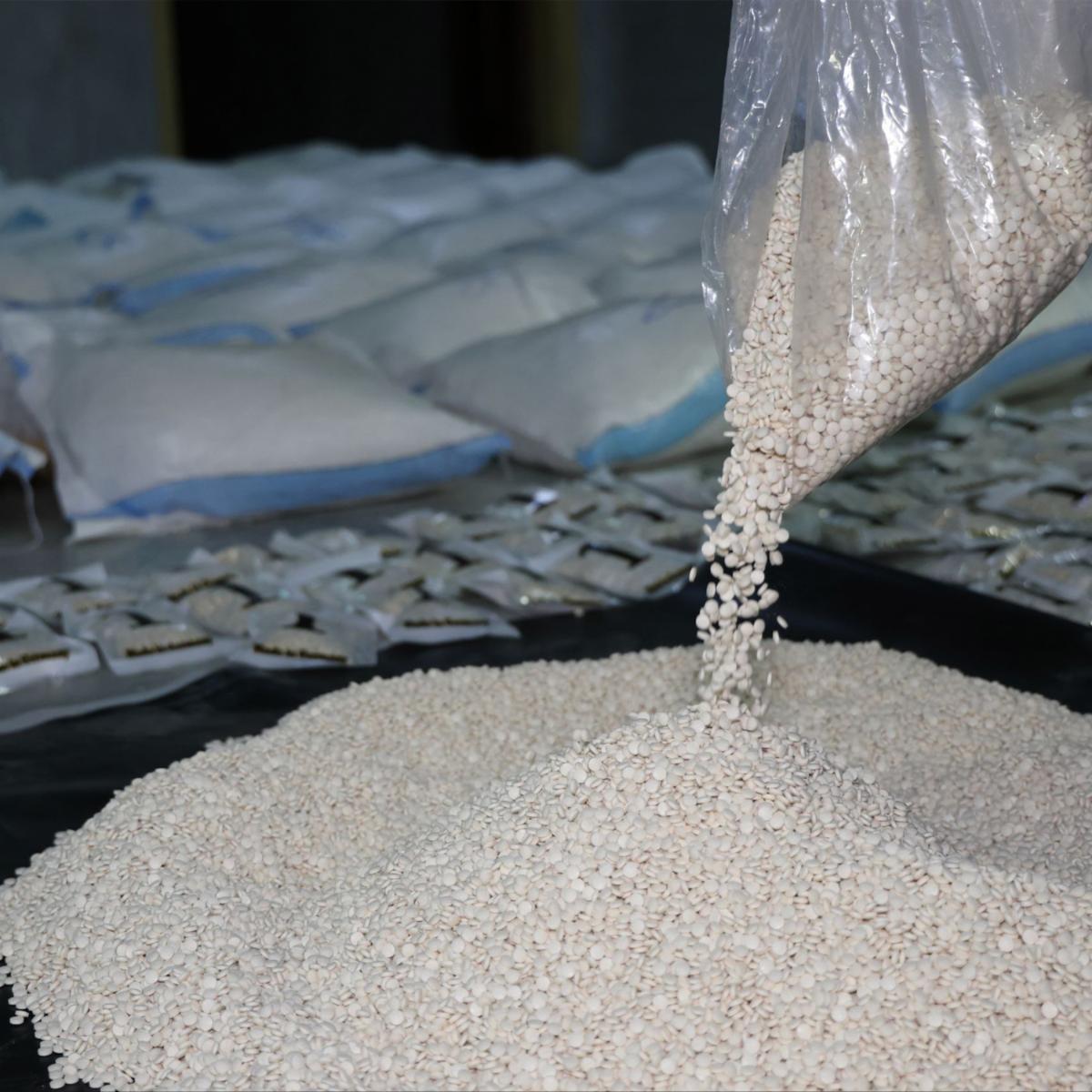
On 28 October 2025, the Homs Anti-Narcotics Branch intercepted a vehicle allegedly entering Syria from Lebanon, seizing 11 million Captagon pills and 19 kilograms of hashish in one of the largest drug busts recorded this year. Authorities have since launched a broad investigation to identify and dismantle the network responsible for the smuggling attempt.
Despite the departure of the Assad regime and Hayy’at Tahrir al-Sham’s (HTS) ongoing efforts to curb narcotics activity in territories under its control, drug trafficking operations continue to thrive across the Levant. Both Lebanon and Syria remain at the core of a regional “narco-state” ecosystem, where profit-driven cooperation among Hezbollah, criminal syndicates, and residual state-linked actors sustains the lucrative Captagon trade. The latest seizure, traced back to Lebanese sources, highlights Hezbollah’s central role in production, trafficking, and export operations, particularly as the group seeks alternative revenue streams amid the financial and logistical strain of its ongoing confrontation with Israel.
The Lebanon–Syria border region, particularly the Bekaa Valley and the adjoining areas of Homs Governorate, serves as a critical trafficking corridor, enabling the flow of narcotics northward and eastward through Syria. Southern and eastern Homs encompass large portions of the Badiya Desert, a region characterized by vast, sparsely governed terrain that facilitates covert movement of both smugglers and militants. The area also borders Deir Ezzor, where Islamic State (IS) cells remain active, further complicating enforcement and increasing the likelihood that drug trafficking and militant logistics intersect along shared smuggling routes.
In response, HTS and its affiliated anti-narcotics divisions have attempted to dismantle trafficking and production networks through raids and public crackdowns. However, the deeply entrenched nature of the Captagon trade, reinforced by cross-border complicity and corruption, continues to undermine these efforts. The persistence of large-scale seizures such as this one in Homs demonstrates how the narcotics economy has become structurally embedded in the post-war landscape, serving as both an economic lifeline and a political tool for armed actors.
TRAC has long documented the strategic importance of Captagon production and smuggling in sustaining militant and proxy activities across Syria and Lebanon. This most recent seizure not only illustrates the scale and resilience of the trade but also highlights the fragile security environment that enables its continuity, despite shifting territorial control and anti-narcotics campaigns.
| | TRAC Insight: Jama’a Nusrat ul-Islam wa al-Muslimin (JNIM) Assaults on Fuel Tankers Bring the Country to the Brink of Collapse, Mali – 03 October 2025 | | |
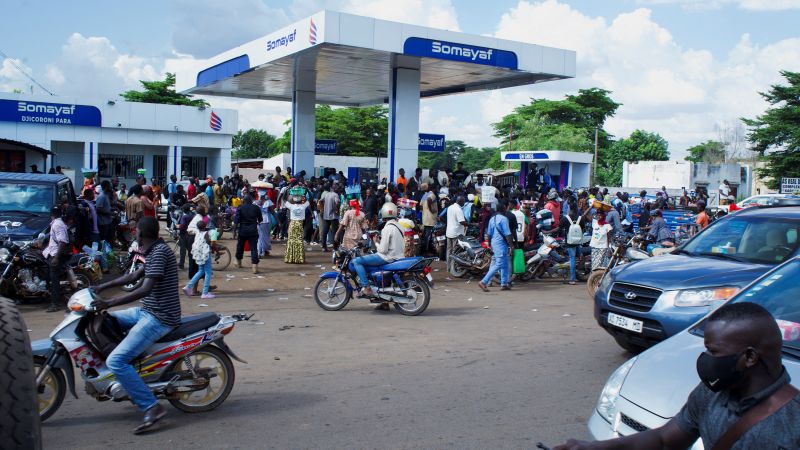
Since September 2025, Mali, particularly its capital Bamako, has been gripped by an acute fuel shortage triggered by a blockade imposed by militants from Jama’a Nusrat ul-Islam wa al-Muslimin (JNIM), al-Qaeda’s affiliate in the Sahel. The group has systematically targeted fuel convoys and logistical routes across the country, striking tankers along major roadways that connect Mali to its coastal suppliers. This deliberate campaign represents more than sporadic insurgent violence, it reflects a strategic effort to strangle Mali’s economic arteries and extend militant control over critical border trade corridors.
The blockade’s impact has been devastating. Gas stations in Bamako, Ségou, and Mopti now see queues stretching for hours, as residents compete for dwindling fuel supplies. The shortages have cascaded into widespread power outages, crippling businesses, hospitals, and public services. In rural areas, where agriculture depends heavily on fuel-powered machinery, the disruption threatens food security and local livelihoods. The crisis Highlights how JNIM’s operations have evolved into a campaign of economic warfare, designed to erode state authority, paralyze the economy, and coerce both government and private sector actors into compliance.
On 23 October 2025, Mali’s Ministry of Transport and Infrastructure announced the suspension of Diarra Transport, one of the country’s largest logistics companies. The decision followed the release of an apology video by the company’s CEO, reportedly directed to JNIM, seeking permission to resume operations. JNIM had previously accused Diarra Transport of collaborating with the Malian government, subsequently banning its vehicles from operating and threatening civilians who used its services. The incident exposed the depth of JNIM’s coercive reach, as even large corporate actors are now compelled to engage with the group under duress, revealing how insurgent power has supplanted state authority in parts of Mali’s economy.
The United States government has also acknowledged the gravity of the crisis, issuing a security alert urging American citizens to evacuate Mali by air due to the severe fuel shortages and deteriorating security conditions. This advisory highlights growing international concern that Mali’s economic paralysis could quickly escalate into a wider humanitarian and political collapse.
Despite the Malian junta’s efforts to strengthen security along major supply routes, all measures have thus far proven ineffective, as JNIM continues to ambush and destroy convoys. In an attempt to alleviate the crisis, Niger recently dispatched a convoy of 60 fuel trucks to Mali; however, JNIM responded by deploying fighters across the Dori department in Burkina Faso’s Seno Province and along the Nigerien border, demonstrating the group’s regional mobility and capacity to disrupt multinational aid efforts.
Looking ahead, TRAC assesses two possible scenarios for Mali’s trajectory. The first involves the potential collapse of Bamako, should the blockade and public unrest continue to erode the state’s ability to govern. The second envisions a negotiated settlement between the jihadists and the military regime, mirroring past truces elsewhere in the Sahel. Ultimately, the fall of the Malian regime could occur either through direct militant offensives or via a popular uprising driven by widespread frustration with the government’s failure to restore basic services and security.
| | (Claim) Tehreek-e-Taliban Pakistan (TTP) Senior Leader Mufti Muzahim (Amjad Swati) Killed Alongside Commander Yasir During CTO in Bajaur District (Afghan Border), Khyber Pakhtunkhwa, Pakistan | | |
On the night of 29–30 October 2025, Pakistani security forces engaged in a major counter-terrorism operation near the Afghanistan–Pakistan border, clashing with a group of militants attempting to infiltrate Bajaur District. The ensuing firefight resulted in the deaths of several militants, including Qari Amjad, also known as Mufti Muzahim, one of the most senior commanders of Tehreek-e-Taliban Pakistan (TTP).
Mufti Muzahim was a key architect of TTP’s cross-border insurgency, serving as deputy to TTP leader Noor Wali Mehsud and holding the title of “Minister of War”. In addition to commanding militant operations across Bajaur Agency, he sat on the group’s Rehbari Shura, its central leadership council tasked with coordinating attacks, managing finances, and directing the group’s regional strategy in northern Pakistan. His death marks one of the most significant losses for the TTP in recent years.
In 2022, the U.S. State Department designated Muzahim a Specially Designated Global Terrorist (SDGT), citing his operational leadership, role in facilitating foreign fighter movement, and coordination of attacks targeting Pakistani and Afghan security forces. Pakistani intelligence reports have long identified him as a critical link between TTP’s Bajaur faction and its networks in eastern Afghanistan, where the group maintains safe havens and training camps. Muzahim’s close associate, Yasir, was also killed in the operation.
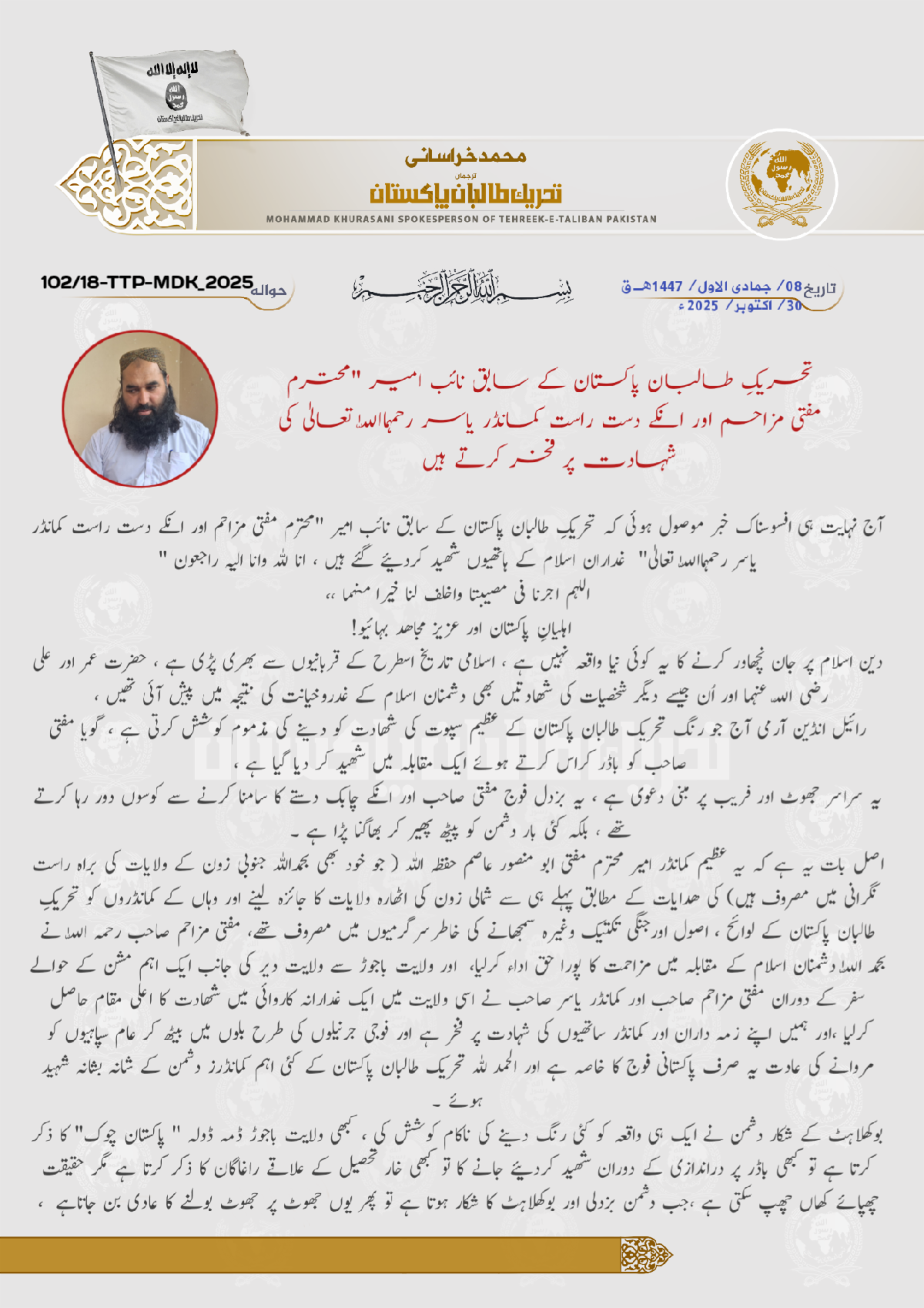
While Pakistani military sources described the encounter as a successful border interdiction, Umar Media, the TTP’s official propaganda outlet, confirmed the deaths but claimed that Muzahim and Yasir were killed through betrayal, rejecting the army’s version of events. This narrative reflects the group’s broader strategy of framing leadership losses as martyrdom or treachery, aiming to preserve morale and justify retaliatory violence.
TRAC contends that the elimination of Muzahim will have a short-term operational impact on the TTP, disrupting its command structure in Bajaur and weakening its ability to coordinate attacks across Khyber Pakhtunkhwa. However, the group will exploit his death for propaganda purposes, portraying him as a martyr to recruit new fighters and reinforce anti-state sentiment in the tribal belt. Given his prominence, retaliatory attacks targeting security installations or checkpoints in the coming weeks are highly probable.
| | TRAC Incident Report: Heavy Gunfights Erupt Between Commando Vermelho-Linked Members and Special Forces in Northern Rio de Janeiro, Brazil | | TRAC Incident Report: Authorities Remove a Sovereign Citizen’s Bus from Nelson Place, Williamstown, Melbourne, Victoria, Australia | | TRAC Incident Report: Suspected Jaish al-Adl Assassinate Two Members of Iranian Revolutionary Guard Corps (IRGC) Basij Paramilitary Forces in Sistan & Baluchestan, Iran | | | | |