|
What stage of training are you currently in?
Assistant Adjunct Professor
Describe your laboratory research.
My research focuses on inflammatory bowel diseases, including Crohn’s disease and ulcerative colitis, with an emphasis on intestinal epithelial cells. We develop and apply live-cell imaging approaches combined with pooled CRISPR perturbations to study dynamic cellular behavior in organoids and related systems. Broadly, my work aims to uncover how gene programs regulate cell state and signaling dynamics in human disease.
What made you want to become a physician-scientist or choose your area of research?
Clinical medicine requires responding to many individual problems throughout the day, often with limited information and the need for immediate solutions. While I enjoy clinical care and endoscopy, I have always been drawn to more abstract problems that require developing new ways to study biology. As a physician-scientist, I maintain a clinical practice while also having the opportunity to build new tools to study challenging diseases such as inflammatory bowel disease.
Describe a major challenge you have encountered in your career as a physician-scientist.
Balancing clinical work, experiments, and grant writing requires constant context switching. This creates pressure to pursue smaller, lower-risk projects, particularly in the context of career development funding, and reviewers often question why I have not yet focused on a single, clearly defined biological problem.
I chose instead to develop an optical pooled screening platform as the foundation of my independent lab, a high-risk, technology-driven approach where progress is often all-or-nothing. While I believed strongly in the technology and its ability to enable many biological discoveries, maintaining momentum while balancing other responsibilities was the most challenging part of my career and tested my persistence.
Describe something that gives you joy in your current stage as a physician-scientist.
My favorite thing to do is drink coffee and sketch ideas on a whiteboard. I especially enjoy meeting with other researchers to discuss science and design new collaborative experiments.
Do you have a recent accomplishment you would like to highlight?
We developed an optical pooled screening platform called RainBar (Rainbow Barcodes), which uses fluorescent protein barcodes delivered by lentivirus and read directly in live cells without fixation or additional processing. This enables multiplexed, imaging-based CRISPR assays in live systems.
A key motivation was to create a platform compatible with organoids grown in Matrigel, which are not readily amenable to fixation-based methods. In doing so, we developed several broadly applicable advances in lentiviral design, barcode stability, and image-based cell segmentation. Our preprint is available here: https://www.biorxiv.org/content/10.1101/2025.11.04.686676v1
Do you have a hobby or fun fact you want to share?
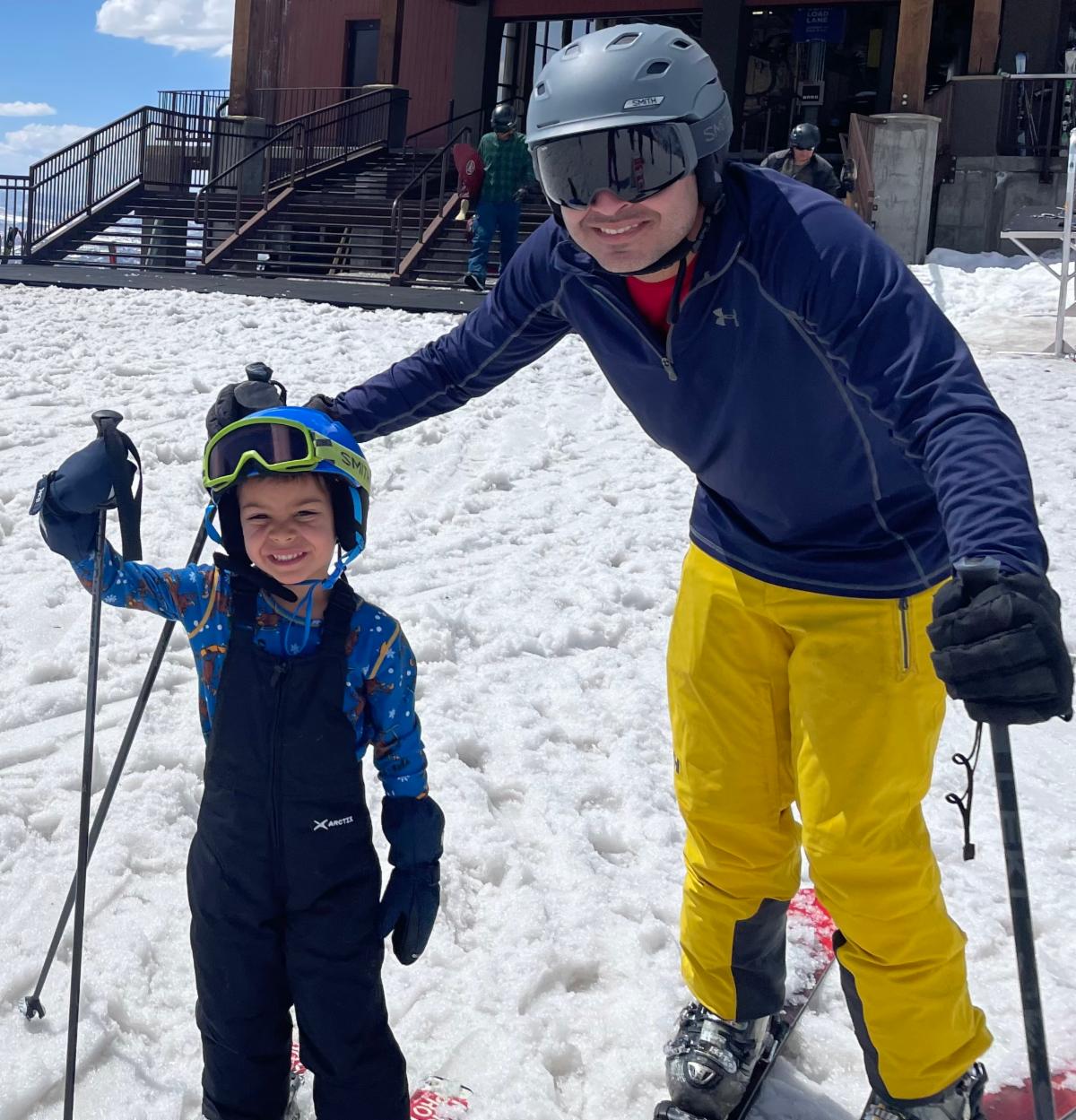
I love skiing with my kids and am looking forward to when my 3-year-old can keep up with the rest of us.
|