Traveling the World While Black & Disabled
Viajando por el mundo siendo negro y discapacitado
| |
|
In this edition: Traveling the World While Black & Disabled
En esta edición: Viajando por el mundo siendo negro y discapacitado
[Image: D'Arcee, an African American with a beard and black rimmed glasses in a black shirt and white sweater, smiling].
[Imagen: D'Arcee, un afroamericano con barba y gafas de montura negra con camisa negra y suéter blanco, sonriendo].
| |
Nuestro boletín de noticias está disponible en Español, a continuación. Desplácese hacia abajo. | |
Traveling the World While Black & Disabled | |
|
This is the first in a series of blogs by Agent of Change, D’Arcee Neal who is a fellow in ECNV’s Ford Foundation Disability Justice Initiative. Over the next year, D’Arcee will share his thoughts and experiences about disability and intersectionality with BIPOC, LGBTQIA+ and other marginalized identities.
By D’Arcee Neal, Agent of Change
A few weeks ago, a found myself in the backseat of an Uber at 1:30 in the morning coming back from, shall we say, a little nighttime fun with a guy I’d met online. I was in Sydney Australia for the first time, and I was trying to experience every piece of the land down under I could get my hands on, whether that was food, culture, music, or well, men. It wasn’t like this was a new experience. I’ve been in many an ubers coming from many an apartment late at night, but as I was coming home in the rain, when I struck up a conversation with the driver, I noticed there was indeed something different about the situation.
I’ll explain a bit. I’m a PhD Candidate in the last year of my studies where I’m working on theorizing how black people with disabilities can take the stigma we receive and use it to our benefit; learning how to recognize and weaponize diversity. As part of that, I was given a fellowship that pays me for a year to work on my research, and as such, I’ve decided to leave America for awhile just to get a chance to focus on other things than…say, cops, brutality, black death, and Donald Trump. It’s been a nice change.
| |
|
However, as part of my trip toward Copenhagen Denmark where I’ll be for a few months, I first came by way of Sydney Australia via a month-long cruise where I met a lot of people on a really big boat…and didn’t see a single wheelchair user under the age of 50. That’s a common occurrence. And it’s a sad one, but I’ll get to that in a second. You see, in the back of this uber, as I was heading home, when I started talking with the driver, I realized that the conception of disability studies that we have in the United States is relatively unique…and progressive, even for countries that are relatively like our own. I discovered this as I was talking to the driver because he told me that he’d been diagnosed with polio as a child, and that being Arab and living in Australia, he didn’t know exactly what he was supposed to do. He started asking me things like where he could buy braces, or how much a wheelchair cost, and even asked he asked me, I realized that my answers couldn’t really help him because as he also discovered, our version of healthcare in America is completely limited by financial resources, in ways no other country on earth has to think about. He was telling me for example, that if he needed specialized braces, he could simply order them from an orthopedic specialist. Or if he needed medication, it was simply a matter of making the requisite appointment from the right doctor and going. Sounds nice, doesn’t it?
| |
|
Aside from the fact that we don’t have universal healthcare in this country because of the continuing grandstanding of the Republican Party (or the fact that we were 2 days away from it passing with bipartisan support in the 1940’s, thanks 1619 Project for teaching me that) the driver reminded me that the concept of disability in a country with universal healthcare is wildly different from our own in that people simply just don’t have to think about such things. But I also realized something else. It robs them of their ability to fight, too. He told me that Australian disability advocates are mostly passive. Because people in the country believe the government will take care of them, it makes it much harder for anything to get done there because the answer is an evitable…yes…at some point. He told me that because he can’t afford to wait, he was forced into looking for employment where he works 2 and 3 jobs (like the Uber that he was driving that night) and that it makes him nervous because he has no idea what kind of life he’s going to have as a person with polio existing in a network of possibility tied to an unknown timeline. It made me think about the United States and about how everything we have here, we’ve earned through fighting. The ADA, and the amendments to include non-apparent disorders like HIV and obesity within it. The on-going fight for marriage equality and ability to increase dual income caps for married couples with disabilities to maintain their services. Hell, even the argument about ableism and the ability to use the maybe-sometimes-possible disability slur ‘spaz’ in Lizzo or Beyonce songs. All of it is a fight, and all of it is uniquely American.
| |
|
He told me he was impressed that a wheelchair user could travel alone all the way to the edge of the world just because. I told him that he shouldn’t be impressed. In America, we’re guaranteed the right to our own standard of living and we fight to make sure we get what we want. Australia would later learn that, when two days later, I had to crawl up a giant flight of stone steps outside of an Outback Steakhouse in full view of the managerial staff and customers; but the issue remained the same. The way we operate in America isn’t always great, and it presents an ever-evolving system of challenges for those caught in the gears of the promise it suggests. However, it also gives us power and agency in challenging our own lives and the rights we want from them, and it’s a lesson that sometimes, I forget other people simply don’t have.
| |
[Image: Specialized Transportation for Arlington Residents, or STAR logo]. | |
Don't forget to support ECNV by shopping at AmazonSmile!
AmazonSmile is a simple and automatic way for you to support your favorite charitable organization every time you shop, at no cost to you. When you shop at AmazonSmile, you’ll find the exact same low prices, vast selection and convenient shopping experience as Amazon.com, with the added bonus that Amazon will donate a portion of the purchase price to ECNV.
[Image: Words Amazon in black with a half arrow smile and the words smile in orange. Under it the words "You shop. amazon gives."]
| |
Nuestro boletín de noticias está disponible en Español, a continuación. Desplácese hacia abajo. | |
Viajando por el mundo siendo negro y discapacitado | |
|
Este es el primero de una serie de blogs del Agente de Cambio, D'Arcee Neal, miembro de la Iniciativa de Justicia por Discapacidad de la Fundación Ford de ECNV. Durante el próximo año, D'Arcee compartirá sus pensamientos y experiencias sobre la discapacidad y la interseccionalidad con BIPOC, LGBTQIA + y otras identidades marginadas.
Por D'Arcee Neal, Agente de Cambio
Hace unas semanas, me encontré en el asiento trasero de un Uber a la 1:30 de la mañana regresando de, digamos, un poco de diversión nocturna con un chico que había conocido en línea. Estaba en Sydney, Australia, por primera vez, y estaba tratando de experimentar cada pedazo de tierra que podía tener en mis manos, ya fuera comida, cultura, música o, bueno, hombres. No era como si esta fuera una experiencia nueva. He estado en muchos ubers viniendo de muchos apartamentos a altas horas de la noche, pero cuando volvía a casa bajo la lluvia, cuando entablé una conversación con el conductor, noté que había algo diferente en la situación.
Explicaré un poco. Soy candidata a doctorado en el último año de mis estudios, donde estoy trabajando en teorizar cómo las personas negras con discapacidades pueden tomar el estigma que recibimos y usarlo para nuestro beneficio; aprender a reconocer y convertir la diversidad en un arma. Como parte de eso, me dieron una beca que me paga por un año para trabajar en mi investigación, y como tal, he decidido dejar Estados Unidos por un tiempo solo para tener la oportunidad de concentrarme en otras cosas además de ... digamos, policías, brutalidad, peste negra y Donald Trump. Ha sido un cambio agradable.
| |
|
Sin embargo, como parte de mi viaje hacia Copenhague, Dinamarca, donde estaré por unos meses, vine por primera vez a través de Sydney Australia a través de un crucero de un mes donde conocí a mucha gente en un barco realmente grande ... y no vio a un solo usuario de silla de ruedas menor de 50 años. Esa es una ocurrencia común. Y es triste, pero llegaré a eso en un segundo. Verán, en la parte trasera de este uber, mientras me dirigía a casa, cuando comencé a hablar con el conductor, me di cuenta de que la concepción de los estudios de discapacidad que tenemos en los Estados Unidos es relativamente única ... y progresista, incluso para países que son relativamente parecidos al nuestro. Descubrí esto mientras hablaba con el conductor porque me dijo que le habían diagnosticado polio cuando era niño, y que siendo árabe y viviendo en Australia, no sabía exactamente lo que se suponía que debía hacer. Comenzó a preguntarme cosas como dónde podía comprar aparatos ortopédicos, o cuánto costaba una silla de ruedas, e incluso me preguntó, me di cuenta de que mis respuestas realmente no podían ayudarlo porque, como también descubrió, nuestra versión de la atención médica en Estados Unidos está completamente limitada por los recursos financieros, de una manera en la que ningún otro país en la tierra tiene que pensar. Me estaba diciendo, por ejemplo, que si necesitaba aparatos ortopédicos especializados, simplemente podía pedirlos a un especialista ortopédico. O si necesitaba medicamentos, era simplemente una cuestión de hacer la cita requerida con el médico adecuado e ir. Suena bien, ¿no?
| |
|
Aparte del hecho de que no tenemos atención médica universal en este país debido a la continua grandilocuencia del Partido Republicano (o el hecho de que estábamos a 2 días de que se aprobara con apoyo bipartidista en la década de 1940, gracias al Proyecto 1619 por enseñarme eso) el conductor me recordó que el concepto de discapacidad en un país con atención médica universal es muy diferente del nuestro en que las personas simplemente no tienen pensar en tales cosas. Pero también me di cuenta de algo más. También les roba su capacidad de luchar. Me dijo que los defensores australianos de la discapacidad son en su mayoría pasivos. Debido a que la gente en el país cree que el gobierno se encargará de ellos, hace que sea mucho más difícil que se haga algo allí porque la respuesta es una respuesta evitable ... Sí... en algún momento. Me dijo que debido a que no puede darse el lujo de esperar, se vio obligado a buscar empleo donde trabaja 2 y 3 trabajos (como el Uber que conducía esa noche) y que lo pone nervioso porque no tiene idea de qué tipo de vida va a tener como persona con polio existente en una red de posibilidades vinculada a una línea de tiempo desconocida. Me hizo pensar en los Estados Unidos y en cómo todo lo que tenemos aquí, lo hemos ganado a través de la lucha. La ADA, y las enmiendas para incluir trastornos no aparentes como el VIH y la obesidad dentro de ella. La lucha continua por la igualdad matrimonial y la capacidad de aumentar los límites de ingresos dobles para las parejas casadas con discapacidades para mantener sus servicios. Demonios, incluso el argumento sobre el capacitismo y la capacidad de usar el insulto de discapacidad tal vez a veces posible 'spaz' en las canciones de Lizzo o Beyonce. Todo esto es una pelea, y todo es exclusivamente estadounidense.
| |
|
Me dijo que estaba impresionado de que un usuario de silla de ruedas pudiera viajar solo hasta el borde del mundo solo porque sí. Le dije que no debería impresionarse. En Estados Unidos, tenemos garantizado el derecho a nuestro propio nivel de vida y luchamos para asegurarnos de obtener lo que queremos. Australia se enteraría más tarde de que, cuando dos días después, tuve que arrastrarme por un gigantesco tramo de escalones de piedra fuera de un Outback Steakhouse a la vista del personal directivo y los clientes; Pero el problema seguía siendo el mismo. La forma en que operamos en Estados Unidos no siempre es excelente, y presenta un sistema de desafíos en constante evolución para aquellos atrapados en los engranajes de la promesa que sugiere. Sin embargo, también nos da poder y agencia para desafiar nuestras propias vidas y los derechos que queremos de ellas, y es una lección que a veces, olvido que otras personas simplemente no tienen.
| |
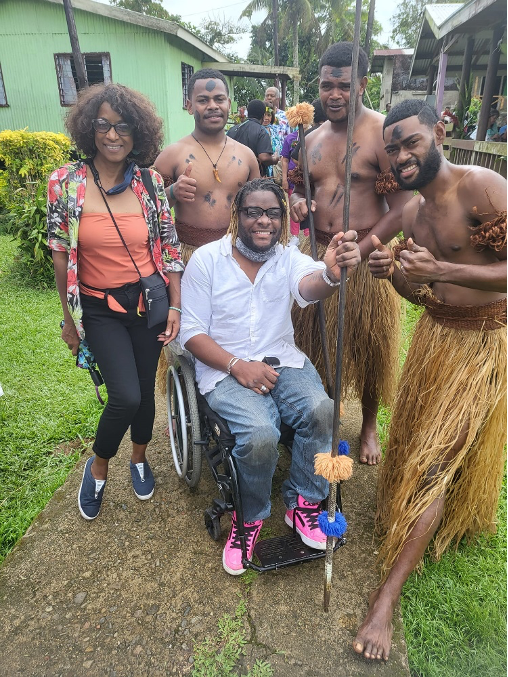
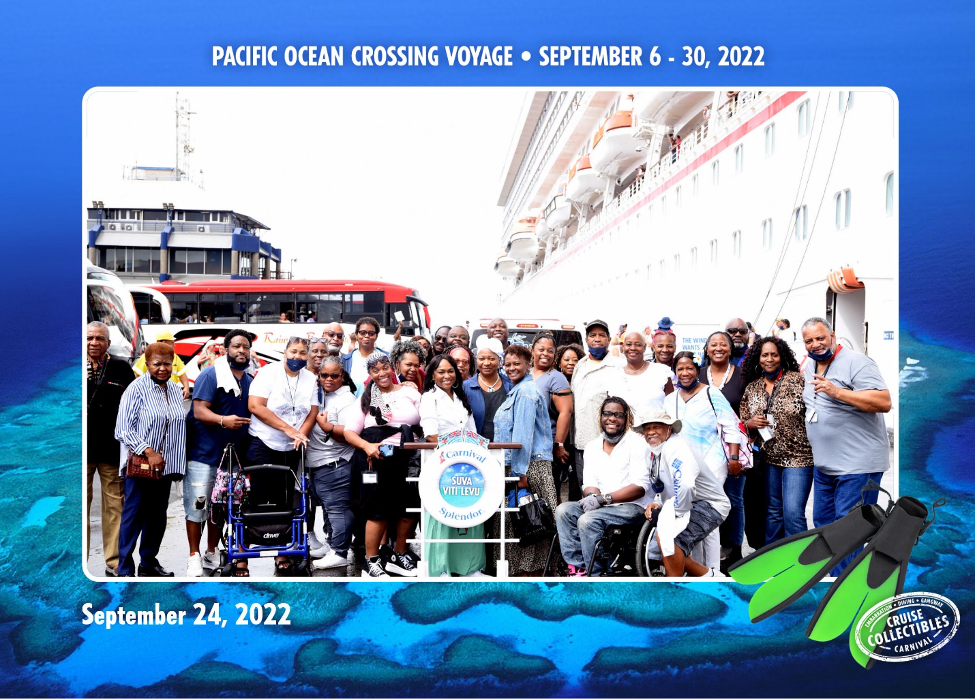
[Imagenes: D'Arcee, un afroamericano con barba y gafas de montura negra con camisa negra y suéter blanco, sonriendo; Crucero masivo en el que viajó D'Arcee; D'Arcee con aborígenes australianos; Foto grupal de D'Arcee con sus compañeros pasajeros de cruceros]. | |
¡No olvide apoyar ECNV comprando en AmazonSmile!
AmazonSmile es una forma simple y automática de apoyar a su organización benéfica favorita cada vez que compra, sin costo para usted. Cuando compre en AmazonSmile, encontrará exactamente los mismos precios bajos, una amplia selección y una experiencia de compra conveniente que en Amazon.com, con la ventaja adicional de que Amazon donará una parte del precio de compra a ECNV.
[Imagen: palabras amazon en negro con una sonrisa de media flecha y las palabras sonrisa en naranja. Debajo, las palabras compras. amazon da.]
| | |
|  |
Follow Us on Social Media | | | | |