|
Asbury provost reflects on revival
By Gregg A. Okesson
From Colloquy March 2023
On February 8, 2023, Asbury University—across the street from Asbury
Theological Seminary—held an ordinary chapel service on an ordinary day. The preacher that morning even texted his wife at the conclusion of the service that it had “bombed.” However, what happened next was anything but ordinary.
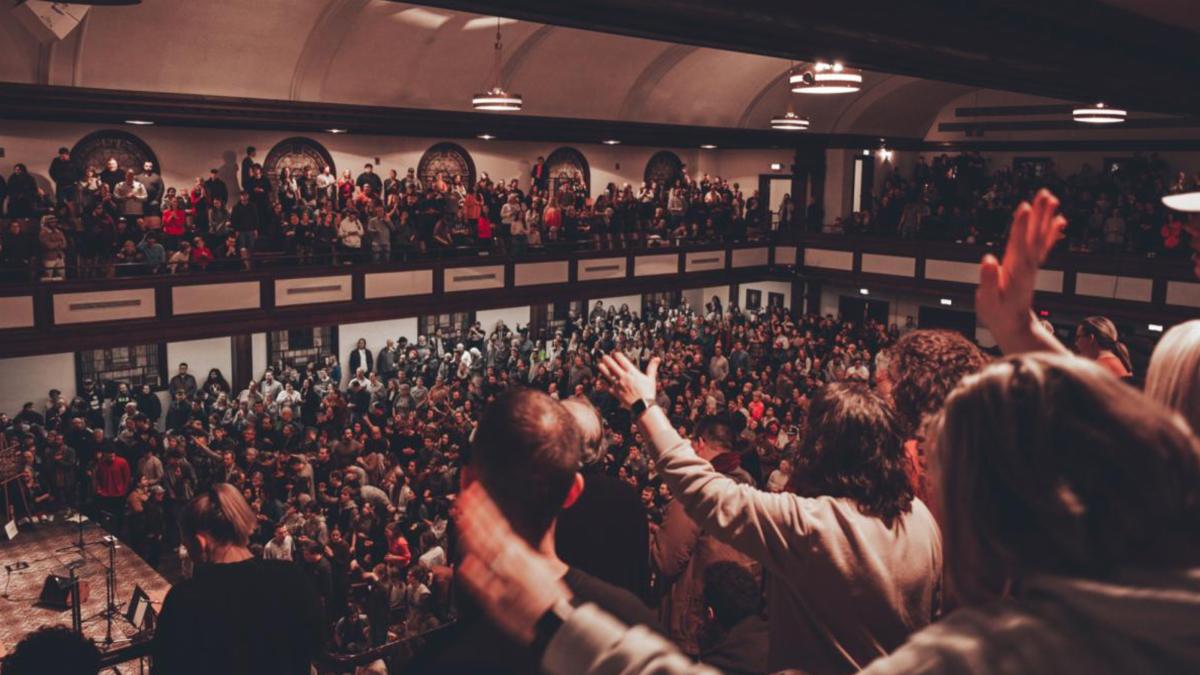
The gospel choir sang two songs at the conclusion of the chapel . . . but then continued singing. A small group of 19 students lingered. They worshiped together, prayed, and prayed some more. Their numbers slowly swelled as students texted their friends, imploring them to return to chapel. Something extraordinary was happening. The Holy Spirit was with them in a way none had ever experienced.
Asbury University and Seminary are rich in revival tradition. Our roots in the Wesleyan Holiness tradition place emphasis on the work of the Holy Spirit to sanctify and empower. The holy, powerful love of the Spirit occupies heightened importance in persons and communities; for piety and works of mercy.
Therefore, revivals, outpourings, and awakenings are not only prayed for, but expected. I received a text at 1 p.m. that Wednesday from one of my students saying she couldn’t attend class because “a revival has broken out in Hughes Auditorium.” More than 50,000 people descended on Wilmore, Kentucky during the next 15 days. Prayer and worship never stopped. People from 280 other institutions and more than 20 countries were drawn like a magnet to this small, two-traffic-light-town in the middle of Kentucky. Social media streamed images to millions of people all around the world. As a case in point, I write this from Londrina, Brazil. Everyone I meet here wants to hear a firsthand account of the Asbury revival. They crave the Holy Spirit.
I woke up that morning and had a vision. I never receive visions. I was praying and saw the Holy Spirit blowing into our former house in Tanzania (I taught in East Africa for ten years before arriving at Asbury). I wasn’t terribly surprised by this vision, as I had recently returned from visiting my village. I wasn’t sure of the meaning of it, but I was hopeful that God was going to do something in that place, or with my family. I wasn’t expecting that—for the next 15 days—the Holy Spirit would blow with sweetness and power upon our campus and community, with implications for all around the world.
Asbury Theological Seminary would play a supporting role in the ensuing days. We livestreamed the service into two chapels on our campus and then opened our cafeteria and gym to thousands more people. Students, staff, faculty, and administrators from the seminary volunteered as hosts, IT assistance, ushers, worship leaders, logistical support, or praying for people at the altar.
We received countless requests to house people or to run to Costco to buy pallets of water. Sarah Baldwin, vice president of student development at Asbury University posted, “Most of the people coming have no idea that their usher navigating a wheelchair through the rain has a PhD, and their prayer minister is a retired seminary professor.” Radical humility combined with radical hospitality continued to be a hallmark of this incredible move of God.
Many call it an “outpouring,” others an “awakening,” still others a “revival.” Most of us don’t care what it is called. The Holy Spirit’s presence was all that mattered.
I was working at Wheaton College during the 1995 revival. Many of the characteristics I saw at Wheaton were also present at Asbury—worship, prayer, insatiable hunger for Christ, public and private confession of sins, acute spiritual sensitivity, and commitments made for lifelong kingdom service in the US and around the world.
Let me highlight a few distinct characteristics of this current move of God.
Revival in a social media age
Few of us can fully appreciate witnessing a revival during a social media age. Images and videos captured hearts all around the world. I heard from friends in every continent asking for my take on the revival. Blogs, Facebook posts, and other media critiqued the event from every conceivable angle—most from miles away. Due to social media, thousands descended on the city for an embodied experience. They wanted prayer. They yearned for physical presence in Hughes Auditorium. People wanted to have others lay hands on them. Digital media fed an insatiable desire for embodied presence.
Led by Gen Z
Asbury University leadership did an amazing job of keeping the focus on the fact that while the Holy Spirit was leading the revival, He was doing it through college students. Few adults were allowed on the stage. All the bands, singers, and most of the testimonies were done by Generation Z. Asbury rejected all offers from celebrities; they were kindly told they could come to the altar and receive prayer. Many did precisely that.
When to stop and how to send
The hardest part of the two weeks was the decision to shift from Wilmore to around the world. How do you stop something so beautiful? How do you send participants into universities and cities elsewhere? We see something similar on the Mount of Transfiguration. The disciples’ plea to build permanent houses was fiercely rejected by Jesus. This revival may have started in a small, two-traffic-light-town in rural Kentucky, but it wasn’t meant to stay in Wilmore. Revivals need to move outward.
For theological educators, the task ahead is the most critical. Thousands of people are crying out for discipleship. Racial and ethnic barriers need breaking down. People need to be sent; both young and old. The church must be mobilized. It is incumbent upon us, in our various traditions and emphases, to discover what God might be saying to us and to our institutions and to explore how we might drink from the wellspring of the Spirit’s presence. This is fitting since this movement began with the Holy Spirit, and it will continue by the Holy Spirit. This is the great confidence we have. Come Holy Spirit!
* Gregg A. Okesson is Provost and Senior Vice President for Academic Affairs at Asbury Theological Seminary in Wilmore, Kentucky.
|