|
The majority of wasps that we see in our gardens are solitary nesters. This means once the male and female have mated, the female goes off to create a place where she will lay her egg. Depending on the species, it may be a shallow tunnel in the ground or a mud covering on a vertical hard surface like a basement wall or something as intricate as an urn-shaped pot affixed to a hard surface, like created by the tiny potter wasp.
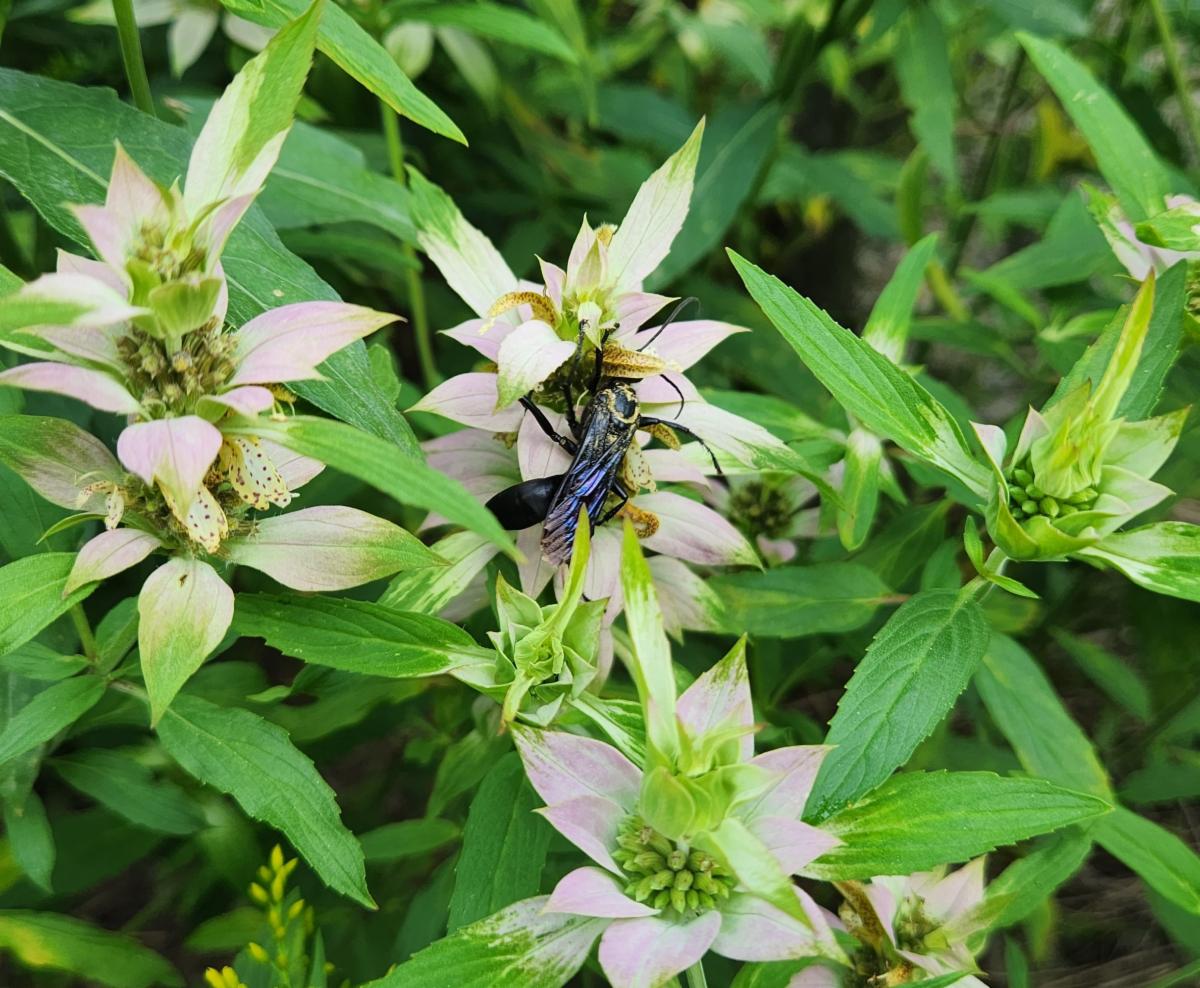
Within these chambers a single egg is laid with some manner of fresh food. While as an adult, wasps are vegetarian and can be seen nectaring on flowers, and are on the prowl for insects and spiders, which they sting to paralyze (not kill). The prey is then stashed in the chamber with the egg, so that when the larvae emerges, it has fresh food for its development. Solitary wasps are not aggressive or territorial and do not protect their burrow or mud nest.
There are fewer species of wasps that are social (only 1.4 percent of wasp species) and they include paper wasps, ground-nesting yellow jackets and aerial-nesting yellow jackets, the latter referred to as bald-faced hornets. They are all in the same insect order Hymenoptera, family Vespidae. These wasps collect bites of dead plant material or strip pieces of wood that they then chew and chew, mixing it with their saliva that contains a starch. This mouthful of masticated mix is then painstakingly added to the nest one wasp-sized mouthful at a time. With close examination, color variation reflects the different wood or plant used.
Sometimes you’ll find a small umbrella-like honeycomb assemblage of open six-sided cells—this is the nest of a paper wasp. The creators of the large gray soccer ball-sized nests (or larger) usually choose to locate them high up and away from human activity. These nests are the work of bald-faced hornets. The nests are covered by a papery shell which is layer upon layer to protect the important contents against the weather and temperature fluctuations. Inside is a matrix of numerous hexagonal cells. Each of the small cells is where the female wasp will lay an egg. The grub-like baby wasps are fed living insects such as caterpillars, beetle larvae or other such insect, but not until the adult chews them up a bit to tenderize. This is why these insects are valuable—they are
a biological control of garden pests and are an integral part of the interconnectedness of nature’s checks and balances.
In the early part of the summer, eggs that the queen hornet lays will become workers that are infertile females whose job is to build more cells and enlarge the nest. Since the female worker hornets do not lay eggs, their modified ovipositors serve as stingers. There can be as many as 400 workers in one nest. The queen continues to lay eggs throughout the summer. Some of the larvae will develop into males, called drones. Late in the summer a few queens will be produced who will leave the nest to find and mate with a drone. These young queens will then seek out an overwintering site, such as a rotting log, where they will hibernate until the following spring when they emerge, and the cycle starts all over again.
If you come across one of these social wasp nests, steer clear as they are protective of the nest. But if it is in a place that can simply be avoided by humans or cordoned off from human interaction until winter, you can feel confident that after a good cold winter frost, any inhabitants will have been done in. They make a new nest annually and will not return to the old nest. As is nature’s way, the vacant nest maybe be reused by other critters—perhaps by a deer mouse seeking a winter hideaway. Come spring, songbirds will use the papery nest material for their own nests. And nature geeks (like me) enjoy collecting them—to hold in hand and admire up close the masterful creation of wasps and to ponder their wonderous ways.
|