Executive director's message
Shortly before the election, I sat down with Oregon Business (virtually) to discuss what might be on the horizon for trade with a potential Biden administration. We covered lots of ground including trade agreements, taxes, foreign policy with allies and China, and more (read the story here). With the certainty of a President-elect Biden - and with more visibility into his proposed cabinet and staff - we are getting a sense for how the new administration may approach trade-related issues.
The new administration will take a more multilateral approach to put pressure on China, climate change will be front and center in trade negotiations, and there will be more active participation to help reform - not hinder - the WTO. Though Biden has not yet announced his pick for USTR, he has selected several key expert advisers that hold refined views of the good, bad, and ugly on trade. This likely means a more complex and nuanced approach that will balance the need to expand opportunities for U.S. firms abroad, with ensuring that those negatively impacted by trade are not left behind.
What it doesn’t necessarily mean is an immediate roll-back of all the 301 tariffs imposed by the Trump administration (though the 232 steel and aluminum tariffs on U.S. allies might be the first to go) or an attempt to join the Comprehensive and Progressive Agreement for Trans-Pacific Partnership (CPTPP), which many will find disappointing. Though the approach will be much less protectionist, politically and with a struggling economy, there will be more pressure on the incoming president to ensure his trade policies benefit Americans first.
The Biden administration will have a very full plate of challenges ahead of them. And while the President-elect and his incoming team recognize the importance of trade to the economy, it may not be an immediate priority for the administration. Rather, it has signaled that it will prioritize COVID-19 relief and economic stimulus, widespread vaccine production and distribution, and investment in infrastructure and the American workforce - all things that will indirectly help the overall economy and trade. Godspeed the President-elect and his team in addressing these pressing challenges.
|
|
The manufacturing slump continues
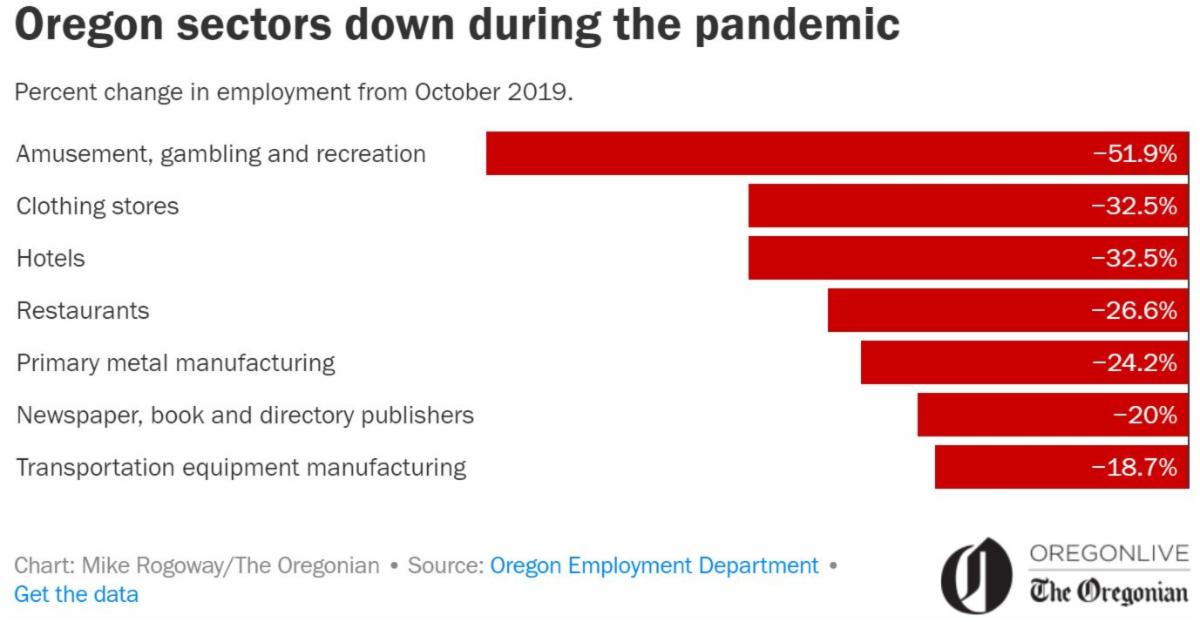
Oregon manufacturing, normally a strong export industry for the state, is faring worse than the rest of the country due to the economic downturn caused by Covid-19. Firms are closing or reducing their workforce and manufacturing jobs are not expected to start ticking upward until next summer.
Oregon transportation equipment manufacturers have lost almost 25% of their workforce and metals manufacturing have lost about 19% of their jobs. Trade-related manufacturing is a critical part of Oregon’s economy, paying higher wages than their non trade-related counterparts and having a follow-on impact throughout the economy.
Groups such as Oregon Manufacturers and Commerce and Oregon Business and Industry (OBI) are asking Governor Brown to do more to prioritize the state’s economic recovery and job recovery, including by warding off revenue measures on the backs of business. According to OBI, “Any tax increase at this time will impact that effort, especially considering that between 2019 and 2022 Oregon businesses already will sustain a 41% increase in their state business tax burden based on increases adopted in 2019.”
|
|
Global and U.S. economies tick upward, slowly
The Organization for Economic Cooperation and Development (OECD) said that for the first time since the COVID-19 crisis began “there is now hope for a brighter future." The agency expects global GDP growth to hit 4.2% in 2021 and 3.7% in 2022.
The agency noted that after contracting 3.7% this year, the U.S. economy will grow 3.2% in 2021 and 3.5% in 2022 – which is slightly lower than the September forecast. However, this bounce back is heavily dependent on a vaccine and the passage of a new federal economic stimulus package. Read more here. For Oregon, like the rest of the country, it will be some time before the economy hits pre-pandemic levels, with Oregon economists warning that industry and labor may not return to health until 2023.
|
|
A mixed bag for Oregon’s timber industry
The timber industry is continuing to see pressure from multiple fronts. From 2017 to 2019, Oregon’s annual $100 million timber exports saw a drop of 70% due to the trade war with China. In 2020 the mix of COVID-19 and a crippling fire season only served to drive exports further down. Despite this, the domestic lumber market is having a great year. COVID-19 is driving a strong housing construction and furniture manufacturing market as families seek to make their work from home situations more comfortable.
Though timber exports represent only a small portion of Oregon exports, the jobs it provides are critical for rural communities. They help support local economies, which had already been hit hard by the pandemic. According to the Oregon Employment Department, the forestry and logging industry employed 9,353 workers and added $563 million in payroll to Oregon’s economy in 2018.
|
|
Changes ahead for the U.S, U.K., and E.U. love triangle |
|
A U.S.-U.K. trade deal may take longer than some had hoped as President-elect Biden signals that he will prioritize mending relations between the U.S. and the E.U and other allies, which he sees as a strategy to temper China’s industrial practices and important for national security. Relations with the 27-nation bloc, which has been a key ally and trade partner for the U.S., have strained under the Trump Administration. When asked about a U.K. deal, Biden responded, “I’m not going to enter any new trade agreement with anybody until we have made major investments here at home and in our workers and in education.”
This comes at a time when the U.S. and the E.U. continue their long dispute over aircraft subsidies. After WTO ruled in favor of the U.S., the Trump administration has levied $7.5B in tariffs on European imports to the U.S for the last year. Conversely, the WTO recently ruled in favor of the E.U. in a related case and in November and started imposing $4B in tariffs on aircraft parts (15%) and agricultural products (25%). That said, the election of President-Elect Biden is seen as a positive and welcome change by the E.U. and leaders say they may be willing to remove these tariffs if the new administration does the same.
Though the E.U. on the whole is a more robust trade partner to the US, the U.K. is important to Oregon, particularly for foreign direct investment (FDI). Over 10,000 jobs in Oregon are supported by U.K. companies, and of those almost 6,000 are supported by Oregon exports into the U.K. Oregon exported over $302 million in goods to the U.K. in 2018.
|
|
The WTO still in a holding pattern
The World Trade Organization (WTO) was close to formally selecting Nigeria's ex-finance minister Ngozi Okonjo-Iweala as its new leader last month - which would have made her both the first woman and first person from continental Africa to lead the organization. Officially, the meeting to finalize the selection was called off due to new COVID-19 safety guidelines. Unofficially, the group is waiting-out the current U.S. administration as its delegate to the body is the only opposition to the appointment. Read more here.
Though the organization has been critically hobbled over the last years with the U.S. blocking appointments to the agency’s appellate body, the WTO is an important factor in maintaining a healthy global trade economy. The WTO is a place for countries to settle trade disputes, and it operates a system of trade rules that member governments can use to sort out the trade problems they face with each other. The appointment of Director-General is extremely consequential and will be key to implementing the reforms needed to make the organization more transparent and effective. Read more here.
|
|
Who should levy digital taxes?
E-commerce was big before COVID-19 and has only exploded during the pandemic as people are shopping online more and more. In a time where multinational e-commerce platforms - think Amazon, Google, and Apple - are selling goods and services across the globe, the question of who and how these transactions should be taxed is getting tricky. The Organization for Economic Cooperation and Development (OECD), with 140 member countries, is reworking international tax rules to better account for the rise of e-commerce and digital services. Their goal is to deliver a framework for the tax by the end of 2020. The U.S. withdrew from the OECD in June but has been very vocal about its opposition to this plan.
The French introduced their own 3% digital services tax last year but stopped collecting in January to give a year for the OECD to come to an agreement with its members on a plan. The Trump administration’s position is that if anyone should tax these businesses, it should be the U.S. where a large portion of these tech companies are headquartered. In opposition to the French tax, the administration plans on imposing additional duties of 25% on French cosmetics, handbags and other imports valued at $1.3B starting in January 2021.
However they are structured and collected, these taxes will surely impact consumers and businesses that rely on e-commerce as the platforms pass-on the cost of taxes. Yet, many countries see this as an opportunity to collect desperately needed revenue to prop-up their depressed economies due to the pandemic.
Learn more about how the digital tax may unfold:
|
|
In case you missed it
Leading up to the presidential election, we hosted a fantastic panel with national and regional trade experts to look at how the outcome would influence trade, geo-political power dynamics, national security, the WTO and more. If you missed it and want to know how this election will impact the Pacific Northwest, give it a listen here.
Speakers included:
-
John Murphy, Senior Vice President for International Policy at the U.S. Chamber of Commerce
-
Andrea Durkin, Editor-in-Chief at TradeVistas and Founder of Sparkplug, LLC
-
Doug Badger, Managing Partner at Quinn Thomas
-
Moderated by Curtis Robinhold, Executive Director at the Port of Portland
|
|
As a member of PNITA, you will be part of a coalition of leading organizations proactively advocating for trade-friendly federal policies that support businesses, workers and families here at home.
Click here to learn more about becoming a member.
|
|
THANK YOU TO OUR PLATINUM MEMBERS |
|
|
|
|
|
|