Quick, Timely Reads
On the Waterfront
|
|
Communist Music:
Our Parents Tried to Warn Us
|
|
By David Frew
February 2022
|
|
Dr. David Frew, a prolific writer, author, and speaker grew up on Erie's lower west side as a proud "Bay Rat," joining neighborhood kids playing and marauding along the west bayfront. He has written for years about his beloved Presque Isle and his adventures on the Great Lakes. In this series, the JES Scholar-in-Residence takes note of life in and around the water.
|
|
‘This land is your land, this land is my land.
From California to the New York Island.’
– Woody Guthrie
|
|
As the 1950s blended into the 1960s, neighborhood music began to change. Old pop songs that had been so common on radio stations were changing into something strange and new. Frank Sinatra and Bing Crosby were being replaced. The new music was a little like old-time Country & Western, but with complicated, political lyrics. Hank Williams had a larger and more social story. Those of us who had matriculated to college were the first to be exposed. Folk music. Even at a tiny school like Gannon in downtown Erie, the early 1960s featured packed concerts with folk musicians. We were apparently being indoctrinated. During my time at Gannon, annual spring concerts included “The Four Freshmen,” “The Lettermen,” The Pozo-Seco Singers” and “Joan Baez.” Was I being infected or were those groups, with the exception of Joan Baez, either reconstituted barbershop quartets or country singers? |
|
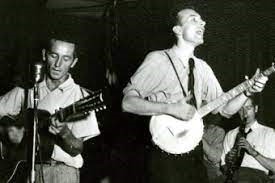
Woody Guthrie (left) playing with his friend, Pete Seeger, in 1947 |
|
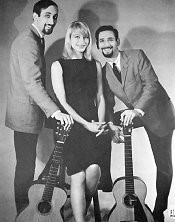
Small groups and individual performers using simple instruments and three-cord melodies seemed to be defining the trend. They sounded like country musicians, without steel guitars (at first), but when we listened carefully there were messages: War is bad. Life is unfair. Workers are taken advantage of. One of the most popular, early breakthrough groups was “Peter Paul and Mary,” a trio from Cornell University that began by performing traditional, old Woodie Guthrie tunes that seemed to celebrate America. Seemed so until the lyrics were taken apart and analyzed. As the new folk group’s popularity escalated, it was noted by critics that while their songs seemed to be celebrating America, they had a political edge. Their music as well as the music of their contemporaries was gaining the title “protest songs.” While we who thought we were “enlightened” asked, “What could possibly be wrong with Woody Guthrie and his old standard tunes?” adults were calling our attention to undertones of sedition. |
|
From left are Peter, Mary, and Paul |
|
Peter, Paul, and Mary credited Pete Seeger and his 1950s group, the Weavers, with much of their style as well as their musical structure when they first appeared in New York. And that public acknowledgment almost submarined their career before it began. Within months of the release of their first album, which seemed to contain lots of protest songs, however, they followed up with several “vanilla” favorites like “Puff the Magic Dragon,” which anti-communists struggled to connect with seditious intent. But those attempts failed. The Weavers had suffered greatly a few years earlier during the McCarthy era. They followed the infamous “Hollywood Ten” into the national spotlight after several film icons, including Charlie Chaplin, Burgess Meredith, Orson Wells, Lena Horne, Arthur Miller, Leonard Bernstein, Burl Ives, and Dashiell Hammett (to name a few) were persecuted, black-listed. Several were sent to prison. |
|
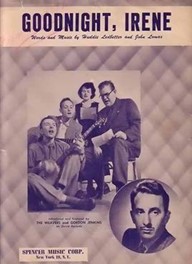
The Weavers with Pete Seeger, front left, made the song, “Goodnight, Irene,” popular just before the infamous Joseph McCarthy anti-Communist hearings of the 1950s. |
|
The Weavers were being criticized on two fronts. Their predilection for singing songs that could be interpreted as being anti-government led to charges that they were all communists. Also, their one breakthrough, popular song, “Goodnight, Irene,” an old Leadbelly (American blues singer, Huddie Ledbetter) tune that flirted with the theme of suicide, was being cited by leading church groups as being sacrilegious. The Weavers, who did not have as many financial and legal resources as the Hollywood Ten, attempted to defend themselves and many of them “took the fifth” when questioned. Ironically, Pete Seeger, who was quoted as having confidence in the American system of justice, freely testified, answering questions directly and honestly. At the end of his testimony, he was quoted as having been proud that he did not “take the fifth” and confident that his innocence would protect him. Sadly, it did not. Seeger was sentenced to one year in prison for having Communist Party affiliations.
While he never served the sentence and was later exonerated, the example and publicity sent two distinct messages. Supporters interpreted Seeger’s experience as proof that the anti-communist hearings had been an unfair witch hunt. How could a simple musician be at the root of a seditious anti-government plot? But others decided that there must be a real problem. Why else would the same government that had just defeated Nazi Germany bother? The second sentiment quickly convinced Bayfront neighborhood adults that folk music was a Communist Party plot, designed to capture vulnerable young minds. And college was the place where this influence war was taking place.
|
|
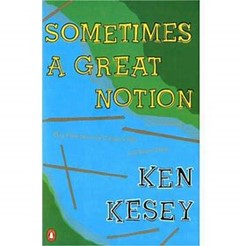
Ken Kesey’s masterpiece, like the Weavers song, was criticized for its focus on suicide |
|
As this was happening, novelist Ken Kesey (“One Flew over the Cuckoo’s Nest”) wrote a critically acclaimed novel called “Sometimes a Great Notion,” which used suicide to poke intellectual fun at America’s anti-communist and anti-labor movements. Though his first book (“Cuckoo’s Nest”) was a popular success, the second was much slower to achieve the accolades that it eventually won. Kesey was criticized in the news for using recreational drugs and having a socialist bias. Our parents were more likely to read the negative headlines about a hippie who was writing anti-big business tomes than to attempt to read an oversized book that has only recently been cited as being one of the all-time best examples of American literature. It was probably the success of the “Cuckoo’s Nest” film that created a resurgence in interest in “Sometimes a Great Notion.” |
|
Irene goodnight, Irene goodnight.
Goodnight, Irene, Goodnight, Irene, I’ll see you in my dreams.
Sometimes I live in the country, sometimes I live in town,
Sometimes I take a great notion, to jump in the river and drown.’
– Leadbelly
|
|
Did we listen to the warnings of our parents? Not exactly. Over the next decade, most of us managed to acquire Bob Dylan, Joan Baez, Ian & Sylvia, John Prine, Joni Mitchell, Judy Collins, Leonard Cohen, Simon & Garfunkel, Townes Van Zandt, Stan Rogers, Gordon Lightfoot, Richie Havens, Neil Young, and Arlo Guthrie (Woodie’s son) records. Vinyl, of course. These were some of the names that put the capital “P” in protest songs. We gave up on the dull, popular music of the day and began to specialize in modern folk sounds. Maybe we liked it so much because our parents did not.
As the 1960s gave way to the 1970s, folk music began to become more “acceptable.” Music scholars point to a number of transitions within the genre that helped alleviate its earlier “radical” reputation. First there was a slow evolution toward Country & Western styles. Several prominent folk singers began to add electric instruments, including steel guitars. Most replaced the traditional upright bass with electric five-string models. Joan Baez and Bob Dylan led the way, releasing albums that featured distinctive “country” sounds. In the case of Bob Dylan, the transition caused quite a stir among his once-loyal fans and led to terrible reactions at live concerts. Dylan used an Ontario group, “The Band,” to drive his transition into non-traditional acoustic sounds. Interestingly, many of the members of The Band were from just across Lake Erie near southern Ontario’s Port Dover, where they had played regularly at the Summer Garden.
As the shift toward a distinct country sound was taking place, there was a second transition. Folk singers began to record more traditionally themed songs and fewer anti-war or anti-government recordings. Joan Baez sang about her husband; Neil Young wrote a tune about his new ranch; and Stan Rogers talked about commercial fishing on Lake Erie. Pete Seeger reminded fans that many of his biggest hits were passages from the Bible and Leonard Cohen recorded “Alleluia.” There continued to be an occasional anti-war song but by that time public opinion regarding the Vietnam War had moved toward the themes that had been associated with folk musicians.
There was an important third transition. Folk singers began to identify their work as “Traditional American Music.” Calling upon the unique contributions of the Appalachian musicians who had integrated sounds of banjos, mandolins, and dulcimers to other uniquely American music that emerged during the late 19th and early 20th centuries (jazz and soul), “folkies” suddenly began to seem like a patriotic component of beloved national history. As resurrected bluegrass, increasingly skillful musicianship, and Traditional American sounds were bended, folk music became a part of acceptable musical styles.
|
|
The final blow to the arguments of Bay Rat parents began to fall into place when Public Broadcasting started presenting programs with and about folk music. Nothing says “mainstream” louder than a 60-something, gray-haired community representative narrating a PBS special about folk songs. Nothing with the possible exception of Bob Dylan, that once-acclaimed “bad boy,” being awarded the Nobel Prize for Literature in 2016. |
|
‘Come writers and critics who prophesize with your pen
And keep your eyes open wide, the chance won’t come again
And don’t speak too soon, for the wheel’s still in spin
And there’s no tellin’ who that it’s namin’
For the loser now will be later to win
’Cause the times they are a-changin.’
– Bob Dylan
|
|
Steve Jobs used the second chorus of Bob Dylan’s “Times They Are A-Changin” (above) to launch his 1984 Apple Product Line. Folk music had become a part of American business. |
|
Accidental Paradise Available at TRECF!
Accidental Paradise
by Dr. David Frew and Jerry Skrypzak
|
|
The beautiful book on Presque Isle published by authors David Frew and Jerry Skrypzak – “Accidental Paradise: 13,000-Year History of Presque Isle” – is on sale at the Tom Ridge Environmental Center’s gift shop and through a special website, AccidentalParadise.com.
The book, priced at $35 plus tax and shipping, can be ordered now through the website sponsored by the TREC Foundation, AccidentalParadise.com.
Presque Isle Gallery and Gifts on the main floor of TREC, located at 301 Peninsula Drive, Suite #2, Erie, PA 16505 will also handle sales daily from 10 a.m. to 4 p.m.
For more information, send an email to aperino@TRECF.org.
To watch "Accidental Paradise: Stories Behind The Stories" click here.
|
|
ABOUT THE AUTHOR
Historian and author David Frew, Ph.D., is a Scholar-in-Residence at the JES. An emeritus professor at Gannon University, he held a variety of administrative positions during a 33-year career. He is also emeritus director of the Erie County Historical Society/Hagen History Center and is president of his own management consulting business. Frew has written or co-written 35 books and more than 100 articles, cases, and papers.
|
|
|
|
|
|
|