Strategic Planning Corporation
Weekly Economic Update
| | |
Last week we talked about how important it is not to panic when you are on a plane and hit turbulence and why it also is important to have that same calmness about yourself when the stock and bond markets hit their inevitable periods of turbulence. We are often seeing swings in the markets that appear to be rather large.... 400, 500, 800, 1,000 point swings on the Dow Jones Industrial Average ("Dow") seem to occur more frequently than in the past. But we have to take those movements in light of where that Dow index is now versus what it might have been like in earlier times when the Dow was lower. For instance, with the Dow in the 52,000 range, a 500 point swing on one day is not quite 1.00% of a move. A 1,000 point move is right around 2.00%.
I think we can all agree that we LOVE TURBULENCE, a/k/a VOLATILITY! Right! We typically hate volatility when it is to the downside. But most of us love volatility when it means markets are moving to the upside. That's just human nature.
Last week I mentioned that just like it doesn't make sense to jump out of a perfectly good plane just because we experience some turbulence, it also doesn't make sense to jump in and out of the market when we experience that same turbulence or volatility. One of our clients responded to us that, as a Lieutenant Colonel in the Army in Vietnam, it was his JOB to jump out of a perfectly good plane!
OK, point taken! I get it, but I know he also gets what the point of my comment about climbing out of perfectly good planes was analogizing!
So why bring this up again this week. Well, it is because we have been seeing these daily market twists and turns for some months now as we have gone through a number of geopolitical situations in America. Inflation, talk of price controls (a big dumb return to the debacle of being idiots in the 1970s!), tariffs, and the current elephant in the room.... midterm elections featuring arguments over Capitalism vs Socialism.
Did you know that Karl Marx is credited with coining the term, Capitalism? Interesting! That wasn't a piece of political commentary there, just a tidbit that I ran across some years ago when giving a talk to some college students about the difference between Capitalism and Socialism.
At any rate, we have seen market gyrations in the wake of the midterm elections debates over all the political positions being taken, as investors try to discern what the market may do if so-and-so wins a particular election. We don't have the president being voted on this year, but the U.S. House of Representatives and U.S. Senate are the major focuses of the nationwide vote.
What does it mean? No One Knows! And anyone who is telling us that a particular race's outcome will impact the markets in a particular way is either lying or very naive. We have video of many, many prognosticators over past election cycles telling us what they would do in the event it looked like some particular candidate for an office, often the presidency, would win. What they said, many more times than not, did not occur. If the guru took action on what he predicted, it was potentially disastrous for his portfolio. But he may have just been setting us up to take the recommended actions and he took a position on the opposite side of that to take advantage of how investors might sway the market so he could clean up!
You don't know what the market will do in the future and you don't know who is shooting straight with you and who is not!
The moral of the story? Don't panic and make changes in your diversified portfolio mix based on a prediction of the future. If you truly do have your entire portfolio diversified prudently to meet your objectives for return and accumulation of wealth over time, there is no reason to be tossed about by the whims of the marketplace. Historically, the market has gone up over time. Just look at any chart of the markets over longer periods of time. In fact, over the last 89 years, the market was up 76% of the years and down only 24% of those years, and when up, the average return for those positive years was almost 20%. In the negative return years, the average was 12.5% in decline for the market, defined here as the S&P 500 Index.^^
So as we enter this last week or so before the votes are tallied (if that can be accomplished nationwide in less than a day), hold onto your seat and enjoy the ride. It could be a wild ride, or a nothing burger! We will see and after it is all over, we can look back and finally know what "would" happen if so-and-so candidate won..... at least what would happen on the day of the election! After that, well.... I guess we will just be back to hearing further predictions of the fallout from these elections in the days to come. Another opportunity to be cajoled and ruffled up by the talking heads! Whew, it never ends!
Enjoy the rest of this week's read.
| | Want to access our Podcast for current and past episodes? You can use this QR Code to go to the website where you can find the full archive of all podcasts beginning with the most recent to oldest. Enjoy! | | |
Weekly Economic Update
for the Week of
October 26, 2026
Quote of the Week:
“Life is 10% what happens to me and 90% how I react to it.”
~ Charles R Swindoll
| | |
The Week in Brief
Markets were mixed last week, though persistent pressure on technology stocks made the week feel more challenging for some investors.
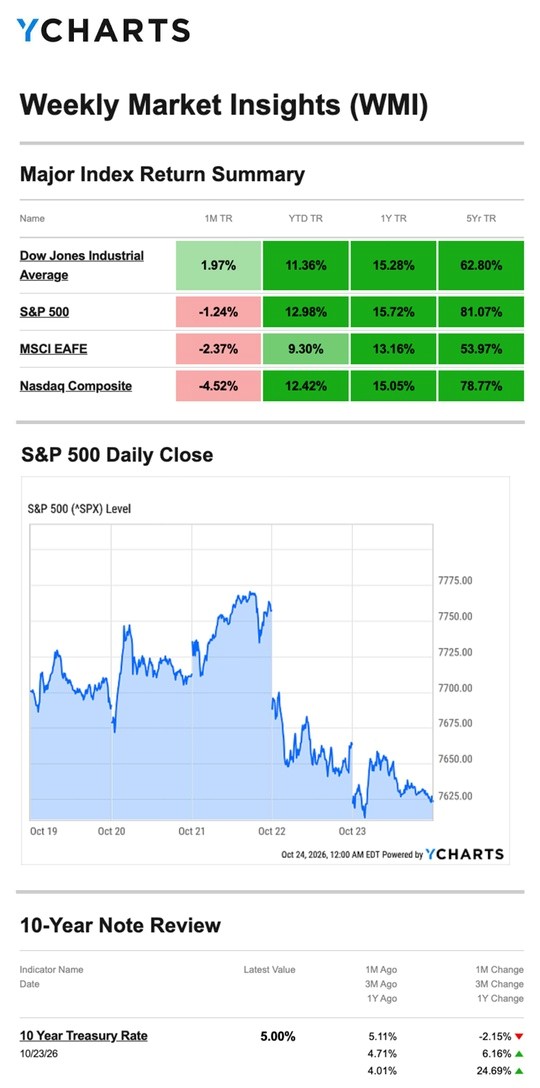
The Standard & Poor’s 500 Index lost 0.47 percent, while the Nasdaq Composite Index declined 0.71 percent. The Dow Jones Industrial Average gained 0.41 percent. The MSCI EAFE Index, which tracks developed overseas stock markets, fell 1.58 percent.1,2
Tech Leads Both Ways
The week began with an AI-led rebound as investors looked ahead to a heavy slate of corporate earnings reports. On Tuesday, investors cheered the first wave of corporate results and falling oil prices, which helped boost investor sentiment.
Tech swung back into favor midweek as investors applauded reports that two of the largest megacap tech firms formed a committee to evaluate a potential merger, lifting all three averages. The Nasdaq gained more than 1 percent, while the S&P posted its third straight winning close.3,4
Boomerang Effect
But the boomerang started to come back on Thursday as AI debt worries returned while oil prices rose again amid fresh geopolitical concerns. The Nasdaq slid more than 2½ percent over the session, while the S&P fell more than 1 percent, posting their steepest daily declines since June and July, respectively.5
The week wrapped up with technology stocks again in the spotlight due to persistent AI-related worries. The Dow closed Friday down more than 1 percent, while the S&P 500 and Nasdaq were under pressure into the close.6
| | Source: YCharts.com, October 24, 2026. Weekly performance is measured from Monday, October 19 to Friday, October 23. TR = total return for the index, which includes any dividends as well as any other cash distributions during the period. Treasury note yield is expressed in basis points. | |
Housing Watch
With everything going on last week, the housing market didn’t get much coverage. But there were some important housing developments.
First, housing starts fell 5.2 percent in September over the prior month, below expectations for a 2 percent rise. It was the second straight month when economists expected starts to rise, and instead they fell, and the third consecutive month of declines.7
Meanwhile, pending home sales fell to their lowest level on record in September in part due to an increase in mortgage rates.8
This Week: Key Economic Data
Tuesday: Durable Goods. S&P Cotality Case-Shiller Home Price Index. New Home Sales. Consumer Confidence (Conference Board). Federal Open Market Committee (FOMC) Meeting, Day 1.
Wednesday: Trade Balance in Goods. Wholesale Inventories. Retail Inventories. FOMC Meeting, Day 2 / Fed Interest Rate Decision.
Thursday: Gross Domestic Product (GDP). Weekly Jobless Claims. Personal Consumption Expenditures (PCE) Index.
Friday: Employment Cost Index.
Source: Investor’s Business Daily - Econoday economic calendar: October 23, 2026.
The Econoday economic calendar lists upcoming U.S. economic data releases (including key economic indicators), Federal Reserve policy meetings, and speaking engagements of Federal Reserve officials. The content is developed from sources believed to provide accurate information. The forecasts or forward-looking statements are based on assumptions and may not materialize. The forecasts are also subject to revision.
This Week: Companies Reporting Earnings
Monday: Verizon Communications Inc. (VZ), Welltower Inc. (WELL), Cadence Design Systems, Inc. (CDNS)
Tuesday: Visa Inc. (V), The Coca-Cola Company (KO), The Boeing Company (BA), S&P Global Inc. (SPGI), Corning Inc. (GLW), HCA Healthcare, Inc. (HCA)
Wednesday: Alphabet Inc. (GOOG / GOOGL), Microsoft Corporation (MSFT), GE Vernova Inc. (GEV), KLA Corporation (KLAC), Amphenol Corporation (APH), T-Mobile US, Inc. (TMUS), ServiceNow, Inc. (NOW), Fortinet, Inc. (FTNT), Automatic Data Processing, Inc. (ADP), Phillips 66 (PSX), Equinix, Inc. (EQIX)
Thursday: Amazon.com, Inc. (AMZN), Eli Lilly and Company (LLY), Mastercard Incorporated (MA), Intel Corporation (INTC), Merck & Co., Inc. (MRK), Caterpillar Inc. (CAT), Sandisk Corporation (SNDK), Gilead Sciences, Inc. (GILD), Bristol Myers Squibb Company (BMY), Altria Group, Inc. (MO), Stryker Corporation (SYK), Starbucks Corporation (SBUX)
Friday: ExxonMobil Holdings Corporation (XOM), AbbVie Inc. (ABBV), Chevron Corporation (CVX), General Dynamics Corporation (GD)
Source: Zacks, October 23, 2026. Companies mentioned are for informational purposes only. It should not be considered a solicitation for the purchase or sale of the securities. Investing involves risks, and investment decisions should be based on your goals, time horizon, and risk tolerance. The return and principal value of investments will fluctuate as market conditions change. When sold, investments may be worth more or less than their original cost. Companies may reschedule their earnings reports without notice.
| | |
FEATURE ARTICLE
You Can't Predict the Future,
But You Can Plan for It
Investor Minute
| | |
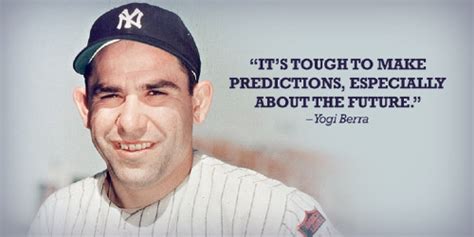
Yogi Berra once said, "The future ain't what it used to be."1 This quote, which at first seems nonsensical, perfectly captures how we anticipate what is to come. Even though the future is unknowable, we routinely use past events to construct the most likely outcomes of things we see happening today.
This means that as current circumstances change, so do our expectations for the future. Take for example the idea that electric cars will replace those powered by gasoline. Just a few years ago everyone was betting on an electric vehicle (EV) future. These cars had fewer moving parts. They didn't need oil or antifreeze. And you didn't have to go to a gas station. So it seemed like a no-brainer when the big automakers sank billions into refitting their factories to produce EVs.
Then gas prices dropped. People thought about range limits. And government incentives expired.2 EV sales dropped dramatically and the automakers were forced to backtrack on their plans, taking billions in infrastructure write-offs.
But now EVs are back. Months of high fuel prices have consumers thinking that a car you plug in at home might not be such a bad idea.3 And worldwide, electric cars account for about half of all sales.4 The idea that EVs will soon replace conventional cars looks viable again.
Coach Berra's statement about the future could also be applied to the stock market in the third quarter. For the first seven months of 2026, the market had been buoyed by news of unchanged interest rates, oil prices that finally seemed to be moderating, and continued gains in the tech sector—particularly among companies whose business involved AI in some way.
But by mid-August a number of these favorable factors were looking less promising. And the market, always forward looking, began to price in lower expectations.
Tensions in the middle east saw oil climb back above $100 per barrel. Politicians and experts began to talk more openly about the downsides of AI development. And for the first time in three years, the US Federal Reserve raised interest rates to combat persistent inflation.5
Still, over the third quarter the S&P 500 rose 2.3% while the tech-heavy Nasdaq grew 2.6%. The tech sector continued its gains on the performance of AI stocks. And though the ongoing conflict with Iran restricted crude shipments through the Strait of Hormuz, causing oil prices to rise worldwide, energy stocks gained 16%, making the sector the top performer for the quarter.6
As might be expected, both consumers and industry were squeezed by higher fuel prices, which contributed to overall inflation. However, with the US economy becoming more services oriented than in the past, businesses are less dependent on oil. Additionally, the US is now a net exporter of oil. As a result, diversified crude sources have been able to lessen the impact of price shocks.
US government debt surpassed $40 trillion, a milestone that has rightly concerned economists and investors alike. However, credit default swap (CDS) spreads, which reflect the cost to insure against the US defaulting on its debt, have remained mostly stable. This indicates that the forward looking market is confident that the US will meet its future obligations.
It's impossible to know ahead of time if or when any of these negative trends will reverse themselves. However, regardless of what the future holds, we can decide in advance how we will respond.
How to Plan for the Unknown
Tony Dungy, who is remarkable for winning a Super Bowl as a player and then doing it again as a head coach, has a simple philosophy for dealing with tough situations.
"You can't always control circumstances," says Dungy. "However, you can always control your attitude, approach, and response."7
This way of thinking is what allowed him to stay calm and think clearly in times when it was tempting to respond emotionally. And it's also a mental discipline practiced by a group of ancient Greek philosophers known as the Stoics.
Many people think that the goal of Stoicism was the complete suppression of all emotions, so that the individual ends up with the coldly logical demeanor of Mr. Spock from Star Trek. But the truth is that the Stoics didn't try to eliminate their emotions. This would be almost impossible. Instead they sought to keep from being ruled by them.
Or, you could say, they learned to domesticate their emotions. For example, a war horse is just as powerful as a wild stallion. It's simply under control.
While the Stoics of two millennia ago probably never dreamed of anything as complex as our stock market, their mindset is perfectly suited to the smart investor. Reacting emotionally to short-term losses or chasing the thrill of short-term gains will not only hurt overall returns and generate needless costs, but they also cause unnecessary fear and anxiety.
Arvind Ven, an independent advisor, says that while market downturns are inevitable, an investor's reaction doesn't have to be.
"We can't control what happens," he says. "What we can control are our reactions."8
Pamela Sams, an advisor who specializes in helping women, uses Stoic principles to help her clients frame their perspective with three disciplines:
1. Discipline of Perception - how they choose to see the world
2. Discipline of Will - how they deal with the things they cannot change
3. Discipline of Action - what they do in response to a situation
When the market turns against them, Sams has taught her clients to take a "freeze moment."
"Whatever you are doing," she says, "take a moment to pause, digest what's going on—emotionally and physiologically—take stock and then decide how to react."
And finally, Stoicism seeks to express gratitude for everything, not just the good things. As John Kadar puts it, whatever has happened is a sunk cost. You can't change it, but you can learn from it.
We can be sure that next quarter and next year will see its share of both good and bad economic news, with the market responding accordingly. We can expect both gains and losses in our portfolios. We just don't know when they will happen or how long the growth or contraction will last.
So even though we can't foresee what the future holds, we can plan how we will respond to both good and bad.
The prudent investor accepts the fact that there are many things he or she has no control over. But if they can exercise patience and resilience, they will not only fare better in the long-term, but also enjoy greater peace of mind.
Sources:
1. https://yogiberramuseum.org/about-yogi/yogisms/
2. https://www.foxbusiness.com/lifestyle/americans-pumping-brakes-electric-vehicle-adoption-affordability-big-issue
3. https://www.coxautoinc.com/insights/q3-2026-ev-sales-report-commentary/
4. https://oilprice.com/Energy/Energy-General/Fuel-Price-Shock-Pushes-Global-Gas-Car-Sales-Below-50-for-First-Time.html
5. https://www.dimensional.com/us-en/insights/quarterly-review-cautious-investors-tap-the-brakes
6. https://www.tradingview.com/news/seekingalpha:a18f29a36094b:0-energy-sector-outperforms-s-p-500-in-q3-as-oil-prices-rise/
7. https://www.azquotes.com/author/4205-Tony_Dungy
8. https://www.wealthmanagement.com/career-moves/the-stoic-s-guide-to-financial-management
| | |
Weekly Tip
A thought to consider!
Keep Your Leftovers from Drying Out
The next time you reheat meat, pasta, rice, or pizza in the microwave, try this: lay a damp paper towel over your food before heating. This small step traps just enough moisture to keep your leftovers from drying out and becoming rubbery.
Tip adapted from BuzzFeed9
Portugal: Europe's Most Welcoming Hidden Gem
Portugal has quietly become one of Europe's most beloved destinations—and it's easy to see why. From the sun-drenched alleyways of Lisbon to the sweeping vineyards of the Douro Valley and the golden cliffs of the Algarve coastline, the country offers an extraordinary range of experiences in a remarkably compact space. The food is exceptional, the pace is unhurried, and the locals are famously warm. Whether you're drawn to history, cuisine, or simply a beautiful place to slow down, Portugal has a way of exceeding every expectation.
Tip adapted from Islands.com10
| | |
Riddle of the Week:
I am a port city in Canada, a state in southeast Australia, a big lake in Africa, and a renowned queen. What is my name?
Last Week's Riddle:
No matter how little or how much you use me, you change your view of me every month. What am I?
Last Week's Answer:
A Calendar.
| | |
Thank you for reading this newsletter. We want to be the financial partner you need . . . the financial partner you can trust. Call on us at (336) 668.4338 for anything we can do to help you.
Please feel free to forward this article to family, friends, or colleagues. You may use the "Forward email" link at the bottom of this page. If you would like us to add them to the list, please reply to us with their address and we will contact them and ask for their permission to be added. Thank you.
Sincerely,
R. Michael Flanders, CLU, CFP®
Certified Financial Planner™professional
Strategic Planning Corporation
mike@SPCinvesting.com
www.SPCinvesting.com
(336) 668-4338
| | |
Blueprint Financial Advisors (“Blueprint”) d/b/a Strategic Planning Corporation is an investment adviser registered under the Investment Advisers Act of 1940. Please note any trade orders received via email or voicemail cannot be honored. Any disclosed data was obtained from third parties deemed by us to be reliable. Nonetheless, we have not verified the results and cannot be assured of their accuracy. This message (including any attachments) is confidential and may be privileged. If you have received it by mistake please notify the sender by return email and delete this message from your system immediately. Any unauthorized use or dissemination of this message in whole or in part is strictly prohibited. Please note that emails are susceptible to change. Electronic communications through Blueprint Financial Advisors systems are the property of Blueprint Financial Advisors. Blueprint Financial Advisors LLC reserves the right to monitor, audit, record or otherwise retain electronic communications at any time for appropriate business usage, standards and compliance with applicable laws and regulations. Anything in this email should not be viewed as investment advice.
All expressions of opinion reflect the judgment of the authors as of the date of publication and are subject to change. Past performance is not indicative of future results. Investment return will fluctuate so that an investment may be worth more or less than the original cost at the time of withdrawal.
Past performance is not indicative of future results. The material above has been provided for informational and educational purposes only and is not intended as legal, tax, or investment advice or a recommendation of any particular security or strategy or of any particular strategy or investment product. The investment strategy and themes discussed herein may be unsuitable for investors depending on their specific investment objectives and financial situation.
Information obtained from third-party sources is believed to be reliable though its accuracy is not guaranteed.
Information contained on third party websites that Strategic Planning Partners may link to is not reviewed in their entirety for accuracy and Strategic Planning Partners assumes no liability for the information contained on these websites.
An index is an unmanaged portfolio of specific securities. The performance of which is often used as a benchmark in judging the relative performance of certain asset classes. It should not be assumed that past performance in any way relates to future results. An investment cannot be made directly in an index. An index does not charge management fees or brokerage expenses, and no such fees or expenses were deducted from the performance shown.
Investing Risk: Investing involves risk, including possible loss of principle.
Dow Jones Industrial Average: A stock market index composed of 30 of the largest companies in the United States.
MSCI EAFE Index: Serves as a benchmark of the performance of major international equity markets, as represented by 21 major MSCI indexes from Europe, Australia, and Southeast Asia.
Nasdaq Composite Index: A market capitalization-weighted index of more than 2,500 stocks listed on the Nasdaq stock exchange. It is a broad index that is heavily weighted toward the important technology sector.
S&P 500 Index: A widely used U.S. equity benchmark. It contains 500 U.S. stocks chosen for market size, liquidity, and industry group representation.
| | |
CITATIONS:
^^ Source: Morningstar, S&P 500 TR USD, 1/1/1937 to 12/31/2025
1. WSJ.com, October 23, 2026
2. Investing.com, October 23, 2026
3. CNBC.com, October 20, 2026
4. CNBC.com, October 21, 2026
5. CNBC.com, October 22, 2026
6. WSJ.com, October 23, 2026
7. WSJ.com, October 20, 2026
8. WSJ.com, October 20, 2026
9. BuzzFeed, October 15, 2025
10. Islands.com, July 22, 2026
| | | | |