|
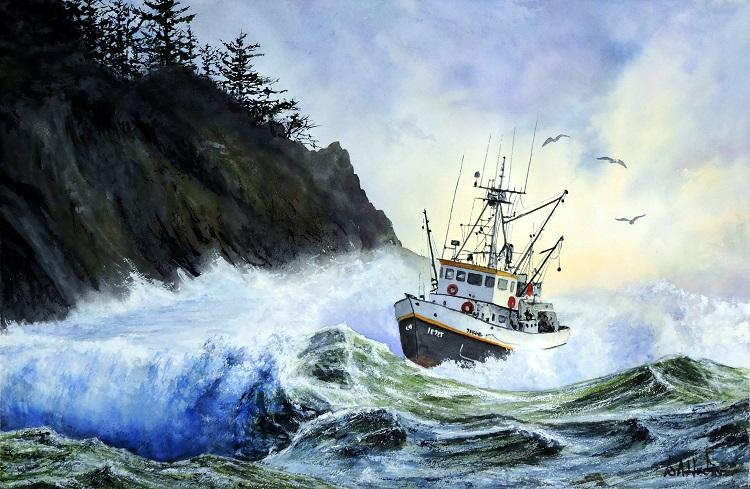
Crossing The Bar
Watercolor & Gouache, 22" x 15"
by Bill Hudson
Original with custom frame ......... $1,650
Nearly every year I drive along the Pacific coast from Los Angeles to Seattle. I love stopping in harbor towns, walking the docks, and talking with the captains and crewmen of fishing vessels. Many of those harbors have been established at or near the mouth of a river for the obvious reasons of natural protection and quick access to both ocean and inland navigation. A few such harbors along my route include:
Fort Bragg, CA on the Noyo River
Brookings, OR on the Chetco River
Reedsport, OR on the Umpqua River
Florence, OR on the Siuslaw River
Newport, OR on Yaquina Bay
Astoria, OR on the Columbia River
The area where the river meets the ocean is called “the bar.” And depending upon the harbor design, the tides, water surface conditions, water depth, and whether a vessel is entering or leaving the harbor …“crossing the bar” can be extremely dangerous . . . even lethal. Therefore, “crossing the bar” is a topic often discussed among the crew of all vessels from small boats to the largest ships.
The “Columbia River Bar” (3 miles wide and 6 miles long), also known as “The Graveyard of the Pacific,” is regarded as the most dangerous bar in the world. And the last sliver of land at the ominous mouth of the Columbia River is appropriately named “Cape Disappointment.” Since 1792, over 2,000 large ships have sunk there. This does not include the incredible loss of smaller vessels. For that reason, the “Columbia River Bar Pilots” association was established in 1846 at the harbor of Astoria. These men, who are highly trained, experienced, and knowledgeable of the ever-changing river conditions, are paid to board (often by helicopter) and guide 3,000 large ships across the bar each year.
So what makes a bar so dangerous?
(1) The water level at the mouth of a river may be shallow before it drops to ocean depths.
(2) The exit from a harbor to the ocean is often a narrow, protected route through man-made jetties. During an ebb tide (when water is flowing toward the ocean), the exiting water velocity increases through the jetties and across the bar (the fire hose effect).
(3) Harbors on the mouth of a river uniquely have the combined momentum of river flow and ebb tides simultaneously exiting through the narrow jetties.
(4) When heavy seas roll in from the ocean against a swift ebb current. . . large, steep, breaking waves form.
As a result, it is normally best to cross the bar during slack tide or flood tide when the waters are calmer.
Due to the inherent danger of navigating bars, the Coast Guard and Oregon State Marine Board offer this advice:
CROSSING THE BAR
“The bar is the area where the deep waters of the Pacific Ocean meet with the shallower waters near the mouth of the river.
Most accidents and deaths that occur on coastal bars are from capsizing.
Coastal bars may be closed to recreational boats when conditions on the bar are hazardous. Failure to comply with the closure may result in voyage termination, and civil and/or criminal penalties. The regulations are enforced by Coast Guard boarding teams.
Improper loading and/or overloading are major causes of capsizing. Improper/overloaded boats have less stability and less freeboard, which can allow seas to break into the vessel, causing the boat to become even less stable.
Boats are more likely to capsize when crossing the bar from the ocean because the seas are on the stern and the boater may have less control over the vessel.
Boaters must make sure the bar is safe prior to crossing. Check with other boaters or the Coast Guard to find out the condition of the bar.
If you are caught on a rough bar running in…
(1) Make sure everybody aboard is wearing a personal flotation device.
(2) Keep the boat square before the seas.
(3) Keep the boat on the back of the swell. Ride the swell and stay clear of the following wave.
(4) Avoid sudden weight shifts from passengers or gear moving around in the boat. If possible, have passengers lie down as near the centerline of the boat as possible.
(5) Do not allow the waves to catch your boat on the side (beam). This condition is called broaching and can easily result in capsizing.”
________________________________________________________________
Although I like to share my thoughts that go into each painting, I just realized how inappropriate this may be for spreading the joy of the Christmas season. But the more I think about it, “crossing the bar” from the ocean, during an ebb tide, is similar to the short life of Jesus Christ here on earth. He did it for us.
|