Starting Position
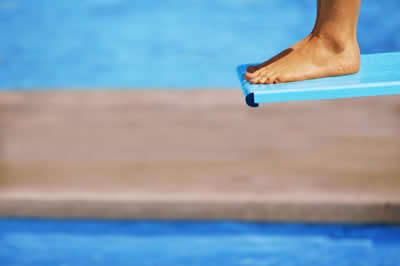
Forward – The diver should demonstrate good posture with arms in a position of the diver’s choice.
Back/inward – The diver should demonstrate good posture, with the head upright, arms in a position of the diver’s choice. A diver may move the arms to a variety of preparatory positions provided there is no attempt to start the dive.
Approach
Forward – The approach shall begin with not less than three steps and finish with a hurdle, defined as a jump off one foot to a landing on both feet at the end of the board. The diver may use steps, hops, leaps and/or jumps during the initial steps and before the culminating hurdle. The forward takeoff shall be from both feet simultaneously to an adequate height to perform the dive. The hops, leaps and/or jumps shall be considered as "steps".
Hurdle
The last step in the forward approach, called the hurdle, consists of the diver lifting the leg (diver’s choice of which leg) to form an angle that may be approximately 90 degrees at the hip and knee. The other leg pushes down on the board and helps the diver jump to the end of the board where he/she lands on two feet. The hurdle is the foundation for the rest of the dive, thus an important element for judges to observe.
Back Press ‐ on back and inward groups, the back press combines the starting position, approach and hurdle.
The diver should stop oscillating the board with the feet to assume a starting position. Once the diver assumes the starting position, the board can be oscillated up to four times prior to the diver leaving the board. The oscillations shall not be so large as to disrupt the tempo or smoothness of the dive. At NO time should the balls of the feet/foot lose contact with the board. If the feet/foot leave the board, or more than four oscillations occur before the diver leaves the board, or the diver takes excessively large oscillations, the judge may deduct 1⁄2 ‐ 2 points.