Connect | Elevate | Advance | |
|
Hello Lisa,
Welcome back to LeaderEdge where we share insights, intel, and ideas you can use
to sharpen your leadership edge.
Our theme for this issue is Due Diligence—the difference maker in:
defining leadership fit for a specific situation, mission, and leadership position;
strategic executive coaching; and selection decision processes.
We look at why due diligence matters even before an executive search begins, why it's foundational to strategic executive coaching, and how it diminishes bias and noise in executive selection.
Enjoy the read!
| |
The Leadership Fit Illusion—and the Due Diligence Blind Spot | |
|
Hiring a Leader is One of the Biggest Investments You’ll Make—So Why Is Your Due Diligence Focused Only on the Candidate?
A hiring process is, at its core, a due diligence process. It’s about making smart, strategic decisions—evaluating risk, ensuring alignment, verifying fit, and ultimately, investing wisely in leadership.
Think about it. Before making any high-stakes investment—whether acquiring a company, purchasing capital equipment, or entering a business partnership—you wouldn’t just evaluate the investment itself. You’d first assess your own position.
You’d ask: Are we financially stable enough? Do we have the right infrastructure? Are there risks in our operations that could impact this investment’s success?
But when it comes to hiring an executive, most companies skip this internal due diligence altogether.
Instead, they zero in on finding “the right leader”—without first ensuring they have a clear-eyed understanding of their own organizational contextual realities, challenges, needs, and readiness.
So why, in one of the most high-stakes relationship investments an organization can make—hiring a leader—does due diligence typically begin and end with the candidates, ignoring the importance of organizational context?
| |
The Hiring Blind Spot—Why Organizations Shortcut Due Diligence on Themselves
| |
|
Every organization thoroughly vets candidates—conducting background checks, skill assessments, reference calls, and leadership evaluations. But how often do hiring teams apply that same level of scrutiny to their own organization before making a leadership hire?
When organizations rush to hire without assessing their own leadership landscape, they create a dangerous blind spot—one that can lead to misaligned expectations, leadership turnover and failed mandates.
Many organizations believe they know themselves well enough to skip this step. But the reality? Familiarity isn’t the same as clarity.
Without a structured process to assess the organization itself—its culture, leadership dynamics, and hidden constraints—hiring decisions become a gamble.
But why do so many organizations overlook this critical step?
Click below to read the full article: Organizational Due diligence-the foundation and roadmap for leadership fit; the consequences of taking a shortcut; cutting through the noise - a four part framework.
| |
|
Slow Down to Speed Up
To get more things done faster, you may
Try to skip steps along the way.
But steps can't be skipped
If you want quality shipped
Do it right from the start every day.
- Mary Lou Kayser
| |
The Science of Hiring:
How Due Diligence Diminishes Bias, Noise—and Bad Decisions
Wherever There is Judgment, There
is Bias and Noise—And More of It Than You Think
Hiring decision processes are rife with bias and noise. They both distort judgment, yet here’s how they’re different.
-
Bias is structured and predictable. It skews decisions in a systematic way, favoring for instance, certain traits, experiences, or personalities—sometimes at the expense of actual leadership fit.
-
Noise is messy and inconsistent. It shows up as random variations in judgment, leading to vastly different assessments of the same candidate—even when using the exact same selection criteria.
Both are human flaws in hiring decisions. And both can be identified and managed—but only if you know what to look for.
Behavioral science has long studied these issues, including extensive research and practical work by the late Nobel laureate, Daniel Kahneman. Kahneman’s pioneering work in how people think and make decisions, in collaboration with other experts in the field, has changed the way we think about “rationality” —because of bias and noise.
The challenge in hiring? Most organizations don’t have a process in place to detect bias and noise—leading to avoidable hiring mistakes that impact the long-term success of leaders and organizations.
Let’s break down how bias and noise distort hiring decisions—and how due diligence in the hiring process helps cut through both.
| |
The Structured Flaw: How Bias Distorts Executive Hiring
Bias is not random—it’s systematic. It influences judgment in predictable ways, shaping perceptions before data and facts even come into play.
And in executive hiring, bias is everywhere.
Common Biases Among Hiring Executives
Encounter any of these situations in your hiring decision process?
-
The Halo Effect. A single positive trait, or a big-name company on a resume, overshadows everything else, making a candidate extra attractive. This results in hiring executives ‘rationalizing’ them as the perfect hire—even when they’re not.
-
Risk Aversion Bias. Companies in crisis may favor highly cautious candidates, even when bold leadership is what’s actually needed—and even discussed throughout the recruiting process.
-
Optimism Bias. Growth-focused organizations overvalue visionary leaders while overlooking execution-focused leadership.
...But hiring teams aren't the only ones affected—candidates also influence and shape perceptions, sometimes without realizing it.
Click below to read the full article: More common biases on the hiring side of the table; Biases candidates bring into the process; the Messy Flaw: Noise; When bias and noise collide - the Executive Hiring Avalanche; Building a framework to detect bias and noise; The Due Diligence Advantage
| |
|
Hire with context, data, and clarity.
Not a gut feeling and a darn good story. -LT
| |
|
Strategic Executive Coaching—Grounded in Due Diligence
Executive coaching is a strategic investment, but without a structured foundation, and a well-crafted design, it can fall short. The key to success? Due diligence—providing context, clarity, structure, and measurable impact.
Coaching is a Bridge—Due Diligence is the Base of the Bridge
A well-built bridge connects a starting point to a destination, considering foundational factors including terrain, weight distribution, and durability. Just as a bridge must be constructed on a solid foundation that is fit for purpose and can withstand the test of time, strategic coaching also requires foundational due diligence. This means understanding not only the executive’s current “positioning” and potential, but also the organizational context in which the executive operates.
Strategic coaching is built on a solid footing of context and strategic intention. It requires contextual consideration—the situation, mission, and ambition—of the executive and the organization. A strategic coaching plan is deliberately designed to elevate and advance leadership advantage for both.
Without due diligence, a coaching bridge can be at risk of shaky grounding, misaligned design, and faltering under pressure—reducing its effectiveness, stability, and long-term impact.
Let’s explore how due diligence elevates executive coaching from a transactional encounter to a transformational experience for the executive and the organization.
| |
|
The Importance of Due Diligence for Strategic Executive Coaching
Context matters. Coaching without due diligence is like navigating without a map—ineffective at best and counterproductive at worst. Due diligence is the cornerstone of strategic coaching.
Context establishes a solid foundation for designing a strategic coaching bridge with navigation strategies that are relevant and actionable within the executive’s organizational framework.
Four Pillars of Coaching Due Diligence
Here's how it breaks down...
Click below to read full article: Explore the four pillars of Coaching Due Diligence; Developing a strategic sustainability plan; measuring what matters - the ROI of due diligence-driven coaching; and how the CEO of Snap (formerly Snapchat) with the support of strategic coaching, established Snap as a major player in the social media landscape.
| |
|
In case you missed this...
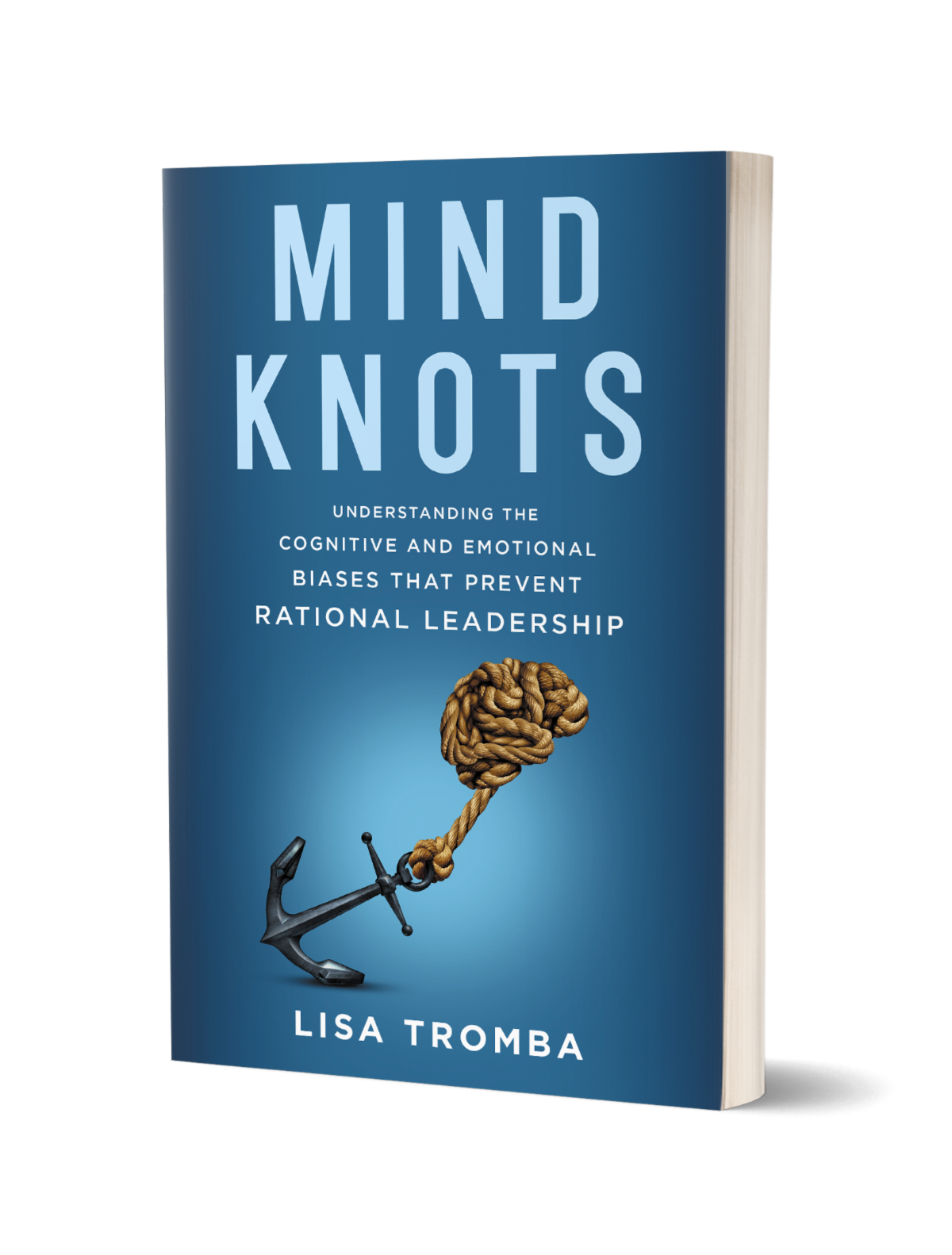
One Year of Mind Knots!
What I Learned...
Last year Mind Knots went from manuscript and message to a value-driven mission—helping executives understand the hidden biases—that shape decisions they make and actions they take.
What I didn't expect was how well this message would resonate. Here are some takeaways from conversations with leaders and readers!
Bias in leadership remains largely unrecognized—Because they are elusive and misunderstood.
Curiosity is growing—Leaders want more. How bias develops, how it impacts leadership, when to trust instinct...
Self-awareness is a game-changer—Readers said the book inspired them to pause and think— reasoning instead of reacting.
Bias is personal and organizational—Questions and strategies from the book are being used for coaching, and to navigate organizational biases.
Bias is predictable and contextually consistent—Key! It can be managed before it hijacks decisions.
| |
|
The journey continues because biases aren’t going away.
What will you do for your leadership, and well, your life.
• Ignore this bias talk, they won’t hijack my thinking.
• Take a step today to elevate my awareness.
• Identify biases that can tie me down.
• Learn to manage biases before they manage me.
More insights here
https://conta.cc/4k4GFuD
| |
To learn more about recognizing and managing biases that may be tying you in place | | |
|
For deeper dive, read Mind Knots offering a framework for bias-aware leadership.
Learn how to harness your biases to work for you instead of against you.
| |
Connect - Elevate - Advance | |
LTA... Executive Search & Leadership Solutions for the lifecycle of leadership. | |
Have questions or want to learn more about how we can support your organization's leadership goals?
We’d love to hear from you!
Let's connect to discuss how our team can help support, elevate, and advance
your organization and leaders.
| | |
|
Thank you for your leadership
and your readership!
We hope you enjoyed this issue of LeaderEdge .
Stay tuned for our next issue.
| |
|
|
Great leadership isn't just found—it's strategically positioned.
| |
|
Know Someone Who Would Find This Interesting?
Feel free to share this issue with your team or colleagues. Simply forward this email to
help someone else sharpen their Leadership Edge!
| |
|
Was this newsletter shared with you?
If this was forwarded to you and you'd like to receive it directly, click below to join our LeaderEdge community and stay informed with insights, intel, and ideas you can use to
sharpen your leadership edge!
| | | | |