|
Drought conditions are likely to blame
Plants absorb nitrate from the soil as part of normal growth. Under favorable conditions, they convert nitrate into amino acids and proteins. When plant growth is interrupted by drought, nitrate uptake and conversion can become unbalanced, allowing nitrate to accumulate in plant tissue.
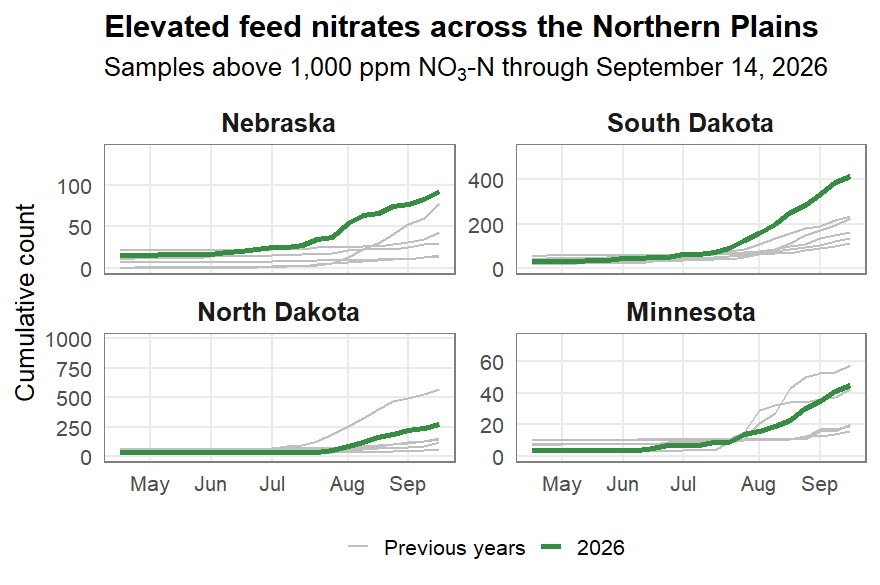
The 2026 growing season produced that risk pattern, with late-summer drought affecting much of the Dakotas, Nebraska and western Minnesota.
Rain following drought can temporarily increase the risk rather than immediately resolve it. Once soil moisture returns, drought-stressed plants may rapidly absorb nitrate from the soil before they regain the ability to convert it efficiently into protein. Nitrate concentrations can increase for several days following rainfall.
Why nitrates are dangerous for ruminants
Ruminants are particularly susceptible to nitrate poisoning because microbes in the rumen convert nitrate into nitrite. Normally, nitrite is converted into ammonia and used by rumen microbes. When nitrate intake is too high, however, nitrite can accumulate faster than it can be converted.
Excess nitrite enters the bloodstream and inhibits its ability to carry oxygen effectively. Although the animal may still be breathing, its tissues are deprived of oxygen.
Early signs can include rapid or difficult breathing, a rapid and weak heartbeat, anxiety, muscle tremors, weakness and staggering. As oxygen deprivation becomes more severe, the animal’s gums and other mucous membranes may appear blue or brown, followed by collapse, seizures and death. The blood of a severely affected animal may have a characteristic chocolate-brown color.
The danger depends on the nitrate concentration, how much affected feed is consumed, the rate at which it is consumed, the remainder of the diet, nitrate in drinking water and the animal’s condition.
The following University of Wisconsin feeding guidelines are expressed as nitrate-nitrogen, or NO₃-N, on a 100% dry-matter basis:
-
Below 1,000 ppm NO₃-N: Generally considered safe.
-
1,000–2,000 ppm NO₃-N: Generally safe when fed in a balanced ration. For pregnant animals, limit the affected feed to no more than half of total ration dry matter and make sure drinking water is low in nitrate.
-
2,000–4,000 ppm NO₃-N: Limit the affected feed to less than half of total ration dry matter. Make sure the complete ration is adequately fortified with energy, minerals and vitamin A.
-
Above 4,000 ppm NO₃-N: Potentially toxic and should not be fed.
Nitrate exposure is cumulative. A forage that can be used safely at a limited inclusion rate may become dangerous when combined with nitrate from other feeds or drinking water. Results should therefore be interpreted as part of the complete diet rather than evaluating each ingredient in isolation.
Actions to take if you suspect high nitrates
With most of this year’s forage already harvested, the priority is identifying affected feeds and managing them appropriately before feeding.
Use extra caution with pasture and any remaining harvest. Rain does not immediately eliminate the nitrate risk in drought-stressed plants. Nitrate concentrations can temporarily increase after rainfall as plants rapidly resume nitrate uptake. Avoid harvesting drought-stressed forage for several days following rain. Pasture requires particular caution because nitrate levels can vary widely and animals selectively consume plants and plant parts, making representative sampling difficult.
Test ensiled feeds before feeding. Proper ensiling typically reduces nitrate concentrations by 40–60%, making it a useful tool for lowering risk in moderately affected forage. It is not a cure-all: forage containing very high nitrate concentrations at harvest may remain unsafe after fermentation. Test the finished silage rather than estimating its nitrate concentration from a pre-ensiling result.
Consider nitrate from drinking water. Nitrate risk is cumulative across the entire diet. A feed that can be used safely at a limited inclusion rate may create a problem when combined with nitrate from other feeds or the water supply. When elevated nitrate is found in feed, consider testing the water and evaluating total nitrate exposure with a nutritionist.
For additional sampling information, visit our our nitrate resource page resource page. Feeding guidelines are adapted from University of Wisconsin Extension guidance on University of Wisconsin Extension guidance on nitrate poisoning in livestock
|