|
|
|
POLICY & ADVOCACY UPDATE
Issue #33, 21 November 2024
| | | |
- National training system failing our sector
- Student caps Bill fails to pass the Senate
- AA and AHA welcome new Tourism Australia Board appointees
- JSA releases latest labour market summary
- Hospitality industry a powerhouse for jobs
- Business Turnover stable in September 2024
- Overseas arrivals for September
| | |
|
National training system failing our sector
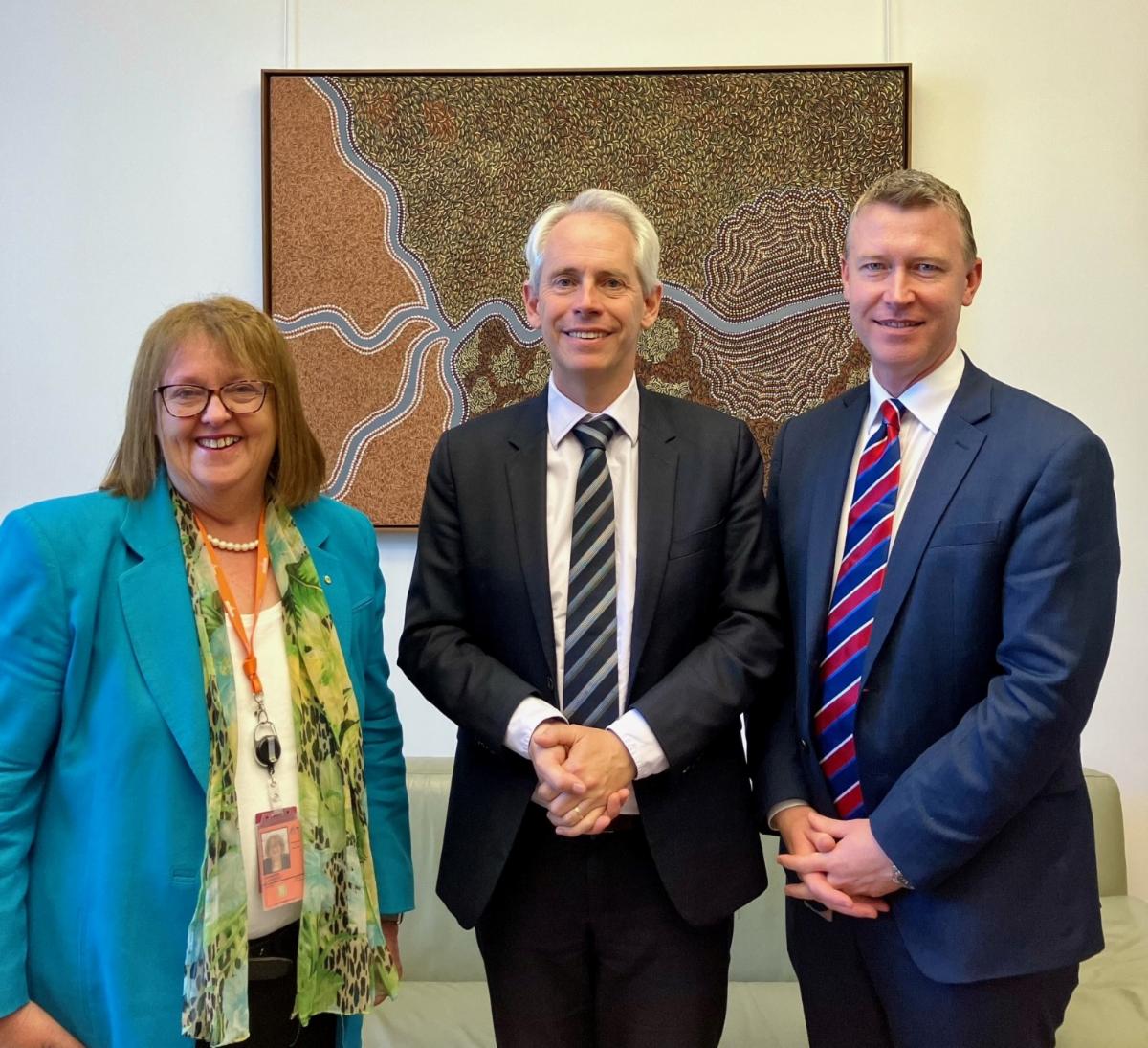
At a meeting this week with the Minister for Training & Skills, Accommodation Australia raised the key concern of the increasing disengagement of industry with the national training system. With declining numbers in apprentice chefs, a loss of federal traineeship employer incentives and a decline in the number of independent students undertaking hospitality certificates, there is a danger that the structured nationally recognised VET system will become irrelevant to our industry. Pictured (left) at the meeting with Minister Giles, AA CEO James Goodwin and I posed the question as to why funding support for training in our sector should be considered less important, given that the productivity improvement arising from training will reap valuable economic dividends in such a labour-intensive industry as ours. It was a very valuable exchange and reassuring that the Minister understood the concerns we were raising. It will be up to all Governments and industry to work together to find solutions.
| | |
Student Caps Bill fails to pass the Senate
This week the Government failed to pass its proposed legislation to impose caps on international students, when the Coalition sided with the Greens to reject the Bill. The plan to cap international students at 270,000 was a concern not only to the higher education sector but an issue we had been raising with government given the reliance on international students as an important supplement to our workforce. With less than two parliamentary sitting weeks before the caps were due to begin on January 1, it is most likely that the current "Direction 107", which prioritises visa applications from students applying to “low-risk” education providers such as the Group of Eight universities, will remain in place. Direction 107 was introduced in December last year and has led to a significant decline in the number of international student visas being granted from a record 577,295 in 2022-23 to 376,731 in 2023-24. The impact for our sector of the failure of the caps legislation to pass is likely to be positive (the least-worse outcome), although some of the regional universities may have seen an uptick in students which may have benefited some of our regional members.
In related news it was great to see some fact-based commentary which debunked the idea that international students were a major cause of the housing crisis. The Student Accommodation Council (part of the Property Council) has issued a report providing evidence that the increase in international student numbers is not creating the housing crisis. In a statement issued yesterday, the Executive Director of the Council, Torie Brown, said "We keep hearing that international students are to blame for the housing crisis, but this does not reflect reality as international students only make up six per cent of the rental market – heavily weighted towards CBDs – with 73 per cent of local government areas having an international student concentration of less than one per cent. Increasing rents do not correlate with rising student numbers. Rents began to skyrocket in 2020, when there were no international students arriving in Australia."
| |
AA and AHA welcome new Tourism Australia Board appointees
The Minister for Trade and Tourism, Senator Don Farrell, yesterday announced four new appointments to the Tourism Australia Board including myself, in addition to the Hon Michael Lee (served as Minister for Tourism and Minister for Resources in the 1990s, Tim Yeend (recently Associate Secretary, Department of Foreign Affairs and Trade, and previously Australian Ambassador to the World Trade Organization) and Peter Laurance AO (owner and developer of major tourism attractions, including theme parks, hotels and resorts). The announcement also confirmed Penny Fowler as the new Chair of TA, and former SA AHA CEO Ian Horne as the Deputy Chair.
In response to the announcements, the AHA and AA issued a joint media release welcoming the appointments, where AHA CEO said: “The appointment of Accommodation Australia’s National Policy Director Jenny Lambert to the board was great news, along with the appointment of serving board member, former AHA South Australia CEO Ian Horne, to Deputy Chair. Promoting Australia to overseas tourists is vital to the hospitality and accommodation sectors and this appointment is an encouraging signal Government is listening to industry and is interested in a broad cross section of views and experience on the TA board.” AA CEO James Goodwin added: "“Tourism is the lifeblood that supports thousands of jobs and businesses right across Australia. I look forward to working with the new appointees and Tourism Australia as they continue to drive demand and attract more international travellers to our shores.”
| |
JSA releases latest labour market summary
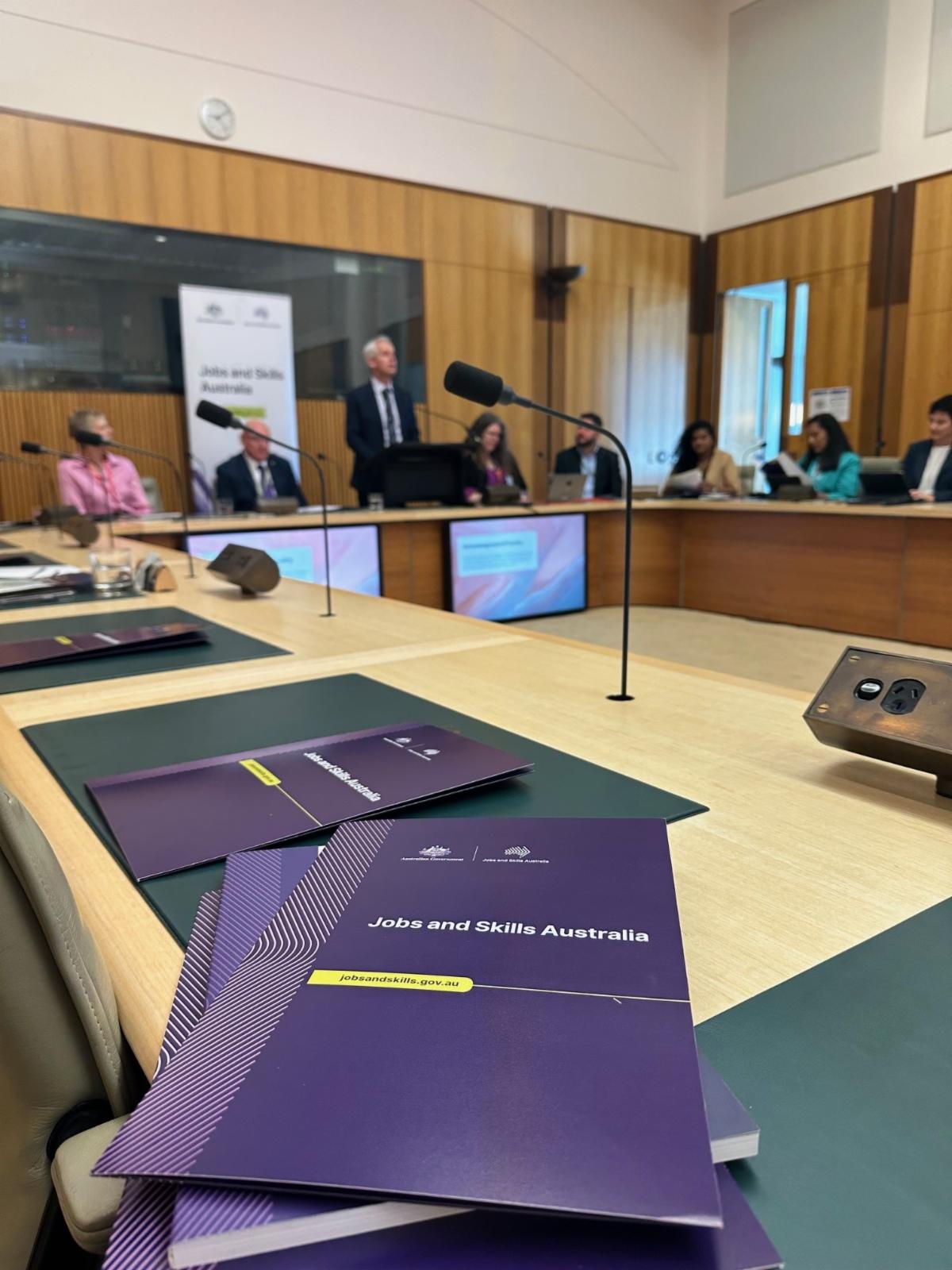
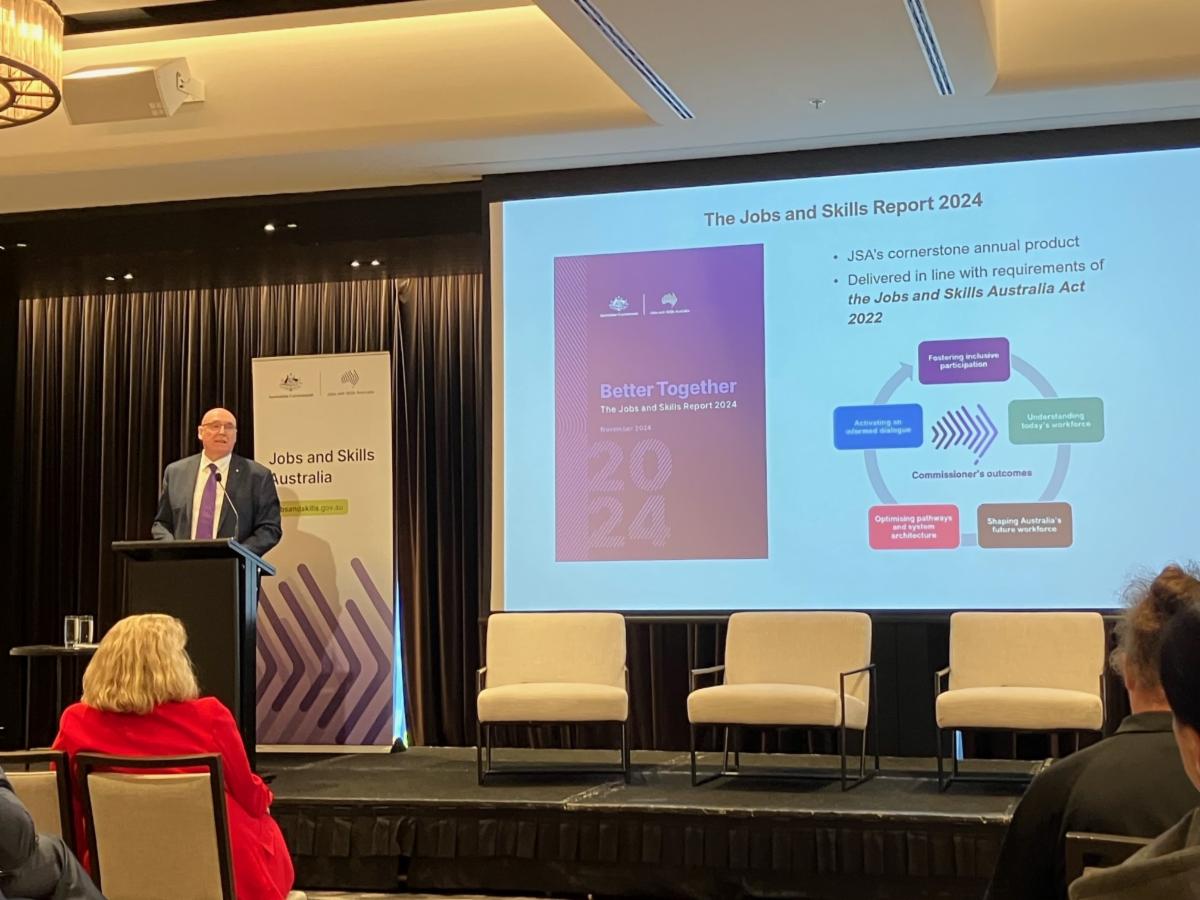
At a Monday launch attended by AA in Parliament House by the Minister, and then by Jobs and Skills Commissioner Professor Barney Glover to the industry, the latest labour market report was released by Jobs & Skills Australia. In amongst the wide range of labour market data was the employment projections that show that the accommodation and foodservice industry is in the top four industries for net job growth in the next ten years with over 110,000 additional jobs in the industry by 2034. Our share of total employment will be about the same at 6.4% of the labour force.
| | |
|
Pictured left, the launch at Parliament House by the Minister for Training & Skills, Andrew Giles, and (above) the presentation of findings by Professor Barney Glover to stakeholders including Accommodation Australia. | |
|
Hospitality industry a powerhouse for jobs
When the labour market is discussed, the big focus is usually on employed persons and the unemployment rate, but the really interesting view is when we talk about jobs. A person can hold several jobs during the year, either concurrently or consecutively. The ABS last week released their analysis on jobs for the year to June 2022 and it showed that the 14.9 million employed Australians worked in 22.7 million jobs, which was 9.1% more than the previous year, and 16.1% more jobs than pre-COVID 2017-18. Gender-wise the numbers was fairly equal - 11.4 million jobs for men, and 11.3 million for women. Hospitality is a powerhouse creator of jobs. The accommodation and foodservice industry generated 8.3% of all jobs in 2021-22, even in a period when we were coming out of COVID lockdowns. This was the fourth highest job share, behind health at 12.9%, administrative 9.4%, and retail at 9.2%.
| |
|
Business Turnover stable in September 2024
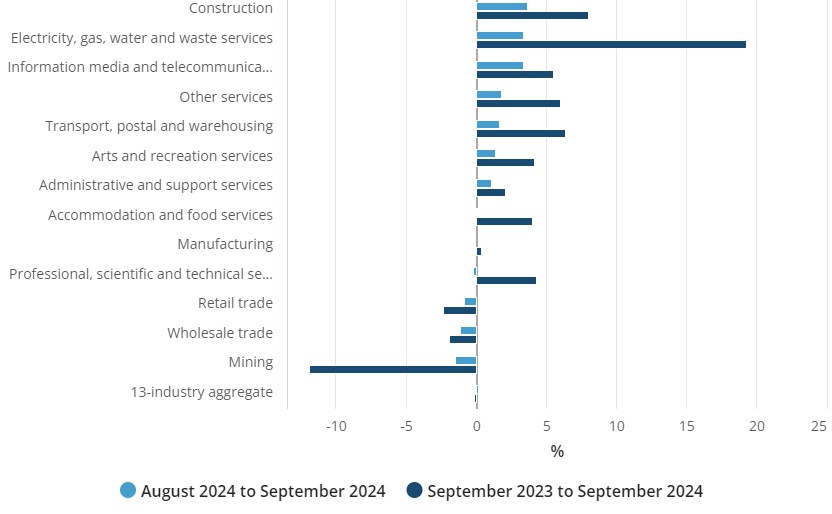
In the latest ABS data on business turnover released for the month and year to September 2024, turnover across 13 industry sectors rose marginally by 0.2% compared with August and fell 0.1% compared to the previous year. Our industry performed better than the average across the year, with turnover rising by 4.0% compared with September 2023. As the graph below shows, there were major differences across the 13 industries included in the analysis with electricity, gas and water experiencing by far the biggest rise in turnover over the year, up 19.3. Year-on-year rises were seen in 10 of 13 published industries, with construction and transport also experiencing turnover increases well above the average which, along with energy costs, is feeding into the cost increases for businesses in other sectors.
| |
|
Overseas arrivals for September
The latest statistics from the ABS for September 2024 show that there were 630,700 short-term visitor arrivals in Australia, an increase of 7.9% compared to September 2023 but 9.2% below pre-COVID September 2019 arrivals, with this last comparison an improvement on last month. New Zealand was the largest source country, accounting for 17% of all visitor arrivals, followed by China and the UK. In terms of State or Territory where visitors indicated they were staying, higher growth in visitors were experienced by WA (up 18.9%), NT (up 17.4%), ACT up 20.2% and Tasmania up 11.7% compared to September 2023. Illustrating the step up in Australians travelling overseas, the number of short-term resident returns in September 2024 topped one million at 1,020,960 which was an increase of 8.1% on a year earlier.
In September 2024 there were 47,230 international student arrivals to Australia, an increase of 2,130 students compared with the corresponding month of the previous year. The number of student arrivals in September 2024 was, for the first time in many months, higher (up 4.3%) than pre-COVID levels in September 2019.
Coming into my Facebook feed this week was the ABS's animated data summary of short-term visitor arrivals since 1983. Here is the link if you are interested in seeing how much it has changed over the last 40 years.
| |
|
Drop me an email at policy@accommodationaustralia.org or give me a call on 0418 277 919 if you have any national policy issue that you think AA should be following up. If you know an AA member who is not receiving this advocacy report but wants to, then encourage them to email me and we can add them to the distribution list.
Kind Regards
Jenny Lambert OAM
National Policy Director
Accommodation Australia
| | | | |