Council Votes to Upgrade Road Conditions in Waltham; Mayor Vetoes Order
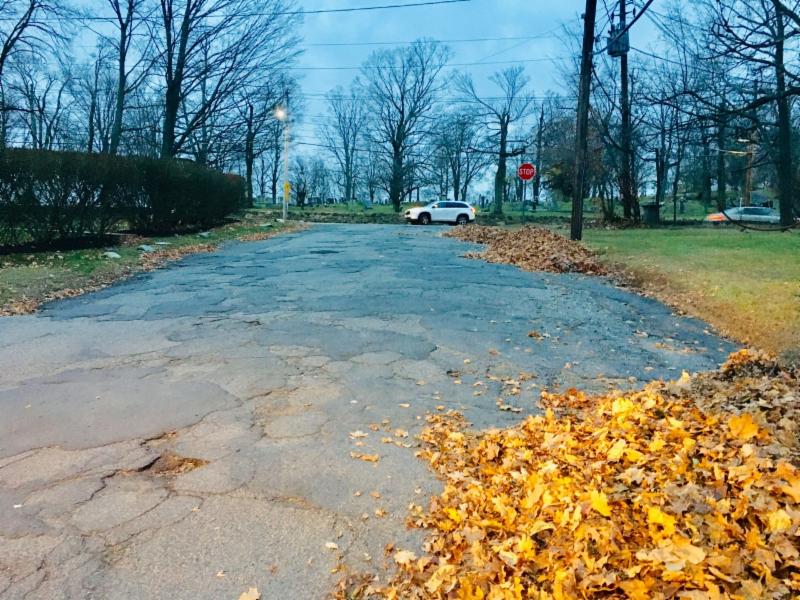
Nearly half of all Waltham roads are private ways which are the responsibility of the property owners. The city repairs pot holes and plows snow on these streets. However, major repair, pavement and construction costs are covered by the residents. Waltham public ways are maintained by the city with on average 1.5 million dollars in state funding assistance annually approved by the state legislature. As a result, there is a large disparity between the road condition of private and public ways. To see if your street is public or private, click
here.
Private ways may be converted to standardized public ways with initial construction costs shared with property owners and paid over twenty years at a rate determined by the city. This cost has historically been set at 75%. Recently, the city council voted 14-1 to change this ratio to 33% in order to upgrade road conditions by encouraging more conversions from private to public roads. Mayor McCarthy vetoed this council order. Mayor McCarthy has been invited to the City Council Committee of the whole to discuss her veto on Monday, November 19th at 8:00 pm.
Opportunity to visit the Fernald Site!
Interested in seeing some of the Fernald grounds? The City of Waltham recently released a Request for Information for the Re-Use of certain Parcels and Buildings of the Former Fernald School. The grounds are normally not open to the public. On November 20th at 10am, there will be a bidder's conference on site. Take this opportunity to get a look around. The Fernald property is located at 190-200 Trapelo Road in Waltham. To learn more about Fernald and the Fernald Working Group, click
here.
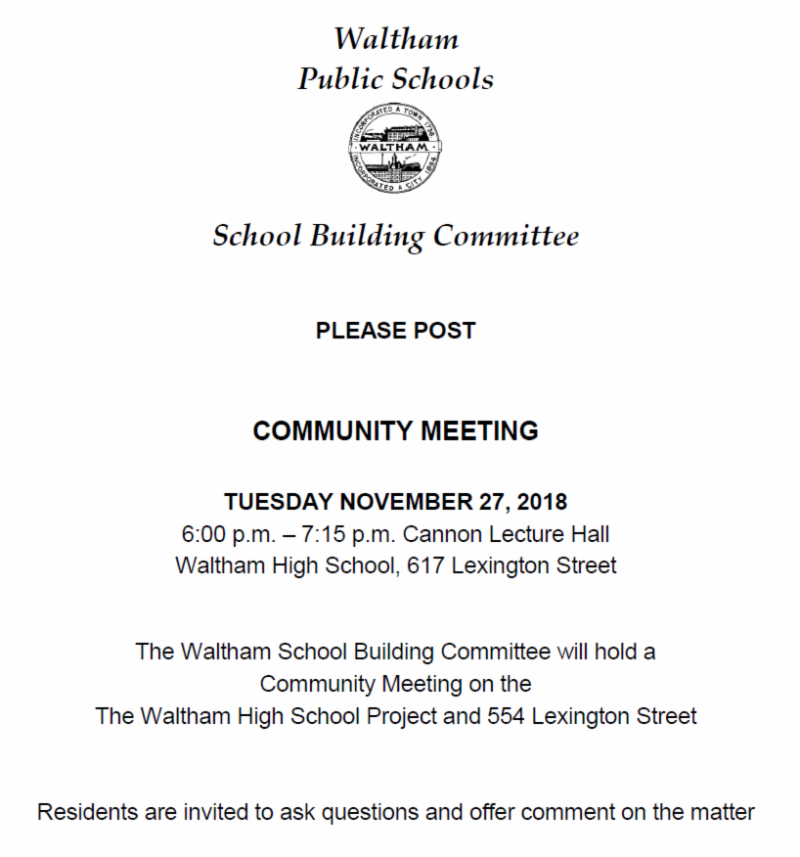
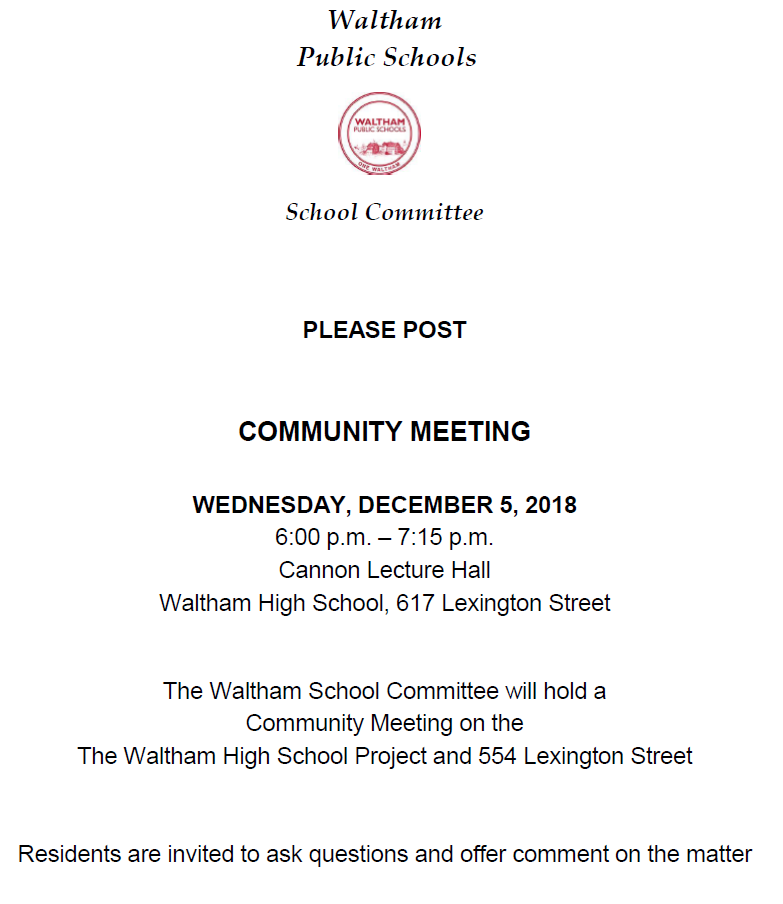
You're Invited: Community Meetings!
The Waltham School Committee will hold two Community Meetings on the Waltham High School Project and 554 Lexington Street. Residents are invited to ask questions and offer comment on the matter. More information is below.
NEWS FROM BEACON HILL
Rep. Stanley signs resolution commemorating the Celebration of Chanukah
Rep. Stanley cosigned a resolution sponsored by Senator Creem and Representative Smizik commemorating the festival of Chanukah which will be celebrated throughout the world from the evening of December 2, 2018 through December 10, 2018. To read the full resolution, click
here.
Gun Violence Prevention: Request for information!
The Department of Public Health is in the process of writing an RFR that will be posted December 7, 2018 to award $10M in gun violence prevention funding to communities in Massachusetts. This program will focus on out-of-school youth and young adults aged 17 to 24 to prevent gun violence and other violent crime in neighborhoods and municipalities with the highest rates of gun violence in the Commonwealth. Funds will be awarded to non-profit, community-based organizations located in and serving high risk youth with preference given to organizations that have:
1. demonstrated street outreach capacity,
2. effective partnerships with neighborhood health and human services agencies, including mental health providers, and with schools and other local educational institutions and
3. clearly outlined a comprehensive plan in support of continued or expanded collaboration efforts with such partners.
The Department of Public Health plans to release a Request for Response (RFR) soliciting services later this year and is looking for input from community-based organizations, community members, partners, elected officials and other stakeholders to inform the design of the procurement. Interested parties may review the
questions attached and send comments by email to gunviolenceprevention@state.ma.us by November 12th 2018 at 5pm. Groups may answer as many or as few questions as they would like.
Governor Baker Signs Supplemental Budget Bill, Investing New Funding in School Safety, Local Infrastructure
In October, Governor Baker signed a supplemental budget for Fiscal Year 2018 (FY18) that includes new investments in education and communities, while making a significant deposit into the state's Stabilization Fund, bringing the balance to more than $2 billion for the first time since 2008.
The bill dedicates $20.7 million in new education support, including funding for two programs to enhance school safety first proposed by Governor Baker in July. Under the supplemental budget, K-12 public schools will receive $7.5 million in grants to invest in security-related infrastructure upgrades and $7.5 million for grants to public schools to hire additional mental health and behavioral health specialists. The budget also includes $5 million for targeted intervention and turnaround efforts aimed at closing achievement gaps in districts with high concentrations of low-income students.
The budget provides $70 million in overall infrastructure spending, including $40 million in grants to cities and towns for local road and bridge improvements and $10 million for clean drinking water projects. The budget also funds a new State Police class and a new class of Department of Correction officers, as well as a $10 million gun violence prevention initiative.
The bill authorizes $541 million in supplemental appropriations overall. It results in a deposit of approximately $220 million into the Stabilization Fund, bringing the fund balance at the close of FY18 to just over $2 billion, or nearly double the balance when the Baker-Polito Administration took office.
The Fiscal Year 2019 budget anticipates an additional $368 million deposit into reserves which, along with interest and other expected transfers, would bring the projected balance at the end of the current fiscal year to approximately $2.4 billion.
"The Baker-Polito Administration has worked in a disciplined way with our partners in the Legislature to put the state on solid fiscal footing, while funding targeted new initiatives that improve services for the people of Massachusetts," said Administration and Finance Secretary Michael J. Heffernan. "This supplemental budget marks an important achievement, restoring the balance of the Stabilization Fund to more than $2 billion for the first time since 2008."
A $10 million appropriation included in the budget will fund a reserve to be used to advance costs incurred by the Commonwealth as it responds to the recent natural gas explosions in the Merrimack Valley.
Governor Baker Signs Bill to Promote Civic Education for Students
Governor Baker signed S2631, an act to promote and enhance civic engagement. This new law will make it a requirement for Massachusetts public high schools and school districts serving eighth-grade students to provide at least one student-led, non-partisan civics project for each student. These projects can be individual, small group, or class wide and they must be designed to promote student abilities related to the analysis of complex issues; consideration of different perspectives; logical reasoning with supportive evidence; engagement in civil discourse, and understanding of the connections between federal, state, and local policies, including those that may impact the student's school or community. Under the new law, a student who chooses not to participate in a particular group or class-wide project must be offered the opportunity to develop an individual civics project, with approval by the principal.
This bill also creates a Civics Project Trust Fund, which will be used to assist Massachusetts communities with implementing history and civics education state requirements, particularly in underserved communities. In addition, the Department of Elementary and Secondary Education (DESE), in consultation with the Secretary of State, will work to form a non-partisan high school voter challenge program to raise awareness for eligible students to register or pre-register to vote. The bill will complement recent actions taken by the Board of Elementary and Secondary Education. In June, the Board voted to approve a revision of the History and Social Sciences curriculum framework, which will improve the impact of civics education across multiple grade levels and subject areas.
T launches MBTA.com/Weekend for upcoming weekend work
The MBTA announced the launch of
MBTA.com/Weekend, a customer-focused webpage that details major weekend rail service changes in one, simplified format. This new page is for customers who use the T differently on weekends than they do on weekdays, and who might be unaware of weekend diversions in places that they're less familiar with. The content is intended to inform customers of planned service disruptions on the T's subway and light-rail systems, as well as on the commuter rail network.
As the MBTA continues to execute on its five-year, $8 billion capital investment plan, these investments will inevitably cause some changes to regularly scheduled service. The T's five-year CIP places heavy emphasis on making core system upgrades to areas such as track, signals, and power systems. Given the nature of this work, and to maximize the amount of time required to make these investments, the T schedules much of this work overnight and on weekends.
MBTA.com/Weekend will be updated on a weekly basis and will provide details of the work underway, the location, service alternatives during weekend diversions, and an estimate of the work's duration. For larger-scale projects, the site will also provide deeper context of a particular project's scope, timeframe, and the ultimate benefits T customers will experience.
Baker Administration Proposes Fentanyl Interdiction Program
Governor Baker filed legislation seeking $5 million to support a regional, multi-agency approach to fentanyl interdiction and crime displacement by Massachusetts municipal police departments. The pilot program was developed in concert with many Massachusetts police departments interested in a regional approach to the epidemic.
Historically, when law enforcement conducts multiple coordinated drug arrests in a particular community, the drug dealers not caught up in the sweep move their operation to a neighboring community and continue to sell. Participating police departments will coordinate regionally to execute arrests that take dealers off the streets. The funding will help supplement surveillance work and overtime costs for units engaged and officers in the field will also work to get buyers into treatment.
Registry of Motor Vehicles Cautions Customers to be Aware of Unofficial Registry Websites
The Massachusetts Registry of Motor Vehicles (RMV) is cautioning customers to make sure that they are using the official MassDOT RMV website Mass.gov/RMV when they are trying to renew a license or registration, schedule a road test, or process any transaction online. Customers may inadvertently come across unofficial third-party websites or "mimic sites" that advertise similar services but have no affiliation with the RMV.
Customers can use the helpful hints listed below to determine whether the website they are using is the official site for the Massachusetts Registry of Motor Vehicles.
*
Massachusetts uses the abbreviation "RMV." Any website using the phrase "Department of Motor Vehicles" or "DMV" should be avoided.
*
Make sure the Commonwealth's seal is located somewhere on the page. This will help ensure that it is an official government website. If it cannot be found, customers should leave the site immediately.
*
The Registry will never charge a customer to check the status of a license, registration, or title. If the site requires payment to access this information, it is an unsecured mimic site.
*
At Mass.gov/RMV, a customer will never be charged to access Registry forms and information, but unofficial third-party sites may charge for this service. Their information is also not guaranteed to be accurate.
*
The Registry never charges for address changes. If a customer uses a mimic site, the change cannot be guaranteed to have actually gone through.
Any information on these third-party websites may not be accurate, and any details or payments that customers submit may not be secure. The RMV is not responsible for the content or actions taken by these sites. For more information on the dangers of third-party services, visit the Mass.gov/RMV.
If you have additional questions, contact the Office of Consumer Affairs and Business Regulation by calling the Consumer Hotline at (617) 973-8787, or toll-free in MA at (888) 283-3757 Monday through Friday from 9:00 a.m., to 4:30 p.m.
For the latest Registry updates and information, follow the RMV on Twitter @MassRMV.
Baker Administration Announces $50 Million Investment in Community Health Centers
The Baker Administration announced new investments totaling $50 million over five years to 35 community health centers (CHC) which serve thousands of individuals annually throughout the Commonwealth. The funding will further provide treatment for young people and adults with behavioral health needs, and acknowledged the important role of CHCs in expanding access for opioid addiction treatment.
In August, Governor Baker signed An Act for prevention and access to appropriate care and treatment of addiction. The law is the Baker-Polito Administration's second major legislative action to address the opioid crisis since taking office in 2015, and expands the Commonwealth's prevention, intervention, treatment and recovery strategies. Building on the STEP Act which instituted the nation's first seven day limit on new opioid prescriptions resulting in a 30 percent decline in opioid prescriptions, the law creates a commission to establish credentialing standards for recovery coaches; expands the use of medication assisted treatment in emergency departments and five Houses of Correction; and requires all prescribers to convert to secure electronic prescriptions by 2020.
Over the next five years, the investment to CHCs will increase provider rates for psychiatry services and medical visits provided to children and adults, beginning January 1, 2019. In addition, MassHealth is improving access to school-based health centers.
In March, MassHealth launched its restructured care delivery system through the implementation of 17 Accountable Care Organizations (ACO) and two Managed Care Organizations. ACOs are networks of physicians, hospitals and health care providers, including some community health centers that are responsible for the quality and total cost of care for their MassHealth members.
RMV License Format Changing on November 13
Starting on Tuesday, November 13, 2018 the RMV is transitioning its new license/ID card issuance format from a nine-digit alphanumeric code consisting of one letter ("S") and eight numbers to one consisting of two letters ("SA") and seven numbers. This change is necessary because we are running out of new "S" combinations in which to issue new Massachusetts licenses and ID cards. This change only pertains to newly issued credentials. The RMV is keeping "S" numbers on all current licenses, IDs, and permits, and they will not change upon renewal.