Preservation in progress
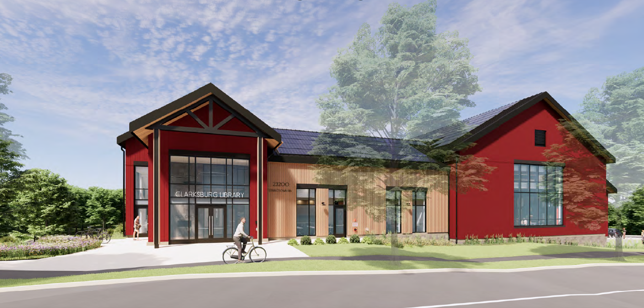
This summer, Montgomery County’s Historic Preservation Commission approved the Historic Area Work Permit (HAWP) for Clarksburg’s first public library! The new library at 23200 Stringtown Road is approximately 21,000 square feet and will provide greater access to a full range of library and community services for the Clarksburg area. The HAWP was necessary for the project to go forward because the property is in the Clarksburg Historic District.
The property includes the historic Day House, which is also a contributing resource to the district. Adopted as a Master Plan Historic District in 1989, the Clarksburg Historic District is significant as an important collection of early 19th century residential and commercial architecture as the community evolved from an early agricultural settlement to an important trade and transport hub.
| | A perspective view showing the front (south) elevation onto Stringtown Road, Clarksburg Library Historic Preservation Commission Presentation July 29, 2026. Illustration via Grimm & Parker | |
Welcome new commissioners
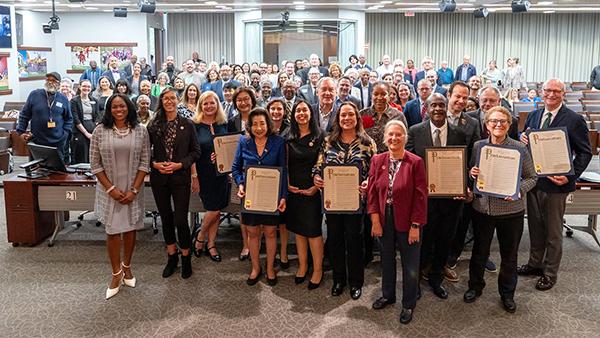
On September 28, the Montgomery County Council swore in two new Historic Preservation Commissioners.
| | |
Jennifer Menassa Kirwan, AIA, is founder and principal of Menassa Architecture in Takoma Park/Silver Spring. A Montgomery County resident with more than 25 years of architectural experience, her practice includes new construction, renovations, additions, and adaptive reuse, with work in historically sensitive communities including Chevy Chase Village, Garrett Park and Takoma Park, as well as Washington, DC’s Sheridan-Kalorama and Logan Circle historic districts. Her work has involved review and consultation with the Montgomery County Historic Preservation Commission, the DC Historic Preservation Review Board and the U.S. Commission of Fine Arts. Prior to founding her firm, Jennifer worked at CG+S Architects, where her projects included renovations to the historic Orangery at Dumbarton Oaks. She earned a master’s degree in architecture from the University of Maryland, and her early professional experience included an internship with the National Park Service’s Historic American Buildings Survey/Historic American Engineering Record (HABS/HAER) documenting historic structures for the Library of Congress. She is licensed in Maryland, Virginia, and DC.
| | | Karl Pitt is a retired engineer and a longtime Montgomery County resident; he’s lived in McKenny Hills, Kensington, and Takoma Park. He has served on the 1996 Forest Glen Sector Plan’s Citizens Advisory Committee and the county’s Committee to Evaluate and Review Boards (CERB). Karl and his wife Ruth are engaged in a long-term effort to rehabilitate and maintain their Takoma Park house (a contributing property in the historic district). Karl is also continuing research, initiated by previous owner Dr. Charles Stevenson, into the history of their Takoma Park house. It was the residence of Bertha Hale White and George Judson King from 1926 to 1958, and from 1940 to 1958 the house was the headquarters of the National Popular Government League; King was the league’s director. | | |
Heritage happenings
On September 22, Historic Preservation Division Chief Rebeccah Ballo, Planning Director Jason Sartori, Planning Board Chair Artie Harris, and Planning Board member James Hedrick attended the County Council’s proclamation ceremony celebrating Montgomery County’s founding 250 years ago on September 6, 1776. Originally considered part of Frederick County, the Maryland General Assembly passed legislation dividing it into three separate counties: Frederick, Washington, and Montgomery. Montgomery County is named after Revolutionary War General Richard Montgomery who was killed in the Battle of Quebec in 1775.
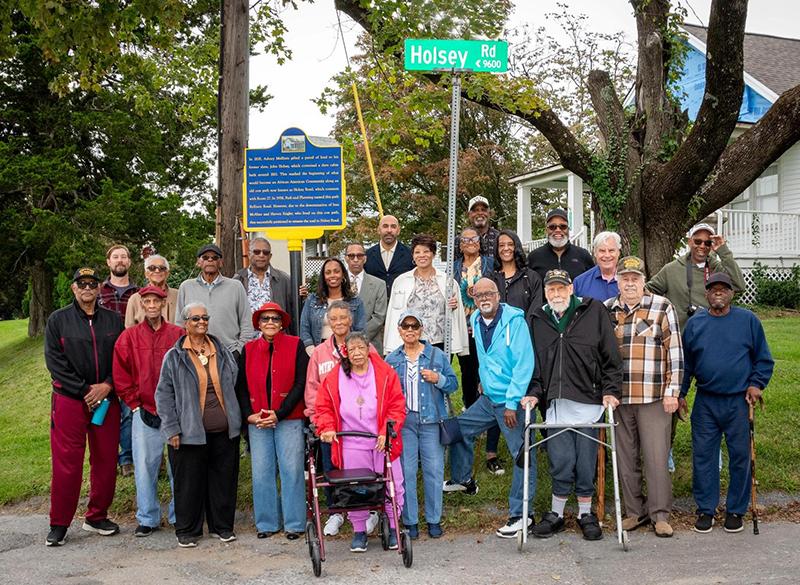
| | On September 27, the Damascus Connection Committee of Montgomery County (DCCMC) unveiled a new historic marker honoring Holsey Road and families connected to its history. Holsey Road is named after John Richard Holsey, an African American man who lived and worked on the Mullinix Plantation and was born free in 1818. Becoming a prominent farmer and carpenter, he played a crucial role in developing the African American community in the Damascus area. Originally a cow path connecting the Mullinix property to Clarksburg, Holsey Road was home to more than 30 enslaved and free families. In 1835 Asbury Mullinix deeded a large parcel of land to John Holsey, including the old cow path. Generations of Holsey family members and community members would call Holsey Road home. DCCMC received a grant in 2025 to install the marker and organize a public event commemorating John R. Holsey and the greater community. The Inez McAbee Home at 9342 Holsey Road is listed in Montgomery County’s Locational Atlas & Index of Historic Sites and is named after John Holsey’s great- great granddaughter. This home was once owned by the Mullinix family and then deeded to John Holsey in 1835. | The Damascus Connection Committee of Montgomery County (DCCMC), current residents, and descendants of former Holsey Road residents pose with the newly installed historic marker. Photo courtesy of Warren Fleming, Damascus Historical Society. | |
Historic building maintenance tips
The first step in preserving an historic building is completing regular annual maintenance tasks. Fall is the time to prepare for winter weather, and while a well-designed building will have systems to mitigate extreme weather, they must be maintained to work effectively. Proactive home repairs and upgrades help property owners address issues before they become more intensive and costly.
The most important fall maintenance task is keeping the building’s drainage systems clear. That means checking the gutters, roof drains and valleys, and removing all debris on a regular basis. Drainage systems don’t stop at the roof line; also make sure all the downspouts and gutter pans are clean and in good working order. Remove any brush or weed growth next to the building and foundation walls, and trim back any tree growth that may touch or otherwise damage your roof. Clean and repair your windows and install storm windows and other weatherization products. Fall is also a great time to make any small repairs to the envelope of your building before the ravages of winter weather. Wash off all the dirt and other organic matter that’s accumulated on the siding, especially in the eaves and other projecting elements like bay or oriel windows. The cool temps and low humidity also make it a perfect time for touch-up painting, especially around windows and doors.
The National Park Service’s Preservation Briefs publication is a great source for property owners on how to recognize and resolve common preservation problems. Helpful issues for planning your fall maintenance work include Maintaining the Exterior of Small and Medium Sized Historic Buildings, and Improving Energy Efficiency in Historic Buildings.
| |
Staff spotlight
Christiana Limniatis is the Historic Preservation Division’s new cultural resources planner. Originally from Upstate New York, Christiana has more than 15 years of experience in historic preservation. She was most recently a program and outreach manager at Preservation Maryland. At Montgomery Planning, she will be working on historic preservation outreach services, master plan amendments and designations, the Asian American and Pacific Islander Heritage Project, and our new capital grant program. Christiana has a master’s degree in historic preservation planning from Cornell University and a bachelor’s degree in history and political science from The College of Saint Rose. Welcome Christiana!
| | |
Historic Preservation Tax Credits
Did you complete some home improvement projects this year? Or maybe you’ve got plans to check them off your list, still? Montgomery County property owners may be eligible for a 25% property tax credit for restoring the exteriors of their historic structures during 2026. To be eligible for the Montgomery County Historic Preservation Tax Credit, the property must be listed in the Montgomery County Master Plan for Historic Preservation. Search to determine if your property is listed. Repairs, restoration or preservation of exterior features of designated structures are considered for the Montgomery County Historic Preservation Tax Credit. New additions and interior work are ineligible.
View a short video about the Historic Tax Credit program. Download the tax credit application. April 1, 2027, is the application deadline.
For more information about filing a tax credit application, please contact: 301-563-3400 or MCP-Historic@mncppc-mc.org.
| |
Hollywood and historic preservation
You might be surprised to know historic preservation is a theme throughout many of your favorite Halloween and holiday movies.
Starting off with the scariest on the spectrum is “Candyman” where the original (1991) and remake (2021) tell poignant yet terrifying stories of how discriminatory housing polices cause pain and destruction in the land of the living and the dead. Spectacularly mysterious Second Empire-style homes are the heart of “The Addams Family” (1991), “Practical Magic” (1998), and “Hocus Pocus” (1993), all which provide perfect case studies in how preserving the character of our small, walkable hometowns can be a boom to the economy and witchcraft alike. Other spooky classics like “Beetlejuice” (1988) and “Vampires vs. the Bronx” (2020) guide viewers through some unique approaches to preserving historic resources and communities.
If scary is not your thing, the cozy films of yuletide have plenty of preservation work to meet your fancy. “It’s a Wonderful Life” (1946) is a perennial holiday favorite and arguably the most famous preservation movie of all time. Yes, a heartwarming story of a downtrodden man getting some heavenly help just in time, but it’s also the story of a man who’s dedicated his life to preserving the naturally occurring affordable housing that made his community vibrant and sustainable. “Holiday Inn” (1942) and “White Christmas” (1954) both revolve around former army buddies finding love while simultaneously trying to protect and rehabilitate underutilized performance venues. “Snowed-Inn Christmas” (2017) is a delightful Lifetime Channel movie where polar opposite co-workers get stranded in Santa Claus, Indiana where they help historic inn keepers Chris and Carol Winters research the history of the property. But will they fall in love? Will the inn get landmarked? Will they prove that Chris Winters is Santa Claus? You’ll have to watch to find out.
| | | | |