DIVISION OF METABOLISM, ENDOCRINOLOGY, AND DIABETES |
|
Dear Colleagues,
We recognize that the COVID-19 pandemic has profoundly altered our lives and that everyone is working diligently, in some capacity, in battling this disease. Please know that we stand with you as we all adjust to what will be our new normal. We hope this email finds you, your families, and your friends safe and well.
Sincerely,
Multidisciplinary Training Program in Basic Diabetes Research Team
Michigan Medicine Division of Metabolism, Endocrinology, and Diabetes
|
|
APPLICATION DEADLINE: JUNE 1, 2021
START DATE: SEPTEMBER 1, 2021
|
|
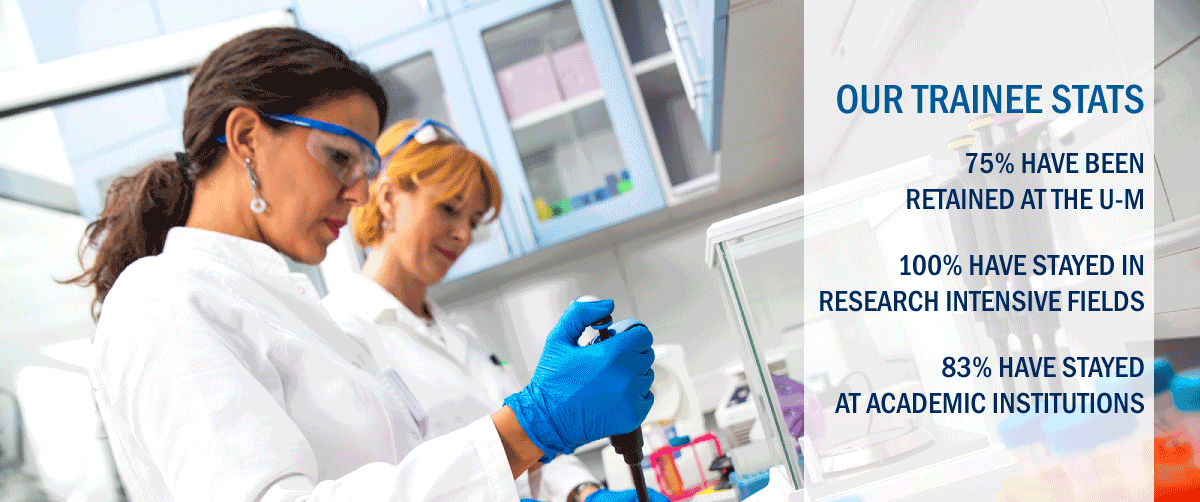
The Multidisciplinary Postdoctoral Training Program in Basic Diabetes Research provides an opportunity for postdoctoral fellows with a PhD to pursue training in diverse aspects of diabetes research. Training grant preceptors fall into major interest groups across a spectrum of type 1 and 2 diabetes research - islet biology, autoimmune diabetes, adipocryte biology, neuronal regulation of metabolism, mechanisms of insulin resistance, metabolic control in liver and muscle, and diabetes complications – each area containing investigators pursuing basic research with potential translational applicability.
Laboratory training is supplemented by a core curriculum in molecular pathogenesis of diabetes, a series of educational seminars/classes and workshops on grant writing, career skills, and research methodologies.
Trainees must have a PhD or equivalent degrees and a desire for a career in diabetes research, no more than three years of postdoctoral training, and be a U.S. citizen or permanent resident. Applicants will provide a research proposal, biosketch, and letter from mentor.
|
|
Ormond MacDougald, PhD
Dr. Ormond MacDougald is the John A. Faulkner Collegiate Professor of Physiology, and Professor of Molecular and Integrative Physiology and Internal Medicine.
Dr. MacDougald is an internationally recognized investigator for his work on metabolism and adipocyte (fat cell) differentiation - the process by which a less specialized cell becomes a more specialized cell type. Specifically, his research explores the signals that act on mesenchymal stem cells (MSCs) to influence fat tissue development and metabolism, including effects on insulin sensitivity. This research provides important insight into the problems of obesity and type 2 diabetes. Dr. MacDougald’s research is funded by the National Institute of Diabetes and Digestive and Kidney Diseases, among other sources.
“Our training program is a tremendous opportunity for postdoctoral fellows, whether they’re applying from within the University of Michigan or from outside the university, who are looking for a program that will significantly impact their early careers by providing a solid foundation in basic diabetes research and a network of world-renowned professionals in their area of specialty.”
|
|
Peter Arvan, MD, PhD
Dr. Arvan leads the MEND division and his laboratory is located within the Brehm Center for Diabetes Research, alongside a group of highly accomplished basic and clinical investigators focused on finding new therapies that better treat diabetes and other endocrine diseases. His laboratory is funded by public research support (from the National Institutes of Health) as well as private research support.
Dr. Arvan's research work has focused on hormone synthesis, especially in two areas: thyroid hormone synthesis and insulin synthesis. He is specifically interested in understanding how the proteins that are hormone precursors are made and converted into medically-active hormones, and how these steps go wrong in various endocrine diseases.
|
|
"My experience on the T32 was very positive. It was a supportive program where I was given the opportunity to explore research I was interested in, and I felt like Dr. MacDougald's door was always open to discuss both triumphs and challenges." - Sarah Elzinga, PhD (2017-2019)
"As a trainee with a PhD in Analytical Chemistry, the transition from chemistry to medical research is a big leap for me. The T32 training program provides me the opportunities to embrace diabetic research quickly via seminars and conversations with experts. The financial and academic support from the T32 training program also motivates me to contribute to the society of diabetic research with new ideas and methods." - Chenchen He, PhD (2019-2020)
"As a postdoc, the T32 Training Program in Basic Diabetes Research was a wonderful stepping stone in my career. It helped me to establish connections with and learn from PIs and other postdocs working on diabetes. I went on to be awarded an F32 and then a K01 from NIDDK to pursue my interests in this area of research."
"I joined the T32 in August of 2018, a few months after starting as a Michigan postdoc. By joining this T32, I was able to meet other postdocs and form new friendships with others who were in a similar stage of their career. The annual T32 symposium was a great opportunity to share my research and learn about what others were doing and how our interests overlap. Under this funding, I was able to collaborate both within my lab and with neighboring labs at Michigan, resulting in 2 recent publications. This T32 also helped me to achieve my goal of successfully obtaining a F32 fellowship from the NIH." - Rebecca Schill, PhD (2018-2019)
|
|
CONTACT US
Program Administrator
(734) 232-2252
|
|
Visit the Go Blue Guide website to discover Ann Arbor and life at Michigan Medicine.
|
|
|
|
|
|
|