¡Versión en español a seguir!


March 2024

This month at QSLA, we focus on working with families to help young children recognize and regulate their emotions to support their well-being and positive behavior.


Welcoming Environment
Ensure Your Program Feels Inviting

Storytelling to Support Emotional Expression

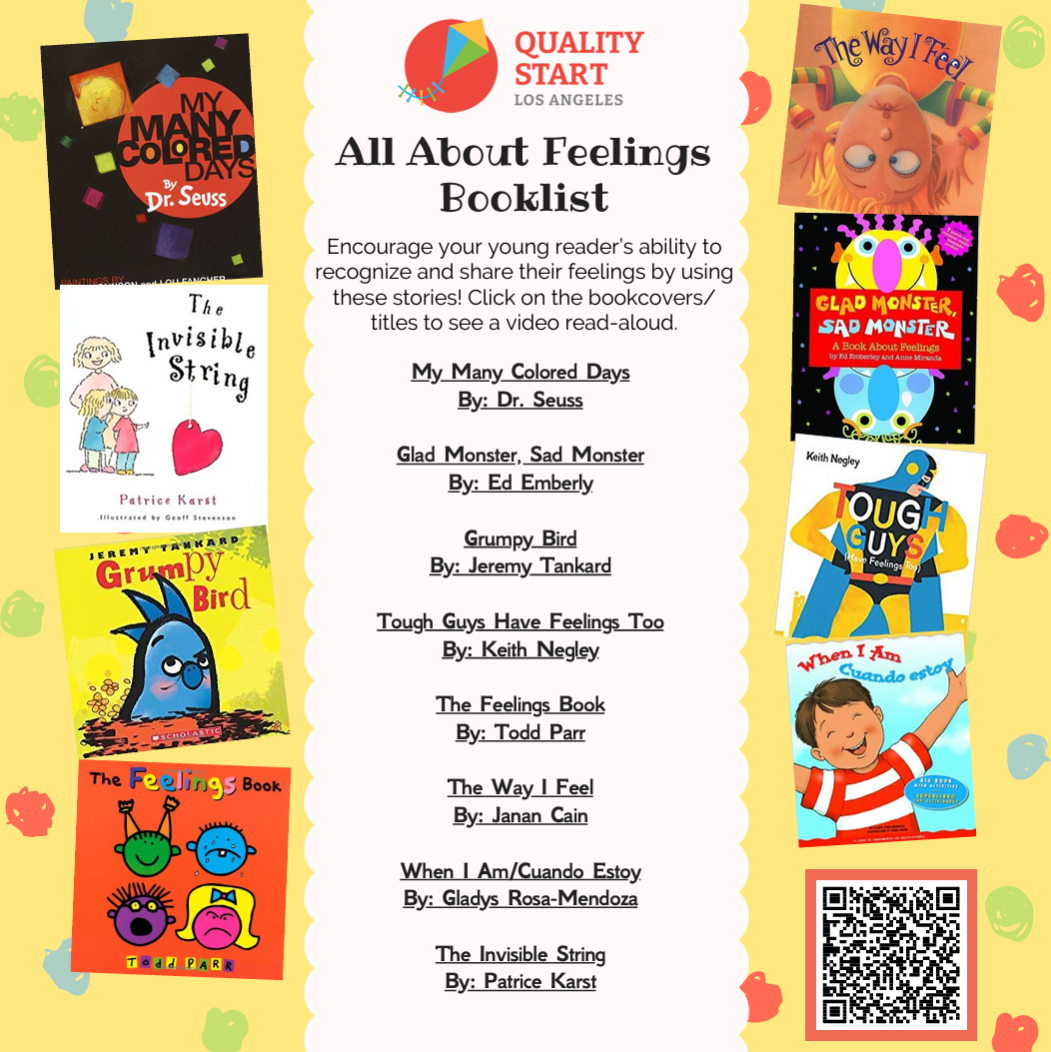
Storytelling and reading books are meaningful approaches that help create brave spaces for young children (and families) to discuss their feelings, big and small. When children connect with characters like themselves in stories, who are having difficult emotions or experiencing challenging events, it helps them learn the words to express their own feelings and gives them a new way to discuss them with trusted adults. Check out QSLA's social-emotional booklists below to support the families you work with in creating brave, feeling-friendly spaces for our young ones!

All About Feelings Booklist

Share with Colleagues & Families!

Feelings and Emotions Booklist

Share with Colleagues & Families!
This resource will support ECERS-R: Item 9 and FCCERS-R: Item 35- Provisions for Parents, PAS: Item 16- Family Communications, and BAS: Item 7- Provider Parent Communications.
Family Partnerships
Work with Families to Build a Stronger Program

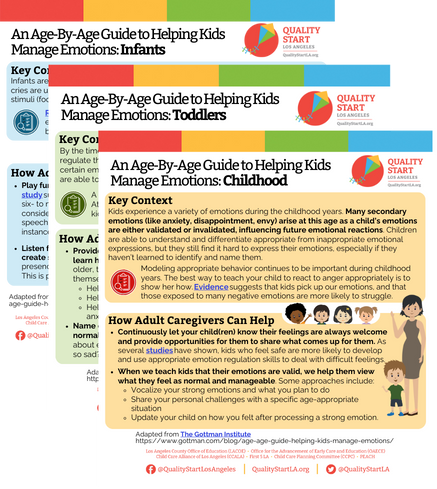
An Age-By-Age Guide to Helping Kids Manage Emotions

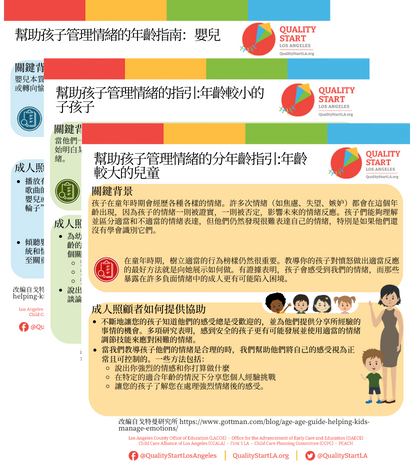
幫助孩子管理情緒的年齡指南

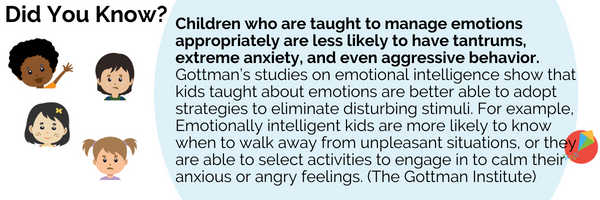
Did you know how we react to the emotions of children in our lives has an impact on the development of their emotional intelligence? When we teach kids to identify their emotions, we give them a framework that helps explain how they feel, which makes it easier for them to deal with those emotions in a socially appropriate way. What’s more, the emotions that children experience vary depending on their age. Take a look at this set of ready-to-share infographics we have designed, inspired by this original article from the Gottman Institute “An-Age-by-Age Guide to Helping Kids Manage Emotions.”


QSLA Age-by-Age Resource Graphics

Share with Colleagues and Families!
 

幫助孩子管理情緒的年齡指南

從這裡點擊
 
This resource will support ECERS-R: Item 38 and FCCERS-R: Item 35- Provisions for Parents, PAS: Item 16- Family Communications, and BAS: Item 7- Provider Parent Communications.
Community Partnerships
Use Community Resources to Strengthen Program Quality

Helping Kids Express Their Emotions with PBS Kids

Explore what our community partners at PBS Kids are sharing in their short, instructional article "Helping Kids Express Their Emotions"! As adults, many times we may struggle to managing our emotions when the children in our lives are having big emotions. Thankfully we can build our vocabulary and try out approaches to help them navigate their feelings! PBS Kid's article focuses on education, listening, and modeling healthy emotional expressions - including a game, crafts, and a song with Daniel Tiger! Check out and share this article with families in your program!

Share with Families!
 
Knowing and using these community resources will support PAS: Item 17- Family Support Involvement, BAS: Item 8-Community Resources, and NAEYC Accreditation: Standard 7-Families
Staff Development and Support
Enhance Your Family Engagement Knowledge and Skills

Professional Learning Focused on Social and Emotional Learning & Behavioral Support

In the Heat of the Moment: Strategies for De-escalating Children’s Challenging Behaviors, by Barbara Kaiser

We’ve all been there: A child is beginning to melt down or heat up! What do you do next? In the heat of the moment, has your response ever escalated a child’s challenging behavior? Children’s behavior can escalate quickly. Your feelings about that escalation can erupt just as quickly. De-escalation – helping children calm down – takes time and only happens intentionally. This 1.5 hour live webinar presented by child development experts, Barbara Kaiser, will help you explore the stages of escalation and ways you can respond that will support and help children to be able to return safely to the group.


Date/Time: Thursday, March 28th from 11:00AM - 12:30PM


Share With Colleagues!

Social and Emotional Learning: A Foundation for Life

In the vein of emotional expression and regulation, CECO offers this set of self-paced training modules on "Social and Emotional Learning: A Foundation for Life" (5 hours total). This valuable series is offered in English, Spanish, & Chinese, and covers:

  • What is Social and Emotional Learning?
  • Supporting Children's Social and Emotional Development Begins With Our Own Self-Awareness
  • The Brain Develops in Response to Its Environment
  • Creating a Climate for Learning


Self-Paced Course (5 hours)


Share With Colleagues!

CSEFEL Teaching Pyramid Framework Overview

Healthy social and emotional development is an essential component to a child’s school readiness and well-being. The California Teaching Pyramid framework provides a user-friendly vision to promote social and emotional development and prevent challenging behaviors. Hosted on CECO's free training website, this overview training "CSEFEL Teaching Pyramid Framework Overview" is a 2-hour self-paced training that introduces the tiers of the pyramid along with ways in which to implement some of the components of each of the tiers.


Self-Paced Course (2 hours)


Share With Colleagues!
These trainings support ECERS-R: Item 43- Opportunities for Professional Growth, PAS: Item 3- Staff Development, FCCERS-R: Item 37- Opportunities for Professional Development, and BAS: Item 1-Qualifications and Professional Development
Equitable Approaches to Supporting Children and Families

Why Is Social and Emotional Learning Important for Equity in Education?

Take a look at this short 3-minute video from American Institutes to explore the importance of incorporating social and emotional learning into our education systems, particularly ECE! Listen in as researcher Jameela Conway-Turner briefly digs into how social and emotional learning (SEL) can improve learner outcomes and how districts can use it in their equity initiatives to support all students.

 
Share with Colleagues and Families!

Source: https://www.gottman.com/

Did you miss any of our previous Family Engagement Newsletters?

Check out and bookmark our Family Engagement Newsletter Archive!

Were you forwarded this email?

Would you like to sign up to receive our Family Engagement Newsletters?

Click Here to Sign Up for Our Newsletters!
Check out our QSLA pages below!
 
Live Trainings
Early Learning Resources
Family Resources
 
Facebook  Twitter  Youtube  
If you have any questions or feedback about the content in this email, please email Comms@QualityStartla.org.