|
“True community is based on equality, mutuality, and reciprocity. It affirms the richness of individual diversity while at the same time it celebrates the common human ties that bind us together.”
— Pauli Murray, The Song in a Weary Throat (1987)
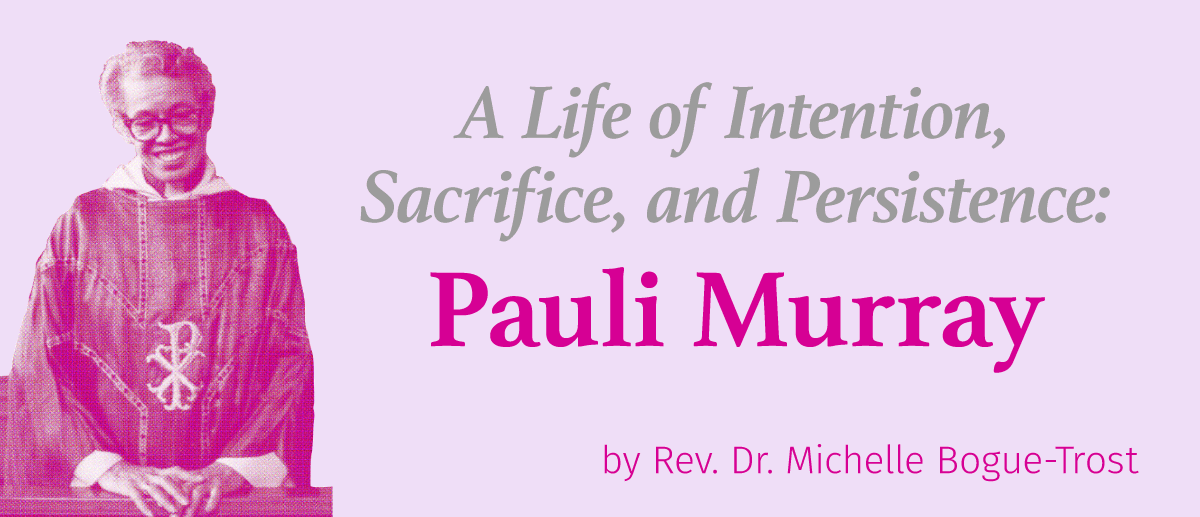
Pauli Murray was a lawyer, civil rights strategist, poet, and later one of the first women ordained as an Episcopal priest. Long before Brown v. Board of Education, Murray was developing legal arguments against segregation that would shape the NAACP’s strategy. Thurgood Marshall referred to her 1950 book States’ Laws on Race and Color as “the Bible” of the civil rights movement. In 1977, she became the first Black woman ordained to the priesthood in the Episcopal Church, bringing together her legal vision and her faith.
Pauli Murray understood that injustice is rarely only personal. It is embedded in structures, habits, and laws. She also understood that community is more than goodwill. It is built—or distorted—by the systems we create and sustain.
Murray’s life sits at the intersection of Black History Month and Women’s History Month. She navigated racism and sexism in academic, legal, and ecclesial spaces that did not yet know how to make room for her. She was often ahead of her time, articulating arguments about equal protection that would not be fully realized for decades. Her work helped shape the constitutional language that protects many of the rights Americans now take for granted.
And yet she was not only a legal thinker. She was a theologian of belonging. When she was ordained, she preached her first Eucharist at the very church in North Carolina where her enslaved grandmother had once been baptized. For Murray, faith and justice were not separate tracks. They were part of the same long work of repair.
As we move through Lent, her vision of community offers a searching question. What kind of shared life are we building? Where are we content with surface harmony, and where are we willing to examine the deeper patterns that shape opportunity, access, and dignity?
For congregations like ours, largely white and often socially stable, the temptation is to treat justice as an abstract ideal rather than a lived commitment. Murray’s life invites us to do more than admire courage. It asks us to study it, to learn from it, and to consider how our own structures in church and in civic life reflect or resist the equality we profess.
Lent is a season for that kind of reflection. Not self-accusation, but clear-eyed honesty. Not performance, but formation. The wilderness work of this season is not only interior. It also reshapes how we live together.
Pauli Murray’s life reminds us that community worthy of the name does not emerge accidentally. It is cultivated through intention, sacrifice, and persistence, and that is holy work.
|