Weekly update from the National Housing Conference | | News from Washington | By Brittany Webb | | |
White House releases economic report, housing affordability strategy
The White House Council of Economic Advisers (CEA) released a new report outlining the Trump Administration’s view of drivers of housing unaffordability and planned strategies to close the supply gap. The report criticizes both immigration policies and government “bureaucrat taxes” as the chief drivers of the housing shortage, as well as issues with green energy and building standards. The “bureaucrat tax” accounts for the costs of building a new home associated with regulatory costs and delays, such as permitting, zoning, mandates, and other forms of regulation. Citing research from both the National Multifamily Housing Council and the National Association of Home Builders, it estimates that these factors add $100,000 in costs for a single-family home due to the “tax”.
The report largely focuses on homeownership, arguing that debt-to-income (DTI) ratios are driving one third of mortgage denials, suggesting that DTI requirements are more problematic for potential homeowners than insufficient down payments.
Analysis from the CEA claims that 10 million more homes would have been built today had the 2008 crisis not derailed the pace of single-family building. It further states that eliminating the “bureaucrat tax” would lead to the development of an additional 13.2 million homes. Estimates of the current housing shortage from housing experts range from 1.2-8 million. The report also claims that illegal immigration drove house prices up by 3.2% across 227 metropolitan areas.
CEA recommends a host of deregulatory best practices to address the supply constraints, largely focused on reducing building codes and climate mandates, ending rent control, aligning codes for manufactured and modular homes, restricting institutional investment, and ending labor rules.
| | | |
Sponsorship Opportunities Available
Aligning your organization with the Gala and its honorees enhances your visibility, engagement, and networking opportunities. Supporting one another and working collaboratively across sectors, we strengthen our collective ability to address the nation’s most pressing affordable housing challenges.
Please consider supporting this year’s honorees and NHC by purchasing a ticket and/or becoming a Gala sponsor. Sponsorship opportunities begin at $3,500. You can also show your support by placing an ad in the Gala Tribute Book. New for 2026, we’re offering the opportunity to display a digital ad onsite at the Anthem.
It’s a meaningful way to celebrate the accomplishments of this year’s honorees or highlight your commitment to our shared mission. Tribute Book ads start at $750 and digital ads start at $325. You can also choose to have your name listed in the Gala Tribute Book for $250. Click here to learn more about these opportunities.
| |
Vought faces Senate questions on CDFI Fund
A bipartisan group of 43 Senators sent a letter to the Senate Financial Services and General Government appropriations subcommittee leadership requesting at least $324 million in funding for the Community Development Financial Institutions (CDFI) Fund in the next fiscal year. The letter was sent following a $289 million apportionment in FY25 CDFI Funds by the Office of Management and Budget (OMB) after over a year of delays. The funds were set to expire on September 30th, and the Trump administration has repeatedly sought to end the CDFI program despite wide-ranging support by lawmakers and housing advocates.
OMB Director Russell Vought testified before the Senate Budget Committee where he continued to criticize the CDFI Fund, stating that the administration has “issues with the program” and characterizing CDFIs as “DEI” and “woke”, despite large amounts of the fund being awarded to rural Southern areas. Lawmakers expressed deep concerns with Vought’s virtual impoundment of Congressionally-appropriated funds to programs that address poverty and help communities.
"When a CDFI does a loan, it is exempt from ability-to-pay requirements, so you're getting a loan on the books that is not necessarily as sound and secure as one that would come from a typical bank,” he said, seemingly framing CDFIs as providers of risky loans rather than critical mission-driven financial options that deliver affordable credit and capital in areas without traditional financial institutions.
| |
Senate Banking Dems call for pause of Warsh nomination
Senate Democrats are calling for a delay in former Federal Reserve Governor Kevin Warsh’s nomination to serve as the next Chair of the Board of Governors of the Federal Reserve until investigations into other Fed governors are concluded. In a letter to Senate Banking Committee Chairman Tim Scott (R-S.C.), all Democratic members of the committee wrote that “it would also be inappropriate to move forward with Mr. Warsh’s nomination as the President publicly threatens the federal judge who found the DOJ’s probe to lack merit.”
The push comes amid new reports that President Trump is once again considering firing Jerome Powell as Fed Chair, though his authority to do so remains unclear and Powell’s term expires in May unless a new Chair cannot be confirmed. Senator Thom Tillis (R-N.C.) has also stated he will not confirm a nominee until the probe into Powell is resolved.
Senator Elizabeth Warren (D-Mass.) also requested additional records related to Warsh’s role during the 2008 financial crisis, arguing that lawmakers need a clearer understanding of his past decisions before moving forward. Warsh will testify in front of the Senate Banking Committee on April 21.
|
| | |
HUD announces over $1B for Tribal communities
The U.S. Department of Housing and Urban Development (HUD) announced it is directing more than $1.1 billion in Indian Housing Block Grant (IHBG) funding to nearly 600 Tribal communities across the country, marking one of the department’s largest recent investments in affordable housing for Native Americans. The grants can be applied toward a broad range of housing needs and are available to American Indian Tribes, Alaska Native Villages, and Tribally Designated Housing Entities.
The announcement coincides with the 30th anniversary of the Native American Housing Assistance and Self-Determination Act, legislation that created the block grant program. Since its passage, the program has supported the construction, acquisition, or rehabilitation of more than 160,000 homes.
“HUD is fully committed to empowering and uplifting Tribal communities by ensuring they have the tools necessary to build successful, high-quality, affordable housing,” said HUD Secretary Turner. “This investment will help us meet the needs of those living in Indian Country by promoting healthy communities while strengthening our partnership with Tribes and their leaders.”
| |  | |
Inflation rises in wake of conflict
The Bureau of Labor Statistics reported that the Consumer Price Index (CPI) rose 3.3% year-over-year in March, with higher energy and gasoline prices driving the increase from February’s 2.4% rate as a result of the conflict in Iran. Energy costs rose 10.9% in March, the largest monthly increase since September 2005, and outpacing shelter as the largest driver to inflation. Still, shelter costs increased by 0.3% in March compared to February, a slight acceleration, and 3% year-over-year.
“Higher inflation has impacted the housing market in a couple of ways. Mortgage rates, which fell briefly below 6% in February, rose for five weeks in a row before declining slightly this week. Higher rates erode buyers’ purchasing power and stall progress toward greater affordability,” said Lisa Sturtevant, chief economist at Bright MLS.
Freddie Mac reported mortgage rates at 6.3%, after only a few weeks of averages under 6%.
At the same time, CPI data is not fully capturing recent shifts in rental markets. In several metro areas, rents have leveled off or declined, but those changes are slow to appear in CPI due to lagging data as leases renew.
| | | |
NHC seeks experienced policy director
The National Housing Conference, the nation’s oldest and broadest housing coalition, seeks an experienced Policy Director to represent our diverse coalition on Capitol Hill, within the Administration, and among key stakeholder groups. This role will help shape and advance NHC’s federal policy and advocacy initiatives, working closely with Congress, federal agencies, and national partners to drive practical, bipartisan housing solutions. Reporting to the president and CEO, the Policy Director plays a central role in convening members, leading key working groups and events, and collaborating across research, communications, and coalition-building efforts. NHC offers a dynamic, team-oriented environment and the opportunity to play a leading role in shaping national housing policy at a pivotal time for the industry.
| | |
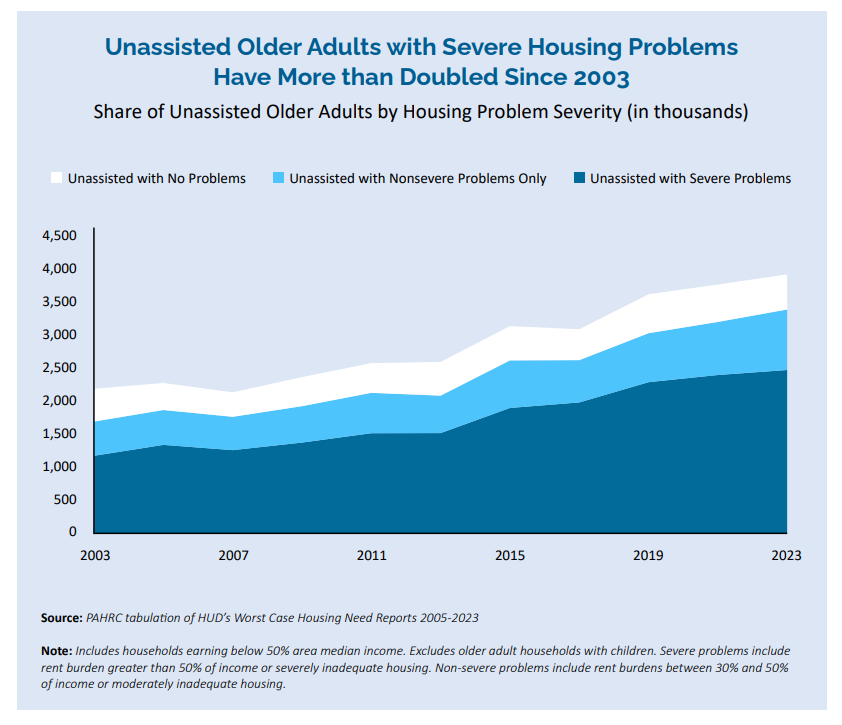
The housing crisis among unassisted, older adults more than doubled
The Public and Affordable Housing Research Corporation examined how affordable housing supports older-adult households across the income spectrum, finding an alarming pattern. The research, titled How Affordable Homes Strengthen People and Communities, tracks unassisted older adults with housing problems from 2003 to 2023. Over the two-decade period, the total number of unassisted older adults facing housing challenges increased steadily, while the share experiencing severe problems more than doubled. Such households are often dealing with the most acute combinations of unaffordable rent, overcrowding, and physically inadequate conditions. The findings suggest that the population in need is not just growing larger, but becoming more concentrated at the extreme end of the hardship spectrum.
| | |
In a collaboration with UCLA and UnidosUS, researchers examine how historical policy decisions have shaped Latino wealth over time in a report titled, Sueño Incompleto: A History of the Latino Wealth Gap in the U.S. The report highlights how land dispossession, redlining, urban renewal, and predatory lending limited Latino families’ access to homeownership and stripped away wealth-building opportunities. Latino households are a growing share of the nation’s population and workforce yet remain exposed to gaps in transfer of wealth and economic risks.
POLITICO reports that a collection of anonymous letters titled “Dear American,” published by the Federalist Union Network, accuse the Trump administration of effectively halting fair housing enforcement. Among the letters, it is noted that HUD issued just three discrimination charges in the past year compared to an annual average of 52 under the previous administrations. The 11 current and former HUD employees behind the letters point to a vague anti-DEI directive, leadership intimidation, and steep personnel cuts, including a nearly 45% reduction in the Fair Housing and Equal Opportunity office. HUD leadership rejected the claims, characterizing the enforcement shift as a return to intent-based, statutory priorities and dismissing the letters as the work of anonymous activists with political motivations.
A new study from AEI titled Rehabilitating Housing Supply examines whether an institutional investor’s acquisition and renovation strategy can do more than just generate returns by putting neglected housing stock back into service. The case study specifically analyzes Invitation Homes’ post-2008, arguing this investor model restores supply faster than local governments or individual owners, challenging the assumption that institutional investors always shrink owner-occupancy opportunities. It explicitly critiques Section 901 and the 21st Century ROAD to Housing Act proposals for potentially restricting contributions to housing supply, potentially undermining weak markets.
| | |
Monday, April 20
WHF Congressional Reception, 5 – 7 PM ET
Tuesday, April 21
Buy Now, Pay Later: Recent Developments and Implications for Mortgage Lending | Urban Institute, 12 – 1:30 PM ET
From Evidence to Power: Community Partnerships and Systems Change | GW Institute for Socioeconomic Opportunity, 12 PM – 5 PM ET
Real Estate Standards Organization (RESO) Spring Conference | NAR, April 21 – 22
Wednesday, April 22
Capital Needs Assessment and Environmental Reports | Enterprise Community Partners, 11 AM – 12:30 PM MT
Thursday, April 23
No events posted.
Friday, April 24
No events posted.
| | The National Housing Conference is a diverse continuum of affordable housing stakeholders that convene and collaborate through dialogue, advocacy, research, and education, to develop equitable solutions that serve our common interest. | | Defending Our American Home since 1931 | | Copyright © 2024. All Rights Reserved. | | | | |