|
I went down a bit of a research rabbit hole putting together this week's issue, MBEXers, and I came across something thought-provoking. A recent article in Finance & Commerce (originally published in The Washington Post) makes the case that the worsening labor shortage is a far bigger threat than artificial intelligence, particularly in fields like nursing, teaching, engineering, mental health counseling, and construction.
In other words, the work you do every day? There's no algorithm for reading a job site, no AI that can bring a deal between a GC and a sub across the finish line, and no software that replaces the kind of expertise your teams bring to every project.
Long story short: the labor problem is real, and it isn't going anywhere easily or quickly. But it's also a reminder of just how essential this industry is to keeping the world running. The skilled trades literally build this world. No prompt can change that 😄🏗️💪
| | |
Five Quick Things To Know & Do This Week:
1.) Eye on the Rock - Team slots are filling fast for our upcoming Sporting Clays Scholarship Fundraiser on August 6. Each team can have 4-6 shooters, so gather your crew and join us for a fun afternoon of networking and friendly competition. Single shooters, as well as duos and trios, are welcome to register, too (we'll handle assembling your full team). Registration for this event will close on July 29 by 3:00pm.
2.) Material Prices - Temporary relief in fuel prices caused input costs to drop in June, but recent escalations in the Iran war are already driving them back higher, according to Associated Builders and Contractors.
3.) Follow Us - If you're not following us on LinkedIn already, here are a few things you might be missing out on: our Jobsite Spotify Playlist for July, useful tips for extreme heat safety, sponsor shout-outs for the (sadly cancelled) Lake Superior Harbor Cruise, and a helpful breakdown of Basic Membership vs Premium Membership. Visit our Business Page, and hit that 'follow' button!
4.) Expiring Soon - Congress has until September 30 to renew the nation's largest transportation bill as the current $1.2-trillion Infrastructure Investment and Jobs Act (IIJA) approaches the end of its authorization period. Outside of the data center construction boom, economists say the public infrastructure sector remains one of the only bright spots of reliable construction activity.
5.) Poolside Shenanigans - That's one way to use an excavator 😂 🤿 (While it looks like a heckuva good time, MBEX does not encourage anyone trying this at home.)
-------
Inside Issue No. 29:
• Skill-Building: Construction Estimating Principles & Application and Reading Construction Documents online courses in August with UChapter2
• Housing Bill: What to know about the recently passed 21st Century ROAD to Housing Act
• Tips & Tricks: Our top suggestions for keywords, phrases, and CSI division codes when setting up project search filters in the Online Plan Room
• Federal Investments: Transportation grants, accelerated federal water infrastructure funding, and the under consideration Water Resources Development Act of 2026
• Upcoming Events: Sporting Clays Scholarship Fundraiser (8/6); Golf North (8/19); Online Plan Room Demo (8/20); and Project Build's Construction Talent Acquisition Conference (9/2)
• Project Download: Updated project information for the week of July 15-21
| |
Sharpen Your Skills with UChapter2
Online Courses Offered Next Month
| | |
Whether you're newer to the industry or a seasoned pro looking to level up, August is bringing two online courses worth adding to your calendar.
Both opportunities are open to MBEX members and non-members alike.
| | | | |
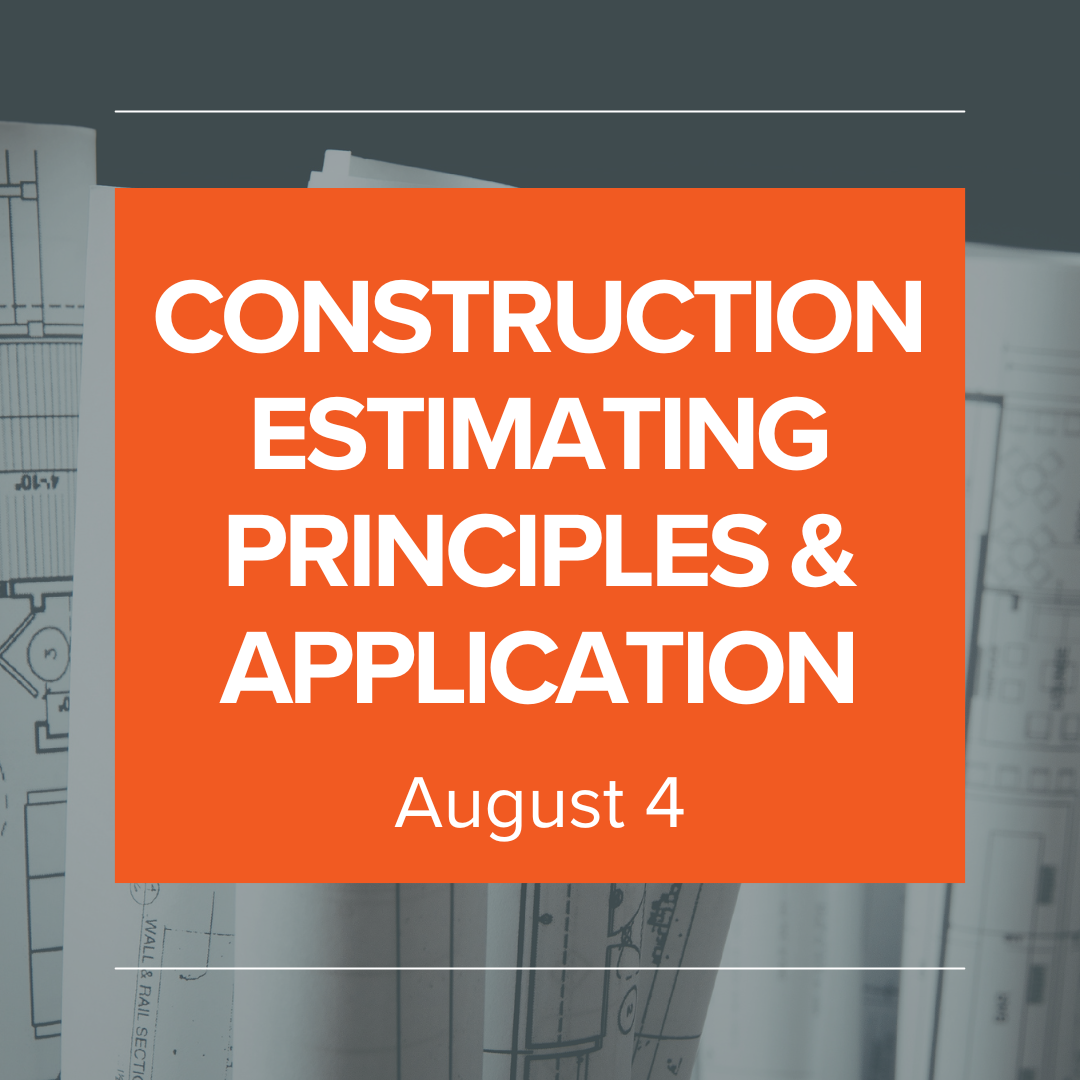
Date: Tuesday, August 4
Time: 12:00pm - 4:00pm
Location: Virtual Event
Cost:
• MBEX Member - $385
• Non-Member - $539
| | |
The upcoming Construction Estimating Principles & Application course is built around a central question that every competitive estimator should be asking: How can we approach this project differently from our competition?
This course is structured around two viewpoints. First, an open-forum discussion led by experienced estimators covering advanced concepts like pricing project constraints, managing risk within the estimate, and building flexibility into your system. The second half zeroes in on how technology can produce faster, more accurate estimates, exploring how digital tools can replace highlighters and calculators with clear, repeatable workflows.
| | | | |
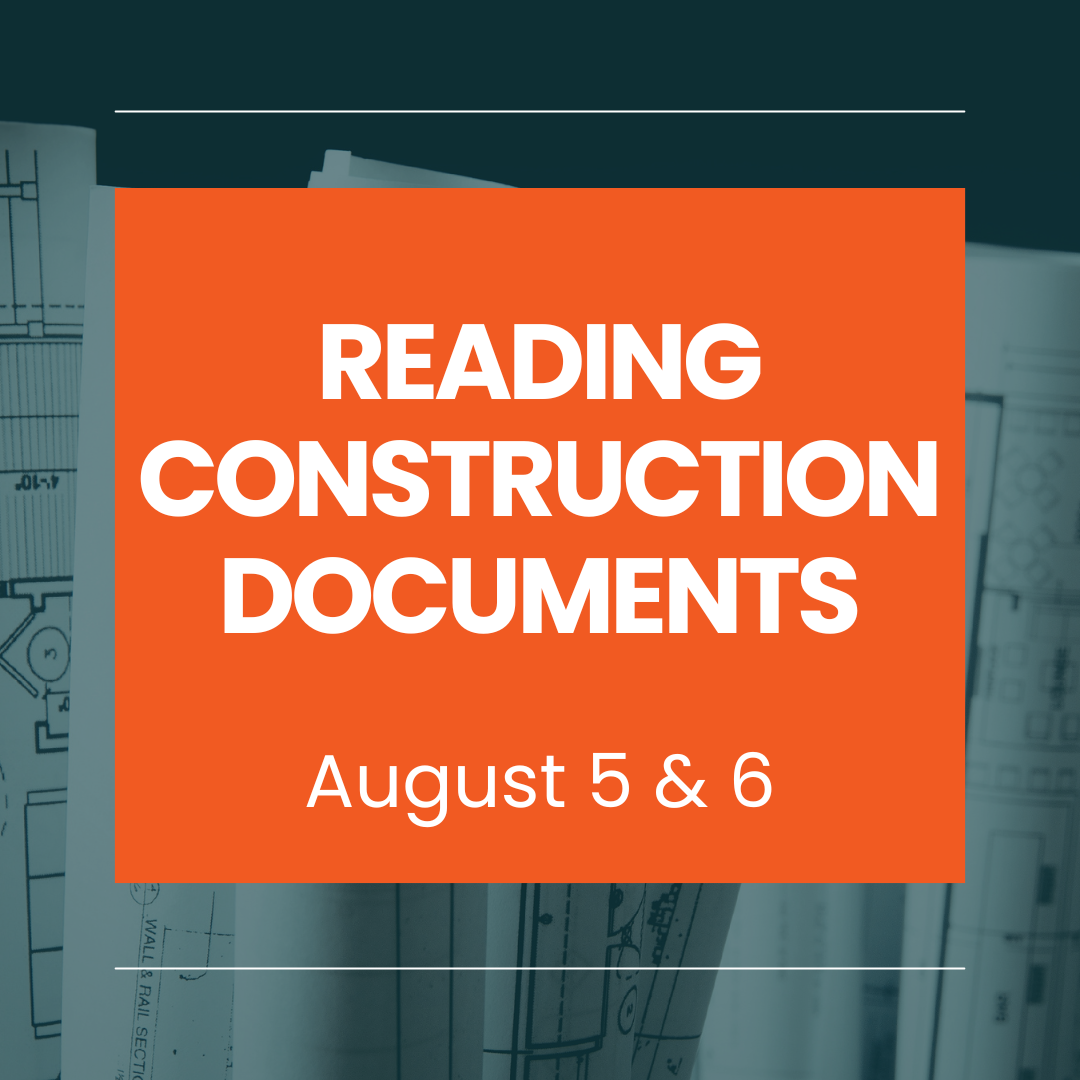
Date: Wednesday, August 5 & Thursday, August 6
Time: 1:00pm - 4:00pm (both days)
Location: Virtual Event
Cost:
• MBEX Member - $362
• Non-Member - $506
| | |
Reading Construction Documents offers a practical, confidence-building foundation for anyone who works with plans and specs.
From identifying title block information to navigating floor plans, elevations, and specification sections, this two-part course equips participants to interpret a full set of construction documents with clarity.
This course is designed for a wide range of roles: apprentices, tradespersons, project coordinators, estimators, specialty sales reps, and anyone in career transition.
| | Both courses are delivered online through MBEX's partnership with UChapter2 and led by Troy DeGroot, a Bluebeam-certified instructor with over 20 years of industry experience. | | | If your interest in professional development extends into this fall, we're also offering Bluebeam Revu courses later in August and into September. Check them out here. | | |
The 21st Century ROAD to Housing Act
What Commercial Contractors Need to Know
| | |
The 21st Century ROAD to Housing Act was officially authorized at midnight on July 11, following months of back-and-forth between the Senate and the House. While the president declined to sign it, he also declined to veto it, allowing it to automatically become law.
The result is the most significant federal housing legislation in decades, and its ripple effects will be felt across the commercial construction industry for years to come.
| | |
⚖️ What the Law Actually Does
At its core, the 21st Century ROAD to Housing Act is a supply-side push, a federal effort to remove barriers that have made it too slow, too expensive, and too complicated to build housing in the United States.
The Act's provisions include:
• Allowing the use of ready-to-use, pre-approved home designs so builders can
get permits faster;
• Modernizing and streamlining federal and local housing processes;
• Strengthening local housing operations and community capacity to produce more
affordable homes in rural and urban areas;
• Modernizing outdated banking regulations to expand local lending;
• Modernizing the HOME Program, the largest federal block grant program for
states to increase the supply of affordable housing; and
• Creating a pilot grant program to help local governments convert vacant
commercial and industrial buildings into affordable housing.
The legislation also creates incentives for localities to reduce entitlement timelines, including a $200-million annual competitive grant program rewarding municipalities that increase housing supply, and it eliminates the chassis requirement for manufactured homes, which will make them cheaper to build.
One provision that had raised significant alarm in the real estate and construction industries (a forced-sale requirement for institutional investors' build-to-rent single-family homes) was removed from the final version of the bill before it passed.
🏗️ Why This Matters for Commercial Contractors
Housing supply has not kept up with demand, leaving the nation short by as many as 5.5-million units. Multi-family starts in May declined 40% from the prior month and 14% year-over-year, a huge contraction that has been felt across the contractor community.
This law won't reverse that dip overnight, but it does create a more favorable environment for housing development to move forward.
🚨 What MBEX Members Should Watch
The most immediate implications are on the multi-family and adaptive reuse sides.
The pilot grant program for converting vacant commercial and industrial buildings into affordable housing is a direct opportunity for contractors already working in renovation and repurposing. The streamlined permitting incentives, including competitive grants for municipalities that move faster, could meaningfully shorten the front end of projects that have historically been bogged down in entitlement processes.
Expanded local lending capacity also means more project financing available for developers, which translates to more projects moving forward.
| | |
The Bottom Line
The National League of Cities applauded the bill's passage, noting that "this legislation preserves local zoning authority, avoids unfunded mandates for local governments, and aligns with local infrastructure needs."
That local-first framework is important for Midwest contractors; it means the implementation of this law will play out at the municipal level, and the contractors who are already building relationships with local governments and housing developers will be best positioned to capture the work that flows in.
Keep an eye on how state municipalities respond to the new competitive grant incentives; that's where the near-term opportunities live.
For a deeper dive into the law's specific provisions, the Bipartisan Policy Center has published a detailed explainer, which you can find by clicking below.
| |
TIPS & TRICKS: Using Keywords & Division Codes in Project Search Filters
| | |
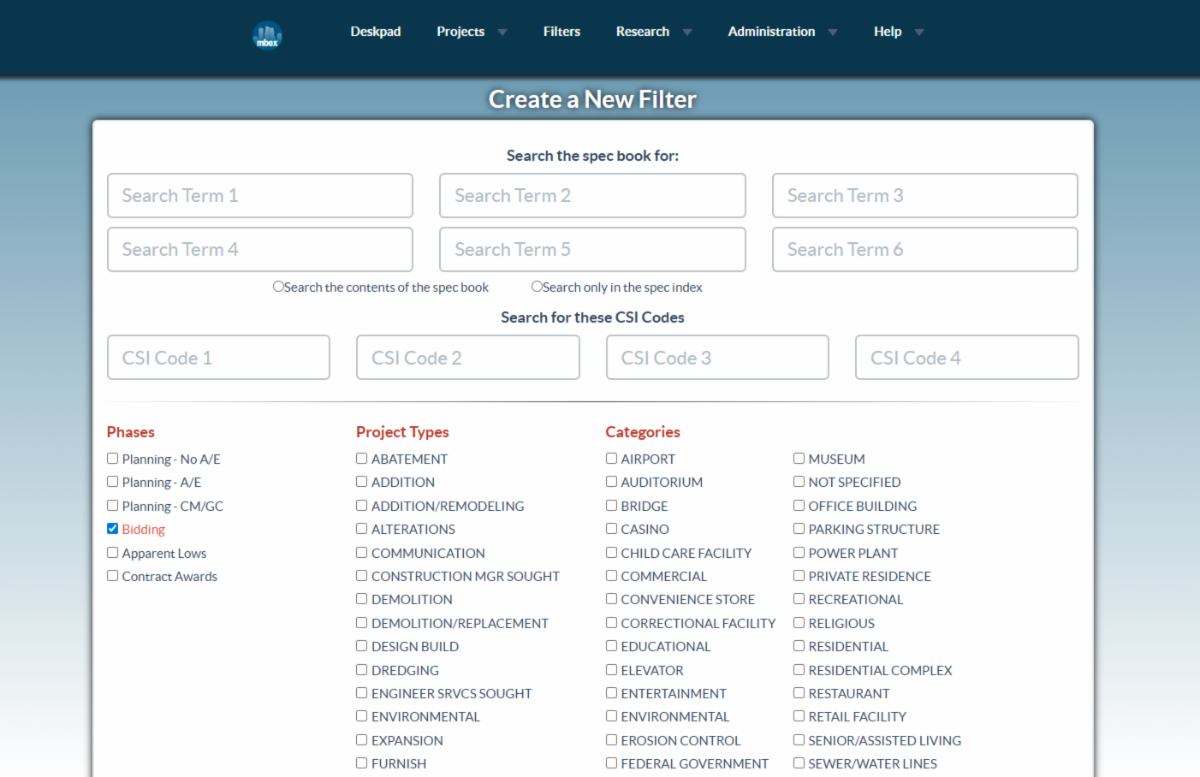
A thoughtfully created project search filter inside the Online Plan Room puts the right projects in front of you automatically, while a lax setup (or zero filters at all) means either missing opportunities or wading through projects that have nothing to do with your work.
Here are a handful of suggestions for how to get it right:
| | |
Start With What You ACTUALLY Do
Before even beginning to set up a project search filter, take a few minutes to think about your work from the outside in:
How would an estimator, project manager, or GC describe what you do when they're looking for a sub or supplier?
The language they tend to use is the language your filters should be built around, not necessarily the internal terminology your company uses.
If you're a mechanical contractor, for example, you might think of your work as "HVAC," but a spec writer might call it "mechanical systems," "air handling," or "ventilation." The more ways you can think about how your work is described on a project, the stronger your filter setup will be.
Choosing the Right Keywords
Keywords and phrases are the foundation of your search filters.
Use Trade-Specific Terms
Think about the material systems and scopes most commonly associated with your work.
A roofing contractor might use terms like "roofing," "membrane," "TPO," "EPDM," "metal roof," or "re-roof." An electrical contractor might search "electrical," "switchgear," "low voltage," "lighting," or "fire alarm."
Go beyond broad terms, like roofing, electrical, or masonry. Broad terms return broad results.
Include Common Abbreviations & Variations
Projects are written by many different people, and the terminology used isn't always consistent.
If you do concrete work, search both "concrete" and "CMU." If you do flooring, try "floor covering," "carpet," "LVT," and "resilient flooring."
Variations in how specs are written mean a single keyword can miss projects that are squarely in your wheelhouse.
Think About Project Types, Not Just Trade Types
If you specialize in certain kinds of projects (think healthcare, education, industrial, or retail), adding those terms can help find relevant work even when your specific trade isn't called out in the project title.
Avoid Terms That Are Too Broad
Words like "construction," "building," or "project" will return everything in the system and aren't useful as standalone filters. Use them only in combination with more specific terms, if at all.
Using CSI Division Codes
The Construction Specifications Institute (CSI) MasterFormat divides construction work into numbered divisions, a standardized system used across the industry to organize project specifications.
Using the right division codes in your filters is one of the most reliable ways to find projects in your trade, because CSI codes are applied consistently across projects in ways that keyword language sometimes isn't.
Knowing your most relevant divisions, as well as related subdivisions, will be incredibly helpful when setting up your filters.
For example, a concrete contractor would use "Division 03 - Concrete." However, by only utilizing "03 00," MANY results will be found because of how expansive that single CSI code is.
Going a little deeper and using subdivisions, like "03 20 Concrete Reinforcing," "03 40 - Precast Concrete," "03 47 - Site-Cast Concrete," or "03 70 - Mass Concrete," will better pinpoint specific projects of interest.
You can either utilize the 'CSI MasterFormat List' found within the Online Plan Room (under the 'Research' tab) or simply Google "CSI MasterFormat" to explore divisional codes.
A Few More Practical Tips
• Set Up More Than One Project Filter If Your Work Varies
If your company does both commercial roofing and sheet metal work, for example, consider setting up separate filters for each so you can review opportunities in each category more clearly.
There is no limit to how many project search filters you can have, so create different filters for separate project types, territories, divisional codes... whatever works best for you!
• Revisit Filters Regularly
Your filters won't be perfect right off the bat. Take time to fine-tune your search terms and CSI codes once you start seeing the results on your Deskpad and in the nightly updates email.
Your company's capabilities or target markets will also likely change over time, and your filters should too. A quick review every few weeks or months ensures you're not missing work you're qualified to pursue, or getting alerts for work that no longer applies.
• When in Doubt, Lean Toward Specificity
Overly broad filters create noise; overly narrow and uber specific ones create missed projects. The sweet spot is specific enough to return relevant projects and broad enough to catch the variations in how those projects get described.
Our recommendation? Don't use an overly niche keyword or phrase unless you have seen it used regularly in spec books, and keep CSI codes to the first 4 digits so as not to miss super specific subdivisions.
| | |
Have questions about setting up your search filters or navigating the Online Plan Room in general?
Reach out to either Ashlee or Melanie; we're here to help you get the most out of your membership's largest benefit.
We also encourage you to join us for our next monthly Plan Room Demo on August 20. Our monthly demos are free for members and happen on the third Thursday of every month at 9:00am.
|
|
Federal Infrastructure Investment is Moving
And there's A LOT of it!
| | |
Between new transportation grants, an EPA water funding push, and a major water infrastructure bill working its way through Congress, the past week has brought a notable wave of federal infrastructure activity.
For MBEX members doing public work across the Midwest, this is the kind of news worth paying attention to.
Here's a consolidated look at what's happening and what it could mean for your pipeline.
| | |
🛞 $1.73B in Transportation Grants Awarded
The U.S. Department of Transportation awarded $1.73-billion in competitive BUILD (Better Utilizing Investments to Leverage Development) grants to 127 transportation infrastructure projects nationwide, covering roads, bridges, freight and passenger rail, ports, transit, bicycle and pedestrian infrastructure, and other surface transportation improvements.
Roads and bridges led the way at $1.3-billion. Transit projects focused on safety and reliability received $169.9-million, while port infrastructure projects aimed at easing congestion and bolstering capacity were awarded $136.8-million. Freight and passenger rail projects received $87.7-million.
BUILD grants (previously known as RAISE, and before that, TIGER) are issued annually, and a wide variety of public agencies can apply, including state and local governments, port authorities, tribal governments, and multi-jurisdictional groups. If you're building relationships with local transportation agencies in the region, this is the funding stream that puts projects into procurement.
⦿ Read more on Government Market News.
💧 EPA Moves to Accelerate Water Funding
The U.S. Environmental Protection Agency (EPA) took a notable step this month to address a persistent frustration in the infrastructure world: federal water funding that exists but moves too slowly to the projects that need it.
The agency convened its first-ever roundtable focused specifically on improving implementation of federal water infrastructure programs, including the Drinking Water and Clean Water State Revolving Funds (SRFs), the Water Infrastructure Finance and Innovation Act (WIFIA) loan program, and the Emerging Contaminants in Small and Disadvantaged Communities grant program.
As an outcome of the meeting, the EPA committed to developing an online resource toolbox for lenders and funding recipients and to establishing collaborative workgroups with states, water sector organizations, and technical assistance providers to improve funding delivery.
Getting that money to move faster between partners means more projects hitting procurement, and more opportunities for contractors positioned to pursue that work.
⦿ Read more on WaterWorld.
💧 Major Water Infrastructure Bill Advances in Congress
Perhaps the most significant near-term development for contractors doing water and civil work is the Water Resources Development Act (WRDA) of 2026, which passed unanimously out of the Senate Environment and Public Works Committee, a day after the House passed its version.
The bill authorizes $14-billion over four years for the Clean Water State Revolving Fund and $16.5-billion over five years for the Drinking Water State Revolving Fund, along with 133 new feasibility studies for locally proposed water infrastructure projects.
The 2026 bill also includes policy changes to speed up water infrastructure projects, such as by giving local stakeholders more say in feasibility studies and helping them access Army Corps resources to get projects started. It also directs the Corps to establish offices with expertise on inland navigation, alternate delivery, water supply, and technical assistance.
The legislation now moves to the House and Senate floors for full chamber votes.
The timing matters here with much urgency behind it. With IIJA funding set to expire September 30, cities and states are facing a potential funding cliff on drinking water, wastewater, and stormwater infrastructure. The WRDA is one of the key vehicles for keeping investment flowing after that date.
⦿ Read more on Smart Cities Dive.
| | |
Three separate federal actions in a single week paint a picture of continued federal commitment to infrastructure investment even in an uncertain policy environment.
If public sector infrastructure isn't already a part of your business development strategy, these developments are a good reason to take a closer look. And if it already is, this is the pipeline signal you may have been waiting for.
Keep an eye on the Online Plan Room as these investments work their way into local and regional procurement.
| | | The IIJA is set to expire on September 30, giving Congress a couple of months to either renew or pass a new transportation funding bill. Delays or legislative detours in the coming months could inject heightened uncertainty into the future of the infrastructure construction sector. | | | |
A valuable benefit of an MBEX membership is invitations to our social and educational events; by being an employee of a member company, you, too, can take advantage and attend all MBEX-sponsored events.
** indicates a newly added or updated event
August 6 - Sporting Clays Scholarship Fundraiser
Registration closes at 3:00pm on July 29
Aim, pull, and shoot to raise funds for the MBEX Scholarship Fund at this annual outdoor event at Game Unlimited Hunting Club. Register
August 19 - Golf North
Join MBEX for a day on the greens of Ridgeview Country Club in Duluth, a favorite annual tradition bringing together golf, networking, and plenty of friendly competition. Register
** August 20 - Online Plan Room Demo
From navigating the Deskpad, setting up filters, understanding project information, and adding your company to a project's bidders list, this free one-hour session is a great introduction to our Online Plan Room. Register
August 25 - Bluebeam 1: Baseline Basics
This session teaches attendees how to navigate menus, toolbars, panels, shortcuts, and key settings. Attendees will also get hands-on with markup and measurement tools, plus insider tips that boost speed, accuracy, and proficiency. Sign Up
August 26 - Bluebeam 2: Material Takeoffs & Estimates (Basic)
This session introduces standard measurement tools and markup customization options to help convert highlighters into powerful takeoff tools. With emphasis on the Markups List and workflow tips, this session helps estimators improve speed and accuracy from day one. Sign Up
August 27 - Bluebeam 3: Material Takeoffs & Estimates (Advanced)
Learn to create custom columns, embed formulas, organize information, and export or live-link Excel templates. Sign Up
** September 2 - Construction Talent Acquisition Conference
This conference, presented by Project Build Minnesota, brings together recruiters, HR professionals, and talent acquisition leaders from across the building and construction industry for a day of learning, networking, and practical retention and recruitment solutions. Learn More
** September 9 - Sporting Clays North
Join in the clay-breaking action in Duluth at Old Vermilion Trail. This year's event is different than in the past, with this year's clay shoot being a 100-round shoot with 50 rounds each on two different courses. Attendees will take on Round 1, reconvene for a BBQ lunch, then head back out for Round 2. Registration opens later this week!
| | |
• Total Projects Received at MBEX from 7/13/2026 - 7/17/2026: 93
• Total Project Leads Reported on at MBEX from 7/13/2026 - 7/17/2026: 7
• Total Active Projects Received / Reported on at MBEX as of 7/21/2026: 328
• Total 2026 Projects posted to the Online Plan Room as of 7/21/2026: 3,698
| | |
Click the button above to view the most recent project data from 7/15/2026 - 7/21/2026.
For information about the Bulletin's content, technical issues, or to place an ad (such as a Minority
Notice, Job Posting, or Event Notice), contact Ashlee, Membership + Communications Director.
| | |
UPCOMING MBEX EVENTS
• August 4 - Construction Estimating Principles & Application
• August 5 & 6 - Reading Construction Documents [Online Course]
• August 6 - Sporting Clays Scholarship Fundraiser
• August 19 - Golf North
• August 20 - Online Plan Room Demo
• August 25 - Bluebeam 1: Baseline Basics
• August 26 - Bluebeam 2: Material Takeoffs & Estimates (Basic)
• August 27 - Bluebeam 3: Material Takeoffs & Estimates (Advanced)
• September 2 - Construction Talent Acquisition Conference
• September 9 - Sporting Clays North
| |
| |
Information within the MBEX Weekly Bulletin are obtained from sources deemed reliable. The Midwest Builders Exchange (MBEX) does not assume responsibility for its completeness or accuracy. You are urged to check your own sources in addition to the information contained in this publication. This issue contains plans and other bidding information received prior to and including the date noted above. The project data within this newsletter is intended for member company's and their employees use only.
2026 BOARD OFFICERS: President - Brian Kalla, St. Cloud Acoustics; Vice President - Sean Ochis, Northern Industrial Insulation; Treasurer - Allie Brady, Veit USA; Past President - Heidi Sedlacek, Associated General Contractors of Minnesota
2026 DIRECTORS: Kevin Bohrer, Donlar Construction; Ben Bowman, Adolfson & Peterson; David Brandt, Schadegg Mechanical; Matt Lennartson, RJM Construction; Chris Niemand, Frattalone Companies; Jason Rentmeester, Kraus-Anderson Construction; Harry Rothstein, Weidner's Mechanical Contractors; Jim Rothstein, Erickson Electric; and Alanna Soukkala, Holden Insurance Agency.
MBEX STAFF: David Siegel - Executive Director; Julie Miller - Executive Assistant / Project Coordinator / Accounting; Ashlee Hartwig - Membership & Communications Director; Melanie Hendrickson - Events & Membership Coordinator; Jeff Boelter - Project Acquisition & Plan Room Support; Shauna Baska - Project Reporter & Bidders Lists; Ka Yang - Addenda & Apparent Lows; Peggy Esboldt, Madison Gentil & Michelle Siegel - Project Reporters; Don O'Connor - Independent Event Planning Contractor
You are receiving this email because you are employed by a current member company in good standing or have indicated you wanted to receive MBEX's Weekly Bulletin. Unsubscribe from the Weekly Bulletin
| | | | |