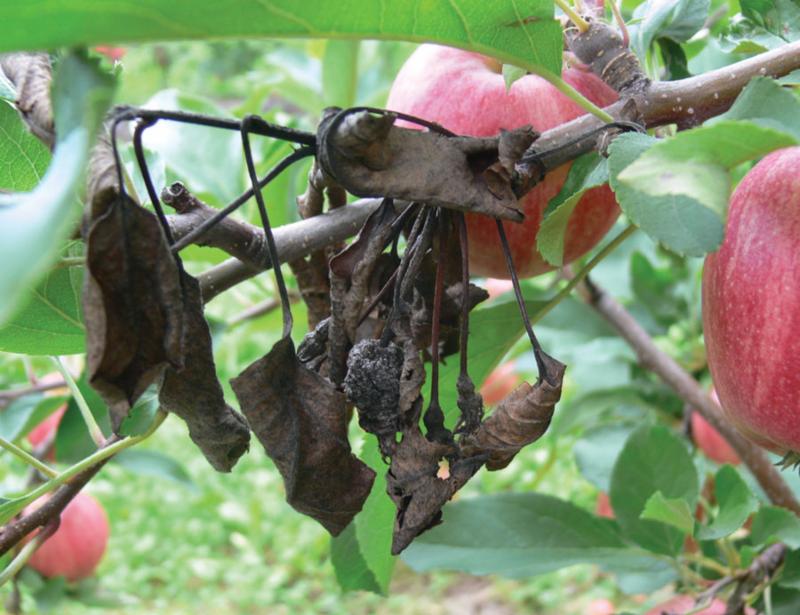
If your property is home to Apple, Crabapple, Pear, or other fruit bearing trees then it is likely you are dealing with fire blight. If not, count yourself lucky. Due to the amount of moisture along with the heat this year, fire blight is thriving. Named for the scorched appearance of infected leaves, fire blight is a destructive bacterial disease found on apples, pears and other members of the rose family. The disease enters the tree at the tips of the branches and then travels down the stems causing die back. It attacks soft new growth first, so you would notice die back at the top of the plant.
Most infected leaves and branch tips wilt rapidly turn brown or black; the leaves die but do not drop off. Trees will also develop reddish water-soaked lesions on the bark. On warm days, these lesions ooze an orange-brown liquid. Fire blight kills blossoms, shoots, limbs and sometimes, the entire tree. The bacteria overwinters in infected bark and is spread by splashing rain, dew, wind and insects. It spreads rapidly in moist, warm weather, especially during bloom.
Our recommendation includes a Cambistat treatment in fall, which helps starve out fire blight. Dormant pruning is necessary to cut out as much of the bacterial disease as possible. Pruning should be done by a professional due to the strict sanitation requirements.