International Foundation for Gastrointestinal Disorders
May 2021 eNewsletter
|
|
|
Greetings!
May is Food Allergy Awareness Month
For individuals with food allergies, a tiny amount of certain foods can cause an immune system response, ranging from mild to life-threatening reactions. Studies have shown that an estimated 6 to 8% of children under the age of 3 are diagnosed with food allergies and up to 3 percent of adults.
Often, food allergies and food intolerances can be misunderstood, and understanding the differences between the two can be challenging for many people with gastrointestinal disorders. When you notice changes in your symptoms, it is important to communicate this with your healthcare provider.
Join us this month as we take a closer look at food allergies, food intolerances, and much more.
|
|
|
|
The symptoms of both food allergies and intolerances are often similar to those of irritable bowel syndrome (IBS), including diarrhea and abdominal pain.
When you notice changes in your symptoms, it is important to communicate this with your healthcare provider.
This March, we were joined by lead host Raquel Durban for our monthly #DDHChat on Twitter. During this chat, she discussed food allergies, food intolerances, tips for dining out, and tips for grocery shopping.
Click here to read the recap of our March DDHChat.
|
|
IFFGD Website Redesign
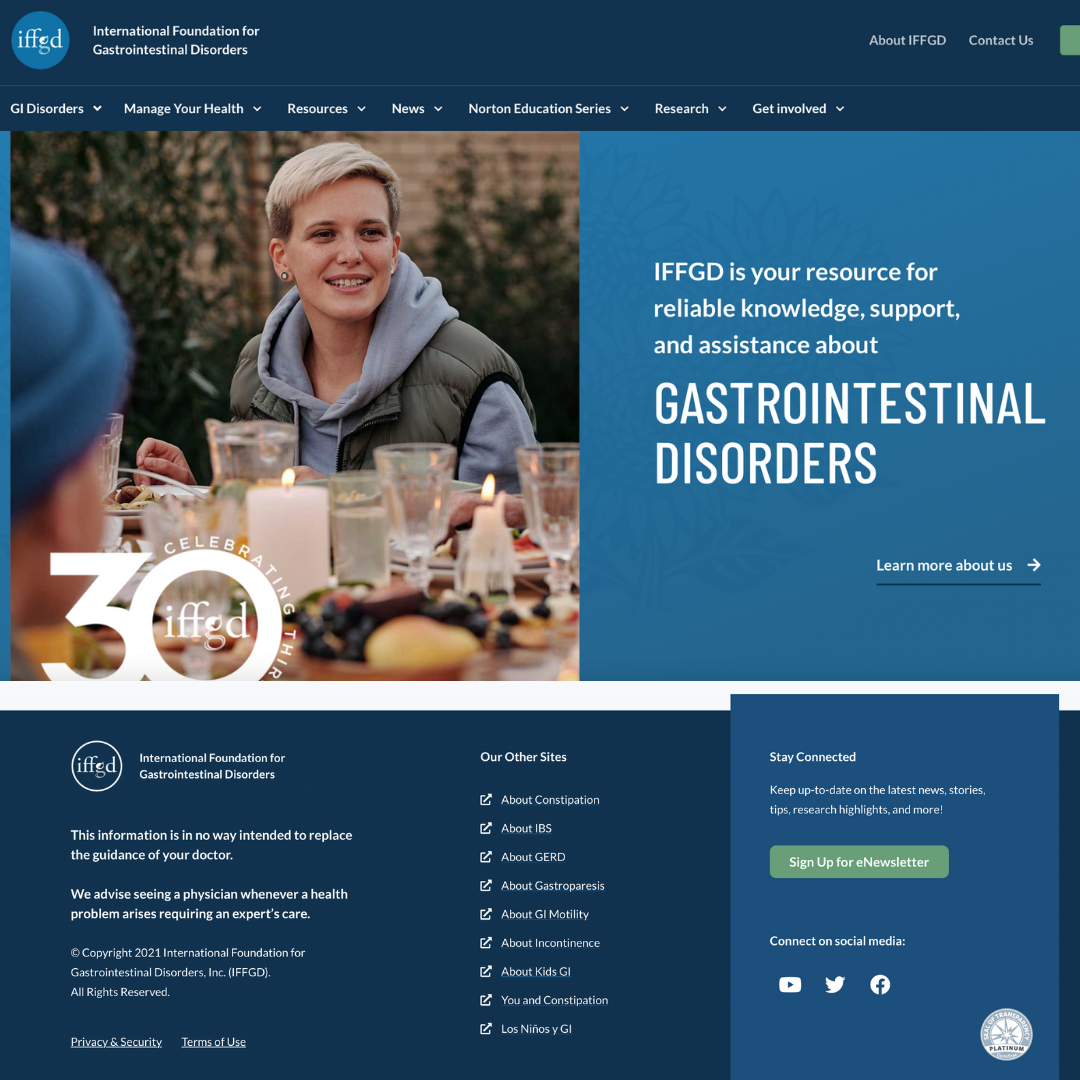
IFFGD is your resource for reliable knowledge, support, and assistance about gastrointestinal (GI) disorders. This year to celebrate our 30th Anniversary, we have redesigned our suite of 9 websites including iffgd.org.
View our new website designs at, www.iffgd.org, and our disease specific site designs using the links for “Our other sites at the page bottom.
|
|
Congenital sucrase-isomaltase deficiency (CSID) is a genetic disorder that affects a person’s ability to digest certain sugars.
People with this condition cannot break
down the sugars sucrose and maltose, and other compounds made from simple sugar molecules (carbohydrates).
The prevalence of CSID is estimated to be 1 in 5,000 people of European descent. This condition is much more prevalent in the native populations of Greenland, Alaska, and Canada, as many as 1 in 20 people may be affected.
However, it is possible that some people remain undiagnosed and that the incidence may be higher.
Click the button below to learn more about CSID.
|
|
As more people receive their COVID-19 vaccines and more states begin to open, it is important for those living with gastrointestinal disorders to ensure that all necessary items are packed.
Travel poses an even greater challenge for those living with GI disorders. The uncertainty of when and where symptoms may occur can cause fear of not being able to control symptoms when you are away from home.
Here are a few tips on what you should keep in your travel "survival kit"
- Medications
- Your own snacks
- Plastic bag
- Change of clothes
- Deodorizing spray
- Carry on bag needed items if traveling by plane
Click the link below for more helpful tips.
|
|
|
|
To commemorate the 30th anniversary of IFFGD, we will be hosting a very special virtual edition of the Norton Education Series (NES).
The Nancy and Bill Norton Patient Education Series Event: IFFGD’s Thirtieth Anniversary Edition - This program will be a mix of pre-recorded videos and live feed that will take place Saturday, November 6th and Sunday, November 7th.
William Chey, MD will Chair the Program Committee and Lin Chang, MD and John Pandolfino, MD will serve as Co-Chairs. The Program Committee will join Ceciel Rooker, IFFGD President, in co-hosting the event.
Click here to learn more about the event and register!
|
|
|
Chronic pain afflicts an estimated 30 to 50 million Americans and is the number one reason individuals seek medical care.
Chronic pain can lead to disability and profound emotional suffering, preventing those affected from participating in personal and professional activities.
If you are suffering from chronic pain, it's important to work with your healthcare provider to develop a pain management plan that works for you.
|
|
Some foods and supplements are known to cause constipation, while others can keep you running for the bathroom.
For some, the good news is that making minor changes to what, when, and how you eat and drink, along with certain medications, if indicated by your doctor, can help reduce chronic diarrhea.
Click below for nutrition strategies to help you manage chronic diarrhea.
|
|
Clinical trials and research studies help to improve our understanding of the underlying mechanisms of diseases and advance the development of new and better treatment options. By participating in a study, you can help further the advancement of research and learn more about your condition.
Here are 3 studies currently recruiting participants:
|
|
Survey on Mental Health for Parents of Children with Rare Diseases |
|
Peroral Endoscopic Myotomy (POEM) for the Treatment of Achalasia (POEM) |
|
A Study of Benralizumab in Patients With Eosinophilic Esophagitis (MESSINA) |
|
IFFGD has an Advisory Board that is made up of 60 medical professionals from various disciplines representing the USA and ten other countries. Many of these individuals are noted experts in the field of functional gastrointestinal disorders. This month we would like to recognize our new advisory board member, Dr. Max Schmulson.
Dr. Max Schmulson is a native of Barranquilla-Colombia. He received his medical degree from the Pontificia Universidad Javeriana, Santa Fe de Bogotá in 1989 where he later completed his residence in Internal Medicine in 1994. Dr. Schmulson also completed his residency in Gastroenterology at the Instituto Nacional de Ciencias Médicas y Nutrición Salvador Zubirán (INCMNSZ) in México City, where he received the Title of Specialist in Gastroenterology in 1997 from the Universidad Nacional Autónoma de México (UNAM).
|
|
|
Later, he completed his Post-Doctoral Fellowship in Motility and Functional Gastrointestinal Disorders under the mentor of Professor Emeran Mayer at CURE-UCLA, from 1997 to 1999.
Dr. Schmulson was a Gastroenterologist at the INCMNSZ from 1999- 2004. He is currently the Professor of Medicine, at the Faculty of Medicine of the UNAM at the Laboratorio de Hígado Páncreas y Motilidad (HIPAM), in the Unit of Research of Experimental Medicine. His research areas include the Epidemiology of Functional Gastrointestinal Disorders (FGID), immunological aspects and microbiota of IBS. Lately, on the Gastrointestinal effects of COVID-19.
Through the years, Dr. Schmulson sat on the board for many medical societies. Most recently, he is a member of the Advisory Medical Council of the International Foundation for Gastrointestinal Disorders (IFFGD). He is also a member of the Board of Director of The Rome Foundation since 2015, Charter Member of the International Liaison Committee (ILC) of the Rome Foundation and Chair from 2009-2013, and current Liaison between the ILC and the Board.
|
|
IFFGD is a nonprofit organization. We rely on donor support to fund research and to provide reliable information and support to those affected by chronic gastrointestinal disorders.
|
|
|
|
|
|
|