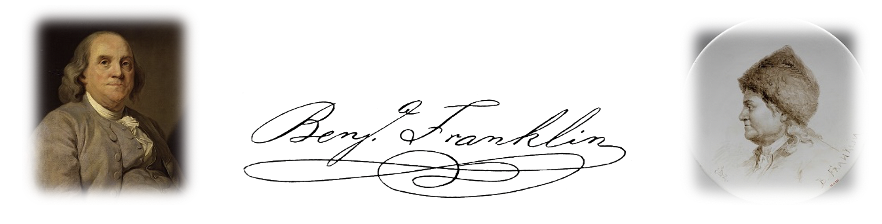
Has Benjamin Franklin been hiding in plain sight?
Why Benjamin Franklin?
Why now?
With PBS’s new film Benjamin Franklin: A Film by Ken Burns, it appears “Ole Ben” is about to get his moment, or maybe his most recent moment. And a wonderful moment it is as Franklin receives the full Burns treatment: great visuals, most of which are in the public domain but there are also some superb original paintings illustrating key moments in Franklin’s career; the typical Burns rolodex of experts, in this case historians both academic and popular from Walter Isaacson, upon whom Burns relies a great deal, to H.W. Brands, Stacey Schiff, Joseph Ellis to Erica Dobson on Franklin and slavery. It continues with a posthumous appearance by Bernard Bailyn; splendid narration, both script and delivery; period music; and the defining Burns trait glossing history with a burnished sheen. Burns has been criticized for that trait, accused of glossing over history’s dark contours, burnishing the American story with a sheen obscuring those moments when America did not live up to its foundational values.
To which I say, “Get a grip!”
True, in Burns’ The Civil War, particularly relying on the late southern historian Shelby Foote, he came close to accepting the South’s mythology of “The Lost Cause,” which falsely attributes the war to a sectional economic rivalry and states’ rights rather than the evil of slavery. But in The War, Burns confronts the internment of Japanese-Americans head-on. In Baseball, he brings the Negro Leagues, as they were known, out of the shadows and into their proper place in the history of the “American Game.” And in Jazz, he agreed, as I do, with Gerald Early who said 2,000 years from now what will be remembered about the American experiment will be “the Constitution, jazz music, and baseball … the three most beautifully designed things this culture has ever produced.” [1] Neither, like some progressive historians, an academic termite feeding on America’s sins nor, like Hillsdale College’s 1776 curriculum, an American triumphalist apologist, Burns (and I’m not sure he’d accept this description) is a great centrist storyteller telling America’s ever evolving commitment to its foundational values of liberty, equality, and opportunity.
Both essential and central to that story is the story of Benjamin Franklin, the original American. Essential because without him it would not have happened and central because his life story is the story of America in miniature. Since the story of Benjamin Franklin is so central to American identity it is hard to say he has been neglected. Yet, in a strange way, he has been neglected. Or at least the real Ben Franklin, the person behind the myth, has been neglected. Franklin is so famous, so ubiquitous in American culture, that it’s almost as if the real Ben Franklin is hiding in plain sight.
Franklin’s name and image are everywhere. He is on the 50-cent coin and the hundred-dollar bill. No state is named after him, but northeastern Tennessee was for a short time a separate state named “Franklin.” There are 24 counties and parishes named for Franklin; there are approximately 45 towns and cities named Franklin, including Franklin, Pennsylvania; at least four mountains bear his name and eight colleges and universities; 25 high schools, 11 middle schools, and 19 elementary schools; multiple businesses including Franklin Mills Mall in Philadelphia; bridges, highways, and streets galore; and zoos, battleships, planetariums, athletic fields, and one men’s club, Philadelphia’s The Franklin Inn Club, the first to admit women. [2] That is only appropriate since Franklin literally invented the American notion of a “service club” with his founding in 1727 of The Junto, “a club of inquirers into matters moral, political, and scientific” who also engaged in public service, like founding America’s first volunteer fire company and its first public library. [3]
Still, despite this omnipresence, most people know very little about the man behind the myth, what he did, and why it is important. Most people’s understanding of Benjamin Franklin does not extend very much beyond what John Adams feared. In a letter to Benjamin Rush (April 4, 1790), Adams wrote that most people’s understanding of the American Revolution would be “that Dr. Franklin’s electrical Rod smote the Earth and out Sprang General Washington. That Franklin electrified him with his Rod – and thence forward these two conducted all Policy Negotiations, Legislation, and War.” [4]
John Adams’ insecurities aside, who, hiding in plain sight, was Benjamin Franklin? Inspired by Ken Burns, in the next several Book Notes I’ll try to bring him out of his ironic obscurity by placing him squarely in the context of my The American Tapestry Project. Franklin will be the sole focus of The American Tapestry Project’s next episode on WQLN/NPR on Sunday, April 10 at 4 p.m. As always, it can then be found on WQLN’s website here and on the NPR One app here. In this Book Note, we’ll connect Franklin to The American Tapestry’s “The American Dream: A ‘Hustling’ Nation exploring the story of Franklin as America’s first entrepreneur and founder of the American self-improvement industry.” In future Book Notes, we’ll connect Franklin to the Tapestry’s “Freedom’s Story at Home and Abroad” and its “Freedom’s Faultlines” exploring Franklin and slavery, immigration, and “The Fusion Thread” on becoming American.
So, who was this man whose name you know probably as well as you know your own, but about whom you may know very little? Born into obscurity in 1706, who was this son of an immigrant candlemaker and his wife who upon his death in 1790 was one of the most famous men in the world? Who was this printer turned entrepreneur who founded America’s first franchise system? Who was this inveterate tinkerer, whose inventions are part of the fabric of American life, who was also a great scientist whose experiments with electricity would have garnered a Nobel Prize, according to historian Gordon Wood, had there been such a prize in the 18th century? [5] Who was this apostle of public service who at the local level defined democratic politics and at the national level was the only Founder to sign all four foundational American documents? Who was this writer – America’s first continentally successful author and publisher – who also invented the American self-improvement industry?
Of all his accomplishments, the one he remained proudest of was his success as a printer. According to Carl van Doren, even after he became famous as an author, scientist, and statesman, Franklin always signed personal letters “B. Franklin, printer.” [6] More to the point for understanding his role in The American Tapestry, how did this poor son of a candlemaker, who ran away from home at 17 and a mere 25 years later at 42, financially secure, retire to the life of a gentleman dedicated to scientific inquiry and public service? Although the phrase was not coined for another 200 years, he did it by living – inventing? – the American Dream. In one of The American Tapestry’s major threads, we talk about how America is a “hustling” nation of “can-do” people. Hustle is a word with two connotations; on the one hand it means working hard; on the other, it can mean cutting a corner or two. Franklin was the “husltingest,” most can-do of people.
As he says of himself in his autobiography, even as a child he “(I) was generally a leader among the boys.” [7] That carried over into his business enterprises and later public service and political leadership. He always had both an energetic and an independent streak. Apprenticed to his older brother James to learn the printer’s trade, he early demonstrated his writing skills in his “Silence Dogood” letters and essays. Chafing under his brother’s discipline, Franklin ran away first to New York City and then to Philadelphia. He described his entrance into Philadelphia in a famous passage from his Autobiography “with a Roll (a loaf of bread) under each Arm, and eating the other. Thus, I went up Market Street as far as Fourth Street, passing by the Door of Mr. Read, my future Wife’s Father, when she standing at the Door saw me, thought I made as I certainly did a most awkward ridiculous appearance.” [8]
In Philadelphia, Franklin embarked upon the printer’s trade, met the Governor of Pennsylvania Sir William Keith, who persuaded him to go to London to acquire the means to set up an independent newspaper. In London, Franklin learned that Keith had sent him upon a fool’s errand and after two years returned to Philadelphia. Back in Philadelphia, after a brief experience as a shopkeeper, Franklin returned to his printer’s trade and established a newspaper – The Pennsylvania Gazette. This was in 1729 – Franklin was 23. As noted above, over the next 19 years, Franklin would make himself financially independent and “retire” in 1748 at the age of 42.
How did he do it?
He tried to tell us in his The Way to Wealth, a book he wrote in 1757 for his nephew Benjamin Mecom, son of Franklin’s sister Jane. [9] The young Benjamin Mecom seemed never to be able to get out of his own way. His sister wanted her famous and fabulously successful brother to set his nephew on the path to success. Alas, it never did work for young Benjamin Mecom, but the book itself invented the American self-improvement industry. Within 40 years, it had been reprinted in 145 editions; it has been continuously in print since the 18th century in more than 1,300 editions. [10]
In it, Franklin largely draws from his earlier Poor Richard essays in the almanacs he published in the 1730s and 1740s. The Way to Wealth contains phrases, axioms, and moralisms that have become part of the fabric of the American vernacular, such as:
- “God helps them that help themselves,”
- “he that riseth late must trot all day, and shall scarce overtake his business at night,”
- “the sleeping fox catches no poultry,”
- “industry need not wish,”
- “he that lives upon hope will die fasting,”
- “have you somewhat to do tomorrow, do it today,”
- “little strokes fell great oaks,”
- “if you would have a faithful servant and one you like, serve yourself,”
- “tis easier to suppress the first desire than to satisfy all that follow it,”
- “the second vice is lying, the first is running in debt,”
- “Now to conclude, experience keeps a dear school, but fools will learn in no other, and scarce in that, for it is true, we may give advice, but we cannot give conduct, as Poor Richard says: however, remember this, they that won’t be counseled, can’t be helped, as Poor Richard says: and farther, if you will not hear reason, she’ll surely rap your knuckles.” [11]
The folksy wisdom of Poor Richard aside, Franklin built his business success upon seven or eight pillars that are as relevant in 2022 as they were in the 1740s.
He worked hard and was trustworthy. In his autobiography he relates an incident “that one Night when having imposed my forms (set type), I thought my Day’s work over, when one of them by accident was broken. … I immediately composed it over again before I went to bed.” [12]
Image conscious, he made sure people knew how hard he worked. It’s been suggested that among his many inventions was public relations. In his autobiography, he remarks how he “took care not only to be in Reality Industrious and frugal, but to avoid all Appearances to the contrary.” [13]
He understood the value of networking, forming his own private club of likeminded young artisans and workingmen – The Leather Apron Club, known officially as The Junto. The group met for discussion of matters moral, philosophical, political, and, of course, business. Not only did Franklin and his associates discuss books and issues of the day for self-improvement and engage in civic activities, they also did business with one another and led other potential customers to one another’s services. [14]
If one of the attributes of a leader is that they are a risk taker, then Franklin thoroughly understood Shakespeare’s admonition that “our doubts are traitors/And make us lose the good we oft might win/by fearing to attempt.” [15] But Franklin was neither a gambler nor a bungee jumper – he took calculated chances often publishing works beyond his newspaper. He published almanacs, pamphlets, and other books. He published English author Samuel Richardson’s Pamela, the first novel published in the colonies.
When young printers working for him wanted to venture out on their own, he bankrolled them and, in the process, created America’s first franchise network. The term franchise wasn’t used in the 18th century, but Franklin’s network of printers who he financed for a share of their profits essentially created America’s first “chain” or “franchise” operation.
He also intuitively understood the concept of vertical integration as he became involved in procuring the manufacture of paper needed in any printing concern, the challenge of distribution which he solved by becoming one of America’s first post masters giving him access to markets throughout the colonies and establishing the home delivery of mail.
He also understood the power of public-private partnerships, extending his printing business to printing currency for the Pennsylvania Assembly and other government documents for both Pennsylvania and Delaware.
In short, long before marketing became an economic discipline unto itself, Benjamin Franklin understood the Four P’s:
lllllllllHe diversified his Products – newspapers, almanacs, books, but he also
lllllllllprinted pamphlets, and entered into contracts printing government
llllllllldocuments and currency; His postal service work enabled him to master
lllllllllPlace – which in marketing jargon is distribution – he sent his products all
lllllllllover the colonies … He understood Price – selling low to counter
lllllllllcompetition and to drive volume and he was an ingenious Promoter –
lllllllllPoor Richard was America’s first commercial icon.
Benjamin Franklin – in many ways, among the many things he invented, it can be argued he invented the American way of doing business. He was a self-employed entrepreneur; he understood the need to know how to “read” a market to satisfy its demands; he understood the need to not only be honest and thrifty but also to be perceived as an honest and thrifty person, one who could be relied upon and trusted. He understood risk, but also the need to temper risk-taking with calculation. And he understood that no one does anything alone. He was the consummate master of relationships. He understood networking long before the term entered the American lexicon both personally through his Junto Club, but also through his involvement in civic affairs.
If anyone exemplifies The American Tapestry’s spirit of a “hustling” America, it is Benjamin Franklin!
Next week in Book Notes: Benjamin Franklin and American Freedom!