|
When you read this, MBEXers, I'll likely be poolside, but certainly out of the office. I'm taking a much-needed break, so if you call to chat (or simply hear my lovely voice 😁), I won't be there to take your call. I'll be living my best summer life poolside, with an endless rotation of iced coffees and chilled adult beverages at hand, a great book, and Taylor Swift on repeat.
Not to worry; I'm leaving you in good hands while I'm away. Melanie and Julie are ready to answer any membership or Plan Room questions and troubleshoot login issues.
In the meantime, consider this your friendly reminder to schedule your much-needed PTO and use your vacation days; you've earned them ☀️ 😎 🍹
| | |
Five Quick Things To Know & Do This Week:
1.) Last Call - This Thursday (July 16), join MBEX staff live for a free one-hour Online Plan Room Demo covering everything from navigating the Deskpad to setting up project search filters. Open to current members and anyone curious about the platform, but registration is required by 2:30pm on July 15. (Can't make this one? Our next Plan Room Demo will be on August 20.)
2.) Member News - ENR Mountain States & Southwest recently named Adolfson & Peterson Construction its 2026 Contractor of the Year for Colorado and Wyoming. Congratulations, A&P! (Can't view the linked article? Click here)
3.) Fed Survey Results - If you weren't able to join the Federal Reserve Bank of Minneapolis' Regional Economic Conditions webinar back in early June, where they shared the survey results of their spring construction survey, you can now view the presentation slides and video, as well as read a summary of the results:
• View Presentation Slides
• Watch Video
• Read Summary of Results
4.) Mark Your Calendars - Project Build Minnesota will once again be holding its Construction Talent Acquisition Conference on September 2, 2026, at The Builders Group in Eagan. Expert-led sessions, networking opportunities, and practical tactics and deeper strategies for recruiting and retaining talent await.
5.) Jobsite Fun - This is your sign to add giant googly eyes to every piece of heavy machinery on your next project 🏗️ 👀 😂
-------
Inside Issue No. 28:
• Aim, Pull, Shoot: Register a team for MBEX's Sporting Clays Scholarship Fundraiser on August 6
• Sage Economics: An industry economy that remains surprisingly resilient
• Newly Launched: Check our our new online member directory
• Know Your Contract [Warranties]: Part 4 of 4 breaking down primary risk management tools found in construction contracts
• Upcoming Events: Construction Estimating Princples & Application online course (8/4); Reading Construction Documents online course (8/5 & 8/6); & Golf North (8/19)
• Project Download: Updated project information for the week of July 8-14
| |
No Sharpshooting Skills Required
Come Have a Great Time on August 6 with MBEX
| | |
On Thursday, August 6, we're hosting our annual Sporting Clays Scholarship Fundraiser, a day out on the course that doubles as a great and one-of-a-kind networking opportunity, all while raising money for scholarships that bring the next generation of talent into the construction industry.
In total seriousness, this event is less about your aim and more about the people standing next to you at each station.
Two good things happening at once? We're so in.
| | | | |
Date: Thursday, August 6
Time:
11:00am - Team Check-In & Lunch
12:15pm - Mandatory Safety Meeting
12:30pm - Clay Shoot Begins
4:00pm - Social & Dinner
5:00pm - Short Program & Awards
Location: Game Unlimited Hunting Club - 871 County Road East, Hudson, Wisc., 54016
Cost: $200 per shooter (4 minimum shooters; 6 maximum)
| | |
Here's what we need from you: round up a team of 4 to 6 people from your company, or reach out to your industry partners, and get registered. (Single shooters and pairs are more than welcome to join us, too!)
It doesn't matter if your crew is full of seasoned clay shooters or has never pulled a trigger before. Sporting clays is one of those activities where beginners and experienced shooters can share the same course, and both walk away having had a blast (pun 100% intended). It's a natural conversation starter, a reason to get out of the office, and a way to spend real time with coworkers and industry peers outside of a conference room.
Even better? Every team and shooter that registers is directly supporting students pursuing careers in construction, the same trades and professionals that keep our industry moving forward. If you've ever benefited from a mentor, a connection, or a door that opened early in your career, this is one way to pay it forward.
Gather your crew, and we'll see you at Game Unlimited!
| | | Sponsorship opportunities are also available at a variety of levels to fit your company's goals, including lunch and dinner sponsors, station sponsors, beer sponsors, and door prize sponsors. | | |
Commercial Construction & Economic Insights
What Midwest Contractors Should Be Watching [Sage Economics]
| | |
June painted a picture of a construction economy that remains surprisingly resilient, even as higher interest rates, inflation concerns, and policy uncertainty continue to create headwinds.
For Midwest contractors, the biggest takeaway is that while demand remains strong in several sectors, success will increasingly depend on careful planning, diversification, and staying ahead of changing market conditions.
Here are some of the biggest takeaways from June, according to Sage Economics:
| | |
😑 Inflation Isn't Gone Yet
The inflation story took a turn in June. The Fed's preferred inflation measure (PCE) rose 4.1% year-over-year, while core inflation reached 3.4%. Although lower fuel prices may offer some relief moving forward, inflation remains stubbornly above target levels.
What This Means for Midwest Contractors
Inflation continues to put pressure on labor, equipment, insurance, and operating costs. Even when material pricing stabilizes, contractors may continue facing margin pressure from rising overhead expenses.
Review pricing assumptions regularly and avoid relying on outdated cost estimates. Small cost increases across multiple categories can quickly impact profitability.
🔩 Manufacturing Continues to Show Signs of Strength
One encouraging signal came from durable goods orders. While overall orders dipped due to transportation equipment volatility, orders excluding transportation increased 1.3% for the month and are up 7.7% year-over-year. Sage Economics notes this is a positive sign for U.S. manufacturing activity.
What This Means for Midwest Contractors
Manufacturing remains one of the Midwest's strongest construction sectors. Continued investment in industrial facilities, production capacity, and supply chains should help support project opportunities throughout the region.
Stay engaged with manufacturing clients and economic development organizations. Industrial work continues to be one of the most active construction segments.
🎡 Recreation & Entertainment Construction is Quietly Booming
One of the more surprising findings is the rapid growth in amusement and recreation construction. Community centers, country clubs, sports facilities, recreation venues, and entertainment projects are seeing significant investment. Sports facilities, in particular, continue benefiting from large-scale projects, while theme park and recreation spending remains elevated.
What This Means for Midwest Contractors
While not every Midwest market will see billion-dollar stadium projects, many communities continue investing in recreation, wellness, community gathering spaces, and quality-of-life improvements that drive economic development.
Don't overlook municipal recreation, athletic facilities, and community center opportunities. Many are being funded through local initiatives and long-term community development plans.
⚡ Energy Infrastructure Could Create Future Opportunities
The Department of Energy announced $17.5-billion in conditional loans to support development of 10 new nuclear reactors across the United States. While projects remain years away from completion, the investment highlights continued federal interest in large-scale energy infrastructure.
What This Means for Midwest Contractors
Energy infrastructure projects create opportunities far beyond the project site itself, generating demand for manufacturing, fabrication, transportation, utility upgrades, and supporting commercial development.
Watch for regional supply chain opportunities tied to energy investments, even if the primary project isn't located in the Midwest.
👷 The Labor Market Remains Surprisingly Strong
Jobless claims remain extremely low, signaling that layoffs are not a major concern at the moment. Consumers may be feeling squeezed by inflation, but employers continue holding onto workers.
What This Means for Midwest Contractors
The industry's labor challenges aren't going away anytime soon. Competition for skilled workers remains intense, particularly in high-demand trades.
Continue investing in workforce development, apprenticeship programs, internships, and retention efforts. Finding qualified workers remains one of the biggest competitive advantages a company can have.
🪙 Interest Rates May Stay Higher for Longer
The Federal Reserve held interest rates steady in June, but its updated economic projections suggest future rate hikes remain possible. Also noteworthy is new Fed Chair Kevin Warsh's announcement that the Fed will move away from providing "forward guidance," meaning markets may have less visibility into future rate decisions.
What This Means for Midwest Contractors
Financing uncertainty remains one of the biggest hurdles facing project owners. Higher borrowing costs can delay projects, reduce project scope, or increase scrutiny on budgets.
Keep communicating early and often with clients about material pricing, escalation risks, and scheduling assumptions. Owners are looking for certainty wherever they can find it.
🏠 Housing Remains Soft
While pending home sales showed modest improvement, broader housing indicators remain sluggish. New home sales fell sharply in May, inventory continues to rise, and mortgage rates remain stuck near 6.5%. Purchase mortgage applications also remain relatively weak.
What This Means for Midwest Contractors
Residential softness often spills into portions of commercial construction, particularly suppliers and contractors serving both markets. However, slower housing activity can also free up labor and materials for commercial projects.
Monitor local residential trends in your market. Changes in housing demand often serve as an early indicator of broader construction shifts.
🛒 Consumer Spending Refuses to Quit
Despite persistent inflation and economic uncertainty, consumers continue to spend at a remarkable pace. Retail sales increased in May, and Americans spent roughly $33.5-billion more during the March-May period than they did during the same stretch in 2025.
At the same time, unemployment remains historically low, suggesting consumers still have the confidence and income to keep spending.
What This Means for Midwest Contractors
Consumer spending drives demand for many commercial sectors, including retail, restaurants, recreation, hospitality, healthcare, and community facilities. While some sectors remain cautious, continued consumer activity helps support project pipelines tied to everyday spending and services.
Continue nurturing relationships with owners in consumer-facing industries. Projects may move more slowly than during the post-pandemic boom, but demand hasn't disappeared.
| | |
Bottom Line
June's data suggests the economy is still moving forward, just at a slower and more uneven pace than many expected. Consumer spending remains resilient, manufacturing continues to show strength, and several construction sectors are finding opportunities despite inflation and financing challenges.
For Midwest contractors, the winning strategy remains largely the same: stay diversified, maintain strong client relationships, keep a close eye on costs, and be prepared to pivot as economic conditions continue to evolve.
| | | This information was compiled and summarized from Sage Economics' email updates distributed June 1-30, 2026. Note that more recent reports may offer updated insights (such as with fuel prices), and MBEX members are encouraged to review the latest data as part of their due diligence. | | |
Explore our New Online Member Directory
| | |
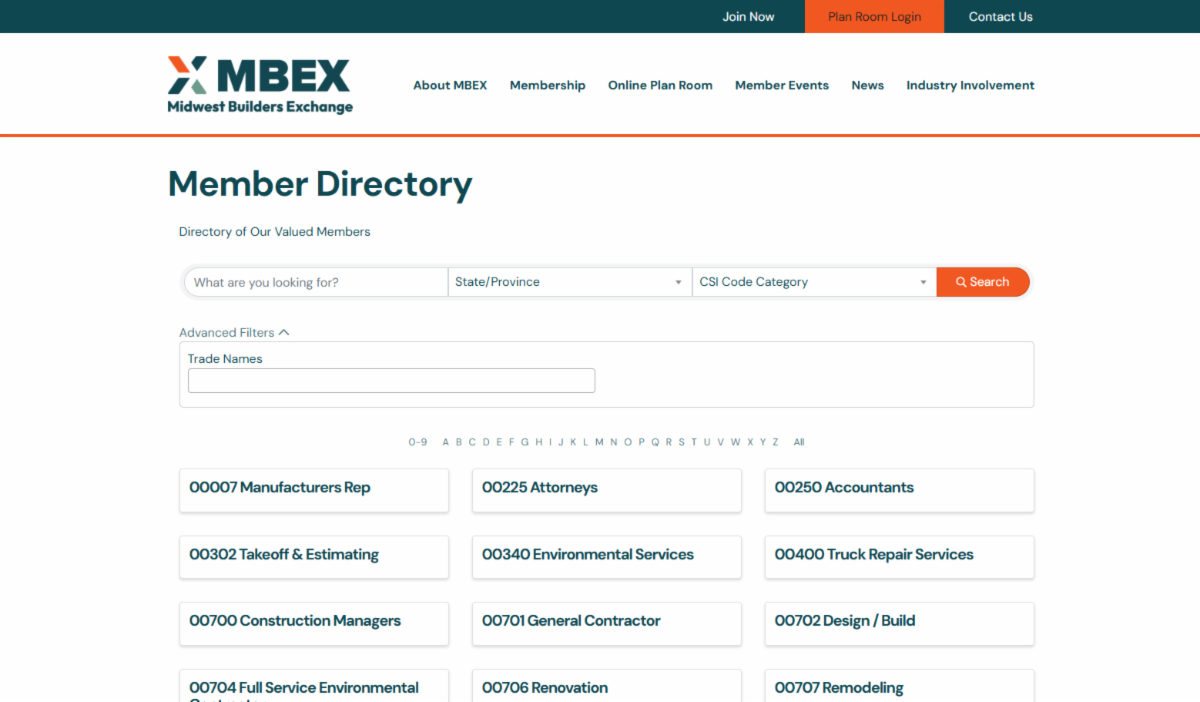
When we launched our new website on June 15, we also rolled out an updated online member directory, and it's worth a few minutes of your time to check it out.
Whether looking to find a subcontractor, track down a supplier, or connect with a fellow member across the region, the directory puts the MBEX network at your fingertips in a clean, searchable format.
| | |
Start with Your Own Listing
Before you start searching for others, take a moment to look up your own company.
Your listing in MBEX's online directory is how other members find you. If your contact information, classifieds, or trade categories are out of date, you could be missing connections and opportunities without even knowing it.
When reviewing your company's listing, ask yourself:
• Is this address current?
• Does the listed phone number go somewhere useful?
• Are you showing up under the right classifieds and/or trade names?
• Are the people listed still with the company, or do a few need to be removed, or new ones possibly added?
These are the small details that make a real difference when another member is searching for exactly what you offer.
How to Update Your Information
If you spot something that needs to be corrected or updated, here are a couple of ways to make the needed changes:
1.) Log in to the Online Plan Room, select 'Edit Your Company Information,' and submit your changes directly.
2.) Email MBEX staff directly:
• Contact Melanie with business information updates or personnel changes.
• Contact Julie about adding or removing listed Classified or Trade Names.
Keeping your listing current takes only a few minutes. It ensures you're represented accurately across the online directory, inside the Online Plan Room, and in future print editions of the Membership Directory & Buyers Guide.
Then Take a Look Around
Once you've confirmed your own listing looks good, spend a few minutes exploring the directory as a whole.
Search by company name, division or trade type, or keyword, and see what comes up. You may find a supplier you didn't know was an MBEX member, a subcontractor you've been trying to track down, or a potential partner for an upcoming project.
| | |
The MBEX network is only as powerful as the connections members make within it, and the directory is one of the easiest places to start.
Head over to mbex.org and take a look. Your next business relationship might already be there waiting.
| |
Know Your Contract: Warranties
Risk Mitigation Tools Every Contractor Should Understand [Part 4 of 4]
| | |
We've made it to the final installment of our four-part series on construction contract risk management tools, and we're closing out with one that often gets the least attention until something goes wrong.
Warranties are easy to overlook during the rush of project closeout, but they can carry significant long-term financial exposure for contractors and subcontractors alike.
Here's what you need to know:
| | |
💯 Your Long-Term Obligation After the Work is Done
A warranty is a contractual promise, a guarantee that the work you've performed meets a defined standard of quality and will continue to do so for a specified period of time after project completion.
When a warranty claim arises, the contractor is typically obligated to return to the project and correct the defective work at their own expense. Understanding what you're warranting, for how long, and under what conditions is essential to managing your exposure on every project you complete.
🔏 Express Warranties: What You Agreed To in Writing
Express Warranties are the ones explicitly stated in the contract, and they're the ones you have the most control over.
These provisions define the scope of your warranty obligation, the duration, and the remedies available to the owner if a defect arises. Common express warranty provisions require contractors to correct defective work for a defined period following substantial completion, typically one year (though that period can be negotiated longer or shorter, depending on the project and the owner).
Before signing, read your express warranty provisions carefully. Pay attention to what triggers a warranty claim, how quickly you're required to respond, and what the remedy actually requires. Some contracts include broad language that could obligate you to repair not just your own defective work, but consequential damages flowing from it.
😕 Implied Warranties: The Obligations You Didn't Know You Agreed To
This is where contractors are most often caught off guard.
Implied Warranties arise by operation of law (not from specific contract language), and they exist whether or not the parties discussed them. Two implied warranties show up frequently in construction disputes:
• The first is the implied warranty of workmanlike performance, which holds that a contractor's work will be completed in a competent, skillful manner consistent with the standards of the trade.
• The second is the implied warranty of habitability, which applies primarily to residential construction. This implied warranty guarantees that the completed structure is safe and suitable for human occupancy.
Because implied warranties aren't defined in the contract, their scope and duration are determined by state law, which varies significantly from jurisdiction to jurisdiction.
Knowing what implied warranties apply under Minnesota law, and under the law of any other state where you work, is important baseline knowledge for any contractor operating across the Upper Midwest.
⏰ Warranty Duration: When Does Your Obligation End?
The duration of a warranty obligation depends on whether it's express or implied, and on the applicable state law.
• Express warranty periods are defined in the contract, commonly one year for construction defects, though again this is negotiable.
• Implied warranty periods are governed by statute of limitations and repose provisions that vary by state and by the type of claim involved.
One important distinction worth understanding: a statute of limitations begins running when a defect is discovered or reasonably should have been discovered. A statute of repose runs from a fixed date (typically substantial completion) regardless of when the defect is found. A statute of repose can cut off warranty claims entirely after a set number of years, even if the defect wasn't discoverable until after that window closed.
In Minnesota, the statute of repose for construction defects is 10 years from substantial completion, a long tail that contractors should factor into their risk management planning.
🔍 Warranty Disclaimers & Limitations
Just as implied warranties can arise without your knowledge, they can sometimes be disclaimed or limited through specific contract language. The enforceability of such disclaimers varies by state and by the type of warranty involved. In some jurisdictions, implied warranties of habitability cannot be disclaimed at all.
Where disclaimers are permissible, they must typically be clear, conspicuous, and unambiguous to be enforceable.
If your contract includes warranty limitation language, review it carefully. Both to understand what protections you may be waiving as an owner and what limitations you may be relying on as a contractor. When in doubt, a conversation with legal counsel before signing is always a better investment than a warranty dispute after completion.
📜 Manufacturer Warranties & Pass-Through Obligations
On most projects, contractors are incorporating materials, equipment, and systems that carry their own manufacturer warranties. Understanding how those warranties interact with your contractual obligations matters.
In some contracts, the general contractor is required to pass through manufacturer warranties to the owner, which can create a disconnect between the warranty the manufacturer actually provides and the obligation the contractor has assumed.
Make sure you understand what warranties you're passing through, to whom, and whether the manufacturer's terms are consistent with your contractual commitments.
| | |
With that, we've officially wrapped up our four-part series.
If you've read all the way through, you now have a solid working knowledge of the four primary risk allocation tools found in construction contracts.
• Bonds (Part 1, June 24 issue) protect against contractor default and non-payment.
• Indemnification (Part 2, July 1 issue) determines who carries the financial weight when third-party claims arise.
• Insurance (Part 3, July 8) transfers risk to outside carriers and keeps intraproject disputes from turning into litigation spirals.
And warranties, the subject of this week's feature, define your long-term obligation to the work you've delivered long after the project is closed out.
Together, these four tools form the risk management backbone of every construction contract you'll ever sign. Understanding them isn't just good practice; it's how you protect your company, your people, and your bottom line.
| | | The information for this feature was sourced from Construction Business Owner. Members are encouraged to do their own due diligence regarding contractual bonds, indemnity clauses, insurance policies, and warranties by speaking with legal counsel. | | | |
A valuable benefit of an MBEX membership is invitations to our social and educational events; by being an employee of a member company, you, too, can take advantage and attend all MBEX-sponsored events.
** indicates a newly added or updated event
July 16 - Online Plan Room Demo - Register by 2:30pm on Wed., July 15
From navigating the Deskpad, setting up filters, understanding project information, and adding your company to a project's bidders list, this free one-hour session is a great introduction to our Online Plan Room. Register
August 4 - Construction Estimating & Principles [Online Course]
This half-day estimating course tackles both the principles and the technology behind competitive bids, covering advanced estimating concepts like cost analysis, risk management, escalation, and flexibility, alongside a practical look at how digital tools like Bluebeam Revu can produce faster, more consistent estimates. Sign Up
August 5 & 6 - Reading Construction Documents [Online Course]
Designed to quickly build confidence and skill set, this course, offered through our partnership with UChapter2, covers the fundamentals of how to read and understand construction documents. From identifying title block information to reviewing floor plans, elevations, and combing through specification sections, participants will learn how to navigate a full set of drawings and interpret material and construction requirements with clarity. Sign Up
August 6 - Sporting Clays Scholarship Fundraiser
Aim, pull, and shoot to raise funds for the MBEX Scholarship Fund at this annual outdoor event at Game Unlimited Hunting Club. Register
August 19 - Golf North
Join MBEX for a day on the greens of Ridgeview Country Club in Duluth, a favorite annual tradition bringing together golf, networking, and plenty of friendly competition. Register
August 25 - Bluebeam 1: Baseline Basics
This session teaches attendees how to navigate menus, toolbars, panels, shortcuts, and key settings. Attendees will also get hands-on with markup and measurement tools, plus insider tips that boost speed, accuracy, and proficiency. Sign Up
August 26 - Bluebeam 2: Material Takeoffs & Estimates (Basic)
This session introduces standard measurement tools and markup customization options to help convert highlighters into powerful takeoff tools. With emphasis on the Markups List and workflow tips, this session helps estimators improve speed and accuracy from day one. Sign Up
August 27 - Bluebeam 3: Material Takeoffs & Estimates (Advanced)
Learn to create custom columns, embed formulas, organize information, and export or live-link Excel templates. Sign Up
| | |
• Total Projects Received at MBEX from 7/6/2026 - 7/10/2026: 87
• Total Project Leads Reported on at MBEX from 7/6/2026 - 7/10/2026: 11
• Total Active Projects Received / Reported on at MBEX as of 7/14/2026: 354
• Total 2026 Projects posted to the Online Plan Room as of 7/14/2026: 3,607
| | |
Click the button above to view the most recent project data from 7/8/2026 - 7/14/2026.
For information about the Bulletin's content, technical issues, or to place an ad (such as a Minority
Notice, Job Posting, or Event Notice), contact Ashlee, Membership + Communications Director.
| | |
UPCOMING MBEX EVENTS
• July 16 - Online Plan Room Demo
• August 4 - Construction Estimating Principles & Application [Online Course]
• August 5 & 6 - Reading Construction Documents [Online Course]
• August 6 - Sporting Clays Scholarship Fundraiser
• August 19 - Golf North
• August 20 - Online Plan Room Demo
• August 25 - Bluebeam 1: Baseline Basics
• August 26 - Bluebeam 2: Material Takeoffs & Estimates (Basic)
• August 27 - Bluebeam 3: Material Takeoffs & Estimates (Advanced)
• September 9 - Sporting Clays North
| |
| |
Information within the MBEX Weekly Bulletin are obtained from sources deemed reliable. The Midwest Builders Exchange (MBEX) does not assume responsibility for its completeness or accuracy. You are urged to check your own sources in addition to the information contained in this publication. This issue contains plans and other bidding information received prior to and including the date noted above. The project data within this newsletter is intended for member company's and their employees use only.
2026 BOARD OFFICERS: President - Brian Kalla, St. Cloud Acoustics; Vice President - Sean Ochis, Northern Industrial Insulation; Treasurer - Allie Brady, Veit USA; Past President - Heidi Sedlacek, Associated General Contractors of Minnesota
2026 DIRECTORS: Kevin Bohrer, Donlar Construction; Ben Bowman, Adolfson & Peterson; David Brandt, Schadegg Mechanical; Matt Lennartson, RJM Construction; Chris Niemand, Frattalone Companies; Jason Rentmeester, Kraus-Anderson Construction; Harry Rothstein, Weidner's Mechanical Contractors; Jim Rothstein, Erickson Electric; and Alanna Soukkala, Holden Insurance Agency.
MBEX STAFF: David Siegel - Executive Director; Julie Miller - Executive Assistant / Project Coordinator / Accounting; Ashlee Hartwig - Membership & Communications Director; Melanie Hendrickson - Events & Membership Coordinator; Jeff Boelter - Project Acquisition & Plan Room Support; Shauna Baska - Project Reporter & Bidders Lists; Ka Yang - Addenda & Apparent Lows; Peggy Esboldt, Madison Gentil & Michelle Siegel - Project Reporters; Don O'Connor - Independent Event Planning Contractor
You are receiving this email because you are employed by a current member company in good standing or have indicated you wanted to receive MBEX's Weekly Bulletin. Unsubscribe from the Weekly Bulletin
| | | | |