The Ohio Water Resources Center Newsletter
Issue 11 | Volume 7 | November 2025
| | |
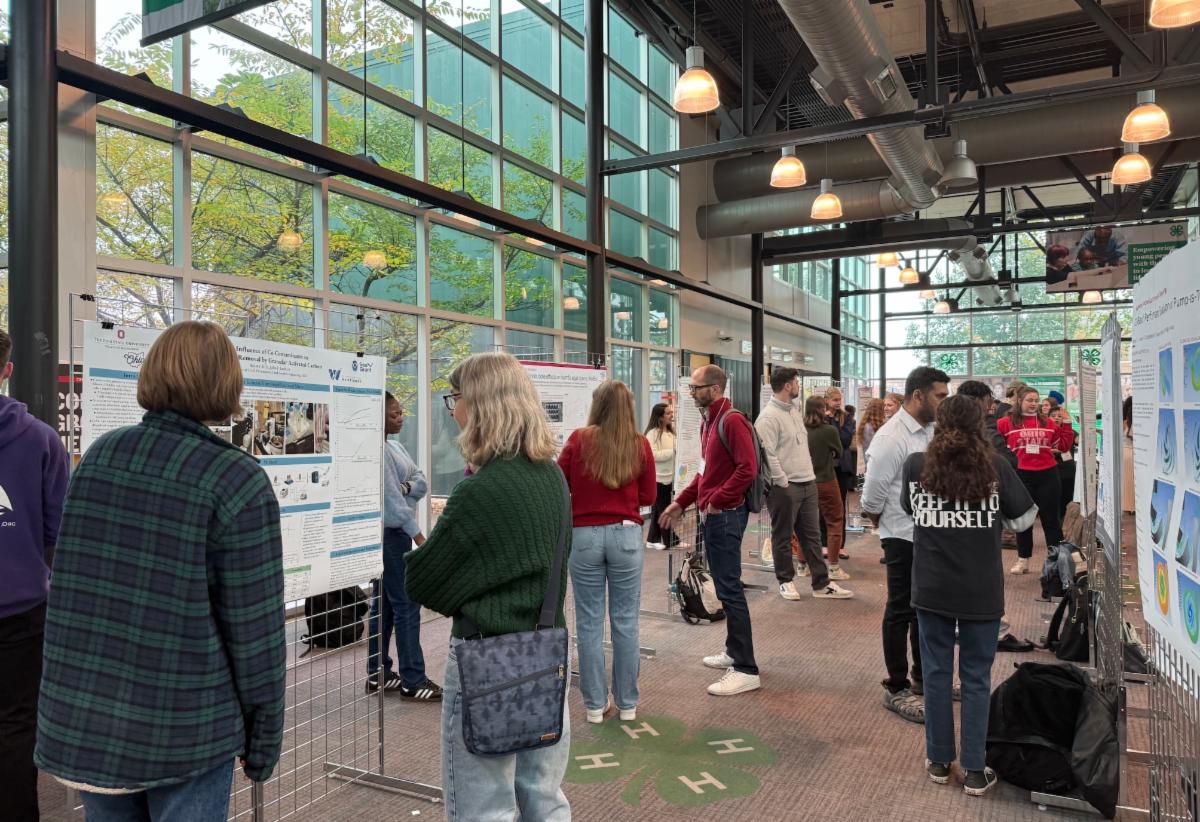
Thank you to all who visited, supported, and presented at this year’s Interdisciplinary Water Symposium! Throughout the day, over 150 students, faculty, researchers, and practitioners heard from experts such as keynote speaker Ruth Briland — the Ohio EPA’s Assessment and Modeling Section Data Lead — and fellow water researchers.
“It was such a great opportunity to talk about my research and get to know other people's research as well. I felt like it helped me a lot with public speaking and sharing scientific findings.”
-MacKenzie Kelso, undergraduate student
“It's really nerve-wracking to be around people who are in your field and to show what you've been doing, but this is a good way to get some practice in and learn what everyone's doing around you.”
-Josephine Sims, undergraduate student
A special shoutout to the graduate student organizing committee — including the center’s own Haleigh Fernandez and Megan Jamison Hart — for their tireless work in bringing everything and everyone together. We look forward to seeing everyone next year.
Click here for photos from the event.
| |
Socio-technological evaluation of treatment for arsenic contamination of private wells in Licking County, Ohio | |
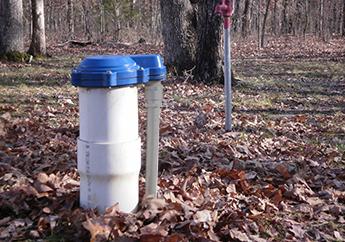
Dr. Kelsea Best — an Assistant Professor in Ohio State’s Department of Civil, Environmental and Geodetic Engineering — leads a 104(b) project on affordable and effective solutions for arsenic contamination in private wells. The research team provided 14 households in Licking County with point-of-use (POU) treatment systems and tailored educational resources to aid families in testing, treating, and maintaining their wells. Over a 12-week period, POU efficacy and changes in the households’ perceptions and practices were evaluated.
Researchers found that the POU system reduced arsenic levels below the U.S. EPA’s Maximum Contaminant Level threshold in all households. Additionally, there was a significant increase in perceptions of water quality and safety, self-efficacy, knowledge of contamination risks, and intentions to engage in future well stewardship. These findings suggest that paired practical treatment solutions and targeted education can positively influence well stewardship and improve access to clean water in rural communities.
Image Credit: Missouri Department of Natural Resources.
| | | |
River-to-lake transitional areas contribute disproportionately to in-lake nutrient loading | |
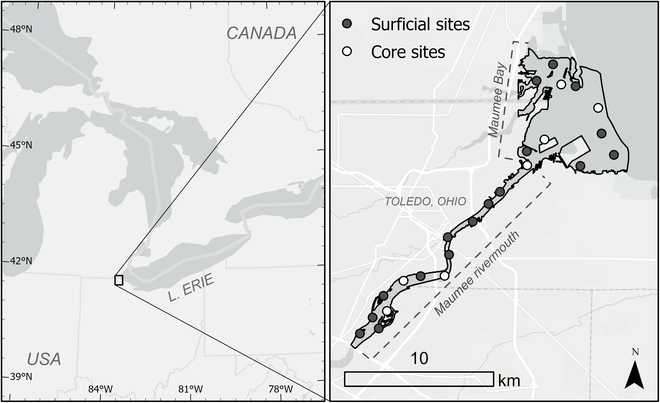
A recent publication from scientists at the Upper Midwest Environmental Sciences Center and the Great Lakes Science Center looked at nutrient loading and transport in river-to-lake transitional areas, where slower flow allows suspended particles to settle into sediments. The research team incubated sediment cores and conducted nutrient assays from the Maumee River — a major tributary of Lake Erie — three times during the field season. They then used statistical models to upscale internal nitrogen and phosphorus loading across the entire impaired mouth of the river, which drains into the western basin of Lake Erie.
The models suggested that the nutrient dynamics in the area were influenced by spatial differences in the physical composition and nutrient and organic matter contents of sediments. The transitional area was a source of phosphorus and ammonium nitrate and a sink for nitrate nitrogen due to high denitrification rates. However, this was seasonally dependent: internal nutrient loading was greatest in the summer, when denitrification was near zero. During that time, sediments could yield an additional 17% more soluble reactive phosphorus and 3% more total kjeldahl nitrogen relative to the daily external load. These results suggest that river-lake transitional areas have an outsized effect on biogeochemical water quality issues. Routine tributary monitoring typically occurs upstream, and these findings suggest that such measurements may miss an important part of lake nutrient budgets.
Figure Credit: Pearce et al., 2025. Service layer credits to Esri, HERE, Garmin, GeoTechnologies Inc., USGS, EPA.
| | | |
Ohio EPA: Final file of NPDES permit rules
The Division of Surface Water adopted final revisions to six Ohio NPDES (National Pollutant Discharge Elimination System) permits rule that went into effect on October 31, 2025. The updated rules can be found here.
Ohio EPA: Final file of record maintenance rules
The Division of Drinking and Ground Waters adopted a revised rule governing record maintenance. The rule went into effect on October 31, 2025, and can be found here.
Ohio EPA: Early stakeholder outreach for water quality trading rules
The Division of Surface Water is seeking input on changes to water quality trading rules, a voluntary program that allows National Pollutant Discharge Elimination System permit-holders to meet regulatory obligations by using pollutant reductions generated by another wastewater point source or non-point source. Details on the changes are available here, and comments can be submitted here until November 10, 2025.
Ohio EPA: Final file of permit-to-install rules
The Division of Surface Water has adopted final revisions to nine Permit-to-Install Program rules. The revisions will go into effect on November 13, 2025.
Ohio EPA: Early stakeholder outreach for SMCL rules
The Division of Drinking and Ground Waters is seeking comments on proposed rules regarding Secondary Maximum Contaminant Levels (SMCL). Specific rules under review include monitoring for compliance — specifically for fluoride — and lowering the SMCL of pH and adding copper. Proposed changes can be read here, and comments can be submitted via Smart Comment until November 17, 2025.
Ohio EPA: Original file for Disadvantaged Community Loans
The Division of Drinking and Ground Waters has proposed changes to rules regarding Disadvantaged Community Loans. Revisions include changed definitions and determination criteria for eligible applicants. The Ohio EPA will hold an in-person and online public hearing on the proposed changes on December 1, 2025, at 11:15 a.m., in the EPA Summer Conference Room at the Lazarus Government Center, 50 West Town Street, Suite 700, Columbus, Ohio 43215. Both virtual and in-person attendees must register here. Written comments can be submitted via Smart Comment until December 1, 2025.
Ohio EPA: Original file of monitoring requirement rules
The Division of Drinking and Ground Waters has proposed changes to rules governing monitoring requirements for inorganic and organic chemicals and radionuclides. The Ohio EPA will hold an in-person and online public hearing on the proposed changes at 10:30 a.m. on December 1, 2025, in the EPA Summer Conference Room at the Lazarus Government Center, 50 West Town Street, Suite 700, Columbus, Ohio 43215. Virtual and in-person attendees must register here. Written testimony can be submitted via Smart Comment until December 1, 2025.
| | |
Job opportunity: ODNR Darby Creek Project Coordinator
The Ohio Department of Natural Resources is seeking a project coordinator to facilitate a new conservation planning effort for the Big Darby Creek State & National Scenic River. Learn more about the position and apply here. Applications are due by November 12, 2025.
Spencer Foundation Research Grants on Education: Small
The Small Research Grants Program supports education research projects that will broadly contribute to the improvement of education. More details can be found here. Proposals are due December 15, 2025.
Call for abstracts: 2026 Emerging Contaminants in the Environment Conference
April 27-28, 2026 • Champaign, IL
This conference, co-hosted by the Illinois Sustainable Technology Center and Illinois-Indiana Sea Grant, will focus on topics in emerging contaminants such as per-and polyfluoroalkyl substances (PFAS), pharmaceuticals and personal care products (PPCPs), plastic debris and microplastics, algae, and other contaminants. The deadline to submit an abstract for an oral or poster presentation is January 16, 2026. There are a limited number of scholarships available for undergraduate students to attend; more details can be found here.
2026 OAWWA Student Scholarships
The Ohio section of the American Water Works Association is offering 12 scholarships for students residing in Ohio or attending an Ohio-based program related to the water industry for 2026-2027. The application is due January 21, 2026. More details on the scholarship and the application can be found here.
| |  | |
Call for abstracts: 2026 Ohio Stormwater Conference
May 6-8, 2026 • Sandusky, OH
In its 19th year, this annual conference is dedicated to comprehensive stormwater and watershed management. The conference will provide updates on environmental issues, new technologies, regulatory information, and pollution prevention. Click here for more information. Abstracts are due November 10, 2025, and can be submitted here.
WRF Research Priority Program request for proposals
The Water Research Foundation’s Research Priority Program is seeking proposals on relevant water sector issues, challenges, and opportunities. More information on the various RFPs can be found here. Most have a November 20, 2025, deadline. Note that applicants must contribute resources equivalent to at least 33% of the project award.
Call for abstracts: One Water Conference 2026
August 17-20, 2026 • Cincinnati, OH
The One Water Conference is seeking abstracts for its 2026 program with a focus on applications for Ohio's water and wastewater communities. The event attracts a diverse audience of utility managers, superintendents, regulators, academics, and students. Submission details can be found here, and abstracts are due by December 15, 2025.
Find undergraduate student researchers from Ohio universities
The Ohio Water Resources Center has developed a survey to connect PIs with students looking for research opportunities. If you are a PI or graduate student looking for an undergraduate student researcher, please fill out our survey. Your information will be available on our website for students who are looking for research opportunities. The connection portal also has guidance for students reaching out to PIs.
| | | |
Ohio Soil Health Week
November 9-15, 2025 • Statewide
Next week is Ohio Soil Health Week, dedicated to Ohio soil conservation. From November 9-15, partners across the state will host events on sustainable agriculture, the web soil survey, and composting. For a full list of events, click here.
Environmental Professionals Network: Emerging GIS applications for community and environmental health
November 13, 2025 • Columbus, OH
The Environmental Professionals Network’s November breakfast event will spotlight GIS applications that support community and environmental health. A panel of GIS experts will discuss case studies on the impact of spatial data analysis in wetland habitat research, transportation planning, and more. Additional details and registration can be found here.
Diversity in Water Speaker Series
November 13, 2025 • Online
This speaker series invites leaders of diverse backgrounds in Ohio’s water industry to discuss their careers, impacts, and what it means to champion diversity in day-to-day life. Tanushree Courlas, Assistant Chief for the Ohio EPA Division of Drinking and Ground Waters, will discuss her nearly 20-year career with the Ohio EPA and her experience as a leader in the water industry. The virtual event will take place from noon to 1 p.m., and registration can be found here.
| | |
Get in Touch
Email: OhioWRC@osu.edu
Website: https://wrc.osu.edu
Address: 473 Hitchcock Hall
2070 Neil Avenue
Columbus, OH 43210
| | | | | | |